
If you’ve spent years perfecting your local SEO strategies, you’ve likely noticed that the old playbook—stuffing keywords into descriptions and hoping for the best—is no longer enough. We are entering the local SEO AI era, where search engines are evolving into answer engines.
Today, Google is providing AI Overviews that synthesize information from across the web to tell a user exactly where to go and why. For local business owners and marketers, this shift means your digital presence must be more than just “found”—it must be “understood” by Large Language Models (LLMs).
At Niara, we’ve seen how this transition can feel overwhelming, but it’s actually an incredible opportunity to dominate your market if you know how to feed the AI the right data.
The AI-First Era Reshapes Local Search Fundamentals
In the traditional search model, Google looked for signals like proximity, prominence, and relevance. While these still matter, AI-driven local search adds a layer of contextual understanding. AI doesn’t just see a “pizza shop near me”; it understands the intent behind the search, such as “best gluten-free pizza for a kids’ birthday party with outdoor seating”.
This shift changes everything. Search results are now more conversational and personalized. AI models pull from a vast array of data sources—your website, third-party directories, social media, and customer reviews—to build a comprehensive profile of your business. To succeed in local SEO, you must shift your mindset from “optimizing for keywords” to “optimizing for entities”. The goal is to provide contextual evidence so that AI validates your business as the most reliable and relevant solution for the user’s specific needs.
How Local SEO Has Evolved in AI-First Era
In the traditional search model, Google’s algorithm was relatively straightforward. It relied on three core pillars:
- Proximity (how close you are),
- Prominence (how famous you are),
- Relevance (do you have the right keywords).
While these fundamentals still exist, the integration of Generative AI and Machine Learning has added a sophisticated layer of contextual understanding.
Proximity is no longer the only goal. Modern local SEO is about relevance—showing up as the perfect solution for a customer’s specific intent, not just the closest one on the map.
Here is a detailed breakdown of what has changed and how data is driving this shift.
Read more: AI Mode vs. AI Overviews: What’s the Real Difference?
1. From Keywords to “Entity-Based” Search
In the past, you might optimize for the keyword “dentist in Chicago”. Today, AI views your business as an Entity—a unique node in a massive “Knowledge Graph”. This means that AI understands the relationship between your business, your services, your location, and your reputation.
- The Data Shift: Google now pulls data from your website, third-party directories, and social media to verify your “Entity” status.
- Why it matters: If the AI can’t connect the dots between your Yelp profile, your Instagram, and your Google Business Profile, it won’t trust you as an authoritative entity for complex queries.
2. The Rise Conversational Queries
Search behavior is shifting from short phrases to natural language. According to industry data, a significant portion of local searches are now conversational, driven by voice assistants and AI chat interfaces. Research from BrightLocal’s Voice Search for Local Business Study indicates that over 58% of consumers have used voice search to find local business information, highlighting a major shift toward natural language queries.
AI models use Natural Language Processing (NLP) to parse these complex requirements. It scans your reviews and menu data to see if customers have mentioned “high chairs” or “patio,” even if those exact words aren’t in your meta description.
3. Review Sentiment Analysis as a Ranking Factor
AI is now capable of “reading” your reviews like a human. It doesn’t just look at the star rating; it performs sentiment analysis and extracts specific attributes.
- The Change: If 50 reviews mention “fast Wi-Fi” or “friendly staff,” AI flags those as “justifications” for the business.
- The Data: When a user asks for a “quiet cafe to work”, AI prioritizes businesses where the review text confirms a quiet atmosphere, moving beyond simple category tags.
4. The Impact of Google AI Mode
AI Overviews and Google AI Mode is fundamentally changing the SERP layout.
- Zero-Click Searches: AI often provides a summarized answer, a map, and a recommendation list directly at the top of the page.
- The Strategy: Your business must have structured data that makes it easy for AI to scrape your hours, prices, and services. If your data is messy or inconsistent, the AI will likely skip you in favor of a competitor with clearer data.
5. Multimodal Search
Local SEO is no longer just text-based. With Google Lens and AI-driven image recognition, users can now search by taking a photo of a storefront or a dish—that’s what we call multimodal SEO.
- The Detail: Google’s AI analyzes the images you upload to your Google Business Profile. It can identify a “margherita pizza” or a “modern dental office” without you needing to tag the image.
- The : High-quality, relevant imagery is now a technical SEO requirement, as AI uses visual data to confirm your relevance to a user’s query.
6. From Information to Action with Agentic AI
The most significant shift on the horizon is the move from Generative AI to Agentic AI. While current AI models answer questions, “Agents” are designed to complete tasks autonomously, transforming local search into a streamlined “intent-to-action” workflow.
By integrating with hyper-local APIs, these agentic systems can autonomously coordinate everything from family outings to instant commerce, processing payments and reservations without requiring the user to navigate third-party sites or filter through manual search results.
- The Shift: In the near future, a user might tell their AI assistant, “Find a certified pet sitter available this weekend who specializes in senior dogs…”. The AI agent will then parse local service directories, cross-reference real-time availability via professional booking APIs, and execute the secure transaction autonomously.
- The Local SEO Impact: To be “Agent-ready,” local businesses must move beyond static text. You need real-time data integration (like live booking calendars) and clear “action triggers” in your metadata.
Read more: AI Agents for SEO: The Ultimate Practical Guide to Agentic SEO
What AI Search Looks For In A Local Business
AI-powered local search doesn’t just look for keywords; it looks for a “Trust Signature”, which means:
- Data Accuracy: Absolute consistency between your website, GBP, and third-party citations.
- Entity Authority: How often your business is mentioned in high-quality, relevant local contexts.
- Sentiment Analysis: The specific praise (or complaints) found in the text of your reviews.
- Technical Health: Fast loading speeds and mobile-first optimization.
- Relevance to Intent: Content that answers the why and how, not just the what.
- Structured Data: The presence of Schema markup that defines your business attributes clearly for LLMs.
How to Adapt in This New Landscape
Navigating a significant shift in the industry demands a proactive and structured response. To maintain your competitive edge, you must pivot from observation to execution.
Your Website as the “Single Source of Truth”
For a long time, the mantra was “Google Business Profile is everything”. While GBP optimization remains critical, it is no longer sufficient on its own. In the age of AI, your website serves as the “Single Source of Truth.”
Models like Gemini and GPT-4 crawl domains to validate data in real-time. If your Google Business Profile states you close at 9 PM, but your website footer says 8 PM, the AI detects a lack of reliability. This data friction can lead to: 1) the AI hallucinating about your brand and providing incorrect information, or 2) your business being overlooked in AI-generated recommendations.
AI bots are looking for specific details: current pricing, live inventory, service areas, and nuanced offerings that a basic profile can’t capture.
Niara Action: You shouldn’t have to guess if your website is performing at its peak. Niara empowers you to optimize your entire digital presence, seamlessly bridging the gap between technical SEO and on-page strategy. With a robust core of tools designed to support you through every stage of the SEO lifecycle, Niara ensures your site’s health is flawless. It removes the friction—from structural errors to metadata conflicts—that prevents AI bots from accurately indexing your “source of truth”.
We often think of SEO as something we do for human eyes, but we are now optimizing for two distinct audiences: human users and AI training bots (like GPTBot or Google-InspectionTool). If an AI crawler can’t easily parse your site, your business essentially doesn’t exist to the recommendation engines of the future.
Speaking the Language of AI with Structured Data
If your website is the book, structured data (Schema Markup) is the index that tells the AI exactly what each page is about. In the local SEO AI era, this is your most powerful tool for eliminating ambiguity.
By implementing advanced schemas like LocalBusiness, Review, Product, and Event, you are speaking the native language of LLMs. Instead of the AI having to “guess” your phone number or your average rating, you are handing it that data on a silver platter. This explicit context gives LLMs the confidence to recommend your business for complex, long-tail queries.
Niara Action: Don’t let the “tech-speak” of coding scare you off. Use Niara’s Structured Data Generator. Simply insert your URL, choose the type of data (article, product, review), and the tool generates error-free code in seconds. You get developer-level precision without needing to write a single line of code yourself.
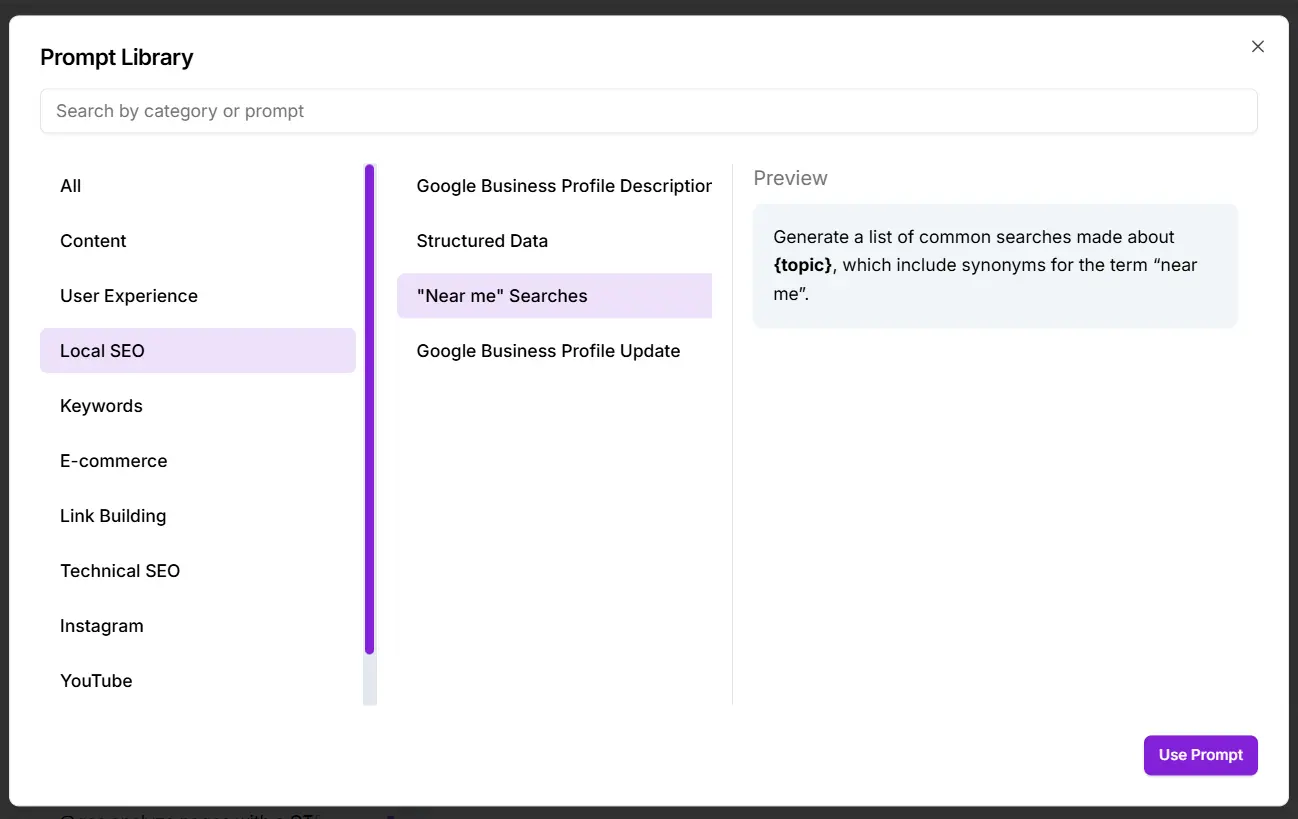
Additionally, within our ChatSEO, users can find specific local SEO prompts ready to use. You simply need to add the requested information and wait a few seconds to see the high-quality results delivered instantly.
Hyper-Local and Conversational Content Strategy
Users now ask complex questions. To capture this high-intent traffic, businesses must adopt a local content strategy built for “Query Fan-Out“—creating hyper-localized landing pages that provide direct, expert answers.
This evolution is being accelerated by AI models like Anthropic’s Claude and Google’s Gemini, which are increasingly challenging traditional search engines. For businesses, this means your content must be “sourceable”. When AI models crawl the web to answer a local query, they prioritize structured, authoritative content that demonstrates a deep understanding of a specific area.
Niara Action: With Niara’s Google AI Model Insights, you can instantly analyze any URL—from landing pages to blog posts—to ensure it meets the latest AI Overviews standards. Our tool identifies content gaps and provides actionable recommendations to align with “Query Fan-Out” patterns, ensuring your business stays relevant and authoritative in the era of conversational search.
Dominating with Topic Clusters
Building topic clusters is the most effective way to establish this local dominance. Rather than relying on a generic “Services” page, you should develop content pillars that bridge your expertise with your geography. This approach signals to both traditional search algorithms and AI models that you are the definitive authority in your niche.
Examples of Localized Topic Clusters:
- Landscaping: Guides on “Best drought-resistant plants for Austin soil”.
- Real Estate: “The best walkable neighborhoods in South Brooklyn.”
This strategy builds the topical authority necessary to thrive in an AI-driven search ecosystem.
Niara Action: Identifying these gaps manually takes days. Use the Authority Map in Niara. By connecting your Google Search Console data, Niara identifies exactly where your content gaps are and generates a 3-month editorial calendar in seconds. It turns raw data into a roadmap for local authority.
Ensuring Uniform NAP Details Across All Online Citations
NAP consistency (Name, Address, Phone number) is the bedrock of local SEO, and in the AI era, it’s even more critical. AI models look for your business information across dozens of directories, maps, and social profiles. If your address is “123 Main St” on Yelp and “123 Main Street, Suite A” on your website, it creates a small seed of doubt in the AI’s “Knowledge Graph”.
Consistency builds entity authority. You must audit and correct your listings across the web to ensure that every mention of your business is identical. This “data hygiene” tells the AI that your business is a legitimate, stable, and trustworthy entity.
The Evolution of ‘Near Me’ and Conversational Search
The phrase “near me” is evolving. While users still type it, they are increasingly speaking it into voice assistants or typing full sentences into AI chats. This is the rise of voice search local and conversational UX.
Optimizing for this means moving away from “stiff” marketing language. Your content should sound like a human answering a neighbor’s question.
Think about the natural way people describe your location or services. Do they say “the shop next to the old library”? If so, that’s a local landmark that AI can use to ground your business in physical space.
As search becomes a conversation, your digital presence must become a helpful participant in that dialogue.
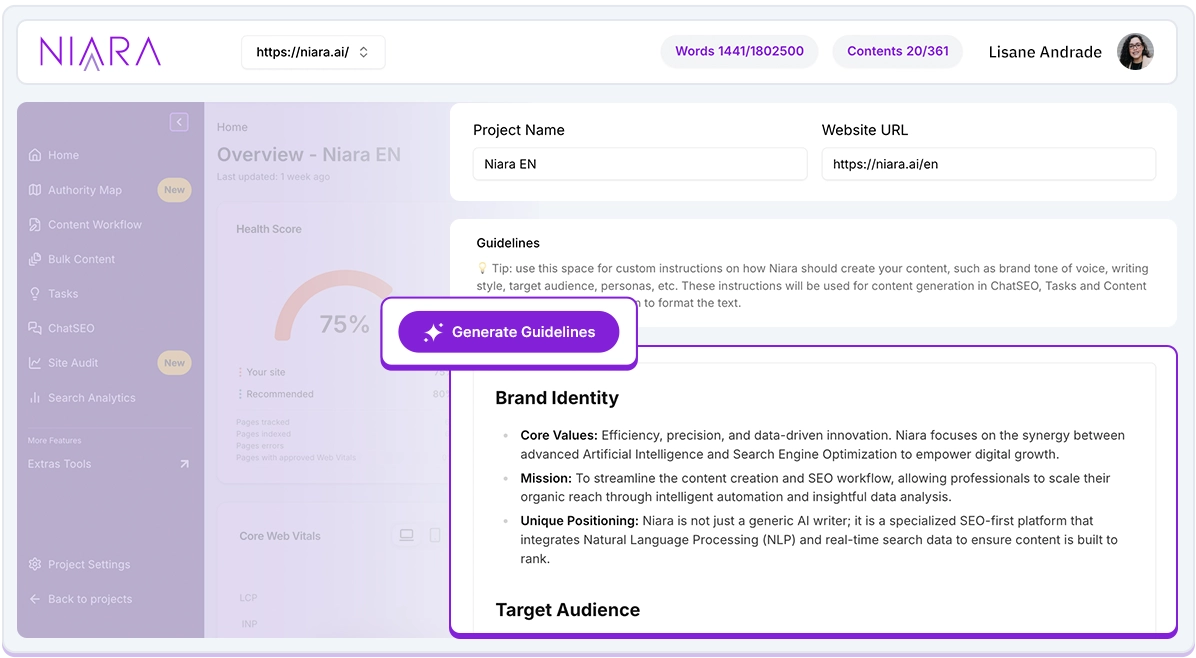
Niara Action: Leverage ChatSEO to refine your communications, transforming technical or rigid copy into natural, conversational dialogue that resonates with modern searchers. To maintain a unified voice, use the Brand Guidelines to define exactly how you want your brand to speak. By setting these parameters, you ensure that every output generated across all tools on the platform remains perfectly aligned with your specific brand pattern and tone.
Building a “Crawlable” Infrastructure for AI
Your website must serve two distinct masters: human users and AI training bots. If an AI cannot easily parse your data, your brand effectively disappears from the generative search ecosystem.
- Performance as a Trust Signal: Core Web Vitals function as a “Reliability Score” for AI recommendations.
- The Rendering Challenge: Ensure that your most vital data is accessible without complex client-side rendering.
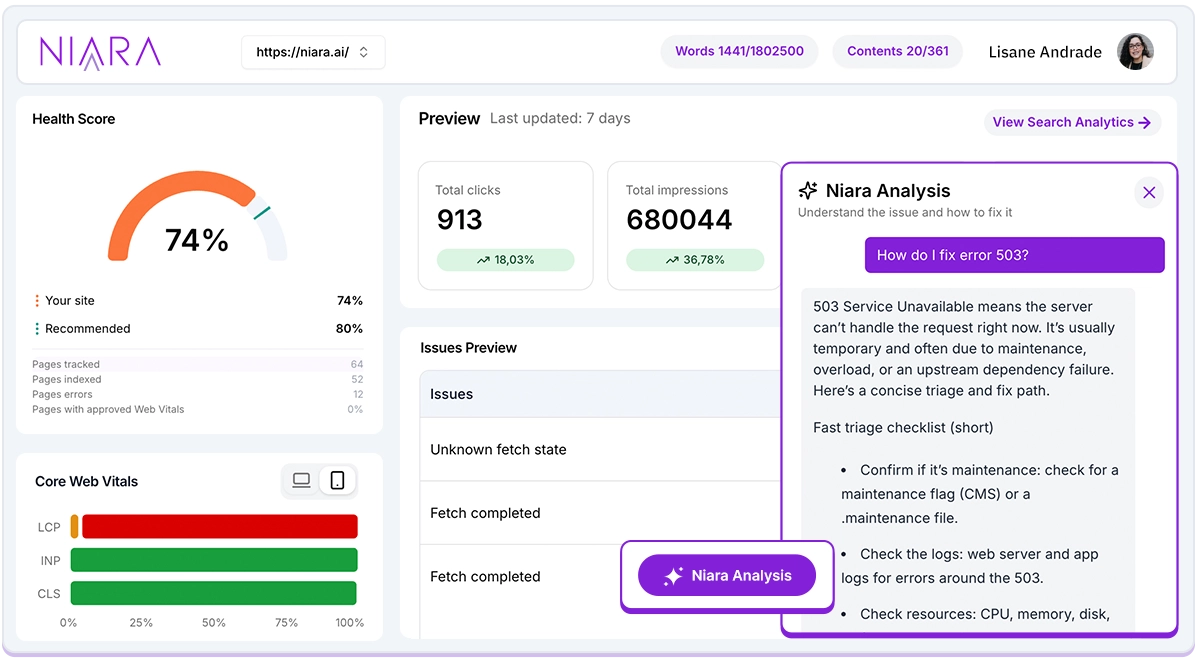
Niara Action: To ensure your site is fully visible to the next generation of search, use the Niara Technical SEO Agent to run a deep health check. This tool identifies specific indexing errors and performance bottlenecks that might be “blinding” AI to your local presence, allowing you to fix structural issues before they impact your AI-driven traffic.
Scaling Local SEO Operations with AI
For businesses with multiple locations, the challenge is maintaining quality without drowning in manual work. Managing SEO for 10, 50, or 500 locations can lead to “cookie-cutter” content that feels robotic—something AI search engines are getting better at devaluing.
We saw this challenge firsthand with our client Ânima Educação. They needed to scale content across multiple brands and units while maintaining high quality and SEO precision. By using Niara, they were able to automate the heavy lifting of content creation and technical audits, allowing their team to focus on strategy. The result? Massively increased efficiency and better visibility across all their locations.
Read more about our sucess case: How Ânima Educação Scaled SEO for 18 Brands with Niara and Exceeded Organic Goals by 110%
Niara Action: Implement the Brand Guidelines. You set your persona once, and Niara applies them across all tools, ensuring consistency across every project.
Niara Enterprise: Scalable AI Solutions for Modern Organizations
Niara Enterprise provides scalable AI solutions tailored for large organizations and agencies requiring high-volume content production and robust security.
Core Benefits:
- Enterprise-Grade Security: Prioritizes data integrity with GDPR compliance, SSO integration, and private cloud options to ensure sensitive data remains confidential and is never used to train public models.
- Customization & Brand Voice: Offers fine-tuned LLMs and proprietary workflows. Businesses can adapt AI to match their specific industry terminology and style guidelines.
- Dedicated Support: Includes a dedicated account manager, priority technical assistance, and personalized onboarding to ensure maximum ROI.
Niara Enterprise delivers unlimited scalability through high-volume API access, multi-language excellence, and a comprehensive SEO suite personalized for your brand.
By combining cutting-edge technology with personalized support, Niara Enterprise enables organizations to scale their content operations efficiently while maintaining full control over their digital assets and brand identity.
The Era of Digital Integrity
As we approach 2026, the benchmark for local SEO has shifted from mere visibility to total digital integrity. The landscape rewards those who provide the clearest, most authoritative answers to both human queries and AI crawlers. Success now lies at the intersection of technical precision and authentic helpfulness.
At Niara, we bridge the gap between complex data and sustainable market dominance. By leveraging our Authority Map and Technical SEO Agent, you move beyond manual guesswork and into a streamlined workflow where your expertise is amplified, not buried. We handle the structural heavy lifting so your brand remains the undisputed first choice in your community.
Ready to future-proof your local presence? Start your free trial with Niara today.
Summary of Local SEO: Importance and Strategies
Is local SEO still relevant now that AI is answering queries directly?
Yes, but the focus has shifted from being a “link” to being the “source” the AI uses for its answer.
Do people still search ‘near me’ or has AI changed that behavior?
People still search “near me,” but the queries are becoming more specific and conversational.
What is a Google Business Profile and why does it matter so much right now?
It’s your official listing on Google. It matters because it’s the primary data source Google uses to verify your location and customer trust.
How important are online reviews for local SEO in the AI search era?
Reviews are critical because AI analyzes the sentiment within the text to understand your business’s strengths.
What is NAP consistency and why does it affect my local search ranking?
It stands for Name, Address, and Phone number. Consistency signals to search engines that your business data is reliable.
Does my website still matter if AI is answering questions?
Absolutely, because your website is the “Single Source of Truth” that AI bots crawl to verify information.