
Search is becoming a destination for immediate answers. With the integration of generative AI, Google has transitioned from a digital librarian into an autonomous curator, synthesizing the web’s vast information into singular, cohesive responses. For over a decade, we optimized for clicks. Today, we must optimize for influence within an AI-driven ecosystem.
Understanding the nuance between Google AI Search Features like AI Overview and AI Mode Google is now a critical skill for any digital marketer. While they share a similar technological DNA, their roles in the user journey and their impact on your organic traffic are vastly different.
We will break down the essential strategies you need to master Google’s AI-driven features. Let’s explore how to adapt your content framework for conversational queries, the technical requirements for AI visibility, and a step-by-step roadmap to ensure your brand remains authoritative in an AI-first world.
Read more: Grounding Indexing: A Practical Guide to Verifiable AI Outputs
What Are AI Overviews and AI Mode?
To the average user, AI Overviews and AI Mode features might look like “Google’s AI talking.” However, for SEO professionals, they represent two distinct ways Google processes queries. AI Overviews (AIO) are integrated directly into the standard SERP, while AI Mode represents a more immersive, experimental environment where the search engine acts as a conversational partner.
The primary difference lies in the user intent. One is designed for speed and efficiency, while the other is built for depth and exploration.
AI Overviews: The Instant Authority
AI Overviews are automated snapshots that appear at the top of traditional SERPs for specific queries. They are designed to provide a “quick-fix” answer without the user needing to click through multiple websites.
Google’s AIO are primarily designed to satisfy informational and transactional user intents. For example, when a user searches for a “how-to” guide, such as “how to clean a suede jacket,” or seeks product recommendations like “best budget laptops 2026,” they are highly likely to encounter an AI-generated summary at the top of the search results.
These overviews are triggered by high-confidence queries where a clear consensus exists across multiple authoritative sources. Because they provide direct answers placed prominently above organic results, they often push traditional “blue links” further down the page, fundamentally changing the search landscape.
To better understand how these overviews function, here are their core features:
- Direct Answers: High-visibility responses positioned at the top of the page to provide immediate information.
- Link Cards: A carousel of citations that Google uses to ground its AI-generated answers in verified, real-world sources.
- Trigger Mechanism: These appear specifically for queries where the search engine has a high degree of certainty and consensus from authoritative data.
Google’s official documentation on AI Overviews and AI Mode highlights that these features are meant to help users find information more quickly while still providing paths to explore further.
Read more: Why isn’t Google AI Overview always at the top? (and What This Means for SEO)
AI Mode: The Conversational Journey
Google AI Mode (formerly part of SGE Labs) is an immersive, chat-based interface. It is designed for complex, multi-step queries where a single answer isn’t enough.
Conversational search represents a dedicated digital environment where users can engage in a dialogue with Google to refine their queries or explore complex topics in-depth. Instead of a traditional static list of results, this space facilitates a more natural interaction, allowing for a thorough investigation of any given subject through a “chat-like” interface.
This interface is primarily designed for exploratory and research-heavy user intent. It caters to individuals who need to synthesize large amounts of information for comparative purposes. For instance, it is ideal for a traveler planning a detailed 10-day itinerary for a trip to Japan or a homeowner researching the long-term pros and cons of various heat pump technologies.
The system relies on several key features:
- Query Fan-out: This process involves Google’s AI breaking down a single, complex prompt into multiple sub-searches to gather a truly comprehensive view of the topic.
- Follow-up Prompts: The interface maintains context throughout a session, enabling users to ask situational questions—such as “What about in winter?” after a travel query—without losing the thread of the conversation.
- Interactive Widgets: The search experience is enhanced by direct integrations with tools like Google Maps, Shopping, and even live code snippets for technical inquiries.
This experimental nature allows Google to test how users explore the web through generative AI, providing a much longer “dwell time” within the search interface itself.
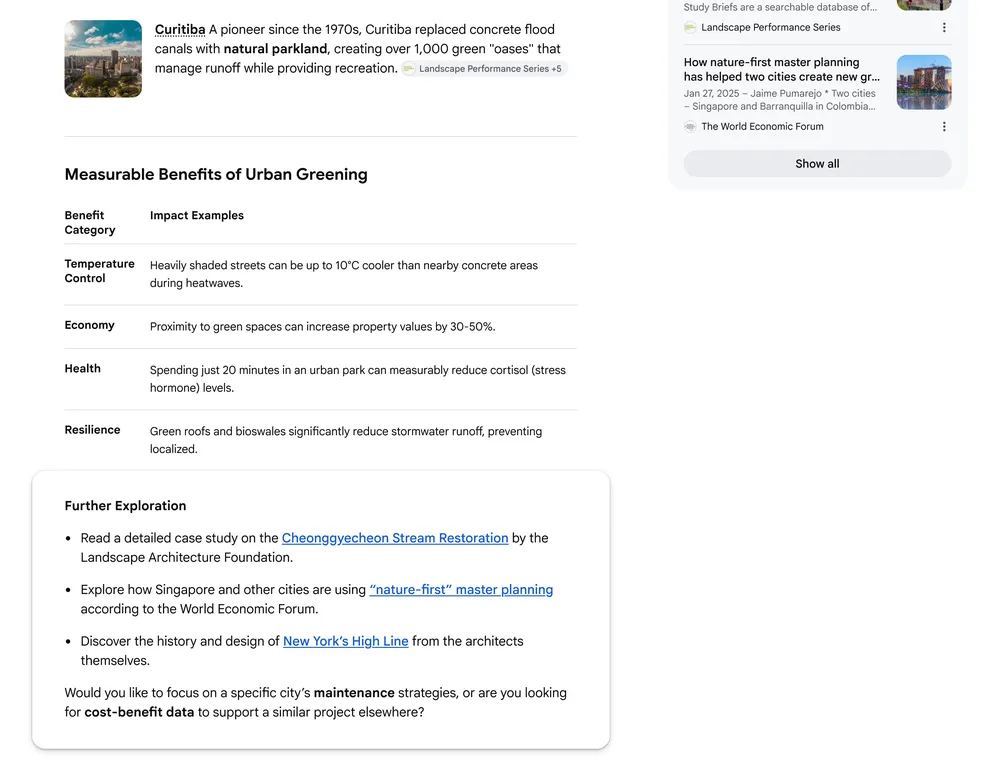
Google is increasingly positioning AI Mode as an exploration engine. With the latest updates, this mode now supports multi-modal search, allowing users to refine their journey using video or images, and features ‘organized search results’ where the AI categorizes the entire SERP into thematic clusters. This transforms the search experience from a list of links into a curated, open-ended research laboratory.
Key Differences Between AI Mode and AI Overviews
To build a winning strategy, you need to see these two features side-by-side.
| Feature | AI Overviews (AIO) | AI Mode |
|---|---|---|
| Trigger | Automatic (System-initiated) | User-initiated / Deep Dive |
| Depth | Summary-level | Comprehensive & Iterative |
| User Journey | Linear (Search -> Answer) | Exploratory (Search -> Chat -> Refine) |
| Visibility | High (Top of standard SERP) | High (Within dedicated AI interface) |
| Context | Single Query focus | Multi-turn conversation |
| Cited Sources & Response Length | Typically cites 3-5 primary sources in a carousel; focus on concise, summary-level responses. | Cites dozens of sources across long conversations; links are embedded directly in text or displayed in a sidebar. |
| Citations | Prominent in-text links and side-rail carousels to drive traffic. | Integrated links within the conversational flow and source sidebars. |
| Data Sources & Model Behavior | Constrained by web “consensus”; grounded in top-ranking search results to minimize hallucinations. | Uses “Query Fan-out” to pull from diverse sources (forums, news, niche blogs) for multi-perspective answers. |
Google continues to improve links in AI Mode and AI Overviews to mitigate “zero-click” concerns, ensuring that high-quality original sources remain accessible to users regardless of the interface.
Core Contrasts at a Glance
- AIO is “Push,” AI Mode is “Pull”: AIO is pushed to the user to save them time. AI Mode is pulled by the user when they need more help.
- Response Length: AIO responses are usually 1-3 short paragraphs (sometimes with videos). AI Mode can generate long-form guides and detailed comparisons.
- Interaction: You can’t “talk back” to an AI Overview easily, you simply read it. AI Mode is built for dialogue.
- Integration: AIO is a feature of the SERP. AI Mode is a transformation of the search experience itself.
How Google AI Mode and AI Overviews Work
Both features are powered by Google’s large language models (LLMs), specifically the Gemini family. With the recent Gemini 2.0 upgrades, these models have become significantly better at reasoning and multimodal understanding.
- E-E-A-T is Non-Negotiable: Both systems rely heavily on Experience, Expertise, Authoritativeness, and Trustworthiness. If your site lacks these, the AI is unlikely to cite you.
- Structured Data: Both features prioritize sites that use Schema markup. Structured data helps the AI understand the entities on your page (products, reviews, events) more accurately.
- Content Hierarchy: Clear headings (H2, H3) and concise paragraphs make it easier for the AI to “scrape” and summarize your content.
In essence, Google is using these models to read the web at scale, identify the most relevant “nuggets” of information, and reassemble them into a format that fits the user’s specific device and context.
Impact of Google AI on SEO and Brand Visibility
The rise of Google AI Mode and AI Overview dynamics means we must redefine “success.”
- Zero-Click Reality: We must accept that for simple queries, traffic will drop. However, the traffic that does click through from an AI feature is often higher intent and further down the funnel.
- Entity Recognition: Google is no longer just looking for keywords, it’s looking for entities. Your brand needs to be a recognized entity in the Knowledge Graph, following semantic SEO basics.
- Citations as the New Rankings: Being the #1 blue link is great, but being the #1 cited source in an AI Overview is the new “Position Zero.”
You need to pivot your budget and strategy. Instead of churning out 500-word “SEO filler” articles, focus on high-value, data-driven content that provides unique insights. If an AI can summarize your article in two sentences and the user learns everything they need, your content wasn’t “sticky” enough. To truly differentiate your brand, you must transition into producing non-commodity content—insights rooted in proprietary data, personal experience, and unique perspectives.
By shifting from surface-level guides to deep, expert-led analysis, you satisfy Google’s E-E-A-T requirements. This approach builds a competitive “moat” around your brand, transforming your blog into a destination for specialized knowledge that AI cannot replicate.
It is important to note that while AI Overviews are becoming a standard part of the global search experience, AI Mode remains a more intentional destination. Users typically enter this immersive environment by clicking ‘Ask a follow-up’ or through Google’s experimental Search Labs. For marketers, this means AIO is your tool for visibility, while AI Mode is your tool for deep brand consideration.
How to Optimize for Both AI Mode and AI Overviews
We’ve developed a framework to help you navigate this transition. You don’t need to choose between one or the other. You need to optimize for the logic that governs both, as the fundamental foundation of SEO optimization remains the same for both.
Specific Optimization for AI Overviews
AI Overviews act as the new “Position Zero.” To capture this real estate, you must optimize for quick synthesis and high-visibility placements.
- Showcase Unique Real-World Insights: Share original research and personal insights that AI cannot invent. This unique data makes your content an indispensable source for AI synthesis.
- Craft Concise Definitions: For “What is…” queries, provide a specific 40–60 word definition. This makes it easy for the AI to copy and paste your text directly into the overview box.
- Structure “How-To” Guides: Organize instructional content with clear, numbered steps (Step 1, Step 2). This allows AI to quickly build a guide using your content as the primary source.
- Target Top-Tier Visibility: Secure a primary ranking on the first page. When content consistently occupies top search results, it is significantly more likely to be cited in the AI Overview snippet.
Advanced Optimization for AI Mode
Optimization for AI Mode focuses on the logical relationship between topics and the conversational flow of information.
- Execute a Semantic Cluster Strategy: Move beyond isolated keywords. Use a Topical Authority strategy to build a semantic web. Use internal linking to connect pillar pages to detailed “spoke” articles, signaling to AI that your site is the most comprehensive resource in your niche.
- Optimize for Anticipatory Flow: Predict the user’s next move. If a user asks “How to start an LLC,” provide the answer followed by information on “LLC Tax Requirements.” Structure your content to answer the questions a user hasn’t even asked yet.
- Mirror Natural Dialogue: Write using conversational language patterns. This allows an AI to pull your text directly into a chat-based response while maintaining a helpful, human tone.
- Apply the “So What?” Factor: End every section by leading the reader (and the AI) logically into the next phase of the problem-solving process, ensuring the AI views your content as a multi-step solution.

Core SEO Strategies for AI Success (Shared Foundations)
To succeed in both AI Overviews and AI Mode, certain foundational elements are non-negotiable. Your website must evolve beyond traditional keyword stuffing as AI models prioritize context, reliability, and technical clarity.
These shared strategies ensure your content is trustworthy and technically readable for any AI agent.
- Optimize for In-Text Citations: Google is moving away from “hidden” links. To be the source the AI links to within a sentence, state facts clearly and follow them with a unique insight. If your sentence is the most concise and factual, the AI is more likely to anchor its link to your site.
- Establish Unshakable E-E-A-T: Google’s AI prioritizes information from verified sources. Prove your authority by showcasing real-world experience (original research, case studies), ensuring every author has a professional bio, and maintaining a secure (HTTPS) site with factual consistency.
- Leverage Advanced Schema Markup: Use backend code (FAQ, Product, and Article schema) to provide AI crawlers with a map of your page. This explicitly defines your data and helps AI understand your content without guesswork.
- Prioritize Scannable & Extractable Formatting: AI models are rapid retrieval engines. Use a rigid hierarchy of headings (H1, H2, H3) and format high-value data into bulleted lists and tables. This significantly increases the likelihood of being featured in AI-generated summaries.
- Master Information Density (“Nuggetization”): Avoid “fluff.” Answer the user’s main question immediately in the first sentence and ensure every paragraph provides extractable facts. Keep language simple and straightforward to satisfy the AI’s preference for concise, high-value data.
Furthermore, as AI models become more integrated into business operations, demonstrating a commitment to AI data governance is essential to ensure that the information being processed and served is not only accurate but also compliant and secure.
Walking the Talk: Niara’s Global Presence in Generative Search
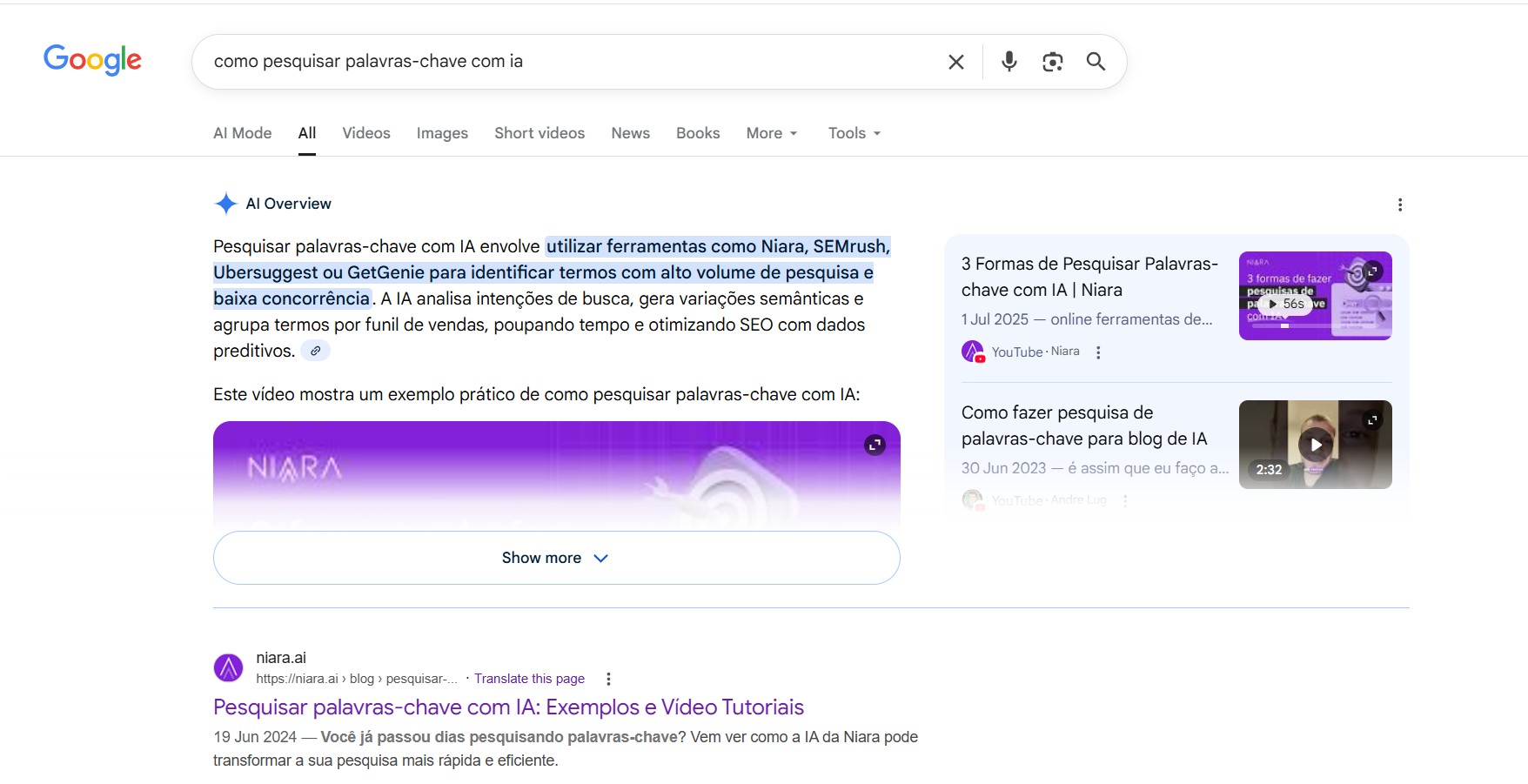
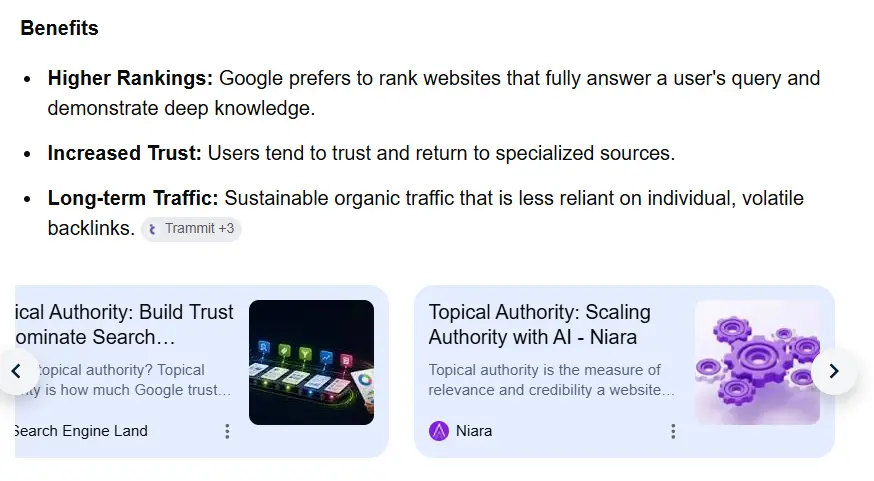
At Niara, we don’t just recommend these strategies. We execute them. Our own success is the best proof that that methodology works. By applying the exact same techniques we share with our users, Niara consistently surfaces as a top authority in generative search results and AI Overviews across multiple languages. Whether it is in English, Portuguese, or Spanish, our localized SEO and content structure ensure that AI engines recognize our value.
Scaling with Niara: Your AI Search Partner
We built Niara to solve the exact problems this new SERP creates. You don’t have to manually analyze thousands of AI responses to find gaps.
- Google AI Mode Insights: Our tool runs a diagnostic on your URLs to find “Query Fan-out” gaps. It tells you exactly what information the AI is looking for that you’re currently missing.
- Authority Map: Move from single keywords to topic dominance. Our Authority Map transforms your Search Console data into a 3-month editorial calendar, ensuring the AI sees you as the primary source for your niche.
- Site Audit (Technical SEO Agent): Automatically detect technical bottlenecks and receive interactive, step-by-step guidance to resolve performance issues and improve site health.
- Content Workflow: Streamlines the production process from initial research to final publishing with built-in SEO quality controls. It enables teams to scale content creation while maintaining consistent optimization standards across every page.
- Structured Data Generator: Automates the creation of complex schema markup to provide search engines with clear context about your content.
- Tasks (Keyword Cluster, Topic Cluster, How to): Access dozens of ready-to-use templates for instant efficiency, from automated keyword clustering to step-by-step article creation. Niara simplifies your workflow with practical tools designed to build topical authority effortlessly.
- ChatSEO (with Prompt Library): Features an AI assistant with a library of specialized prompts designed to handle repetitive SEO tasks and creative brainstorming. It accelerates your workflow by generating optimized outlines, meta descriptions, and on-page copy in seconds.
- Search Analytics: Translates complex data into actionable insights by visualizing your organic performance and ranking trends. This allows you to track the ROI of your SEO efforts and make data-driven decisions to stay ahead of competitors.
What used to take an SEO specialist days of manual SERP analysis, Niara delivers in seconds. We simplify the complex so you can focus on strategy.

Read more: 5 Free AI Tools to Supercharge Your SEO and Digital Marketing
Adapting to the New AI Search
The evolution of Google AI Search represents a fundamental shift in how information is synthesized and delivered. To thrive in this landscape, your strategy must evolve to prioritize SEO for AI features, which means moving beyond traditional keyword density to focus on becoming one of the primary citation sources that these models rely on to generate their summaries.
While the technology behind the SERP has changed, the objective remains constant: delivering profound value to the end-user through structured, high-quality data that machines can easily interpret.
By blending your unique human perspective with technical optimization, you ensure your brand remains at the forefront of this transformation.
Are you prepared to lead in the age of generative results? Explore Niara’s AI Mode Insights today and secure your place at the top of the AI-driven SERP.
