
We’re quietly retiring the old digital etiquette of “type, click, and scroll.” It served us well, but let’s be honest—it always felt a bit robotic.
Now, the internet is finally learning to speak our language. We’ve entered a new chapter where information isn’t something you hunt down; it’s something you engage with. It’s less like a library search and more like a quick chat with a friend who happens to know everything.
With the recent advancement of voice intelligence—highlighted by OpenAI’s GPT-4o Realtime API—AI models now offer low-latency, emotionally nuanced, and multitasking capabilities that make digital interactions feel indistinguishable from human conversation.
For SEO professionals, this means the goalpost has moved. It’s all about being the chosen answer in an LLM-driven dialogue.
Explore our guide to mastering conversational SEO and discover the essential strategies you need to dominate this new era of AI-powered search.
Read more: How to Optimize for Google AI Mode: 6 SEO Strategies
What Does Conversational SEO mean?
Conversational SEO (C-SEO) is the practice of optimizing digital content to be easily discovered, understood, and cited by AI agents and voice assistants during natural language interactions. Unlike traditional SEO, which focuses on matching specific search terms, C-SEO prioritizes intent, context, and dialogue.
In the landscape of 2026 and beyond, LLM-driven discovery means that Large Language Models (like Gemini or GPT) act as the primary interface between the user and your brand. Instead of a user browsing a SERP, an AI agent “reads” the internet to provide a synthesized answer. If your content isn’t structured for these “conversational queries”, you risk becoming invisible in the voice-first era.
This scenario directly reflects how OpenAI is continuously refining its models to align with the evolving ways users conduct online searches and interact with information, for example.
With the launch of new voice intelligence models in the API as of May 2026, developers now have unprecedented access to low-latency, high-fidelity speech-to-speech capabilities. These advancements, highlighted in OpenAI’s latest documentation, focus on reducing the “uncanny valley” effect by incorporating sophisticated emotional prosody and real-time conversational pacing.
By integrating these new models, businesses can move beyond static voice commands to create truly fluid, multimodal experiences. This OpenAI update signifies a shift toward AI that doesn’t just process text, but understands and responds to the nuances of human vocal expression.
This change scenario is evolving fast, as consumers increasingly shift toward hands-free, intuitive digital interactions.
Understand AI better: Grounding Indexing: A Practical Guide to Verifiable AI Outputs
From Simple Queries to Real-Time Reasoning
The transition from “Keyword Search” to “Conversational Intelligence” is driven by user behavior. People no longer want to hunt for answers; they want to be told the answer. According to recent market insights, this shift is fueling a significant transformation in how information is accessed and processed. This is a primary factor in the rise of zero-click searches, where the dialogue itself provides all the necessary value.
The rapid expansion of the voice search engine market is primarily fueled by the widespread adoption of smart devices and a growing consumer demand for speed and convenience. Central to this evolution is the dominance of AI-based voice search, which leverages machine learning and natural language processing (NLP) to deliver superior accuracy and contextual understanding compared to traditional recognition methods.
As AI-driven solutions capture the largest market share and become the preferred choice for personalized results, optimizing for a voice-first digital landscape has transitioned from an optional tactic to a strategic necessity for businesses aiming to remain competitive.
According to a study by BrightLocal, 58% of consumers use voice search to find local business information. If an AI agent cannot fetch your data instantly or if your content lacks the semantic depth to answer follow-up questions, the agent will simply move to a competitor.
The Anatomy of Conversational Content
Conversational content relies on Natural Language Processing (NLP). In practice, this means the focus is on semantic dominance — in other words, how relevant your website is to the core entity of your niche.
- User Intent in Voice: Spoken queries usually fall into three buckets: Informational (“I want to know”), Navigational (“I want to go”), and Transactional (“I want to buy”).
- The “Question-Answer” Framework: Structure your content to answer the “Who, What, Where, When, Why, and How.” Research from Backlinko shows that the average voice search result is only about 29 words long. Being concise is key to being featured. Being concise is key to being featured, which is why adopting an SEO chunking strategy is essential to help AI models extract the exact snippet they need.
For example, consider how search behavior has evolved:
- Traditional Text Search: A user would typically type fragmented, robotic keywords like “best natural cat food 2026.”
- Modern Voice Search: That same user now asks their device a full, natural question: “Hey Google, what is the best cat food for senior cats with kidney disease under $100?“
This shift demonstrates the transition from rigid keyword strings to fluid, long-tail queries that prioritize specific context and natural phrasing.
Your content must mirror how people actually speak, not just how they type.
The Principles of Conversational SEO and AI Optimization
To stay visible in a landscape dominated by AI Overviews and voice assistants, businesses must shift their focus toward understanding user intent and building deep topical authority.
1. Shift from Keywords to Intent and Query Fan-Out
In conversational search, queries are longer, more specific, and often lead to follow-up questions. Instead of targeting broad terms like “SEO tools,” you must optimize for specific queries like, “What is the best AI SEO tool for a small agency?”.
In this new search landscape, Niara serves as your strategic ally, moving beyond traditional metrics like keyword density and search volume to focus on building broad-scale authority.
Through the Authority Map, Niara helps you clearly define your site’s area of influence, identifying both content strengths and gaps. This comprehensive overview ensures you address every necessary topic to establish your brand as the ultimate specialist in your niche.
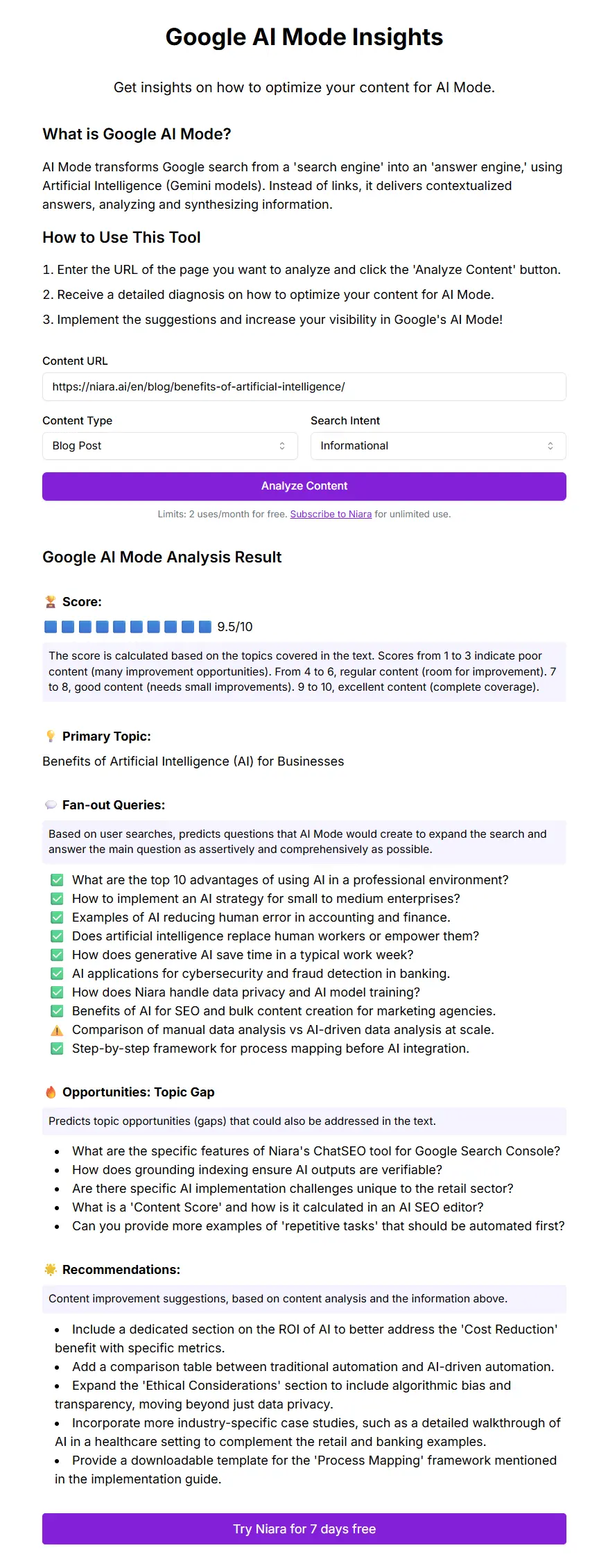
To further refine your strategy for generative search, you can leverage Google AI Mode Insights. This tool allows you to optimize your pages for AI-driven results by identifying query fan-out—the secondary, follow-up questions that users and AI Overviews are likely to generate.
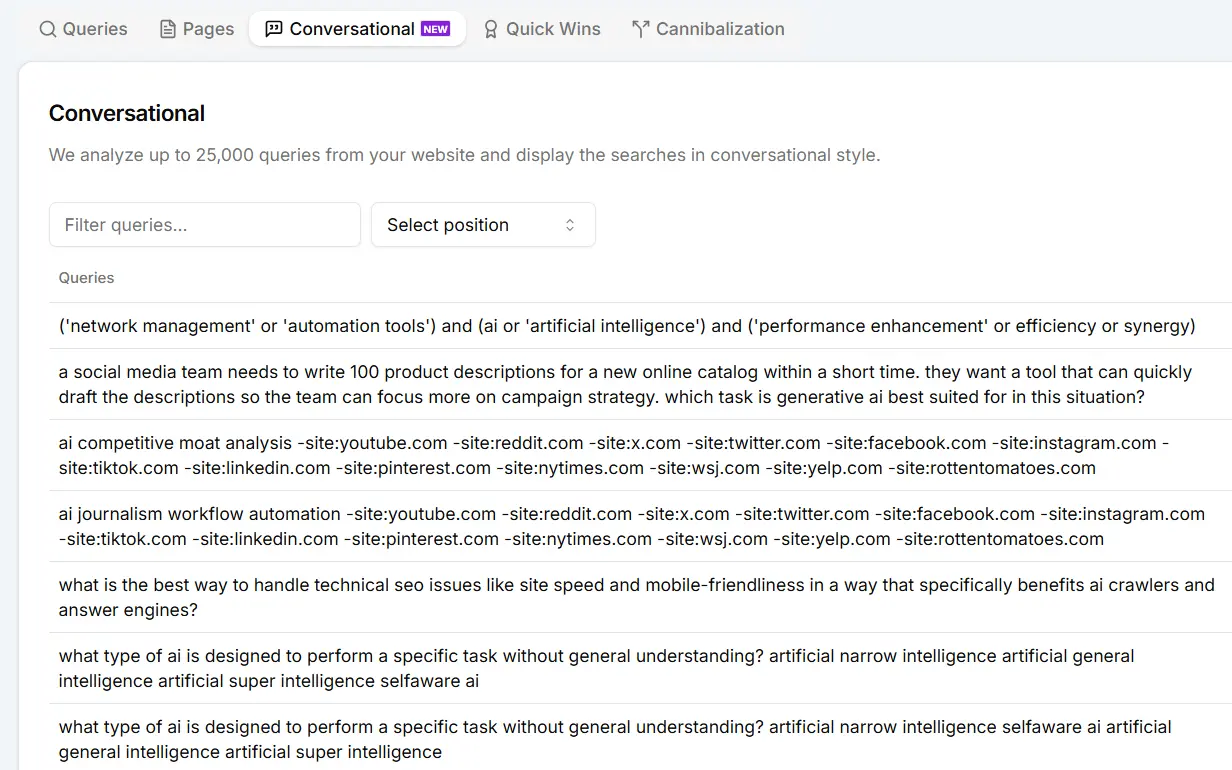
Additionally, Niara’s Search Analytics provides deep visibility into conversational queries. By analyzing the specific prompts users use that return your brand as an answer, you can better understand how audiences are discovering you. These insights are crucial for determining where to focus your content efforts to maintain relevance and dominate your field of expertise.
2. Semantic SEO and Entities
Search algorithms have evolved beyond literal text matching to decode human intent through Semantic SEO. This framework replaces rigid keywords with Entities—distinct, interconnected concepts that transform your content into a meaningful anchor within a digital knowledge graph. By mapping relationships between ideas, you ensure your site isn’t just a list of words, but a structured source of intelligence.
This shift is critical for the rise of Voice Search. When users ask natural questions—like “What’s the best way to waterproof a basement?”—AI utilizes Natural Language Processing (NLP) to identify the core entities involved. It seeks the most contextually accurate “node” to provide a direct, spoken answer.
In the age of Siri and Alexa, the goal is “Position Zero”. To win this exclusive spot, your content must serve as a definitive expert. It’s no longer about “strings” of text, but the “things” they represent.
Mastering this requires building Topic Clusters. For instance, a guide on “Renewable Energy” should seamlessly bridge to “photovoltaic cells” and “grid storage.” This holistic mapping satisfies complex user intent and signals deep topical coverage.
Adopting an entity-centric strategy offers three pillars of success:
- Credibility: Establishing your brand as a primary, trustworthy knowledge source.
- Visibility: Aligning with the structured data AI uses to navigate the web.
- Precision: Meeting the nuanced demands of modern, conversational search.
Google and other AI engines treat user experience as a ranking factor, prioritizing nodes of information that are not only accurate but also easy for the user to consume.
3. Topical Authority and E-E-A-T
Modern SEO has shifted to establishing comprehensive topical authority. AI agents like Perplexity, Gemini, and ChatGPT prioritize sources that demonstrate deep E-E-A-T (Experience, Expertise, Authoritativeness, and Trustworthiness) across an entire subject area.
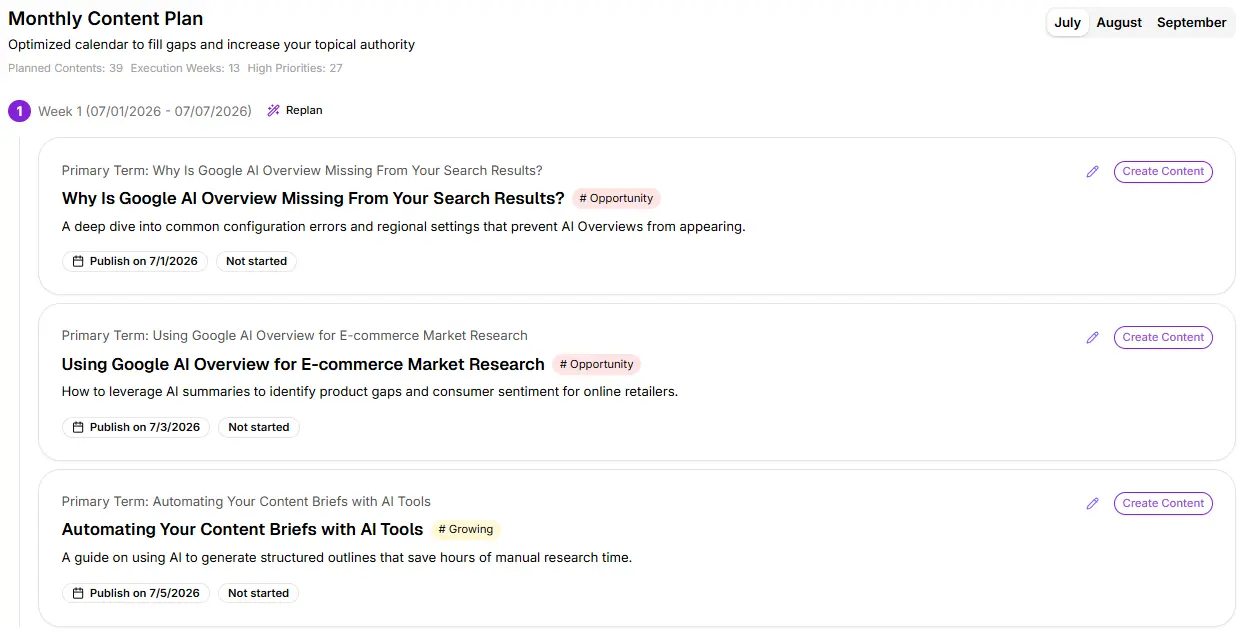
By using Niara’s Authority Map, you can move beyond single-post optimization and instead build interconnected content clusters that prove your brand is a credible, go-to resource for complex queries.
This authority-first approach replaces the outdated strategy of targeting isolated search terms with a more holistic ecosystem. Instead of writing a lone guide on a broad topic, you use the Authority Map to identify and fill specific content gaps, such as:
- Visualizing ecosystems: Mapping out related sub-topics like predictive analytics and first-party data.
- Proving depth: Demonstrating expertise through niche, interconnected articles.
- Securing citations: Positioning your brand as the primary source that AI agents summarize for users.
Ultimatelly, implementing strategic internal linking for discovery allows search engines and AI models to map the full depth of your site’s expertise effectively. This interconnected structure ensures your brand is recognized as a definitive authority, making it the primary source cited in generative search results.
4. Local Search Optimization
Optimizing for local search requires a shift toward question answering content that addresses specific long-tail questions users ask while on the go. By providing direct, high-value answers, you build significant authority in local SEO, ensuring AI assistants recognize your business as the most reliable local source.
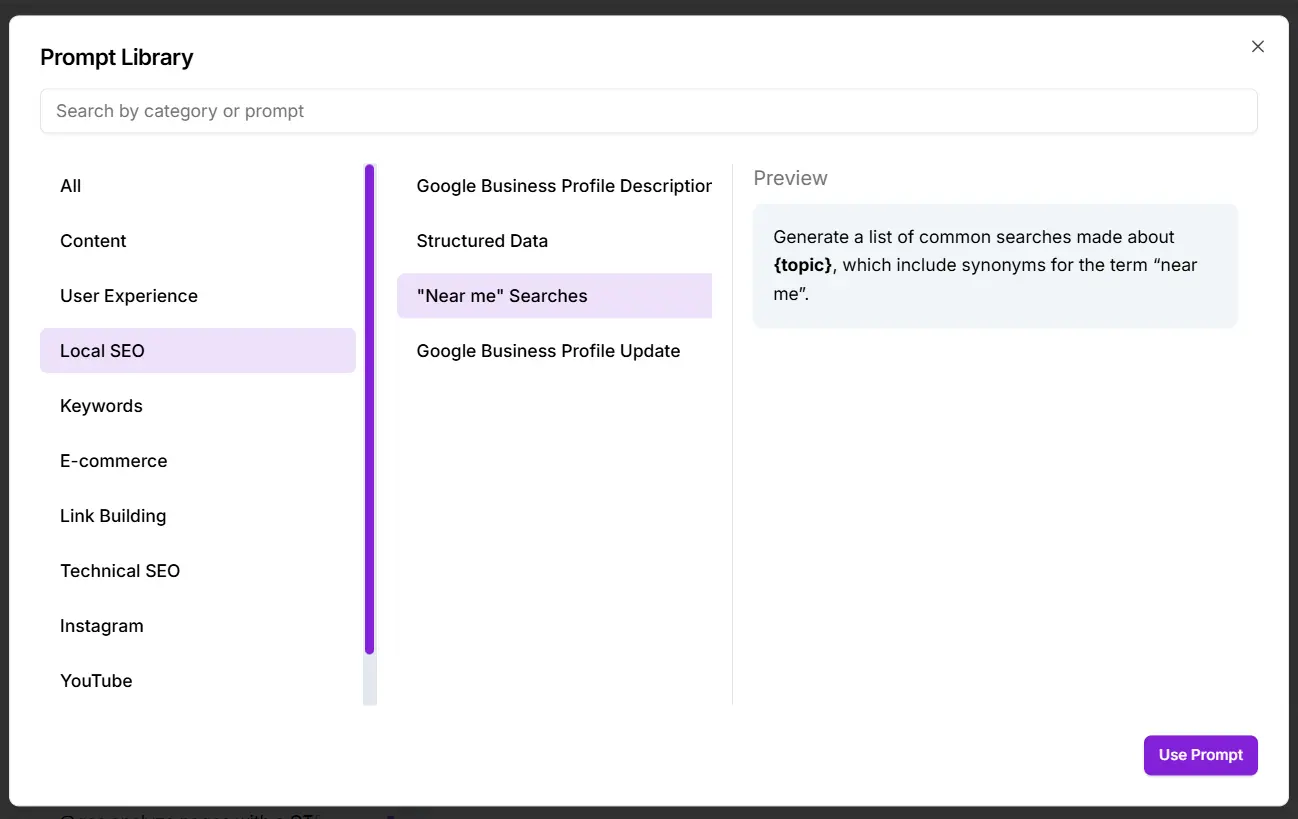
Niara makes this optimization easier. Within our Prompt Library, you will find ready-to-use prompts specifically focused on local SEO. Whether you are using ChatSEO for quick insights or the Content Workflow to generate localized landing pages and blog posts, Niara helps you create the structured, semantic content necessary to capture the local voice search market.
To dominate local search, businesses must prioritize hyper-local relevance by integrating specific neighborhood landmarks and conversational phrases into their digital content. By identifying key regional terms—such as “South Congress” or “Zilker Park” in Austin—owners can tailor their messaging to match the exact way residents search for services “near me.” This strategy involves:
- Geographic anchoring: Embedding local identifiers to increase authority within a specific zip code or district.
- Intent-based content: Creating landing pages that answer immediate, location-specific needs to drive foot traffic.
Effective local optimization also requires technical precision through structured data and dedicated landing pages designed for regional visibility.
5. Content Scaffolding and Structured Data
To be discovered by AI and voice assistants, your content must be a “scaffold” that is easy to crawl and summarize. This means using clear headings, bullet points, concise summaries and FAQs that directly address common conversational prompts.
Niara features ChatSEO, an AI assistant specifically trained on SEO and marketing data. Unlike general generative platforms that can often produce generic or inaccurate results, ChatSEO provides more reliable, data-driven recommendations. It is purpose-built to understand search intent and marketing nuances, making it a more dependable partner for professional strategy development.
To leverage its capabilities for tone adjustment, you can use specific prompts to refine your content. For example, if you want to make a formal section more approachable, you could use a prompt like:
Rewrite the following paragraph to be more conversational and engaging for a blog audience, while ensuring the primary SEO keywords remain naturally integrated.
Furthermore, implementing Structured Data Markup (Schema)—such as Speakable, LocalBusiness, and Product Schema—removes the “guesswork” for LLMs, making your data instantly readable and ready for voice search results. Technical optimization is aslo further simplified through Niara’s comprehensive toolkit, which includes:
- A curated Prompt Library designed specifically for technical SEO tasks and content refinement.
- An automated Structured Data Generator to instantly implement Article, FAQ, and Product Schema without manual coding.
These features ensure your content is not only high-quality but also technically flawless and ready to be indexed by Large Language Models (LLMs) and voice search engines.
6. Technical Excellence and Core Web Vitals
If an AI cannot crawl your site efficiently, it cannot cite you. Solid technical health—including indexability, canonicalization, and high page speed—is the baseline for success.
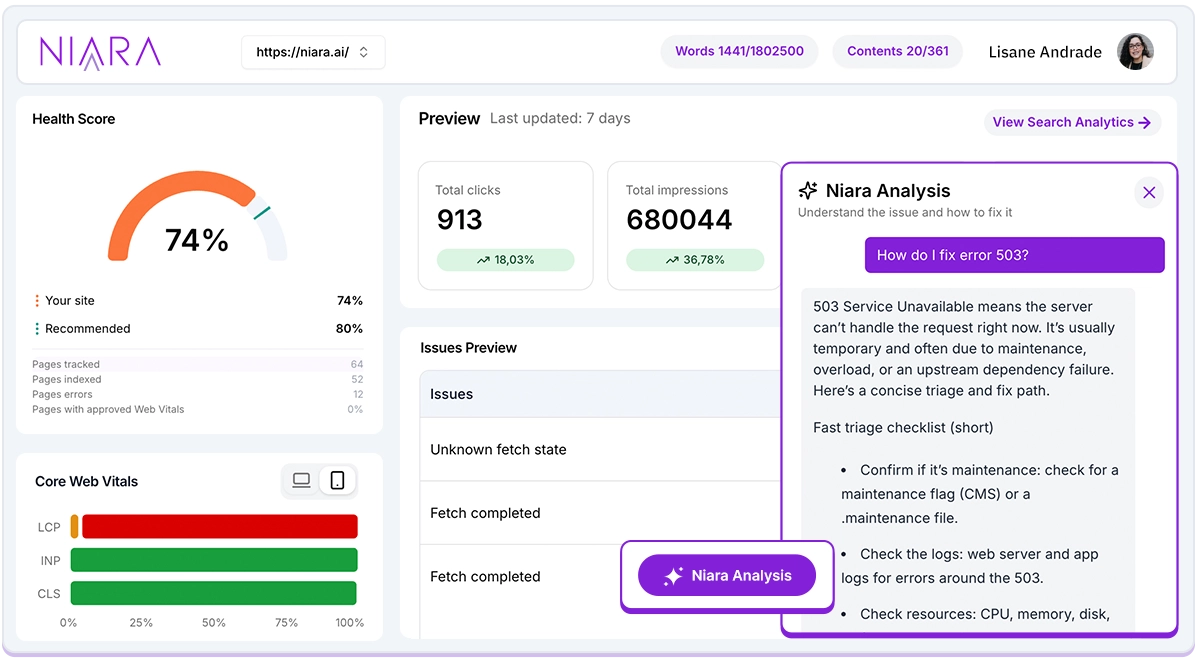
In a real-time conversational environment, latency is a dealbreaker. If your page loads slowly, an AI agent will simply fetch data from a faster source. Niara’s Technical SEO Agent acts as a 24/7 consultant to ensure your site meets these high-performance prerequisites.
7. Brand Voice Consistency
Whether a user reads your blog or hears an AI summarize your content, your brand identity must remain consistent. Conversational SEO is not just about being found; it’s about how you are represented. With Niara’s Custom Brand Guidelines, you can define your persona and tone of voice once, ensuring every AI-generated article or meta description maintains your unique identity across all conversational touchpoints.
To make your brand guide truly effective within Niara, you need to provide specific guardrails that shape the AI’s output. Think of it as building a “DNA profile” for your content. When setting up your profile, consider including these key elements:
- Target Audience Persona: Clearly define who you are talking to (e.g., tech-savvy Gen Z, corporate decision-makers, or small business owners).
- Core Brand Values: List the principles that drive your business, such as “innovation,” “transparency,” or “sustainability.”
- Vocabulary Preferences: Specify industry-specific terms you want to prioritize and a “blacklist” of jargon or buzzwords to avoid.
- Formatting Guardrails: Tell the AI if you prefer short, punchy paragraphs, frequent use of bullet points, or a more narrative, long-form structure.
One of the most critical adjustments you can make in Niara is refining your tone of voice. To stay ahead in the age of smart speakers and digital assistants, we recommend steering your tone toward a conversational style.
By instructing Niara to adopt a “conversational, helpful, and direct” tone, your content will mirror the way people actually speak.
Also read: How to maintain a consistent brand voice at scale using AI
Analytics and Metrics for Conversational SEO Strategy
In the era of voice search and AI-driven queries, traditional SEO metrics like clicks and impressions are no longer the sole indicators of success.
Conversational search optimization prioritize natural language, voice search, and question-based content. To truly measure effectiveness, you must focus on how well your content satisfies user intent and resolves specific queries.
To determine if your conversational SEO strategy is effectively resonating with your audience, focus on these specialized performance indicators to measure how well your content aligns with natural search behavior:
- SERP Feature Dominance (AIO & PAA): Monitor how often your content captures zero-click searches, such as AIO and “People Also Ask” boxe. Securing these spots proves that search engines view your content as the most authoritative answer to a specific question.
- Natural Language & Prompt-Style Query Performance: Shift your focus from rigid, short-tail keywords to fluid, conversational phrases. Our Search Analytics features a dedicated area designed for professionals to monitor conversational queries.
- Audience Retention Metrics (Dwell Time & Scroll Depth): High-quality conversational content should feel like a dialogue that keeps the reader moving forward.
- Informational-to-Actionable Conversion Rates: Measure how effectively your educational content leads to tangible actions.
Read more: Beyond Vanity Metrics: Turning SEO Data into Revenue and Decisions
Implementation Roadmap: A 90-Day Playbook for Voice-Search Success
Transitioning to a conversational SEO strategy requires a structured approach. This 90-day roadmap is designed to help professionals integrate Niara’s AI-powered capabilities to secure long-term search engine visibility.
Days 1-30: Foundation, Audit, and Authority Mapping
The first month focuses on identifying where your brand stands in the current digital landscape and defining your “area of influence”. This phase involves auditing existing content for E-E-A-T and identifying “content gaps”.
- How Niara helps you: By utilizing the Authority Map, you can instantly visualize your site’s topical coverage. Additionally, A Technical SEO Agent provides 24/7 infrastructure auditing.

Days 31-60: Content Transformation and Semantic Optimization
The second month is dedicated to execution. You need to shift your content production toward a “scaffolding” structure that uses Natural Language Processing (NLP) friendly formats. This means rewriting key pages to answer specific user prompts.
- How Niara helps you: You can leverage the Content Workflow alongside your Custom Brand Guidelines to generate conversational entity-based SEO articles. By using Google AI Mode Insights, Niara helps you identify query fan-out opportunities.
Days 61-90: Local Dominance and Performance Scaling
The final phase focuses on hyper-local relevance and data-driven refinement. For businesses with a physical presence, you must optimize for “near me” queries by integrating geographic anchors.
- How Niara helps you: Our Prompt Library contains specialized templates for local SEO. To track your success, Niara’s Search Analytics provides a unique window into conversational queries.
Transforming Every Voice-Query into a Conversion
Stop viewing search engines as mere digital libraries and start seeing them as active participants in a global conversation. Your brand is no longer just a link on a results page; it is becoming a direct answer delivered in real-time.
The digital landscape is evolving at a breakneck pace, and the window to establish your voice as the dominant authority is narrowing. Those who embrace this conversational shift today will define the market of tomorrow.
Ready to lead the evolution of search? Join the Niara community today and leverage our cutting-edge AI tools to simplify your strategy and turn conversational potential into measurable growth.
