
There was a time when SEO success depended almost exclusively on a mechanical formula: the exhaustive repetition of keywords within a page. Do you remember?
That scenario is in the past. With the constant evolution of Google’s algorithms and the rise of generative platforms, strategies that prioritize only individual search volume have become obsolete, giving way to a much more sophisticated and semantic approach: topical authority.
The algorithm has advanced to the point where it doesn’t just look for isolated terms, but for the depth of knowledge demonstrated. Being the most trusted and comprehensive voice within an information ecosystem is what separates market leaders from sites fighting for traffic crumbs.
In this article, we will explain what it means, in practice, to completely dominate a topic. Understand how to structure a strategy that builds and protects your authority and how to use the power of Niara to scale topical authority, ensuring a solid digital presence. Check it out!
What is Topical Authority?
Topical authority is the measure of relevance and credibility a website has on a specific subject in the eyes of search engines. The focus here is on the depth and breadth of your coverage of a topic — unlike Domain Authority (DA), which focuses on the raw strength of backlinks across the entire site. We are talking about making your site the definitive reference in a specific niche.
To make it clearer, let’s look at an example. Imagine two sites focused on “Specialty Coffee.” Site A belongs to a large coffee industry portal that covers the market in a generalist way. It has excellent articles on specialty coffees but also talks about supermarket coffee, large industrial coffee chains, and commodities.
Site B, on the other hand, is a hub dedicated exclusively to the specialty coffee ecosystem. Its content focuses 100% on SCA (Specialty Coffee Association) criteria, exploring everything from extraction chemistry and complex sensory profiles to specific micro-lots, controlled fermentations, and the terroir of award-winning regions.
Even if Site A possibly has a higher DA (Domain Authority) because it is a larger portal, Google will likely prefer Site B for specific searches about specialty coffee. This happens because Site B demonstrates depth and specialization that make it the ultimate authority in that restricted niche.
With the advancement of algorithms, Google doesn’t just want to deliver an answer; it wants to deliver the answer from someone who truly understands what they are talking about.
Read also: Query Fan Out in Google AI Mode: Master the Technique and Optimize with Niara’s new free tool
Google’s History and the Evolution of Topical Authority
To understand this evolution in practice, consider the following search: “where to eat a craft burger in the state capital.” In the past, search engines focused almost exclusively on exact word matching.
For example, if a craft site located in the capital repeatedly used the terms “craft” and “burger,” it could appear in the top results, even if the content had nothing to do with gastronomy. Google did not yet understand the user’s search intent; it only identified the presence of isolated words in the text, without interpreting the context of what was being sought.
Due to this problem (displaying “any” result to the user), search evolved from simple string matching (exact keywords) to the understanding of entities and intentions. Over time, updates like Hummingbird (2013), RankBrain (2015), and MUVERA (2025) began to understand context and depth.
The major turning point came with the introduction of the E-E-A-T concept and the emphasis on semantics. Google began mapping the “Knowledge Graph,” connecting concepts.
For Google, a domain’s authority is not built by repeating isolated terms, but by the richness of its semantic ecosystem. When searching and mapping content, algorithms look for the relationship between specific entities.
If you talk about “burger joints in New York,” the search engine expects to find connections with terms like “meat blend,” “brioche bun,” and “homemade mayo,” contextualized in neighborhoods like “Brooklyn” or “Manhattan,” for example.
This deep understanding of context is what allows the algorithm to validate your topical authority. It is through this analysis that Google distinguishes, for example, a food expert from a craft site, ensuring that only domains with real expertise are displayed for searches like “where to eat a craft burger.”
The end of the volume era and the beginning of the citable relevance era
In addition to algorithm updates, we are witnessing a paradigm shift. We have moved from the era where the goal was just to rank in “blue links” to the era of being the referenced source in Large Language Models (LLMs), such as Gemini and GPT-4.
When AI needs to answer a technical question, it looks for sites that are “sources of truth.” If your brand is the most consistent and precise, the AI can anchor its response in your content. You stop being just a link and become the authority that teaches the AI itself.
But it must be reinforced: we say it “can anchor” because there is no exact evidence of how to be referenced in generative AI responses. What we do know is that AI prioritizes reliability, authority, efficiency, and structure.
Recent studies, such as “GEO: Generative Engine Optimization,” show that visibility in generative engines tends to improve when content includes verifiable evidence, such as citations, statistics, and reliable sources, rather than relying solely on keyword repetition. The study also indicates that these practices can increase a domain’s visibility in AI responses by up to 40% within the scenario tested by researchers.
To become this “anchor” of trust, the focus must shift from post volume to value density.
How does the Topical Authority strategy work?
Google’s evaluation mechanism for topical authority is based on completeness. The algorithm analyzes whether your domain covers all sub-questions and related topics to a main topic. If you have a site about “digital marketing” but never talk about “email marketing,” Google understands that your authority is incomplete.
The interrelation between content is what “ties” authority together. When you create a web of content that links logically, you signal to the bot: “I know this subject from end to end.”
How Google Evaluates Topical Authority
Google uses various signals and documented systems to determine if a site is an authority on a particular subject. According to the official documentation on the Topic Authority System and E-E-A-T guidelines, the evaluation is based on:
- Deep and useful content: articles that exhaust the topic, demonstrate first-hand experience, and answer user questions without them needing to return to the search.
- E-E-A-T signals: Google analyzes the author’s and the site’s history in the specific niche to validate the credibility of the information.
- References and citations: authority is reinforced by outbound links to government or academic sources and by citations from other relevant sites in the same sector.
- Topic cluster structure: grouping information helps algorithms understand the site’s semantics, confirming that you cover a topic comprehensively, and not just with isolated pages.
On news sites and in local searches, Google uses a specific system to identify which publications are experts in specific geographic areas or topics (such as health or finance), prioritizing them in the results.
The pillars of authority in the era of answer engines
To survive and thrive in the new “answer engines” (like Perplexity or Google AI Mode), your strategy must focus on three pillars:
- Comprehensiveness: define your entity without ambiguity. If you are an SEO consultancy, your site should make it clear whether you focus on E-commerce, Local, or Enterprise. The AI needs to know exactly who you are.
- Credibility: authority is also validated by third parties. Digital PR gains strength here. Being mentioned in strategic channels gives powerful signals to the AI that humans trust you.
- Cross-Platform Consistency: AI is trained across the entire web. If you say one thing on your blog and another on your YouTube channel or LinkedIn, you generate noise. Maintain a single voice and consistent information across all channels.
Take Niara’s case, for example: we apply this methodology to consolidate our digital presence:
- Delineated entities and concepts: we strategically focus on being the reference authority for searches related to AI, technology, SEO, and marketing. Therefore, these themes are not just isolated keywords, but recurring semantic pillars across all pages of our site, helping algorithms map our expertise accurately.
- Natural mentions: Niara is mentioned naturally and organically in various portals and industry channels, which strengthens our reputation and sends unquestionable signals of trust to answer engines.
- Multichannel presence: we maintain an active and strategic presence on networks like YouTube, Instagram, and LinkedIn. All our communication, regardless of the platform, follows a specific tone of voice guide and content guidelines. No matter where the AI or the user finds us, the message is always cohesive, qualified, and aligned with our purpose of transforming the routine of marketing professionals with artificial intelligence.
How to measure the site’s Topical Authority?
Measuring topical authority is more complex than looking at total traffic. Now, it is necessary to analyze the depth of coverage of a theme, the semantic interconnection between contents, and how search engines perceive your domain as a reliable reference source and expert in a specific niche.
To understand if your SEO strategy is truly building this authority, you should consider the following factors:
- Entity coverage in the index: how many keywords of a certain cluster do you dominate?
- Crawl behavior: does Googlebot visit your niche pages frequently?
- Organic traffic by topic: is growth consistent across all pages in the cluster?
- Real conversions: is authority traffic generating leads or sales?
Avoid vanity metrics. Ranking first for an isolated keyword is good, but dominating 80% of the terms in a topic is what brings security to the business.
Read also: How to align SEO with business objectives and prove ROI
Steps to build your Topical Authority strategy
Building authority doesn’t happen overnight, but with the right tools, the process is much faster.
1. Topic-based keyword research
Forget linear keyword lists. Think entities.
While keywords are isolated terms or phrases that people type into search, entities are concepts, objects, people, or places that search engines can uniquely identify and, more importantly, understand how they connect to each other.
Example: you are creating content about skincare.
- In the keyword era: you would worry about repeating terms like “what is skincare,” “skincare step-by-step,” or “best skincare products.”
- In the entity era: Google expects that for the content to be relevant and complete, it connects the main entity (Skincare) to other related entities, such as active ingredients (Vitamin C, Retinol), professionals (Dermatologist), and skin conditions.
How Niara helps you
At Niara, we created tools specifically designed to master this logic of entities and topical authority:
- Content Workflow: automates the creation of optimized briefs and texts, ensuring that connections between concepts are present naturally.
- Authority Map: analyzes your niche and generates a complete ecosystem of subtopics and related entities.
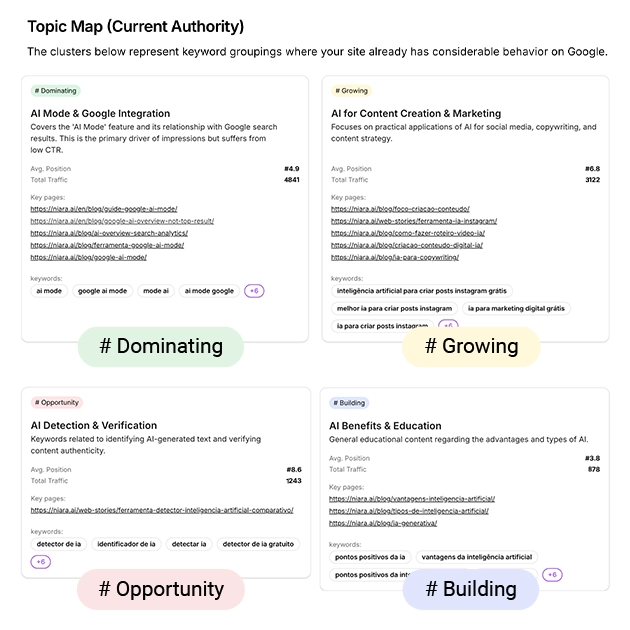
Result: you save hours of manual research and ensure that your content is not just a repetition of words, but a robust and interconnected source of information, which is fundamental in the era of semantic search.
2. Creating topic clusters
The Topic Cluster strategy organizes your content around a central theme. Instead of creating isolated pages for specific keywords, you create a Pillar Page (a comprehensive guide on a subject) connected to several Clusters (supporting articles that delve into subtopics).
This structure helps Google understand that your site doesn’t just mention terms but dominates the full context of an entity, establishing a logical and semantic hierarchy between information.
How Niara helps you
Organizing a content ecosystem can be complex, but Niara simplifies every step of this process:
- Generating semantic insights: during the writing stage in the Content Workflow, the tool suggests terms that cannot be missing from your article to ensure Google understands the depth of your text.
- Cluster mapping: through Tasks and ChatSEO, Niara can group similar terms into semantic groups and even help you create a strategy from scratch if your site isn’t live yet. Additionally, the entire clustering process can be accelerated with the Authority Map.
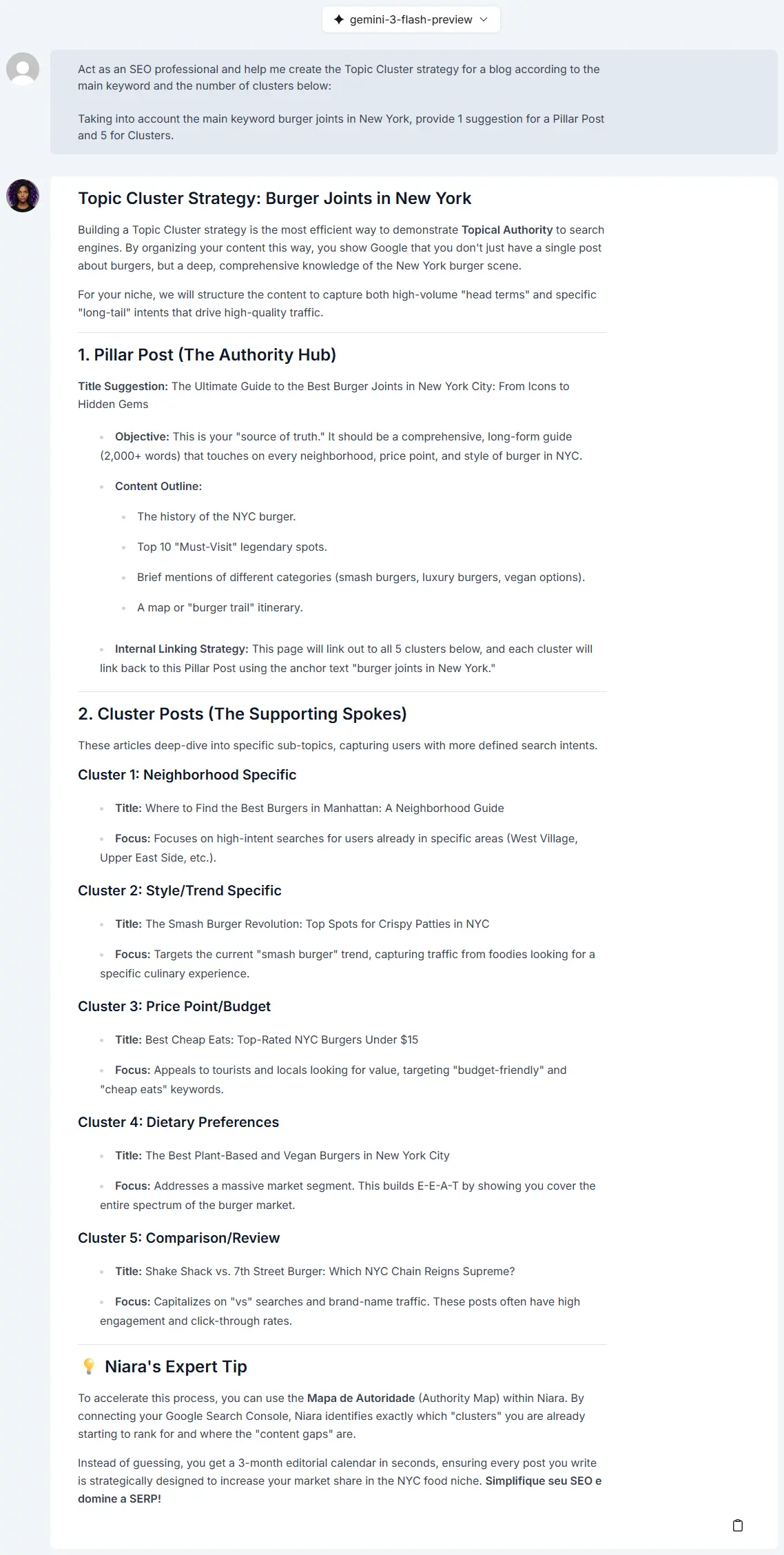
Result: what would take days of manual keyword research and planning, Niara delivers in minutes, allowing you to build your topical authority much faster and more strategically.
3. Producing authority content
To build authority, your content needs to be deep and useful. In practice, it must:
- exhaust the theme in a technical and complete way, going beyond the obvious to answer the user’s most complex questions.
- be aligned with search intent, delivering real value, practical solutions, and information that the reader can apply immediately in their journey.
How Niara helps you
- SERP Analysis: identifies what search results are prioritizing.
- Optimized brief generation: creates outlines that are born aligned with SEO best practices.
- Scalability with curation: produce at scale with Bulk Content without losing quality.
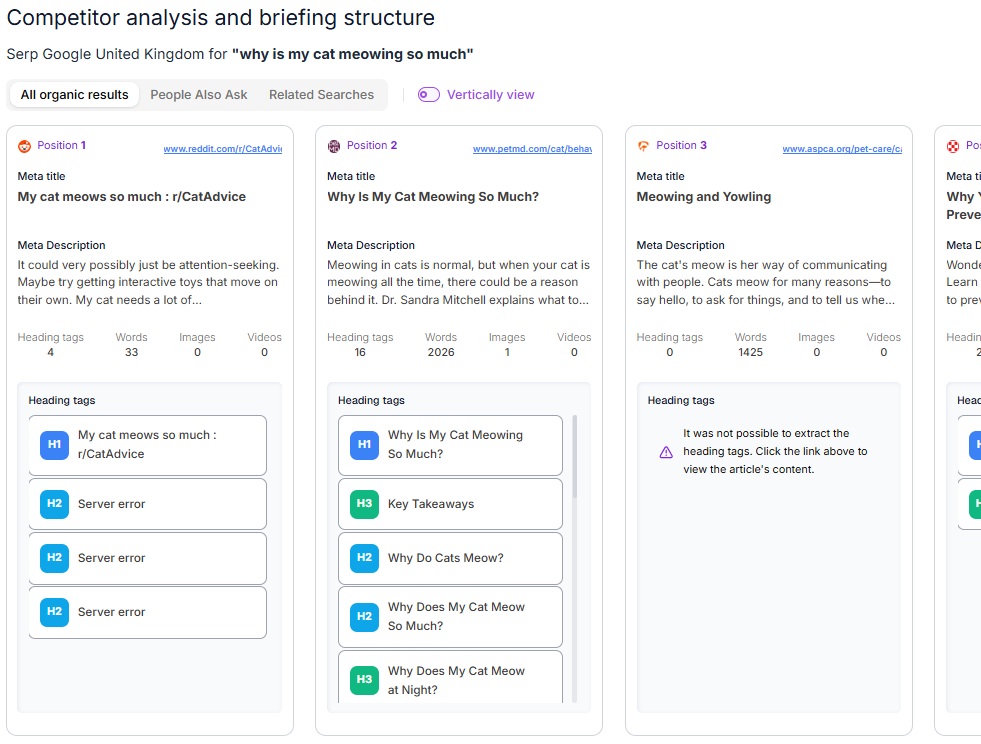
Result: say goodbye to creative block and drastically reduce time spent on manual research. The result is a more productive and strategic routine, where the expert delivers high-performance content that establishes a real connection of trust and authority with the audience.
Read more: From commodity to non-commodity content: how to escape “more of the same” and generate authority
4. Building relevant links
Focus on contextual links. A link from a blog specialized in your niche is worth more than ten links from generic sites. Also, do not underestimate the power of internal linking to organize relevance within your own domain.
While backlinks build your authority before the market, internal links are fundamental to organizing this relevance within your own domain.
A well-planned internal link structure helps search engines understand your site’s hierarchy and distribute “link juice” (authority) among pages.
In this way, you not only improve crawling by algorithms but also enrich the user experience, guiding them to complementary content and increasing time spent on the site – as we did in this text you are reading.
How Niara helps you
In our Prompt Library, you will find ready-made and optimized templates for creating high-impact guest post prospecting emails and press releases, facilitating communication with partners and media outlets.
Additionally, in the Tasks section, we have a specific tool that generates ideas for digital assets to promote your brand. This helps you create attractive and “linkable” content, ensuring natural mentions and strengthening your authority in the market.
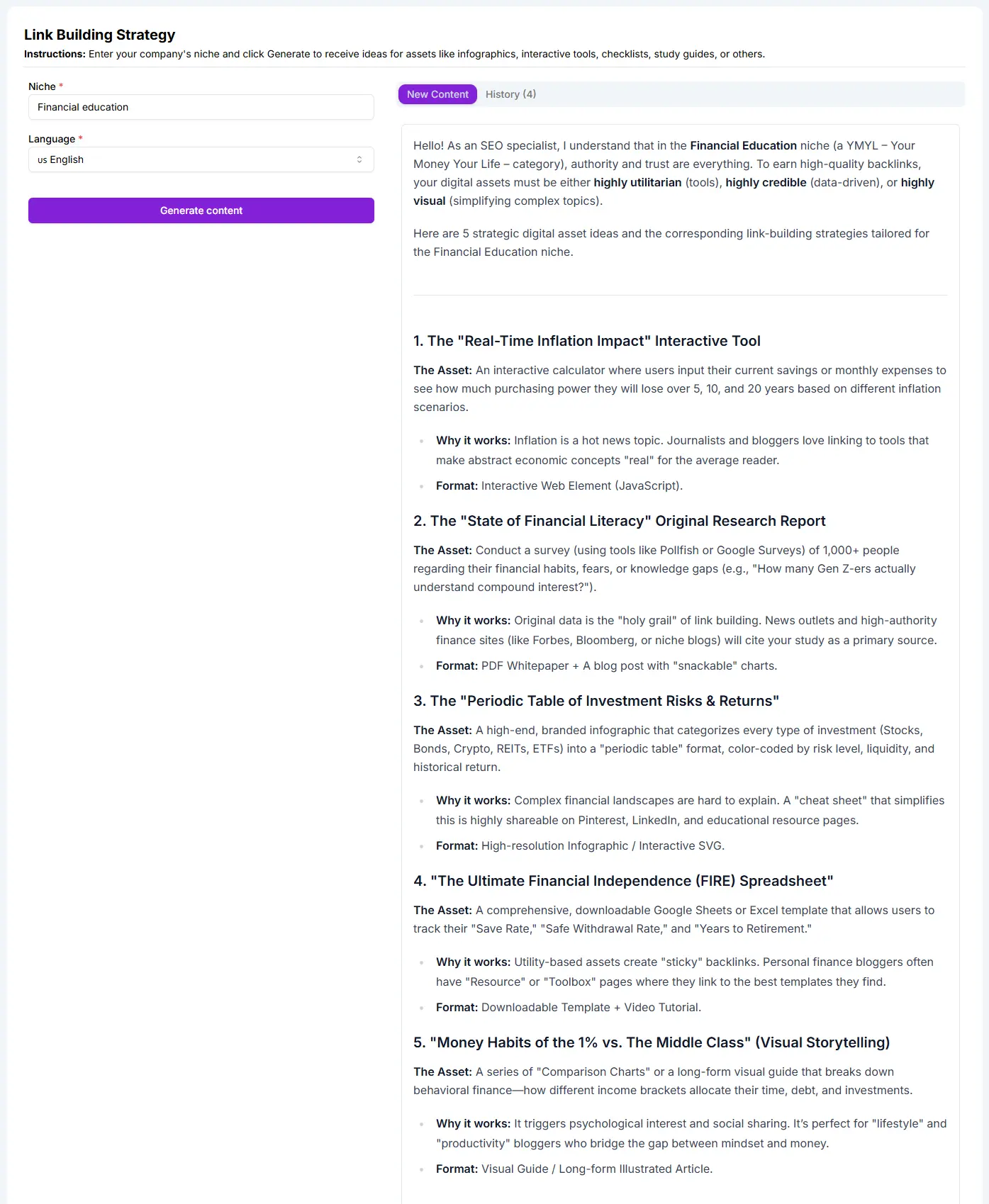
Result: you gain agility in executing complex tasks, increase the success rate in your partnerships, and build a solid backlink profile.
5. Conversion points for the business
Authority without conversion is just ego. Define clear CTAs at each stage of the cluster. If the content is informational, offer a lead magnet; if it’s consideration, offer a trial.
How Niara helps you
Niara simplifies the creation of conversion strategies through ChatSEO. You can use the tool to generate creative ideas for personalized CTAs for your target audience.
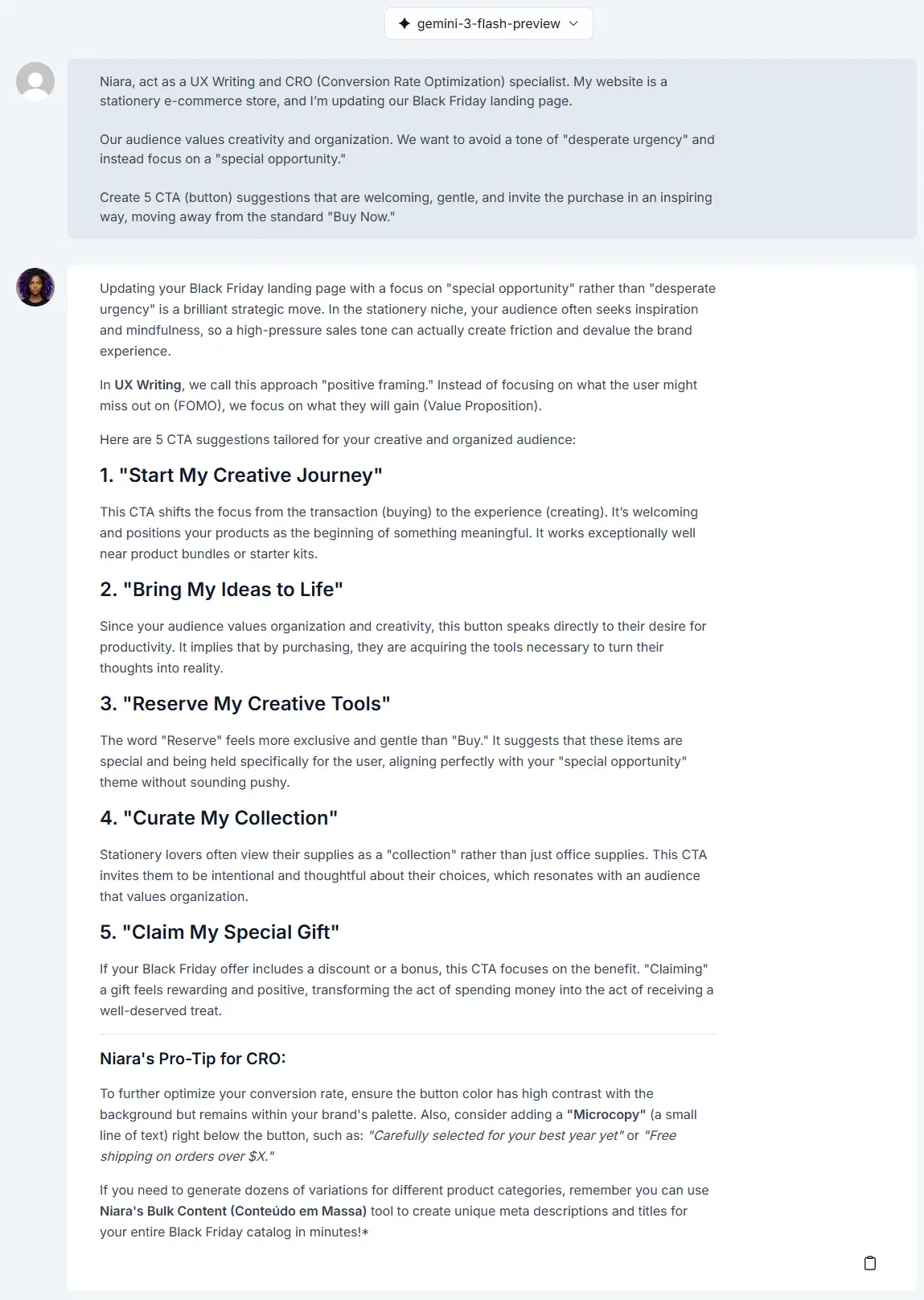
Another suggestion is to use the tool to identify strategic moments on the page to include these calls, whether on institutional pages, where the focus is direct conversion, or in blog articles, where the goal is to nurture the user and guide them through the sales funnel.
Result: more agility in producing persuasive copy and precision in positioning conversion elements for A/B testing.
6. Tracking results
The search landscape is dynamic, and what works today may need adjustments tomorrow due to algorithm updates or competitor movements.
Reviewing your data monthly is essential to understand your site’s behavior and ensure that your optimization efforts are generating the expected return.
How Niara helps you
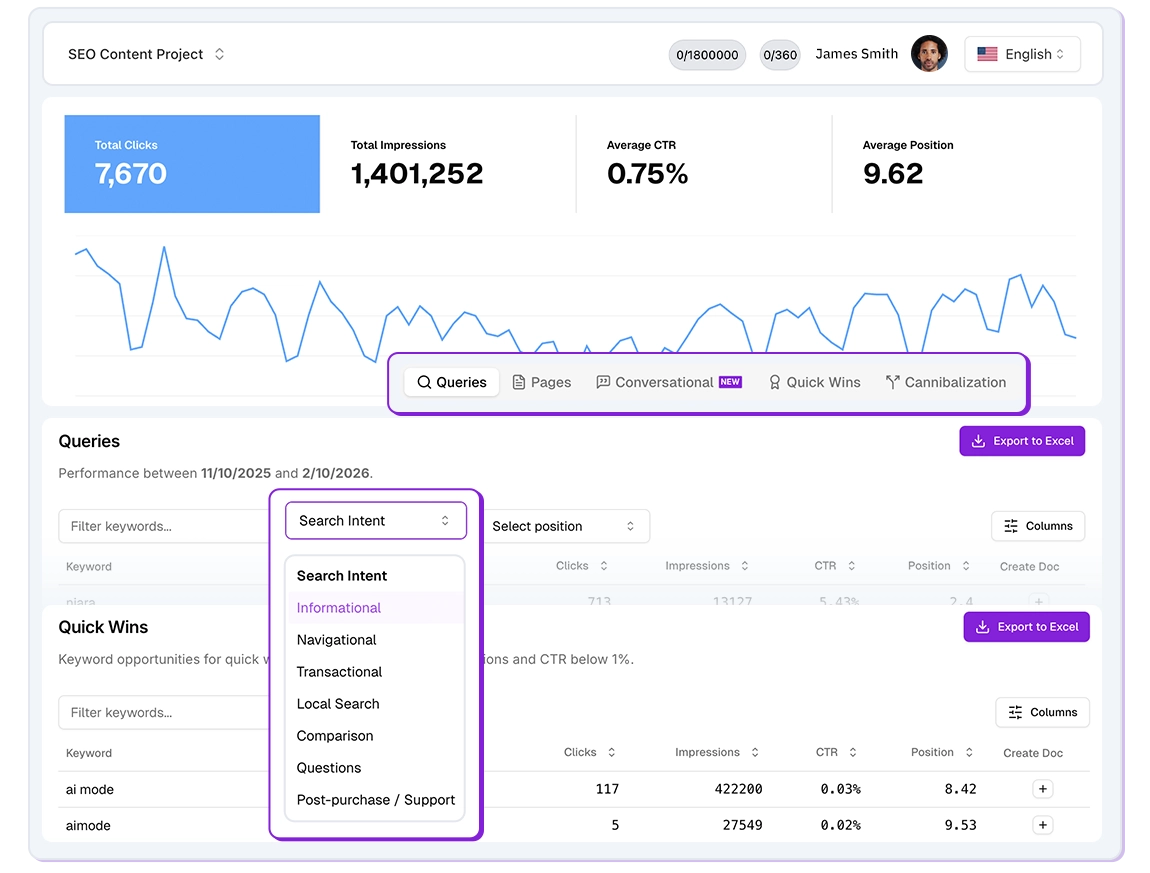
Niara simplifies complex data analysis through conversational Search Analytics via ChatSEO. Instead of wasting hours crossing spreadsheets, you can simply ask the chat to identify what has been working or not in your strategy.
Inside the Search Analytics dashboard, the user has access to a complete strategic view, being able to visualize:
- Queries and pages: identify which terms and URLs bring the most traffic.
- Quick Wins: locate opportunities for quick gains to climb positions with little effort.
- Cannibalization: detect if different pages are competing for the same keyword and hurting your performance.
Result: agility in decision-making and surgical precision in optimizations. The workflow becomes more productive as you can act quickly to recover lost clicks, eliminate structural errors, and focus on what truly brings conversion and authority to your domain.
How to identify if the site is already an authority on what it says
Do a quick diagnosis with this checklist:
- Share of Voice by topic: monitor the growth in the number of keywords. List and group the main searches and analyze how many of them you appear in the top 3 and/or generative results.
- High-quality content: is your content frequently cited or shared organically? This is the ultimate sign of authority.
- Internal link profile: do your most important pages receive the majority of internal links? Use a hub-and-spoke structure where everything points to what is essential.
How Niara accelerates topical authority in practice
Niara was built to facilitate all SEO work, from strategy building to analysis. Therefore, the platform has a complete ecosystem that helps you transform authority building into a strategic and highly automated process.
To achieve this end, we have tools such as:
Authority Map: the “ace in the hole” for content strategy
Building authority starts with a clear view of the content ecosystem. Niara’s Authority Map works like a strategic radar, automatically identifying which topic clusters you already dominate and, more importantly, where the “holes” or gaps are that the competition is exploiting.
Instead of spending weeks on manual research, the tool allows for the creation of editorial calendars for up to three months in a matter of seconds. This ensures total semantic coverage, making sure Google understands that your site is the most complete source on a given subject.
Site Audit: the technical foundation for a reliable experience
It’s no use having the best content if the site doesn’t offer an impeccable technical experience. Topical authority requires a solid foundation, and this is where Site Audit, our Technical SEO Agent, comes in.
Focused on performance and Core Web Vitals, the agent acts as a specialized auditor, identifying flaws and bottlenecks that can hurt your site’s performance in search results. It signals technical errors that prevent your pages from being properly crawlable and analyzable.
In addition to providing this detailed diagnosis, the tool offers consultative support: within the dashboard itself, you can talk to Niara to deeply understand what each error means.
If you don’t know how to proceed, it guides you on what should be done to solve the problem, allowing you to optimize your site’s technical infrastructure with clarity and security.
Search Analytics & Conversational Analytics: intelligence beyond spreadsheets
To be an authority, you need to understand what the user truly wants. Through Search Analytics and Conversational Analytics, Niara allows you to go beyond static spreadsheets. You can literally “talk” to the data to discover hidden search intents that traditional keyword tools often ignore.
With the use of advanced search intent and position filters, the platform ensures that you create the exact type of content needed for each stage of the customer journey, from discovery to the purchase decision, eliminating guesswork in content production.
Building for what comes next
The digital marketing and SEO landscape is no longer the same as it was a few years ago, and the speed of change only tends to increase.
More than just automating tasks, the true power of artificial intelligence lies in freeing up your time for what truly matters: strategic vision and human creativity. Building for the future means creating solid foundations today, using tools that allow for scale, technical precision, and, above all, a real connection with your audience’s search intent.
The future of SEO belongs to those who know how to unite data and intuition. Don’t wait for the next algorithm update to adapt; stay one step ahead with the right tools by your side.
Want to transform your content production and optimize your SEO intelligently?
Try Niara’s features for free and discover how to boost your results, from planning to execution.