
Spending days researching keywords, switching between dozens of tabs, spreadsheets, and tools, is a common reality for any SEO professional. However, this manual process consumes precious time that could be dedicated to strategy. When selecting the ideal terms, it is fundamental to consider the project’s goal, the target audience, brand positioning, and, most importantly, the user’s search intent.
Traditional tools have limitations in these targeting options. They tend to suggest terms very close to the initial idea, making it difficult to discover new semantic opportunities. Even for professionals with years of experience across various markets, there comes a point where ideas run out and the process becomes repetitive.
SEO keyword research has evolved and today requires a perspective that goes beyond vanity metrics, such as just search volume or ranking difficulty. The current focus of modern SEO is on building topical authority. Although the ultimate goal is to master a subject completely, keywords continue to serve as the essential foundation for content production, guiding the structure of what will be written.
In this scenario, Niara emerges to transform the workflow. Instead of a slow and limited process, AI allows for much faster, deeper, and more efficient keyword research, helping to find strategic angles that conventional tools ignore.
Discover below how to integrate Niara’s technology to elevate your content planning.
1. Finding Keywords
The first step of any planning is discovery. In this phase, the goal is to generate as many relevant ideas as possible that make sense for your business or your client. In the past, we were stuck only with what traditional tools showed. Today, we have a much wider range of options.
Generating Ideas with Content Seeds
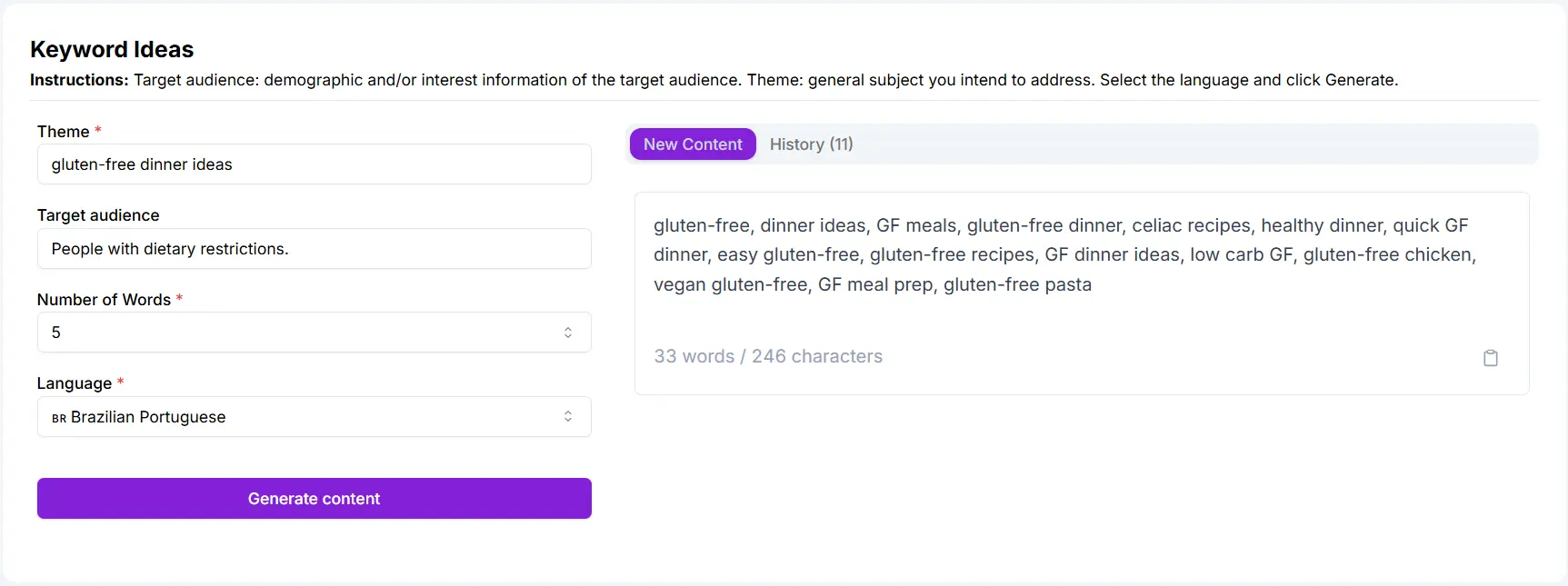
Everything starts with a “seed keyword.” If you have a vegan cooking blog, your seed might be “vegan recipes.” From there, AI can expand this into hundreds of variations you might not have considered, such as “vegan snacks to take to work” or “cheap vegan Christmas dinner.” The secret here is to use AI to explore niches and specific pain points of your audience.
Identifying Long-Tail Keywords
Long-tail keywords are the “ace up the sleeve” for those who want qualified results, especially in the era of AI and conversational search. These searches are more specific and generally have a lower search volume but a much higher conversion rate.
For example, “English course” is highly competitive, while “best online English course for beginners with a focus on conversation” is an example of specific targeting to attract a more qualified audience. This term attracts a user who is much more decided on making a purchase.
With AI, it becomes easier to find these semantic variations that escape human eyes in a conventional keyword spreadsheet.
Analyzing Competitors and Identifying Gaps
For a long time, the idea was sold that the secret to growing fast in SEO was to focus exclusively on what the competition was doing. And, indeed, analyzing competitors’ keywords and identifying content gaps on your site is a good strategy. But, rigor is necessary.
Before any external movement, the fundamental step is to look at your own domain. To conquer the top positions, you first need to build your topical authority. This means understanding what gaps your own site has and which topics need to be addressed in depth so that Google understands you are an expert on the subject.
A strengthened foundation is what ensures your domain has the “muscle” to rank. Only after consolidating this internal structure does it make sense to look at competitors to try to reach or surpass them.
With Niara, you automate this analysis on both fronts. First, we help you identify what is missing in your own strategy to consolidate your authority. Then, with a solid base, our tools allow you to map opportunities neglected by the market. The goal is not just to copy what already works, but to understand demand and deliver much more complete and strategic content.
2. Analyzing Keywords
With a well-defined list, you need to filter what really matters. Not every high-volume word is worth the effort, and not every low-volume word should be discarded. In the era of AI and modern SEO, analysis goes far beyond cold numbers.
In addition to organic links, search engines display knowledge panels, image and video carousels, and more recently, we see the increasingly active insertion of AI Overviews and Google AI Mode in organic results as search facilitators.
To refine this selection, the SEO professional should focus on search intent and SERP anatomy. Remembering that today, the goal is not just to attract clicks, but to ensure that the content is useful enough to convert or establish authority in a scenario where “zero-click” searches (where the user finds the answer without leaving Google) are growing.
So, do search volume and keyword difficulty no longer matter?
Search volume and keyword difficulty have ceased to be the only protagonists of the strategy. In the current scenario, what really moves the needle is not gross volume, but search intent. Monthly volume is a dangerous metric when analyzed in isolation: what’s the point of attracting thousands of visitors if they are only looking for quick information and your goal is conversion?
The real value of a solid content strategy lies in the ability to align content with what the user actually wants—whether to learn, compare, or buy.
AI now allows us to categorize these intents at scale, avoiding the common mistake of draining resources trying to rank informative articles for transactional searches. Similarly, keyword difficulty should not be seen as an insurmountable barrier, but as a guide to finding the “path of least resistance” based on your site’s current authority.
The key piece for success in this new landscape is not just technical, but cultural. It is essential to maintain a continuous dialogue with leaders and clients to make them aware of this new moment in organic search.
Modern SEO requires a change in mindset: we need to stop chasing only vanity metrics and focus on strategic relevance. Educating stakeholders on why intent and authority matter more than inflated numbers is what ensures sustainable ROI and avoids frustration with projects that, while technically correct, do not align with business objectives.
3. Segmenting Keywords
Strategic organization is a fundamental step in all keyword research, as a well-segmented SEO structure facilitates measurement, scaling, and avoids cannibalization between pages. In this sense, it is necessary to group terms under two main pillars:
1. User Journey
Segmentation should follow the maturation of your audience, dividing keywords into three stages:
- Top of the funnel (awareness and discovery): broad and educational terms for those who are starting to understand a problem.
- Middle of the funnel (consideration of the solution): terms that compare options or look for practical “how-to” guides.
- Bottom of the funnel (purchase decision): specific product terms, prices, coupons, and reviews focused on conversion.
2. Semantic Grouping
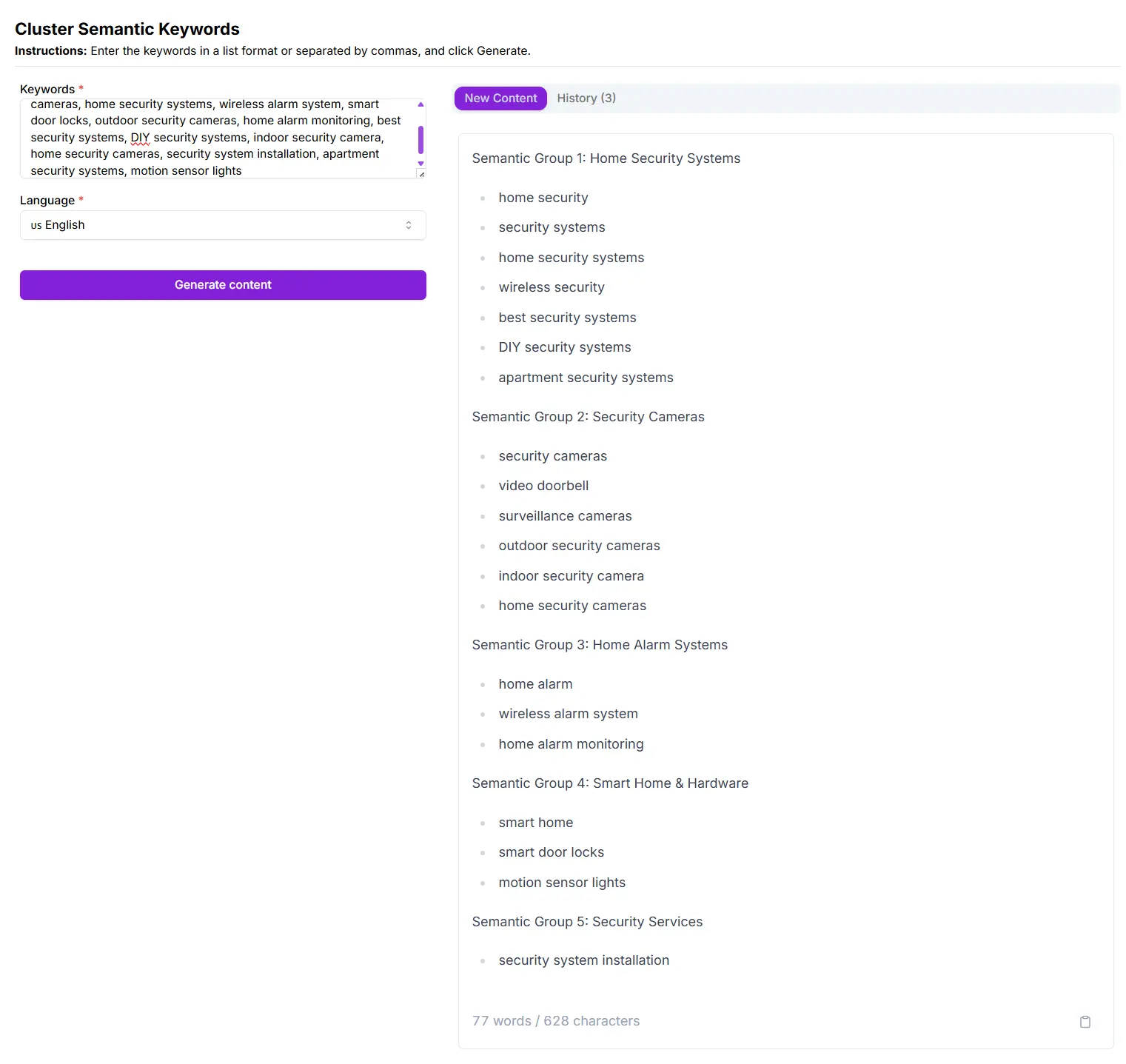
Beyond the funnel, use the clustering technique (keyword grouping). Instead of creating isolated posts for very similar variations (like “chocolate cake recipe” and “how to make fluffy chocolate cake”), the goal is to group semantically related terms into a single pillar content.
It is this practice that will strengthen your semantic authority (topical authority), proving to search engines that your site masters a topic completely.
With the help of AI, it becomes simpler to identify language patterns and group hundreds of terms into logical clusters much faster and more accurately than a manual process.
Keyword Research Tools
To execute these steps with mastery, you need the right tools. Options include:
Google Tools
Google’s free tools are great for conducting keyword research for blogs or corporate websites. You can consult:
Google Search Console (GSC)
Google Search Console is your source of truth, as it provides real organic traffic data to identify which queries already generate visibility and where there is potential for improvement. To use it in a keyword audit, access the “Performance” report and analyze the intersection between impressions, clicks, CTR, and average position.
A suggested analysis is to filter terms with high impressions but low CTR. This indicates that your page is relevant to the search, but the title or meta description is not attracting the click.
Additionally, in “Queries,” you can discover semantic variations you haven’t explored in the text yet, allowing for adjustments to capture broader search intents. This tool eliminates guesswork, ensuring your SEO decisions are based on actual user behavior and the domain’s historical performance, focusing effort where return is most likely.
Google Trends
Google Trends is great for understanding seasonality and consumer behavior over time. To get the most out of the tool, the user should go beyond simple queries of isolated terms. Use the comparison function to place synonymous keywords side-by-side and discover which has a higher search volume in specific periods, avoiding the waste of resources on terms that are in decline.
You can also use Google Trends to conduct regional analyses. Trends allow you to identify in which states or cities a subject is more relevant, enabling the creation of paid traffic campaigns or geographically targeted content.
By monitoring interest over months or years, you can predict demand peaks and prepare your inventory or editorial calendar in advance.
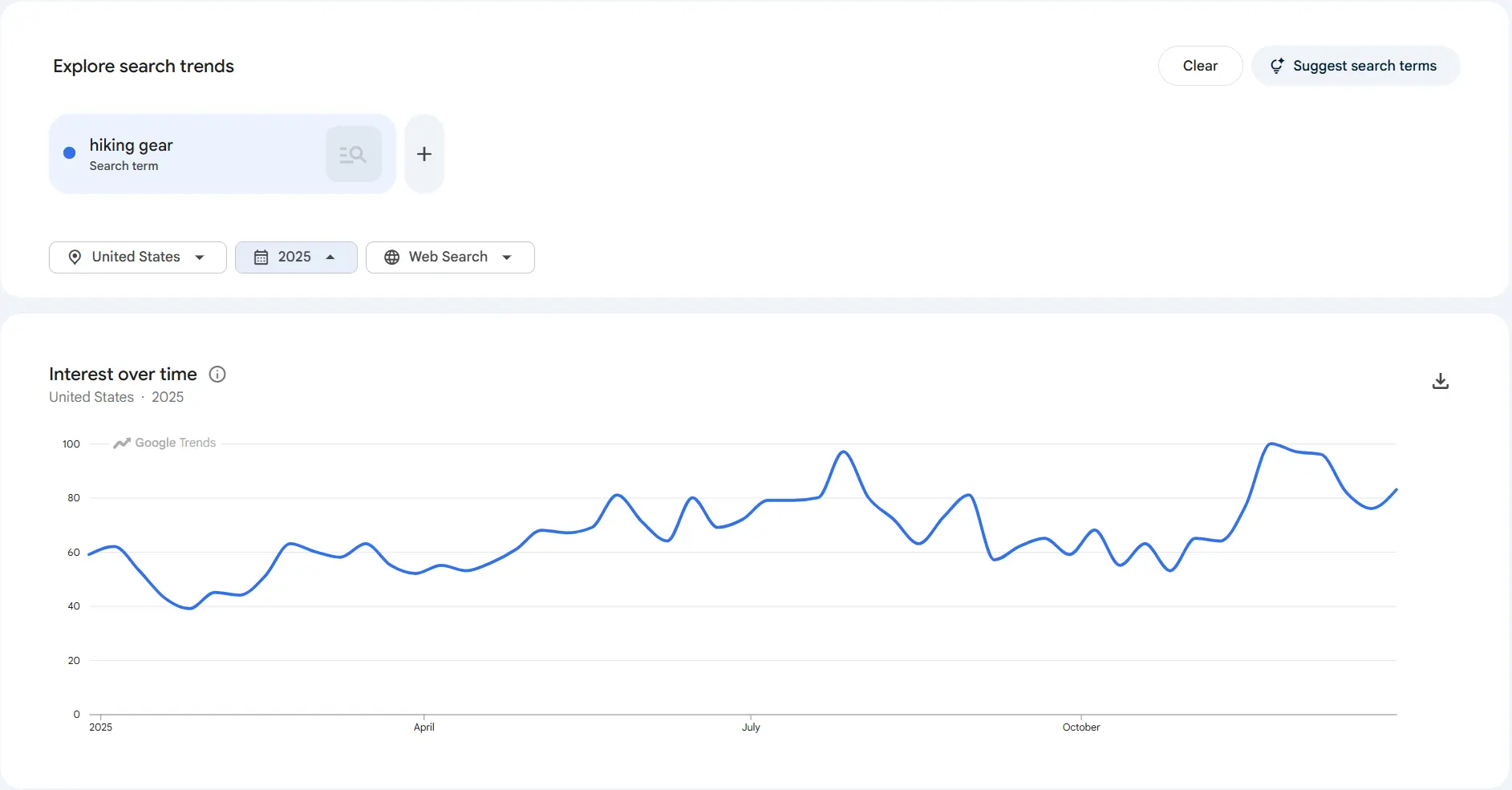
With the Trends + Gemini integration, you can also use the platform’s smart mode to find search term suggestions.
Google Keyword Planner
Although focused on ads, Google Ads gathers volume and competitiveness data directly from the source. To get the most out of this tool for SEO, use the “Discover new keywords” function by entering not only generic terms but also a competitor’s URL to identify content gaps your site may have.
It is possible to deepen your analysis by filtering results by geographic location and language, ensuring your strategy is precise for the regional target audience.
Another secret is grouping semantically related keywords, which helps structure your site’s information architecture. Even without an active campaign, insights into monthly search volume are fundamental for prioritizing terms with actual demand, ensuring your organic optimization efforts are directed toward topics that truly attract qualified and relevant traffic for your business.
ChatSEO
Niara’s ChatSEO is an AI assistant specialized in SEO that understands the market context. The great differentiator here is our Prompt Library, which features over 50 tested and approved templates for various demands.
With ChatSEO, you can request:
- Semantically related words: expand your semantic field so Google understands your content is comprehensive.
- Words according to the sales funnel: ask the AI to classify your list of terms into top, middle, and bottom of the funnel instantly.
- Keywords for B2B: if your business is focused on other companies, the language changes. Our prompts help find the technical and decision-making terms that the B2B audience uses.
To select the ideal prompt, select the “Prompts” option below the text box, look for the ideal template, and click the “Use Prompt” button. Replace the items in brackets with the topic, audience, or other requested information and click “send message.”
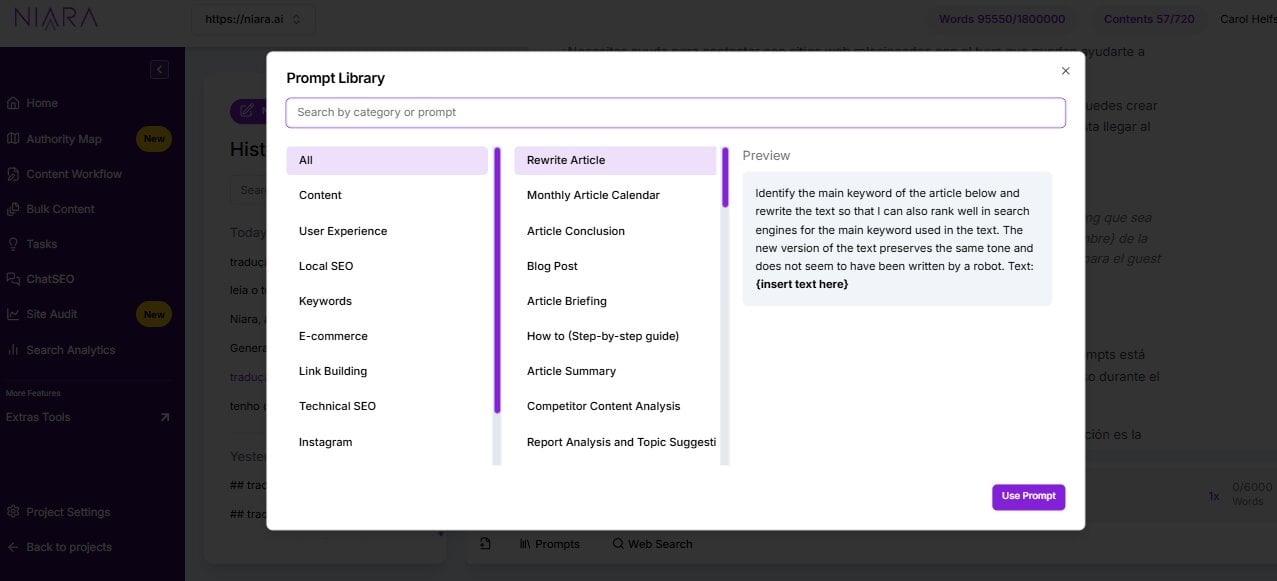
In seconds, Niara will suggest several keywords for your SEO project. After the response, you can ask her to suggest more, give a few more instructions to improve the result, or even have her cluster the suggested words, for example.
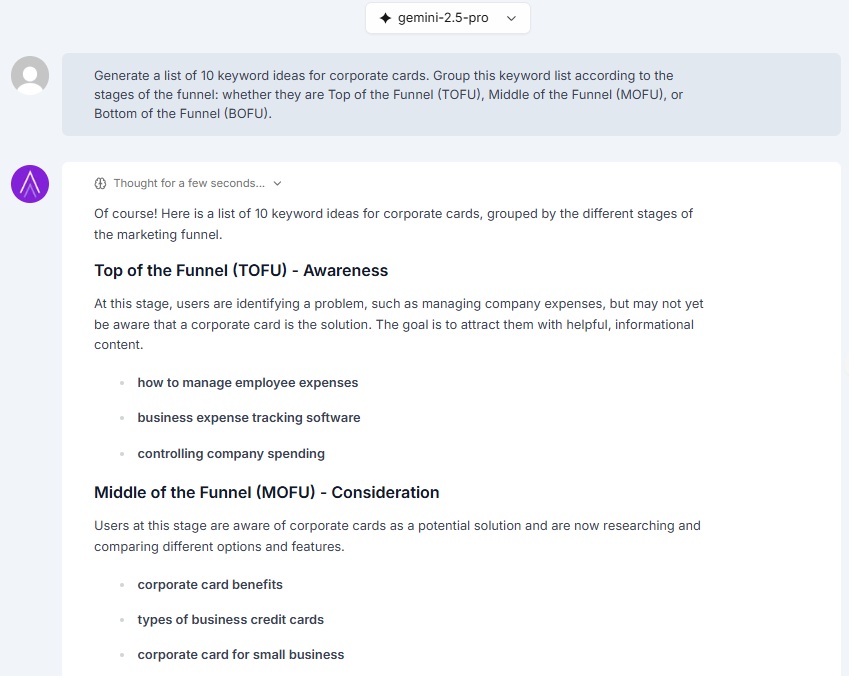
Additionally, ChatSEO accepts attachments and connects to your Search Console data, allowing you to “talk” to your data without needing to open a single Excel spreadsheet.
Niara Tasks
Tasks are AI agents trained for specific routines, eliminating manual and repetitive labor. They are ideal for those who need scale. There are 5 very important ones for your strategy:
- Keyword Ideas: generate 5 to 30 keyword ideas according to your audience.
- Topic Cluster: receive 5 to 30 content ideas to create and show Google you are an authority!
- Semantic Keyword Ideas: Generate a list of 5 to 30 words related to a main keyword.
- Cluster Semantic Keywords: Cluster your keyword list according to semantics.
- Keyword Search Intent: Group keywords according to user search intent.
To use them is also simple: select the “Tasks” tab in the left sidebar menu, look for the one most suitable for your needs. Fill in the indicated fields and click “Generate content.” In seconds, Niara answers you according to your instructions.
4 Examples of AI Keyword Research
1. B2B Keyword Research
If you are working in B2B markets, your mission is to find words that company employees use when searching for your product or service.
However, no matter how experienced we are or how many niches we work in, tools like Keyword Planner require an initial seed keyword to generate others. But who says we always know what that initial input should be?
That’s where Niara comes in! 💜
In the examples below, we used the terms “corporate credit card” and “online form.”
See how easy and fast it is to get several keyword suggestions for your project:
- Access the Prompt Library
- Select “Keywords” > “B2B Keywords”
- Use the following prompt:
“I am an SEO professional selecting keywords for an optimization project. The topic is 'enter topic here' and the idea is to select keywords considering how each company department (HR, Finance, Marketing, and others) uses online forms in their routine. Suggest 5 keywords for each department below.”
Check out the examples below and see how Niara considered the audience, interests, departments, and various other details, offering more personalized and efficient keywords for the SEO project:
a) Keyword Suggestions for “Corporate Credit Card”
Prompt: “I am an SEO professional selecting keywords for an optimization project. The topic is 'corporate credit card' and the idea is to select keywords considering how each company department (HR, Finance, Marketing, and others) uses online forms in their routine. Suggest 5 keywords for each department below.”
Result:
Human Resources (HR)
- Corporate card for HR expenses
- Benefits management with corporate cards
- HR expense reimbursement
- Corporate card for recruitment
- Corporate card for training sessions
Finance
- Financial control with corporate cards
- Corporate card for business expenses
- Business credit card for financial management
- Financial reports with corporate cards
- Corporate card for financial auditing
Marketing
- Corporate card for marketing campaigns
- Advertising expenses with corporate cards
- Event management with corporate cards
- Corporate card for marketing tools
- Corporate card for media buying
Sales
- Corporate card for sales expenses
- Sales expense reimbursement
- Corporate card for sales travel
- Client expense management
- Corporate card for sales teams
IT (Information Technology)
- Corporate card for IT purchases
- Software management with corporate cards
- Hardware expenses with corporate cards
- Corporate card for IT services
- IT subscriptions with corporate cards
Administrative
- Corporate card for general purchases
- Administrative expenses with corporate cards
- Supply management with corporate cards
- Corporate card for business travel
- Administrative expense reimbursement
b) Keyword Suggestions for “Online Form”
Prompt: “I am an SEO professional selecting keywords for an optimization project. The topic is 'online form' and the idea is to select keywords considering how each company department (HR, Finance, Marketing, and others) uses online forms in their routine. Suggest 5 keywords for each department below.”
Result:
HR Department
- Online recruitment form
- Employee feedback form
- Performance review form
- Online vacation request form
- New employee onboarding form
Finance Department
- Expense reimbursement form
- Budget request form
- Financial accountability form
- Payment approval form
- Financial control form
Marketing Department
- Market research form
- Event registration form
- Customer feedback form
- Lead capture form
- Campaign evaluation form
IT Department
- Technical support request form
- Equipment registration form
- Incident report form
- Access request form
- Software update form
Sales Department
- Purchase order form
- Customer registration form
- Price quote form
- Sales prospecting form
- Sales follow-up form
According to Niara, “These keywords were selected considering the specific activities of each department and how they might be using online forms to optimize their processes.”
2. Keyword Research by Sales Funnel
By grouping keywords according to funnel stages, you can better target content and marketing strategies to meet the specific needs of users at each stage of their buyer’s journey.
Prompt: "Generate a list of 10 keyword ideas about corporate credit cards. Group this keyword list according to the funnel stages: Top of the Funnel (ToFu), Middle of the Funnel (MoFu), or Bottom of the Funnel (BoFu)."
Result:
a) Keyword Ideas for Corporate Credit Card
Top of the Funnel (ToFu)
1. What is a corporate credit card
2. Benefits of corporate credit cards
3. How a corporate card works
4. Difference between corporate and personal credit cards
Middle of the Funnel (MoFu)
5. Types of corporate cards
6. How to choose a corporate credit card
7. Best corporate card options for small businesses
8. Corporate card comparison
Bottom of the Funnel (BoFu)
9. Apply for a corporate credit card
10. Online corporate card application
3. Keyword Research for Topic Cluster Strategy
A Topic Cluster strategy not only improves your content organization but also boosts your site’s authority, facilitates Google indexing, and enhances user experience. Careful and continuous implementation of this strategy can result in significant gains in SEO and user engagement.
a) Topic Cluster in ChatSEO
Prompt: "Act as an SEO professional and help me create a Topic Cluster strategy for a blog based on the main keyword and number of clusters below:

Taking into account the main keyword 'corporate credit card', provide 1 Pillar Post suggestion and 4 Clusters."
Result:
Topic Cluster Strategy for the Keyword “Corporate Credit Card”
Pillar Post
Title: Everything You Need to Know About Corporate Credit Cards
Description: This comprehensive post will cover all aspects of corporate cards, including what they are, how they work, advantages, disadvantages, and how to choose the best card for your company.
Clusters
- Title: Benefits of Corporate Cards for Small Businesses
Description: Explore how small businesses can benefit from adopting a corporate card, with practical examples and tips. - Title: How to Implement a Corporate Card System in Your Company
Description: A step-by-step guide on setting up and managing a corporate card system, including policies and best practices. - Title: Main Differences Between Corporate and Personal Cards
Description: A detailed comparison between corporate and personal cards, highlighting the pros and cons of each. - Title: Corporate Cards and Expense Control: Best Tools and Software
Description: Analysis of the main tools and software that can be used alongside corporate cards for expense control and financial reporting.
Topic Cluster Structure
Pillar Post:
- Introduction
- What is a Corporate Credit Card?
- Pros and Cons
- How to Choose the Best Corporate Card
- Conclusion
Internal Links:
-
- Benefits of Corporate Cards for Small Businesses
- How to Implement a Corporate Card System in Your Company
- Main Differences Between Corporate and Personal Cards
- Corporate Cards and Expense Control: Best Tools and Software
💡 Niara’s Tip: Make sure to use internal links to connect the clusters to the pillar post, improving user navigation and the site’s SEO structure.
b) Topic Cluster Task
You can also create this strategy using the Task > Topic Cluster feature. In this case, you don’t even need a prompt. Just enter the central theme (of your pillar post), and Niara will generate 5 to 30 topics for your cluster.
4. Keyword Generator
Unlike the examples above, with ChatSEO’s keyword generator, you don’t need to type the prompt. See how easy it is:
- Select the Keyword Ideas Task to generate a list of suggestions;
- Indicate your site or blog theme and the target audience;
- Enter the number of keywords you would like to obtain;
- Click generate and watch the magic happen!
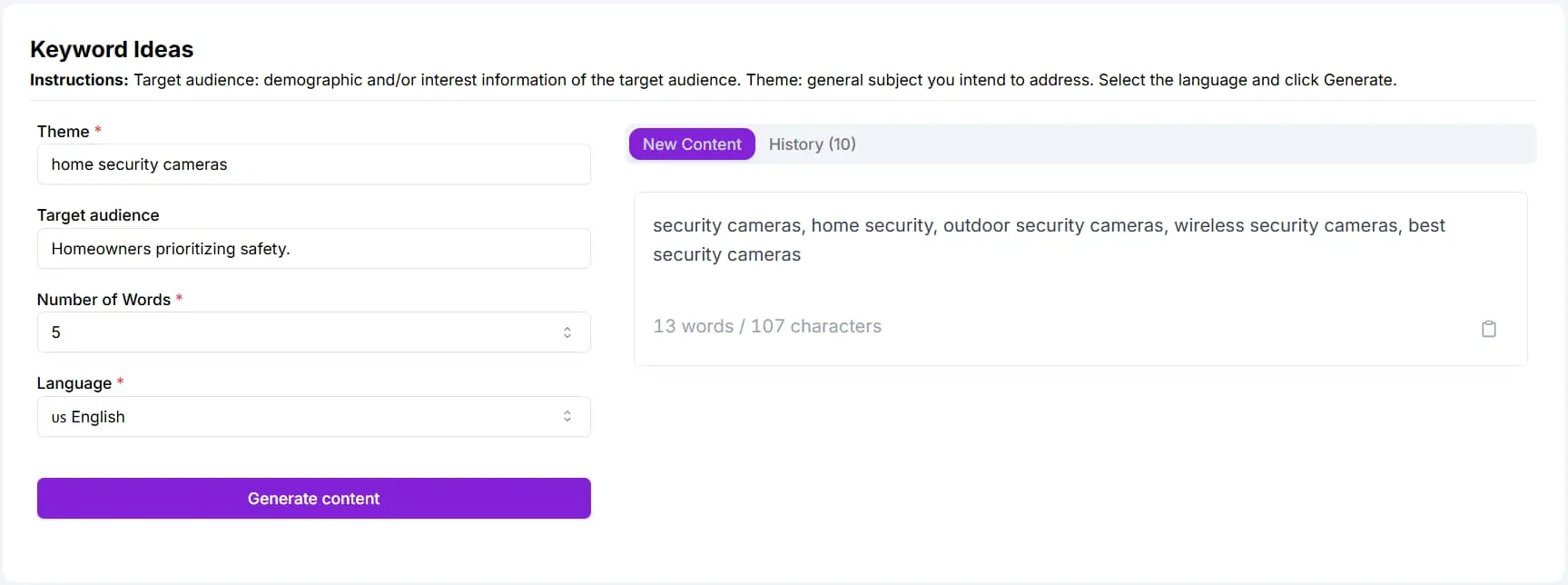
See? In just 4 simple steps, you went from zero to creating different opportunities.
Niara Video Tutorial: 3 Efficient Ways to Research Keywords with AI
Did you like the examples above? We recorded a video tutorial with all of them!
You will see, in practice, how Niara can help you gain productivity and efficiency in your keyword research 🙂
- The difference between researching keywords with Google Keyword Planner vs. Niara, and the results of each tool.
- 3 ways to research keywords using Niara’s artificial intelligence:
- Semantically related keywords;
- Keywords according to the sales funnel;
- Topic Cluster strategy according to the project’s audience interests.
- Tips and techniques for you to get the results you need, based on the details of your SEO and Content project.
Live: How to Research Keywords with AI
A 1-hour live session to help you become an expert in keyword research with Niara.
More important than technical skills and knowing how to use the tool is knowing the strategy—why to use each form of research and AI.
Learn how to research semantic, B2B, sales funnel keywords, and more!
Press play and check it out!
Benefits of Researching Keywords with AI
With Niara, SEO professionals now have access to a vast amount of data: topic ideas, audience insights, market trends, and much more. This data is essential for getting keyword suggestions best suited for your project!
- Precision and Relevance: AI analyzes large volumes of data, ensuring that suggested keywords are not only relevant but also aligned with your market and user behavior.
- Personalization: With the ability to understand the context and specificities of your project, AI provides highly personalized suggestions, considering the niche, competition, and specific goals of your business.
- Identifying Opportunities: Through personalization and a wide information base, AI identifies terms that haven’t been explored yet, allowing you to discover new gaps in the market.
- Time Savings: By automating repetitive and complex tasks, AI frees up time for professionals to focus on strategic and creative activities, increasing productivity.
- Deep Audience Insights: It offers a deeper understanding of the audience (interests and general behavior), resulting in more precise targeting and effective communication. Note: Niara does not analyze your specific audience, but rather the general audience interested in a certain type of product or service.
- Content Suggestions: In addition to terms, AI assists in creating highly optimized and engaging briefs, articles, and blog posts.
Taking advantage of these benefits transforms keyword research into a more efficient, precise, and data-driven process, boosting the performance of your SEO project.
Building Your Authority Based on Topical Authority
In modern SEO, Google no longer looks only at isolated keywords but at your authority over an entire topic. If you want to be an authority on “Digital Marketing,” it’s not enough to have one good post about “SEO.” You need to cover Social Media, Email Marketing, Analytics, and so on—a strategy known as Topical Authority.
Building this authority manually requires complex mapping of how each piece of content connects. It’s information architecture work that, if done wrong, can take months to fix. So, how can you speed up the process?
How Niara’s Authority Map Can Help You
The Niara Authority Map is a revolutionary feature that transforms raw data from your Google Search Console into a clear growth strategy.
It identifies your “dominant clusters” (where you are already strong) and, more importantly, where your gaps are. With just one click, Niara analyzes your site and generates an editorial calendar for up to 3 months, focused on filling the gaps needed to dominate a topic completely.
What used to take days of heavy manual analysis, Niara delivers in seconds, allowing you to go straight to creation.
How to Apply Keywords to Content
Finding the words is half the battle. The other half is on-page SEO: knowing where and how to place them so that both users and Google bots understand your page’s relevance.
- Title (H1) and Subheadings (H2, H3): The main keyword should be in the H1, preferably as far to the left as possible. Use semantic variations and long-tail keywords in H2s and H3s to capture secondary searches.
- Meta Description: While not a direct ranking factor, a well-written meta description with the keyword increases the click-through rate (CTR).
- Alt Text: Don’t forget the images! Use Niara’s Alt Text Generator to create accurate descriptions that help with accessibility and image SEO.
- FAQ: Adding an FAQ section to institutional pages (products, services, and plans) is an excellent way to answer direct questions users ask on Google, increasing your chances of appearing for different types of searches.
Automate Operational Research and Focus on Strategy
Keyword research is a fundamental process in any company’s SEO strategy, and Niara is your ally in making this step more efficient and effective. Niara is a tool made by and for SEOs, giving you access to a vast amount of data, audience and market insights, and personalized suggestions, helping you save precious hours and increase your work efficiency.
To see how Niara can further revolutionize your marketing, access all the video tutorials at Niara Academy—content, analysis, code, and more with Niara!
All features shown in the article are available in all Niara plans.
Want to transform the way you conduct keyword research? Sign up now and try it for free for 7 days. Discover how we can revolutionize your SEO strategy and take your content to the next level! 🚀💜