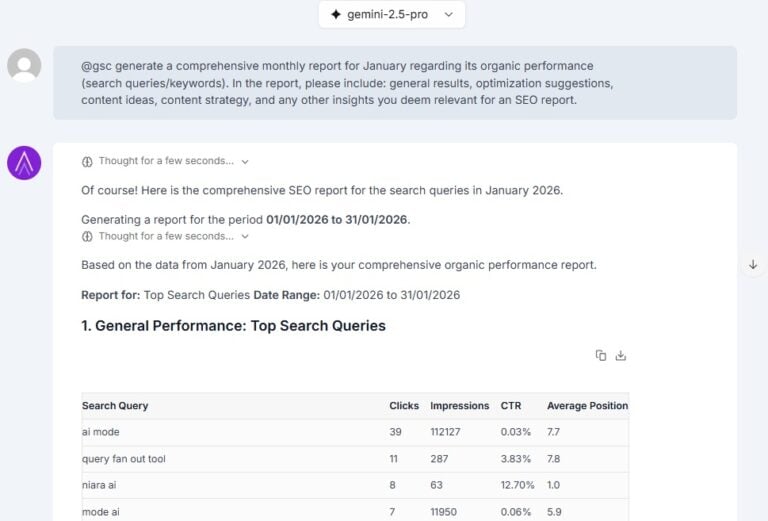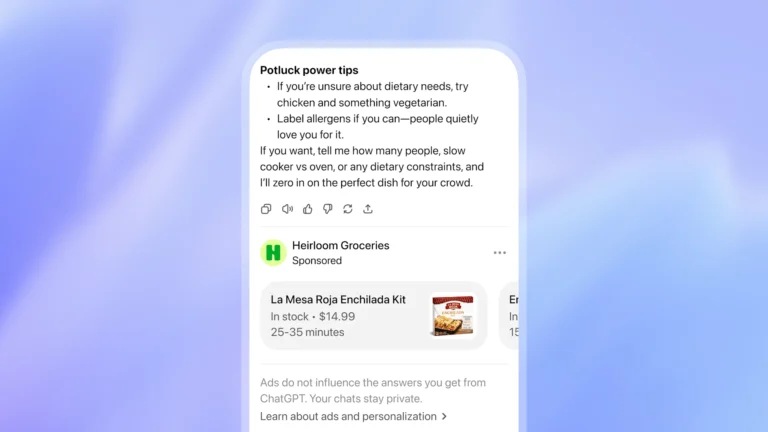
Organic search is no longer just about a blank text box. Today, people point their cameras to find or learn more about specific items, ask questions via voice, and expect instant answers in multiple formats. Consumer behavior has shifted, and traditional SEO is no longer enough to capture this attention.
Search engines now use advanced Artificial Intelligence to see images and interpret videos with human-like precision. Google has evolved toward multimodal understanding, meaning that beyond text, algorithms can now interpret audio, video, and images.
To strengthen your brand’s presence and ensure it remains easily discoverable, the secret lies in building harmony between different media formats and the strategic use of metadata. By publishing multiple formats across various platforms, companies can transcend the limits of traditional text searches and capture user attention across multiple touchpoints.
Master multimodal SEO to lead your niche in the era of AI. Learn how to integrate different formats and gain even more relevance across multiple search engines.
The Concept of Multimodal SEO
Multimodal SEO is the practice of optimizing various content formats (text, image, video, and audio) in an integrated way so that search engines understand the core message of a page through multiple signals.
When searching for “how to change a car tire,” in traditional SEO, a user would find an article with written step-by-step instructions. In multimodal SEO, Google understands that the best answer combines:
- A short explanatory text.
- A demonstrative video (with marked chapters).
- Detailed images of each step.
- A voice guide so the person can listen to instructions while performing the task.
The importance of this for AI ranking is absolute. Large Language Models (LLMs) are trained on multimodal datasets. Therefore, by providing context in different formats, you increase the chances of your brand being cited in various ways in generative results, as the AI has more informational “anchors” to validate your authority on the subject.
Why is Multimodal SEO Important in the AI Era?
One thing is certain: search is no longer linear. Google has evolved from a “keyword matching” system to a “semantic understanding” system. Generative AIs have accelerated this process, requiring content to be semantically rich and accessible in whatever format the user prefers.
Read more: Topical Authority: How to Become the Ultimate Reference in Your Market
Artificial Intelligence and Multimodal Processing
The big game-changer was Natural Language Processing (NLP) combined with computer vision.
AI doesn’t just need to read your alt text to know what’s in a photo; it can analyze pixels and understand the context, for example.
Multimodal search processing allows the AI to cross-reference information: if your video says “X,” your text says “X,” and your image shows “X,” the AI’s confidence in your answer is infinitely higher. This reduces the chances of “AI hallucinations” and positions your site as a high-trust source.
Changes in User Behavior
Consumer behavior dictates the rules. The exponential growth of visual searches (Google Lens) and the use of TikTok and YouTube as search engines by Gen Z prove that pure text is no longer enough. People seek convenience and accessibility.
Audiences start a search on desktop, continue listening to a podcast in the car, and finish by watching a quick tutorial on their phone. Multimodal SEO ensures your brand is present at all these touchpoints, respecting each individual’s browsing preferences.
Does Multimodal SEO Replace Traditional SEO?
Actually, multimodal SEO expands traditional SEO. On-page, technical, and link-building best practices remain the foundation. Multimodal SEO is the finish and the structure that allows this foundation to reach new heights.
In terms of cost-benefit, producing a video is more expensive than writing text, but the return in engagement, authority, and trustworthiness is usually much higher.
The good news is that with automation and Niara’s AI tools, the cost of “multimodalizing” your content drops drastically. You don’t need a team of 20 people; you need smart processes that transform one asset into many.
Read more: 5 Free AI Tools to Supercharge Your SEO and Digital Marketing
The 4 Pillars of Multimodal SEO
To master this strategy, we need to look at four main fronts working in harmony.
1. Image Optimization for Visual Search
With the advancement of technologies like Google Lens and Pinterest Lens, the smartphone camera has become a research tool as powerful as the keyboard.
Through image search, users can find information by pointing their camera at an object or uploading a photo. To give you an idea, in 2024, Google stated that over 20 billion searches were made via Google Lens—one in four with commercial intent.
In practice, visual optimization is not just a technical adjustment. To be found, the basics of image SEO remain crucial.
How Niara helps you: Through the Alt Text Generator, the tool interprets the context of your photos to create precise, automatic technical descriptions. This ensures your catalog is perfectly “read” and indexed by tools like Google Lens (check more details in the “From planning to execution” section).
2. SEO for Video and Audiovisual Content
Video has consolidated itself as one of Google’s preferred formats for offering quick and dynamic answers on the SERP. With algorithm evolution, search engines not only identify the video but understand the content within it to satisfy user intent immediately. What’s cool is that this visibility, previously limited to YouTube, has expanded.
In a strategic move to keep up with shifts in consumption behavior, Google began indexing and displaying content from TikTok and Instagram in its results pages.
This integration began to take shape in late 2020 when Google started official tests to include a dedicated “Short Videos” carousel in mobile search results.
The relevance of this indexing is backed by data. According to Senior VP Prabhakar Raghavan, in July 2022, nearly 40% of young people looking for a place to eat lunch don’t use Google Maps or Google Search, but TikTok or Instagram instead.
This means that video optimization for SEO (on TikTok, Instagram, and YouTube) helps you appear on the first page of Google for specific keywords, increasing organic traffic.
How Niara helps you: You can use our features to multiply your channel’s authority. In Niara, users can convert videos into structured posts or create optimized scripts, ensuring your message is captured by both video algorithms and AI Overviews (check more details in the “From planning to execution” section).
Videos are the new “shortcut” to the top of AI Overviews
Beyond SERP visibility, videos have become a cornerstone of trust for LLMs. Since AI is mostly trained on text—a format that is easily replicable and prone to conflicting information—it is susceptible to hallucinations and outdated data.
In this scenario, video becomes a strategic differentiator: Ahrefs data reveals that 18.2% of citations in AI Overviews come from YouTube, often bypassing traditional domain authority. For AI, audiovisual content is a primary source that is harder to dispute.
This is because they act as “visual evidence” that text alone cannot support. They have higher data density: by combining audio, transcription, and practical demonstrations (such as tutorials, product screens, and pricing), you provide the AI with irrefutable proof. This drastically reduces the risk of your brand being misinterpreted by intelligent assistants.
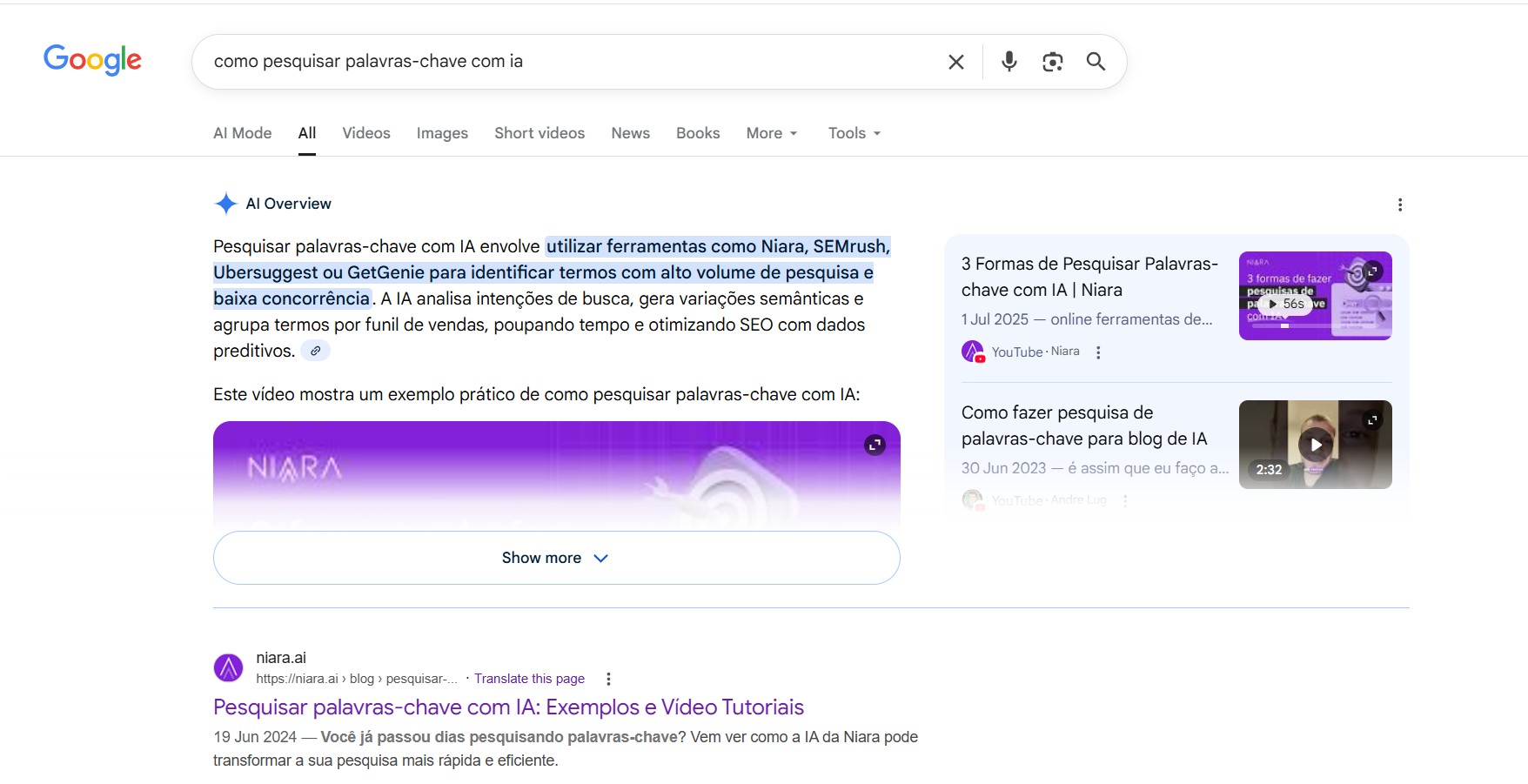
At Niara, we create dozens of tutorials to explain the tool, aiming to assist users and ensure the correct interpretation by LLM models.
A great example from the past year was the launch of the Authority Map. The feature appeared accurately in AI Overviews right after a livestream hosted by Lisane and Cadu in September 2025—even before we published an official article here on the blog.
Based solely on the video, the AI processed the information, understood the concept, and began recommending it.
3. Voice Search Optimization
Voice search transforms short, fragmented queries into full dialogues. Unlike traditional typing, voice is inherently conversational and based on immediate intent. For SEO, this means content needs to be optimized for Natural Language Processing (NLP), focusing on how people actually speak, not just how they write.
In practice, no one opens Siri and says “best pizza New York.” People ask, “What is the best pizza place open now near me?”
The growth of this trend is linked to the exponential rise of virtual assistants. In 2024 alone, data from Statista indicated that the number of devices with integrated voice assistants was expected to reach 8.4 billion units worldwide—a number higher than the global population.
Furthermore, recent global studies indicate that 20% to 21% of the global population already uses voice search on digital devices. Common uses include local searches, playing music, checking weather/traffic, and controlling smart devices.
To adapt, structure your content with natural language, mimicking a human conversation.
How Niara helps you: On the platform, you will find features like ChatSEO and the Brand Voice Guide to adjust your tone and responses for conversational formats (NLP) that answer exactly what users ask virtual assistants (check more details in the “From planning to execution” section).
4. Optimized Text Integration
And, of course, text is not left out. Text is the “glue” that holds all other formats together. It should serve as the guide for a page.
When creating a blog post, such as a guide on “small living room decor,” it’s not enough to just insert a video of the room and three furniture photos. The text surrounding these files should describe what is being shown, using related terms like “space optimization,” “color palette,” and “functional furniture.” Here, semantic relevance makes all the difference.
It is this connection between text and image that creates clear context, making it easier for Google to understand that your content is complete and relevant to the topic.
How Niara helps you: Whether through ChatSEO, Content Workflow, or our Tasks, Niara is specifically trained in SEO to ensure your text connects images and videos semantically. This delivers impeccable on-page optimization that transforms data into authority (check more details in the “From planning to execution” section).
From Planning to Execution: How Niara Helps You Build a Multimodal Strategy
Is it possible to manage multiple types of content without stalling your growth? It might seem like a lot at first—and it is. But don’t worry! At Niara, we help you put this strategy into practice easily.
Our platform doesn’t just automate tasks; it merges with your process to convert data and media into an agile operation. Here is the step-by-step guide to building your multimodal SEO strategy with us:
1. Strategic Planning and Gap Identification
Before recording a video or requesting an image, you need to know what your audience wants, right? In this context, Niara’s Authority Map is your starting point.
The Map connects Niara to your Google Search Console (GSC) and analyzes which content clusters you already dominate and where the gaps are that need to be filled.
With this strategic focus on topics, you understand exactly which subjects need to be covered for your brand to be recognized as a top authority in your niche.
Once topics are identified, Niara offers automatic brief suggestions for blog articles, ensuring your content covers all user search intents. However, your planning doesn’t have to (and shouldn’t) be restricted to text.
The big advantage is the versatility of this strategy. You can take insights generated by the Map to Niara’s ChatSEO and expand your digital presence to other channels. For example:
- YouTube Videos and Reels: Transform an article suggestion into a detailed video script.
- Social Media: Create threads for X (Twitter) or carousels for Instagram based on authority clusters.
- Newsletters and E-books: Dive deeper into themes where you already have dominance to nurture your lead base.
Optimization for Generative Answers
With the advent of Generative AI, you need to be the source cited in search results. Niara features Google AI Mode Insights, a tool configured based on official Google documents regarding generative search.
By entering your URL, Niara performs a detailed diagnostic, identifying gaps and recommending specific adjustments to increase the chances of your content being chosen by AI to answer the user.

Read more: What is Google AI Mode? A Complete Guide for SEOs and Content Creators
2. Technical Performance Optimization
There’s no point in having amazing multimodal content if your site takes 10 seconds to load a video. User Experience (UX) remains one of the primary ranking factors.
Use the Site Audit, Niara’s technical SEO agent, to track all problems and errors that could affect your domain. Our agent acts as your 24/7 consultant, integrating PageSpeed Insights and Search Console data. If an image is too heavy or there’s an indexing error in your video sitemap, Niara alerts you and explains how to fix it in your CMS.
3. Textual Style Personalization for Voice Search
To dominate voice searches, your content needs to sound natural and answer user intent directly.
With Niara, you simplify this process through the Brand Guidelines. Simply set up your brand’s persona and tone of voice once in the project settings.
You can include instructions such as:
- Tone of voice: “Adopt a helpful, empathetic, and direct tone, as if answering a friend in an audio conversation.”
- Writing instructions: “Avoid long, subordinate clauses; prefer short sentences that are easy to understand when heard. Use active voice instead of passive voice.”
- Connecting phrases: “Incorporate expressions like ‘Basically’, ‘The idea here is’, ‘The main point is’, or ‘This happens because’.”
- Focus on the answer: “Answer the main question in the very first sentence, simulating a voice snippet.”
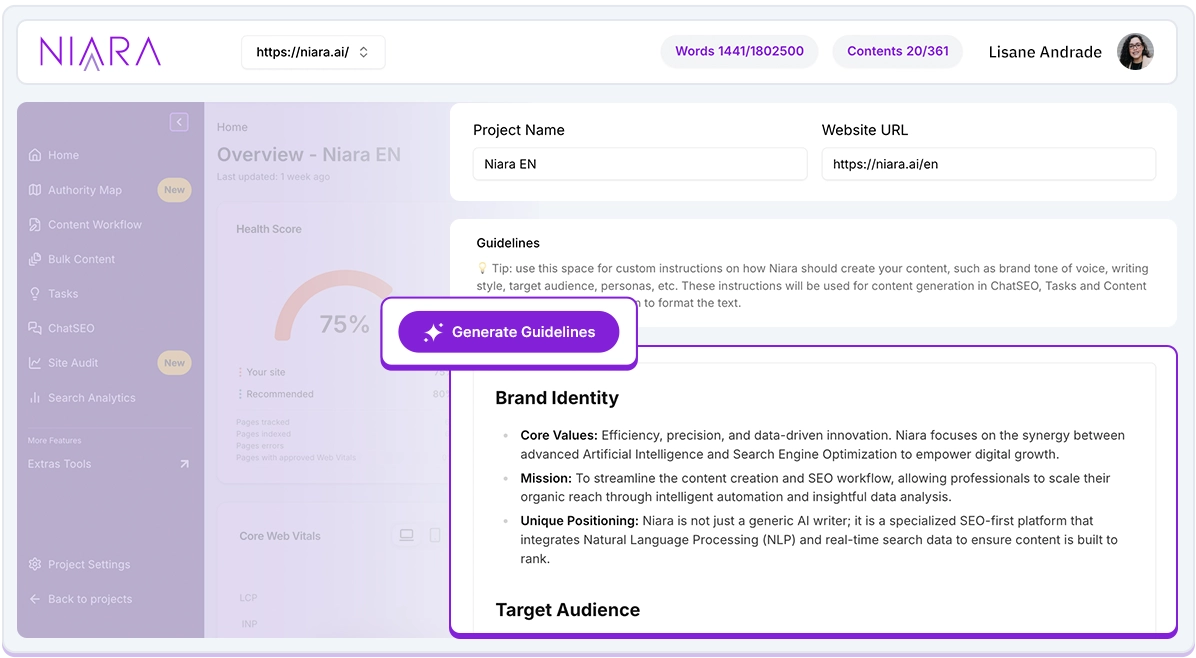
This intelligence is automatically replicated across all our features, ensuring that every generated text uses Natural Language Processing (NLP) to respond in a fluid and human-like manner.
This way, you scale your production while maintaining brand consistency and exact optimization for virtual assistants, without the need to repeat complex commands or prompts.
4. Structured Data Creation
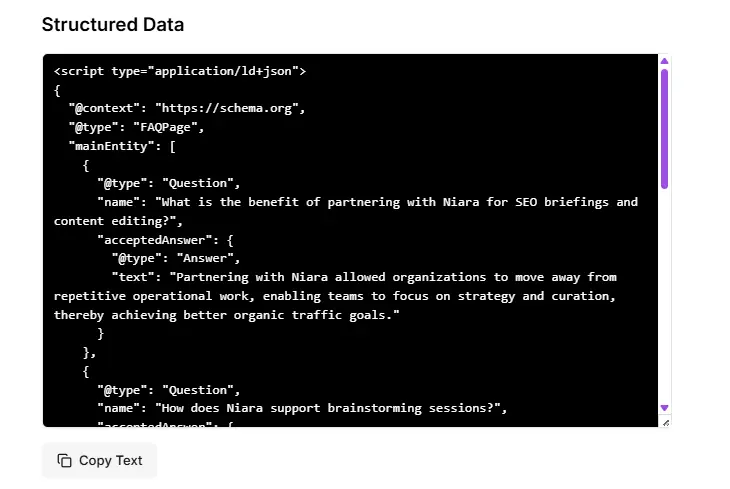
Structured data acts as a universal “translator”: it provides the explicit context needed for Google to identify, for example, that a video on your page is a step-by-step tutorial or that an image belongs to a specific product with defined stock and price.
To simplify this technical implementation, Niara developed the Structured Data Generator. It’s intuitive: enter your URL and choose the ideal markup type (Article, Product, FAQ, or Video). Niara automatically generates the code in JSON-LD format (the Google-recommended standard) ready to be pasted into your site.
5. Repurposing Text for Video Scripts
Content recycling is the key to scale. If you have an excellent blog post, why not turn it into a video script for YouTube or Reels? Niara’s ChatSEO makes this easy.
You can attach your article’s PDF or paste the link and ask: “Niara, based on this PDF, create a 10-minute educational YouTube video script, indicating what I should cover in each topic.” In seconds, you have the foundation for your audiovisual production.
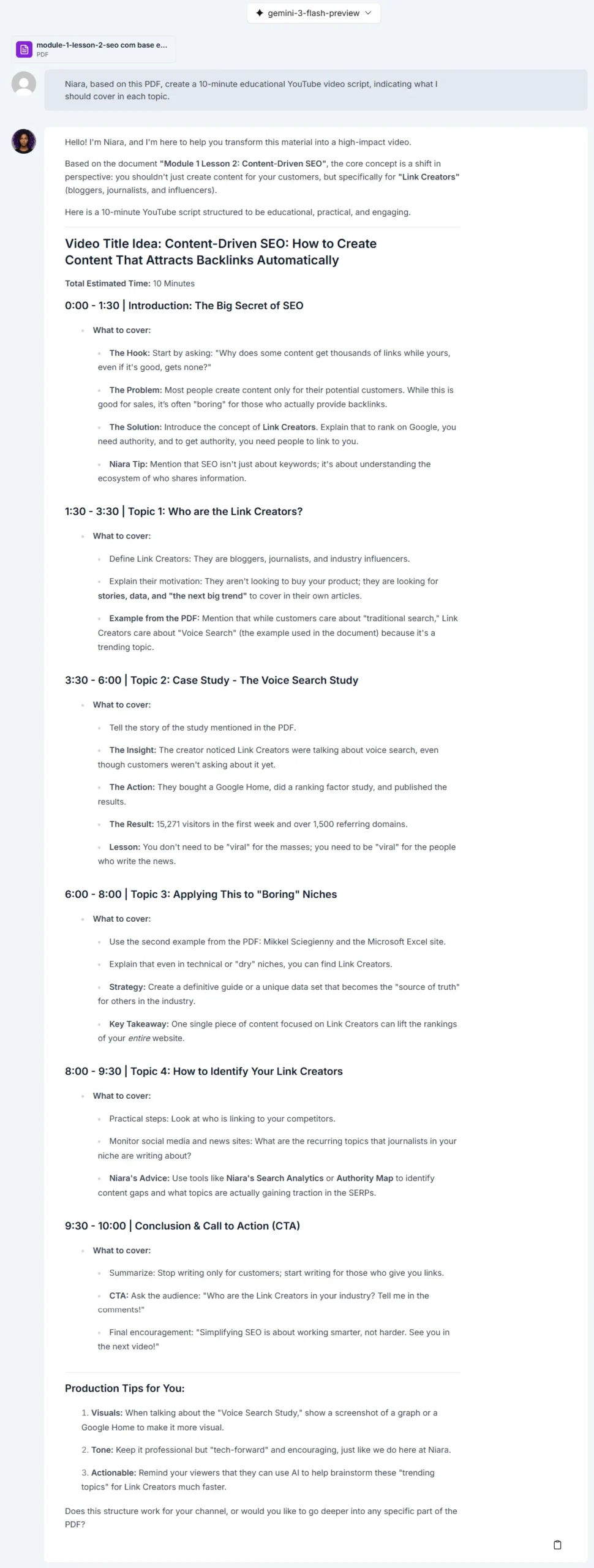
Our Prompt Library also features ready-to-use templates, such as the Reels prompt.
Once you send your message, you’ll have a foundation for your video production in seconds, ensuring total consistency between your script and the voiceover.
6. Converting Videos into Strategic Articles
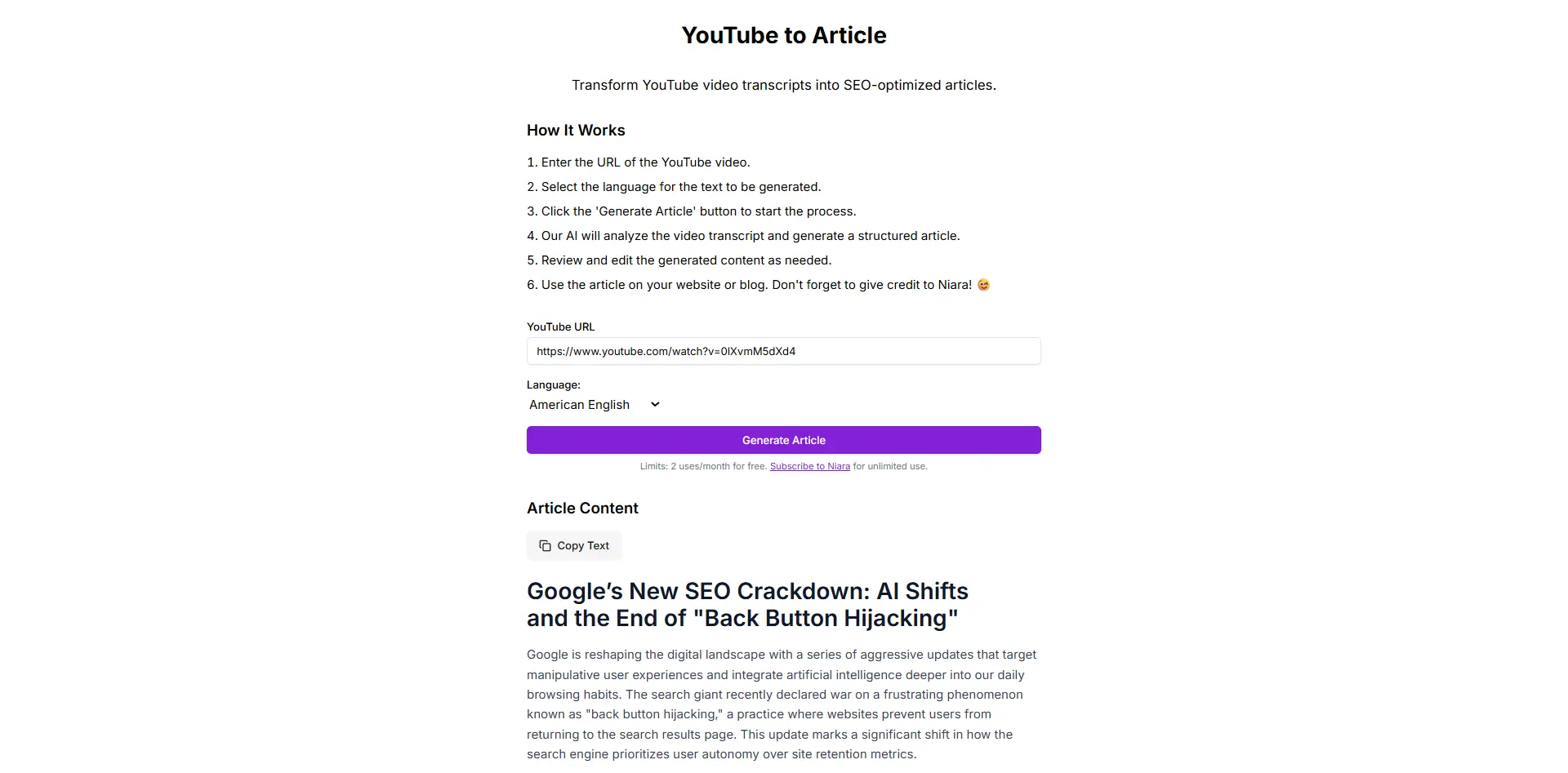
The reverse path is also vital. If you have a successful YouTube channel but your blog is neglected, you are losing organic traffic.
With the YouTube to Article tool, Niara converts video content into a structured article with H2s, H3s, and full on-page optimization. This saves hours of manual transcription and ensures your site’s SEO benefits from your video content’s authority.
7. Image Optimization
Accessibility and image optimization are fundamental pillars of E-E-A-T, gaining even greater relevance with the rise of visual search. Ensuring your images are understood by both users and algorithms is vital to capturing the growing volume of commercial intent emerging through visual discovery.
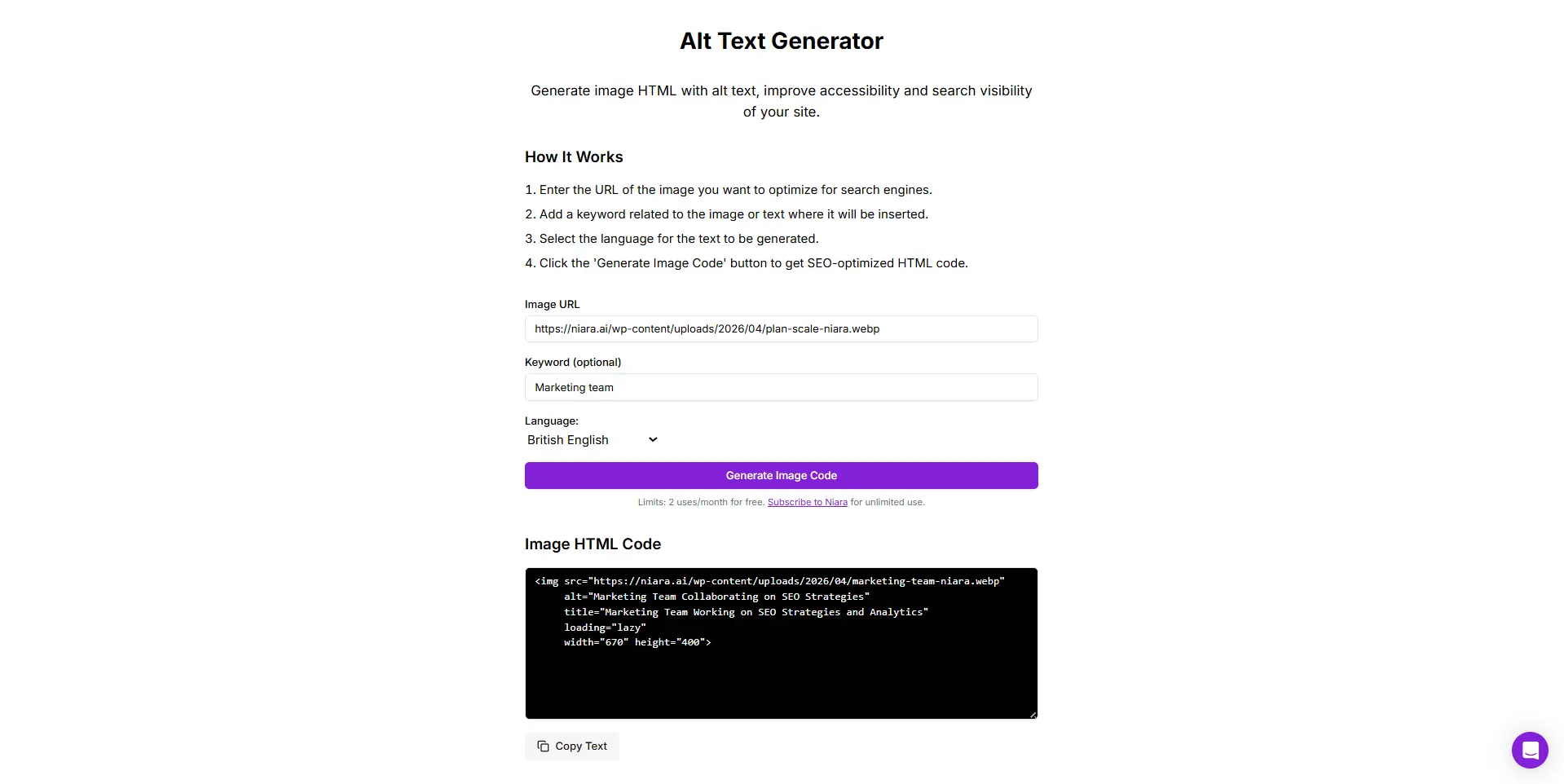
To streamline this process, Niara’s Alt Text Generator is here to help. This tool analyzes images directly from the URL and automates the creation of both the HTML code and the alt text.
Going beyond a simple description, Niara’s AI contextualizes each element for SEO, naturally incorporating keywords to ensure your catalog is accurately indexed and ready to appear in tools like Google Lens.
Read more: Accessibility & Inclusive Content: The SEO Strategy You’re Missing
Scalability for E-commerce and Enterprise Sites
For large companies and e-commerce, the challenge is volume. How do you maintain multimodal quality across 10,000 product pages? The answer lies in Bulk Content combined with the Brand Guide (Custom Brand Voice).
Beyond speed, Niara understands that large-scale operations demand flexibility and exclusivity. That’s why we offer resource customization through Niara Enterprise, ensuring the platform molds itself perfectly to your business’s specific needs.
The goal is to ensure that technology isn’t just an additional tool, but a strategic engine that adapts to your performance KPIs and internal workflows, providing scalability with total control and precision.
Metrics and KPIs for Multimodal SEO
As traffic may shift due to direct SERP answers, success is now measured by engagement quality and brand presence across new touchpoints. In the multimodal SEO era, you should track:
- Engaged Sessions: Monitor scroll depth, time on page, and specific event triggers.
- Returning Visitor Behavior: Measure repeated engagement as proof of brand trust.
- Assisted Conversions: Look beyond the last click to see how SEO influenced the journey.
- Brand Search Volume Growth: Indicates that users remember your brand after seeing it in multimodal discoveries.
How to Implement Multimodal SEO in Your Current Strategy
The transition should be gradual and strategic. Here is a checklist:
- Asset Audit: Use the Authority Map to list your top-performing content.
- Visual Enrichment: Add original images and infographics. Use Niara’s Alt Text Generator for indexing.
- Format Conversion: Turn your top 5 articles into videos using ChatSEO scripts.
- Technical Markup: Implement structured data on all pages using Niara’s Generator.
- Technical Monitoring: Keep the Technical SEO Agent running to ensure performance doesn’t drop.
Errors to Avoid in Multimodal SEO
Multimodal SEO isn’t about randomly inserting different media formats into your pages or creating various types of content without a plan. Your brand needs strategy and context. To ensure your actions boost brand recognition, avoid common pitfalls such as:
- Heavy Files: Optimize images and videos using modern formats (like WebP) to protect Core Web Vitals.
- Lack of Accessibility: Always implement descriptive alt text and captions.
- Disconnected Content: Align media information with page text. Use Brand Guidelines to maintain communication consistency.
Search is Plural
Multimodal SEO is simply search keeping pace with real life: plural, visual, and instantaneous. We know balancing text, video, and audio production can feel like a heavy burden. That feeling of overload is real, but it doesn’t have to be your rule.
Niara was born to be the balance point in this transition. Instead of requiring you to master every new technical complexity, we offer a structure that simplifies the process. Our focus is converting exhaustive manual labor into fast, strategic decisions.
The way people search has changed forever. Now, the next step is ensuring your brand is found across all these new paths, efficiently and elegantly.
Ready to turn this evolution into your greatest competitive advantage? Don’t get left behind in the era of intelligent search. Sign up for Niara now and start using it for free to feel the power of IA in your daily routine.