
You are staring at the search engine results page, watching a competitor with a lower domain rating and fewer backlinks dominate the top of the screen. They are featured in the Google AI Overview, and your site is buried in the traditional blue links below. This scenario is the new reality of search, and it forces a complete recalibration of how we understand ranking mechanisms.
The question of why my competitor appears in AI Overview and I don’t is not answered by looking at traditional SEO metrics. Google’s generative AI features do not merely scrape the first ranking page and regurgitate it. They synthesize information based on a distinct set of priorities focused on semantic completeness, entity relationships, and risk mitigation.
Generative engine acts as a synthesizer, looking for the most efficient, accurate, and comprehensive path to resolve a user’s query. When your competitor secures that placement, they have successfully signaled to the algorithm that their content provides a safer, more structured, and more complete answer. They have mapped their content to the specific nodes the AI needs to construct its response.
To reclaim your visibility, you must decode the signals the AI Overview prioritizes and restructure your digital footprint to serve as the definitive source of truth. Let’s see how to do it below.
Read more: AI Overview vs. AI Mode: Mastering the New Search Ecosystem
What the AI wants and considers when looking for an answer?
To be featured in an AI Overview (AIO), your content must pass through a multi-layered verification process. The AI prioritizes factual precision, immediate utility, and, above to all, informational safety. Here is the framework Google uses to determine if your content is AIO-worthy:
1. E-E-A-T and data corroboration
The foundation of any AI citation is E-E-A-T (Experience, Expertise, Authoritativeness, and Trustworthiness). The model is specifically tuned to identify first-hand experience and recognized topical authority.
- Data corroboration: AI operates on a safety first logic. It cross-references your claims against the global Knowledge Graph and trusted databases. If you publish bold or contrarian claims without verifiable proof, the AI will filter them out to mitigate the risk of hallucinations.
- NAP consistency: for local search, accuracy in Name, Address, and Phone number (NAP) is non-negotiable. A single discrepancy in your operating hours or address creates a trust fracture, elevating the risks of hallucinations or even worse, simply excluding the inconsistent entity from answers.
- Data quality: the AI evaluates the factual accuracy, depth, and grammatical precision of your text. It looks for logical progression and the absence of contradictory statements within your own domain. If your content is fragmented or relies on outdated statistics, the model will bypass your site in favor of a source that presents a cohesive, verified narrative, or will hallucinate on your facts.
- Content freshness and content structure: AI prefers updated content to reflect the current state of a topic, especially when grounding information in YMYL (Your Money or Your Life) categories. Structurally, the text must be highly scannable.
2. Query fan-out and information gaps
The AI seeks content that solves the user’s problem so comprehensively that they don’t need a secondary search.
- User intent: it governs the entire selection process. If the user wants a step-by-step tutorial, the AI will pull from pages or videos structured as instructional guides, ignoring theoretical essays regardless of their traditional ranking power.
- Query fan-out: the AI looks for content that anticipates the user’s next questions. For example, if a user searches for “how to fix a leaking pipe”, the AI looks for a source that also covers the required tools, estimated time, and when to call a professional.
- Filling information gaps: if ten sites provide the same generic advice, the AI doesn’t need to cite all of them. It will look for the source that provides a unique data point, a proprietary statistic, or a fresh perspective. This unique value add (commonly related to non-commodity content) is what forces the AI to include your brand in the summary.
3. Technical architecture
Even the best content will be bypassed if the AI has to work too hard to extract the meaning. A flawless technical base is your direct line to the model.
- Semantic HTML: using Semantic HTML (H2s, H3s, bulleted lists, and tables) allows the model to extract distinct data points effortlessly. High-quality content hidden is often skipped in favor of well-structured competitors.
- Schema markup: in AI Overviews, it acts as the direct translator for these signals. By implementing precise structured data you help crawlers understand who wrote the content, what entities are discussed, and how the data points relate to each other.
- Recency and information velocity: in volatile niches like tech, finance, or news, the AI prioritizes the most recently updated truth. Maintaining freshness requires refreshing data points and contextual references to reflect the current state of the topic.
Pro tip: if your site relies heavily on client-side Javascript rendering without dynamic rendering for bots, the AI may struggle to access the core content efficiently. That’s why clean HTML structure and precise schema markup are non-negotiable. For a deeper dive into how this interface functions, check out our complete guide to Google AI Mode.
Can I override AI Overview?
You cannot manually force your way into an AI Overview using traditional ranking tactics, nor can you edit what the AI says about you once it’s generated. The AI operates on dynamic synthesis, not static indexing. To influence AI Overview visibility, you must optimize for the engine’s specific synthesis criteria.
Influence is achieved by becoming the most structured and comprehensive node of information available. Your strategy should focus on:
- Semantic depth: moving beyond keywords to entity relationship building. The AI needs to see how your brand, products, and experts connect to the broader topic.
- Query fan-out: ensuring your content provides the exact data corroboration the model seeks to satisfy the user’s “next” questions.
- Technical precision: using tools like Niara’s AI Mode Insights to diagnose gaps and ensure your page is mathematically optimized for the synthesis algorithm.
- Trust signals: bolster your E-E-A-T, by implementing clear authorship, verified credentials, and strong citations from other authoritative entities in the niche.
Instead of trying to beat the algorithm, focus on grounding your information so the AI has no choice but to cite you as the primary source of truth.
How to optimize your site for AI Overviews (AIO): your 6-steps strategic action plan
To move from traditional search results to being the primary source for a search assistant, you need a structured approach. This plan takes you from initial discovery to technical execution, ensuring your brand becomes the “source of truth” that AI engines trust.
1. Identify and audit your high-potential pages
Before changing a single word, you must identify which pages you want to become AI Overview triggers for your brand.
Start by analyzing your current traffic to find your money pages — the most important ones for your brand. Analyze these pages within a SERP where the AI Overview and traditional results layout exists, as this often triggers a significant shift in user behavior and click-through rates, often leading to zero-click search scenarios.
You should also perform a competitor AI Overview analysis by searching for your main topics. Observe which competitors are being cited and identify what makes their content citable. Is it a unique statistic, a clear step-by-step guide, or a verified expert opinion?
- Example: if you run a gardening site, search for “how to prune hydrangeas”. If a competitor is cited because they have a “Pruning Calendar” table, that is your signal that the AI values structured, time-based data for that specific query.
2. Map the query fan-out and information gaps
Start by analyzing the queries that trigger AI Overviews you want your page to appear on. For a transactional query like “best podcasting microphones”, the AI fans out into sub-topics like connection types (USB vs. XLR), polar patterns, and environment needs. By identifying what the AI mentions but doesn’t explain well (or what it ignores entirely) you find your opportunity to provide the missing piece.
You must: cover what is being said in the AI answer (because it’s what the user most consider when Googling) and fill these gaps with specific, data-rich content. This combination will increase your visibility not only for this specific search but also for even more targeted, long-tail queries, because AI begins to see your page not just as a store, but as the authoritative source that completes the user’s research journey.
- Example: if you are targeting “microphones for podcasting” and the current AI Overview lists top-rated mics but fails to explain how much gain a specific mic needs or which budget interfaces are compatible with them, that is your information gap. Create a dedicated section or a technical table comparing “Gain requirements and compatible interfaces for the Top 5 Podcast Mics”. By bridging the gap between the product (the mic) and the setup (the interface), you position your content as the essential resource.
3. Implement content structure for AI Overviews
AI models are lazy in the sense that they prefer data that is easy to extract. You need to organize your information so the engine can scrape the answer in milliseconds. This involves using a clear content structure for AI Overviews. You can:
- Use descriptive headings (H2 and H3) that mirror the questions users are asking
- Use bulleted lists for any sequence of events
- Create comparison tables, as AI models prioritize structured data for “best of” queries
- Lead with a direct answer paragraph immediately under your main H2 to provide a concise summary that the AI can easily clip
- Use bold terms for key entities and technical requirements to help the AI identify the topical relevance instantly.
- Organize content in a modular way, ensuring each section (H2/H3) can stand alone as a complete answer if extracted from the rest of the page.
Also read: To Chunk or Not to Chunk? What Google Says About It
4. Deploy schema markup for AI Overviews
By adding schema markup for AI Overviews, you are explicitly telling the search engine what your data represents. This technical layer moves you beyond simple text and into the realm of entities. Schema acts as a shortcut, reducing the computational effort for the AI to understand facts, prices, and specifications.
- Example: using “Recipe” schema for a recipe page allows the AI to instantly see the “total time,” “ingredients,” and “calories,” which it can then pull directly into a summary box.
5. Strengthen trust and E-E-A-T signals
Because AI engines are programmed to avoid hallucinations, they prioritize citing sources they perceive as safe and authoritative. However, even when they ground their answers in trusted data, hallucinations can still occur. Strengthen your E-E-A-T signals and ensure that all information on every page is accurate are practices that can’t be ignored.
This leads many to ask: does AI content rank when E-E-A-T is the priority? The answer lies in the quality and verification of the output.
Establishing this trust starts with transparency and verifiable expertise. Every piece of content should be backed by detailed author biographies that highlight real-world experience, citations from reputable external sources, and a robust “About Us” page that clearly defines your brand’s credentials and industry standing.
For fast-paced sectors like SaaS, where features and product capabilities evolve rapidly, maintaining information freshness is a critical defense against AI misinformation. Outdated documentation or conflicting product descriptions across different pages are prime triggers for AI hallucinations. To mitigate this risk, you must implement continuous content audits. Every time a product update or a new feature launches, perform a sweep to synchronize data across all landing pages, blog posts, and support docs. Ensuring a single source of truth prevents the AI from generating inaccurate summaries about your product’s current capabilities.
For businesses with a physical presence, local SEO for AI Overviews is critical. You must ensure your GBP optimization is perfect, as the AI uses GBP data for AI Overviews to verify your location, reputation, and service hours.
6. Monitor and perform AI Overview diagnostics
The AI landscape changes daily, which is why your strategy must be rooted in real-world performance data. Instead of guessing, you should rely on Google Search Console, Bing Webmaster Tools, and Microsoft Clarity to monitor how users are discovering your brand through AI-driven searches. These platforms provide direct insights into which pages and queries are triggering your content.
This active monitoring gives brands absolute clarity on whether their optimization strategies are hitting the mark. By analyzing actual search behavior, you gain invaluable insights into the specific questions your audience is asking. This allows you to refine your content and tools to support the user throughout their entire journey, positioning your brand as a trusted companion at every stage of the funnel — from initial awareness to final conversion.
- Example: review your Search Console Performance reports weekly to identify long-tail, conversational queries that are driving impressions and clicks.
Here’s the thing: traditional SEO tools are blind to AIO
Traditional SEO tools were built for a blue-link ecosystem. They operate on the metric gap: they measure search volume and keyword difficulty (KD), but they are fundamentally incapable of measuring semantic density or query coverage. They tell you how many times a keyword is searched and how many backlinks you need to rank, but they cannot tell you if your content satisfies the multidimensional intent of a generative AI model. This creates a massive blind spot for modern SEO professionals trying to diagnose why a competitor is securing AI citations.
This blind spot manifests as the Ranking Paradox. You can hold the #1 organic position in traditional results and still be completely excluded from the AI Overview. The traditional algorithm rewards link equity and historical authority, while the generative AI rewards information completeness and entity structuring.
Furthermore, the manual struggle makes traditional analysis obsolete. It is impossible to manually analyze every competitor’s information gaps across thousands of queries to determine exactly which sub-topic the AI prioritized. Relying on legacy rank trackers to solve AI Overview visibility issues is like using a thermometer to measure wind speed; you are looking at the wrong data entirely.
Also read: Why isn’t Google AI Overview always at the top? (and What This Means for SEO)
Bridging the gap: Niara as your modern GEO partner
While traditional tools leave you guessing, Niara was built for the Generative Engine Optimization (GEO) era. As we pivot towards the future of search, Niara helps you to create AI strategies by automating the complex analysis required to dominate AI Overviews.
Remember that 6-steps strategic plan? Check how Niara powers every step of it:
Audit and strategy with Search Analytics and Google AI Mode Insights
You can use our Search Analytics to get 5x more data than the standard GSC, allowing you to pinpoint your money pages with surgical precision. To master the query fan-out, our Google AI Mode Insights performs a deep-dive diagnostic of your URLs (or your competitor ones), automatically identifying the specific information gaps and query fan-out topics that you need to cover to outperform competitors.

Structured content creation with Content Workflow
don’t waste hours manually structuring data. Our Content Workflow analyzes the SERP and your competitors in real time to generate a comprehensive briefing for blogposts, landing pages and product descriptions. It suggests and writes the content for you, using Google’s official documentation about AI Overviews and AI Mode.

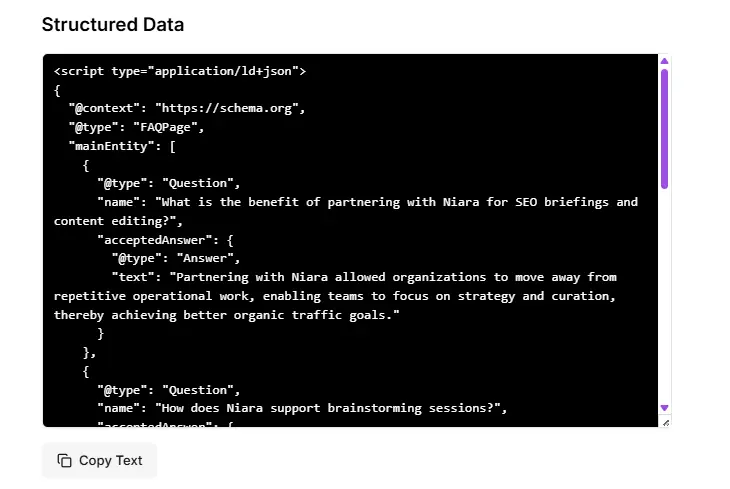
Schema markup precision with Structured Data Generator
Technical SEO shouldn’t be a bottleneck. Use our Structured Data Generator to instantly create the Schema Markup that tells AI engines exactly what your data represents, reducing their computational effort and increasing your chances of being featured.
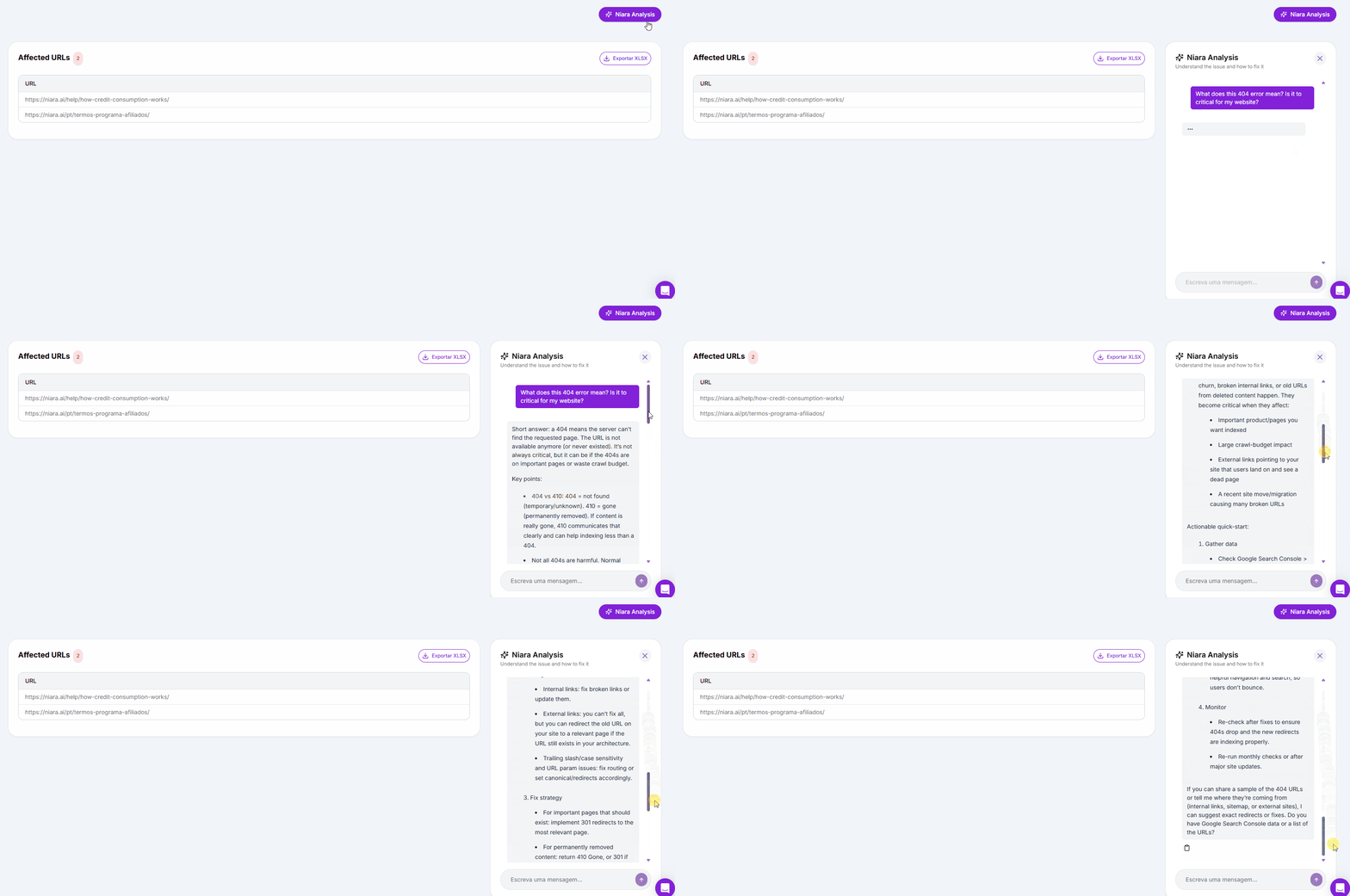
Technical SEO health with Site Audit
AI engines prioritize sites that are technically sound and fast. Our Technical SEO Agent acts as your 24/7 consultant, integrating GSC and Page Speed Insights data to identify indexing errors and Core Web Vitals issues. Through a conversational interface, it provides personalized recommendations and CMS fixes to ensure your site is optimized for AI search agents and crawlers.
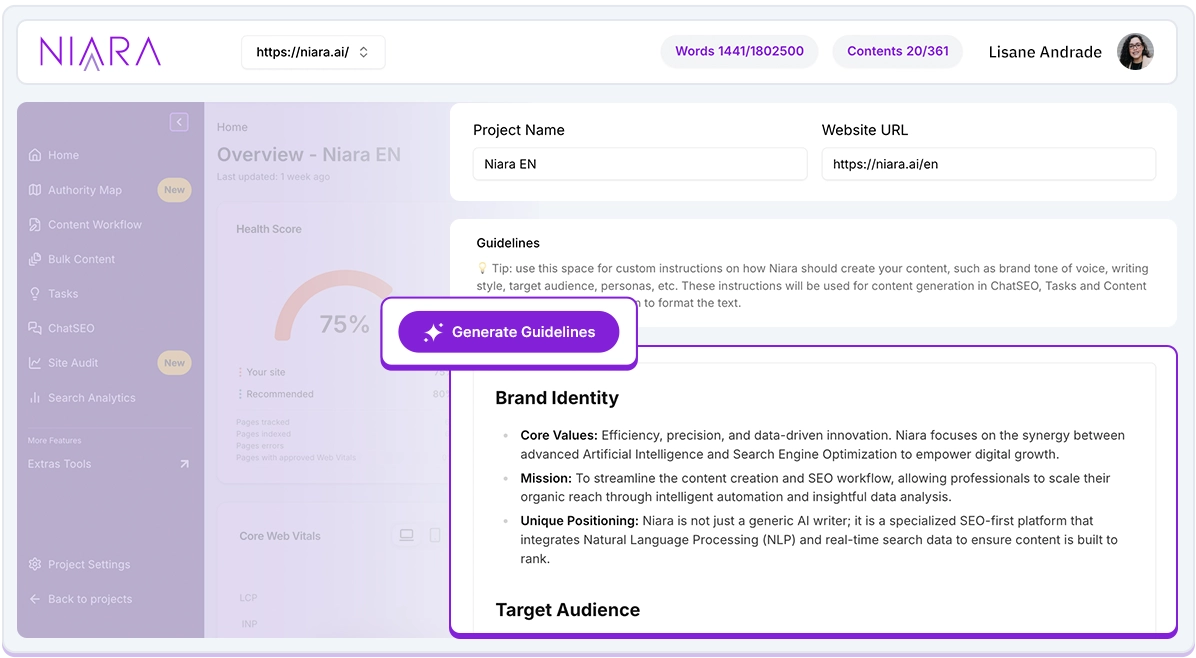
Authority and trust with Brand Guidelines
maintaining E-E-A-T requires consistency. With the Brand Guidelines, you set your brand’s persona, tone of voice, and expertise rules once. Niara then applies this context across all tools, ensuring every piece of content, from a quick blog post to a massive product description, remains authoritative and aligned with your unique source of truth.
Real-time diagnostics with Conversational Analytics
stop digging through messy spreadsheets. Use Conversational Analytics through ChatSEO to talk directly to your data. Simply ask: “Which of my top pages lost clicks last 7 days?” or “What are the conversational queries with more than 5 words driving the highest click-through rate (CTR) to my website last month?” to get instant, actionable answers.
Niara gives you a full roadmap. By unifying your entire SEO workflow we ensure you stay ahead of algorithm shifts.
You should also check: [Study] Is Your Ecommerce AI-Ready? 8 Tips & Errors
Becoming the source of truth
To appear in the AI Overview, you must be the most useful, corroborated, and well-structured source available on the internet. The generative engine demands semantic density, verified E-E-A-T signals, and a technical foundation that allows for effortless data extraction.
Stop wondering why your competitor is in the spotlight while your traffic stagnates. The rules of the SERP have fundamentally changed, and relying on traditional metrics will only widen the gap between you and the generative results.
Use Niara’s tools to diagnose your specific content gaps, map your query fan-out, and reclaim your visibility. Transform your content from a simple webpage into the undeniable source of truth that the AI is forced to cite.
Ready to dominate the new era of search? Try Niara for free today and transform your site into the ultimate authority for AI Overviews.
