
The era of mechanical keyword stuffing is over. We have transitioned decisively from strings to things, where search engines no longer just match character sequences but understand entities, people, and places. This shift represents a move toward a deep, structural understanding of the world, where defining a concept is far more valuable than simply repeating a word.
In this AI-dominated landscape, semantic SEO has become the architecture of meaning. Rather than targeting isolated terms, the goal is now to build topical authority through a web of interconnected data. By providing the context and knowledge graph that modern algorithms require, brands can establish themselves as definitive sources of truth rather than mere matches for a query.
This evolution is driven by the fact that search engines, powered by natural language processing (NLP), now decipher the “why” behind a search. Google often understands user intent better than the users themselves, looking past vague phrasing to find the underlying goal. If your content focuses only on literal strings, you miss the opportunity to satisfy the sophisticated way AI now interprets human thought.
To remain resilient in a modern search ecosystem, brands must prioritize semantic depth over superficial optimization. Read on to discover the actionable strategies you need to master semantic SEO and future-proof your digital presence.
Also read: Future of Search: AI, Agents and the Multi-Surface Discovery Era
What is semantic SEO?
Semantic SEO is the strategic practice of optimizing web content to help search engines understand the underlying meaning, context, and user intent behind information, rather than simply matching isolated keywords. While traditional SEO once relied on keyword stuffing, modern semantic SEO focuses on enhancing the depth of web pages by identifying entities, concepts, and the relationships between them.
Semantic search is about entities and user intent.
An entity is a thing or concept that is singular, unique, well-defined, and distinguishable. Think of it this way: “Apple” is a keyword. But “Apple Inc.” (the tech company) and “Apple” (the fruit) are two distinct entities.
Semantic SEO helps search engines understand which one you are talking about by looking at the context and the relationships between other words on your page.
User intent is the “why” behind the search. When someone searches for “how to fix a flat tire”, they are looking for a step-by-step guide, perhaps a video, and a list of tools. Semantic SEO ensures your content answers that underlying need by providing a comprehensive map of the topic, covering all the related questions and subtopics a user might have. It’s about building a web of meaning that proves to Google you are an expert on the subject.
The algorithmic evolution
To understand where we are, we have to look at how we got here. Semantic SEO didn’t happen overnight. It began to emerge subtly between 2004 and 2008, but the real acceleration happened after 2010. As search engines grew more sophisticated, they moved away from simple pattern matching and toward true language comprehension.
- Knowledge Graph (2012): this was the birth of the entity-based database. Google moved from strings to things, starting to understand the relationships between people, places, and objects. If you search for a famous author today, the Knowledge Panel on the right side of the results is a direct product of this entity-based mapping.
- Hummingbird (2013): this was the first major step into conversational search. Hummingbird allowed Google to look at the whole sentence of a query rather than just individual words, focusing on the context of the search.
- RankBrain (2015): this introduced machine learning into the mix. RankBrain helps Google process search results and provide more relevant search results for users by interpreting the intent behind unfamiliar queries. It was the first time an algorithm could “guess” what a user meant based on similar past searches.
- BERT (2019): Bidirectional Encoder Representations from Transformers (BERT) was a massive leap in natural language processing (NLP). It allowed Google to understand the nuance of language, such as how prepositions like “for” or “to” change the entire meaning of a sentence.
- MUM and AI Overviews (2021 to today): the Multitask Unified Model (MUM) is 1,000 times more powerful than BERT. It is multimodal, meaning it can understand information across text, images, and videos simultaneously. This has led directly into the integration of Generative AI in search, such as AI Overviews, where Google provides a synthesized answer to complex questions by pulling from its deep understanding of semantic relationships.
With generative AI, the process of understanding meaning is further enhanced by a mechanism called query fan-out. When a user types a search query, Google doesn’t just look for those specific words anymore. It ‘fans out’ the search to include related entities, synonyms, and broader concepts that define the topic.
If your content is semantically rich, it becomes the perfect match for this expanded search. By covering a topic in depth, you ensure your page is surfaced not just for the exact keywords used, but for the entire web of related queries the search engine generates to satisfy the user’s intent.
Read more: How to Optimize for Google AI Mode: 6 SEO Strategies
Core concepts of semantic SEO
To master this landscape, you need to grasp four structural components of a modern SEO strategy.
Entities
Entities are the building blocks of the semantic web. In SEO, an entity is any noun that Google can identify and categorize. While keywords are what users type, entities are what search engines understand. To identify entities in your content, look for specific names, places, technical terms, and brands. By connecting your content to well-known entities, you provide hooks for the search engine to categorize your page correctly.
Here are some examples of entities categorized by type:
- Names: Individuals like Lisane Andrade, Cadu de Castro Alves, Marie Curie, or Steve Jobs.
- Places: specific locations such as The Eiffel Tower, Silicon Valley, or The Amazon Rainforest.
- Technical Terms: specialized concepts like Artificial Intelligence, Photosynthesis, or Blockchain Technology.
- Brands: Companies and organizations like Niara, Apple or NASA.
Search intent categories
Understanding intent is non-negotiable. We generally categorize intent into four buckets:
- Informational: the user wants to learn something (e.g., “what is semantic seo”).
- Navigational: the user wants to find a specific site (e.g., “Niara login”).
- Transactional: the user wants to buy (e.g., “buy Niara subscription”).
- Commercial: the user is researching before a purchase (e.g., “best SEO AI tools”).
Your content must align perfectly with the category the user is in; otherwise, you might even rank, but your page likely won’t retain user’s attention, regardless of how many keywords you use.
Topic clusters and topical authority
Topical authority is the holy grail of semantic SEO. Instead of writing one-off articles, you build a web of related content. You start with a pillar page (a comprehensive guide on a broad topic) and surround it with cluster content (shorter articles that dive deep into specific subtopics). By linking these together, you signal to search engines that you have covered every possible angle of a subject, making you the definitive expert.
Read more: How to Build Topical Authority for AI & LLM Systems
Semantic markup
This is the technical side of meaning. Semantic markup involves using specific code, primarily in alignment with the Schema.org vocabulary, to structure your on-page data. It tells search engines exactly what a piece of data represents — whether it’s a product price, a review rating, or a frequently asked question.
Technical implementation: the semantic architecture
A great content strategy will fail if your site’s architecture is a mess. You need to build a semantic foundation that search engines can easily crawl and interpret.
Use semantic markup and schema
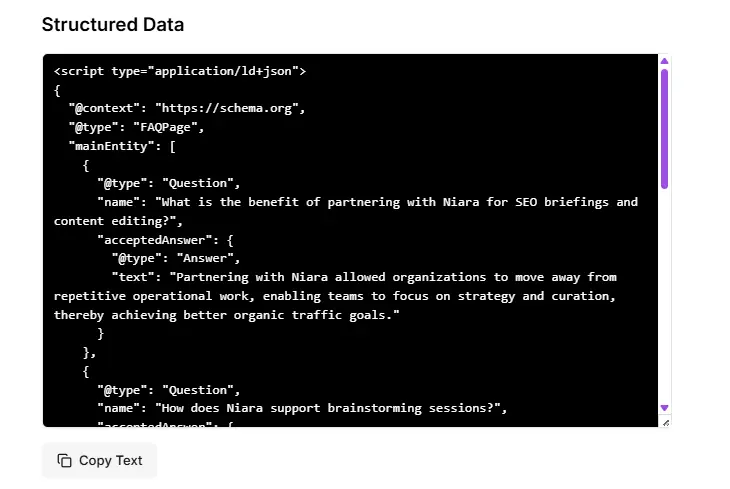
Schema markup is the “translator” between your human-readable content and the search engine’s database. The best practice is to use JSON-LD (JavaScript Object Notation for Linked Data), as it is Google’s preferred format and is easy to maintain.
You can implement specific schema types based on your content, such as:
- Article: for blog posts and news.
- WebPage: to define the structure of your main pages.
- Product: To show price, availability, and reviews.
While a page can rank without structured data, implementing it provides the critical context that modern algorithms need to interpret your content with absolute clarity. Structured data helps AI agents identify exactly what your page is about, increasing the chances of your content being cited in generative responses.
Furthermore, beyond the technical benefits, schema markup powers rich snippets, such as star ratings, prices, and FAQ dropdowns, which make your listing visually stand out in the SERP, significantly improving your click-through rate (CTR).
Semantic HTML
Don’t ignore your basic HTML tags. Using tags like <article>, <aside>, <header>, and <footer> does more than just organize your code. It tells the crawler which parts of the page are the main content and which are supplementary. This helps the algorithm focus on the most important entities on the page and provides a clear hierarchy for crawlers and AI agents.
By using these tags correctly, you effectively reduce the noise-to-signal ratio of your pages, allowing algorithms to focus on the most important entities and contextual relationships within your content.
This structural clarity is essential for future-proofing your site, as it ensures that when an AI agent parses your data to generate a summary or an AI Overview, it can accurately identify and prioritize your core expertise, significantly increasing your chances of being cited as a primary, authoritative source.
Content strategy: writing for entities and humans
Writing for semantic SEO requires a balance. You need to satisfy the algorithm’s need for structure while providing genuine value to the human reader.
Also read: Does AI Content Rank on Google? The Truth + Flash Benefícios Case Study (2x Market Share)
Build keyword clusters by topic
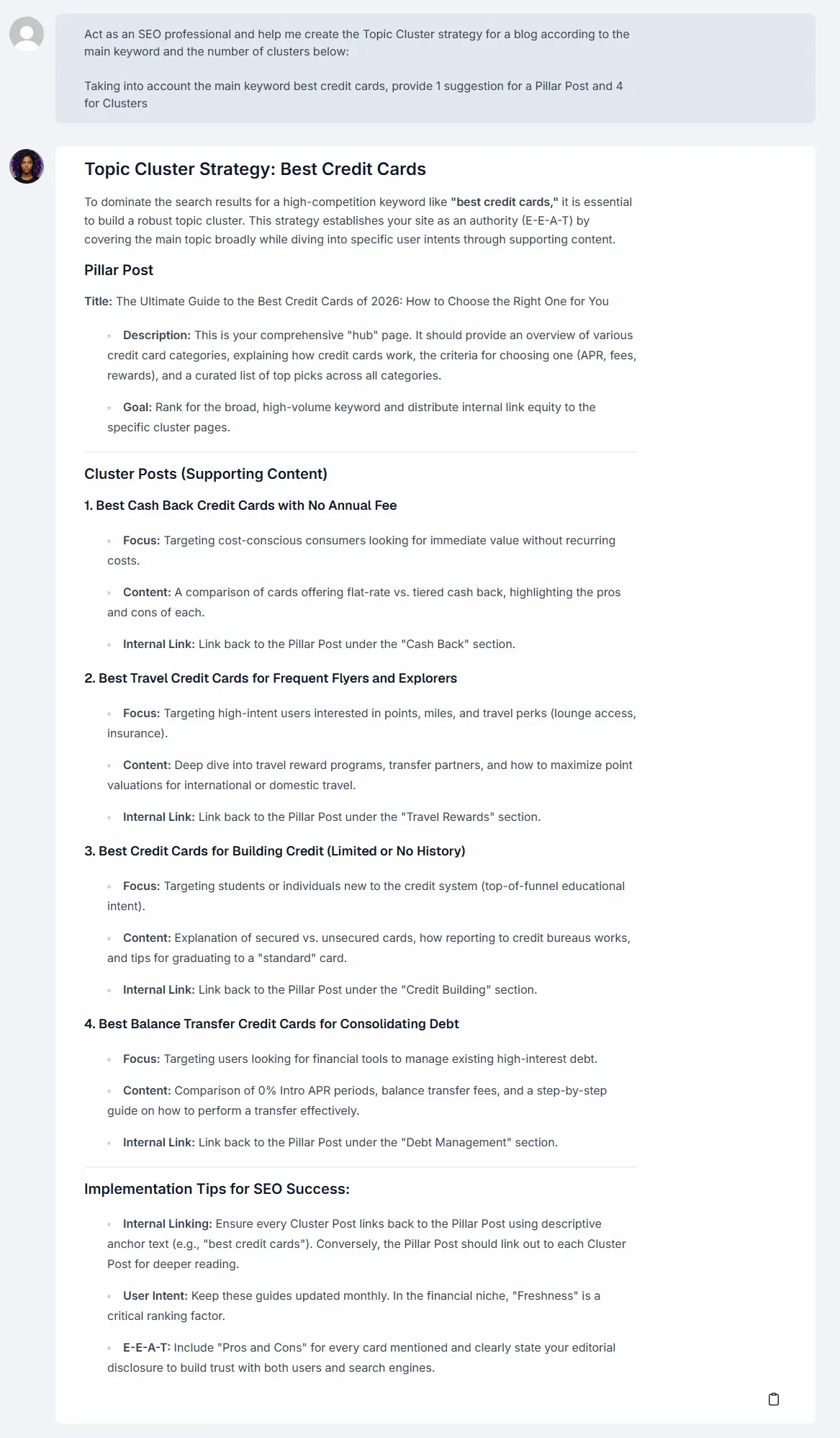
Building keyword clusters by topic means moving away from targeting individual, isolated keywords and instead grouping related terms into clusters that cover a specific subject in its entirety.
Instead of creating separate, disconnected pages for “best credit cards” and “credit cards for travel rewards,” you treat the broad topic of “Credit Cards” as a central hub (pillar page) and strategically link it to all related sub-topics (clusters) like:
- annual fee comparisons,
- credit score requirements,
- cashback optimization, ensuring search engines recognize your site as a comprehensive authority on the entire subject rather than just a collection of isolated keywords.
E-E-A-T in semantic SEO
While content quality focuses on the “what”, E-E-A-T focuses on the “who” and the “why” behind the information.
In semantic SEO, Google looks for verifiable connections between entities (people, brands, and topics) to establish trust. To effectively promote and demonstrate E-E-A-T on your site, implement these essential practices:
- Verified Author Entities: create detailed author bios that highlight specific expertise and years of experience. Link these bios to social entities, such as LinkedIn profiles or professional portfolios, to help Google’s Knowledge Graph connect the content to a real-world expert.
- Fact-Checking and Citations: always back up claims with links to high-authority, external sources like official government data (.gov), educational institutions (.edu), or recognized industry leaders.
- Transparency and Contact: maintain clear “About Us” and “Contact” pages. For YMYL (Your Money, Your Life) topics, ensure your physical address and clear editorial policies are easily accessible.
- Trust Anchors: showcase industry certifications, awards, and trust badges. If your content is technical or medical, include a “Reviewed by” section with the credentials of the professional who verified the information.
- Social Proof and Reviews: encourage and display authentic user reviews or testimonials on third-party platforms to build off-page reputation, which Google uses to verify your brand’s trustworthiness.
Providing deeply researched, accurate, and verifiable information is critical not only for human trust but also for grounding AI models. The more reliable and structured your data is, the more you help prevent AI hallucinations when search engines summarize your content.
High-quality content with editorial value
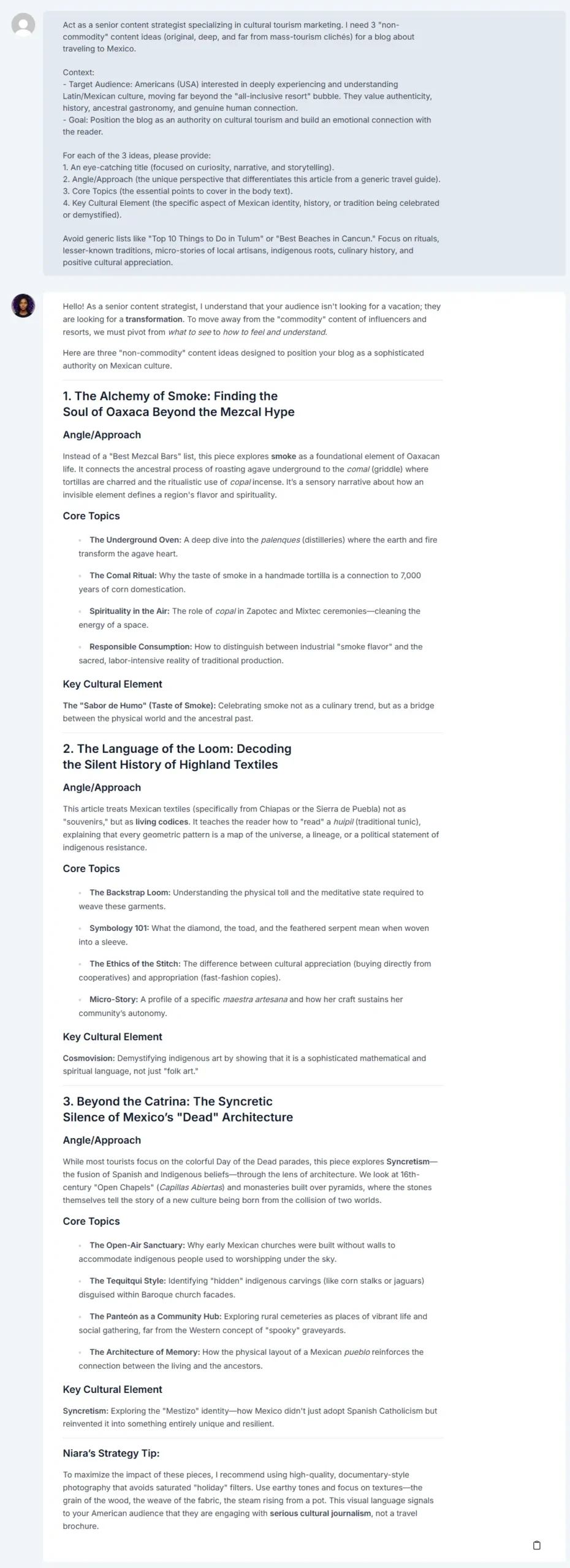
To stand out in a saturated market, you must move beyond commodity content, the kind of generic, surface-level information that AI can generate in seconds and that offers no unique value to the reader.
High-quality content in a semantic SEO strategy requires editorial depth and original insights that cannot be easily replicated. This means incorporating proprietary data, unique case studies, or contrarian viewpoints based on professional experience.
For example, instead of a basic “how-to” guide on SEO, you could produce a deep dive into “How we scaled organic traffic by 40% using specific semantic clustering techniques”, featuring real screenshots and failure analysis.
By focusing on non-commodity content, you provide the Information Gain that Google increasingly rewards, signaling that your page offers something new to the index. This approach transforms your site from a simple information provider into a destination for thought leadership, encouraging longer dwell times and more natural backlinks.
Natural and semantically rich language
You don’t need to over-optimize or force-feed keywords. Instead, focus on building a robust semantic context. Modern algorithms like RankBrain and BERT are designed to understand natural language patterns and the relationships between entities.
You just need to write naturally to cover the topic comprehensively. For example, if you’re writing about baking, it’s expected that you’ll mention “oven”, “flour”, “temperature” and “yeast.” These are semantic signals that help search engines confirm the specific context and depth of your content, ensuring it aligns with the user’s search intent.
Integration of relevant multimedia
Search is now multimodal. Enriching your articles with images, infographics, and videos provides additional context that search engines can now “see” and “read”.
To maximize impact, you must leverage multimodal SEO by combining rich media with semantic metadata. For example, properly marked-up videos can trigger “Key Moments” or video previews directly on the SERP, while optimized images can dominate visual carousels.
This technical layer helps search engines like Google connect entities, such as linking a “how-to” video to a specific product entity, increasing your visibility and click-through rates.
Beyond rankings, multimedia signals quality and depth. Algorithms like RankBrain prioritize content that offers high editorial value and a superior user experience. A complex guide on “Home Brewing”, for instance, becomes far more authoritative when supported by a technical infographic and a video tutorial. This variety not only satisfies different user intents but also reinforces your topical authority, ensuring your site is seen as a reliable, comprehensive source in an AI-driven search landscape.
Information architecture and logical flow
Organize your content with a clear hierarchy, which means:
- Hierarchical Tagging: use a single H1 for the core topic, H2s for main pillars, and H3s for supporting details to signal the importance of each entity.
- Semantic Connectivity: group related subtopics together to help search engines grasp the context beyond isolated keywords.
- Multimedia Integration: embed images and videos within relevant sections, using structured data markup to link these assets to your text’s concepts.
- User-Centric Navigation: design content paths that guide visitors naturally, increasing dwell time and reducing bounce rates.
A well-structured flow signals quality to algorithms. For example, a guide on “Sustainable Living” that flows from “Waste Reduction” (H2) to “Composting Tips” (H3) — complemented by a semantically marked-up video — allows search engines to generate rich snippets and video previews. This integration enriches the editorial value, proving your content is a comprehensive resource.
Ultimately, a logical flow builds the semantic authority needed to dominate modern search results.
Optimizing for generative AI
With the rise of AI Overviews, your content needs to be summary-ready. Use clear, concise definitions for key terms, bullet points for lists, and tables for data. When you make it easy for an LLM to parse your data, you increase your chances of being the cited source in an AI-generated answer.
To dominate this landscape, focus on grounding. LLMs use retrieval-augmented generation (RAG) to anchor their responses in factual data; by providing structured, authoritative information, you ensure your site acts as the primary “ground truth” for the AI’s response.
This is essential for navigating the era of zero-click searches, where users get answers directly on the SERP. If the AI provides the answer using your data, being the cited source is the only way to capture brand authority and residual traffic.
Internal linking strategy
Internal links are the roads that connect your entities. A semantic internal linking strategy uses strategic anchor texts that describe the relationship between pages.
Instead of linking “click here”, use “learn more about structured data for SEO”. This tells the crawler that the destination page is semantically related to the current topic, strengthening your overall topical map.
Semantic SEO in practice: industry-specific use cases
Different industries require different semantic approaches. Here is how you can apply these concepts practically.
E-commerce: beyond product names
In e-commerce, the goal is to move from simply selling a product to owning an entire ecosystem. For example, let’s think about a sports accessories brand.
- Strategy: instead of just targeting “Polarized Cycling Sunglasses,” target the “Cycling Performance Ecosystem”.
- Implementation: create content clusters around “Long-Distance Recovery”, “Aerodynamics for Beginners”, and “Cold-Weather Training Gear.”
- Semantic Actions:
- use Product and Review Schema to link entities like Brand, Durability, and Material. This allows Google to display rich snippets with star ratings and pricing directly in search results, which significantly boosts CTR.
- link specific accessories to comprehensive buying guides and “maintenance how-tos” to create a semantic web. This supports the shopper’s entire journey, from initial research to post-purchase care, ensuring your brand remains the top-of-mind authority.
Local businesses: dominating the neighborhood
For local businesses, you want to be seen as a “Local Entity”. Besides local SEO strategies, focus on:
- Strategy: connect your business to specific geographic landmarks and community events.
- Implementation: optimize your content to mention neighborhood names, nearby parks, or local festivals.
- Semantic Actions:
- LocalBusiness Schema and a perfectly optimized Google Business Profile are essential. This helps Google understand your physical location and service area.
- create localized content clusters, such as “Best [Service] in [Neighborhood]”, to strengthen your geographic relevance.
SaaS & B2B Tech: solving complex problems
SaaS companies need to map the “Problem-Solution” entity relationship.
- Strategy: position your brand as the primary source of truth for your niche. This means becoming the definitive resource that competitors and customers alike reference for industry standards, definitions, and best practices. For example, HubSpot became the source of truth for “Inbound Marketing”. They didn’t just sell CRM software; they wrote the “bible” on how modern marketing should work.
- Implementation: develop deep-dive guides into industry pain points, technical glossaries that define niche terminology, and transparent “Alternative to” comparison pages.
- Semantic Actions:
- use FAQ and SoftwareApplication Schema to answer technical queries directly in the SERP.
- establish verified profiles on authoritative platforms (G2, Capterra, LinkedIn) to reinforce your Knowledge Graph entry.
- mark up high-value formats like whitepapers and tutorials with structured data to help search engines interpret the depth and relevance of your expertise.
News & editorial: establishing instant authority
Freshness and fact-checking are the primary semantic signals. Search engines prioritize content that is both timely and originates from a trusted, identifiable source.
- Strategy: leverage freshness and accuracy as primary signals of authority. In an era of AI-generated misinformation, being the first verified source to report on a topic creates a massive SEO advantage.
- Implementation: ensure clear author bios are linked to social entities (like X or LinkedIn) to boost E-E-A-T. Use topic pages to aggregate all coverage regarding a specific person, event, or niche. This tells Google you aren’t just reporting a one-off story, but that you are an authority on that entire subject.
- Semantic Actions:
- NewsArticle, Author, and FactCheck Schema are non-negotiable. This structured data helps search engines instantly identify the publisher, the specific journalist, the exact timestamp of the update, and whether the information has been verified.
- monitor your performance in the “Top Stories” carousel. If your articles aren’t appearing there, it’s a signal that your semantic markup is incomplete or your site’s “Trust” signals (E-E-A-T) need strengthening.
Powering semantic SEO strategies with Niara
While the manual effort described above may seem extensive, Niara was developed to streamline the whole process. The platform leverages SEO AI agents to demystify the complexities of semantic SEO, making high-level optimization accessible for everyone from solo freelancers to global enterprise teams.”
Action: optimize for AI Overviews. Solution: Google AI Mode Insights
Google AI Mode Insights tool is perfect for the final polish. It analyzes your content according to official Google documentation on AI Overviews.
It will tell you if your content is clear enough for an AI to summarize and feature, identifying query fan-out opportunities and content gaps that need to be filled to improve your visibility in AI-driven search results.
Try Google AI Mode Insights for free.
Action: create topical authority. Solution: Authority Map
Authority Map is our flagship tool for semantic strategy. It connects to your Google Search Console data and identifies exactly which content clusters you need to build to dominate your niche.
It turns raw data into a strategic roadmap in seconds, automatically generating a full editorial calendar for up to 3 months.
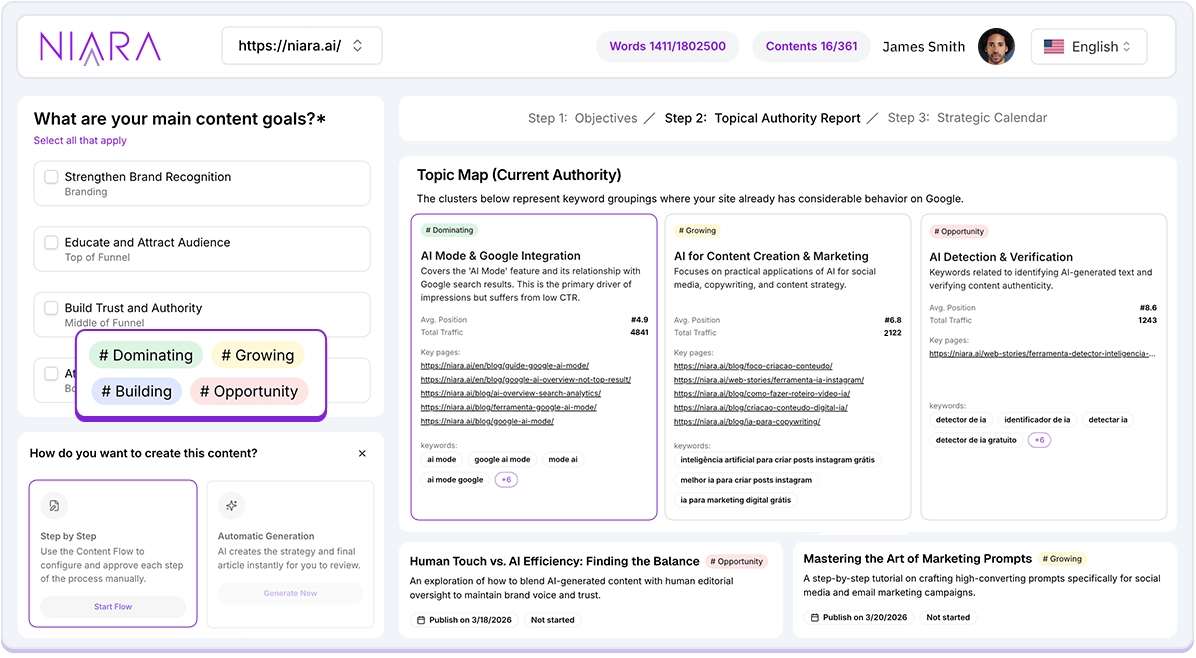
Once your strategy is mapped out, you can seamlessly transition to our Content Workflow to create high-quality, optimized articles for your blog and other key pages. This integrated flow ensures that every piece of content you produce is semantically aligned with your overall topical authority goals.
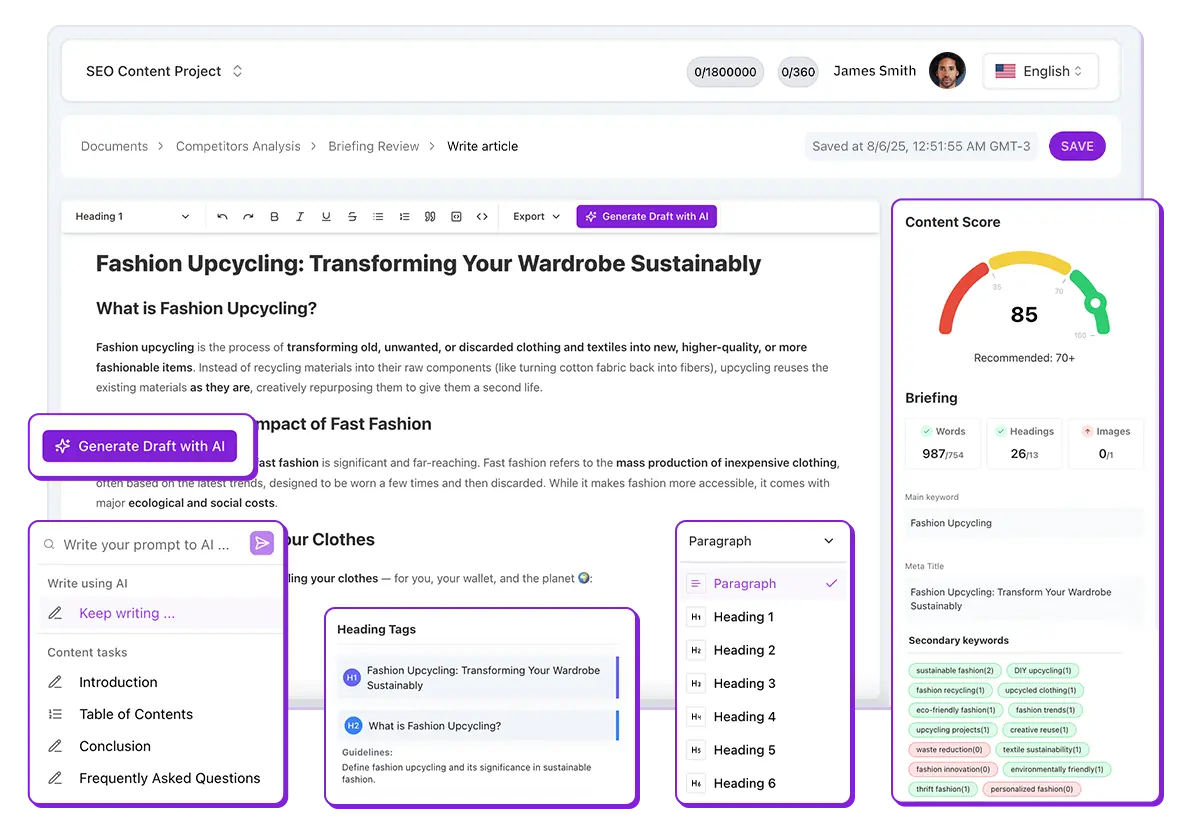
Action: deepen content research. Solution: ChatSEO
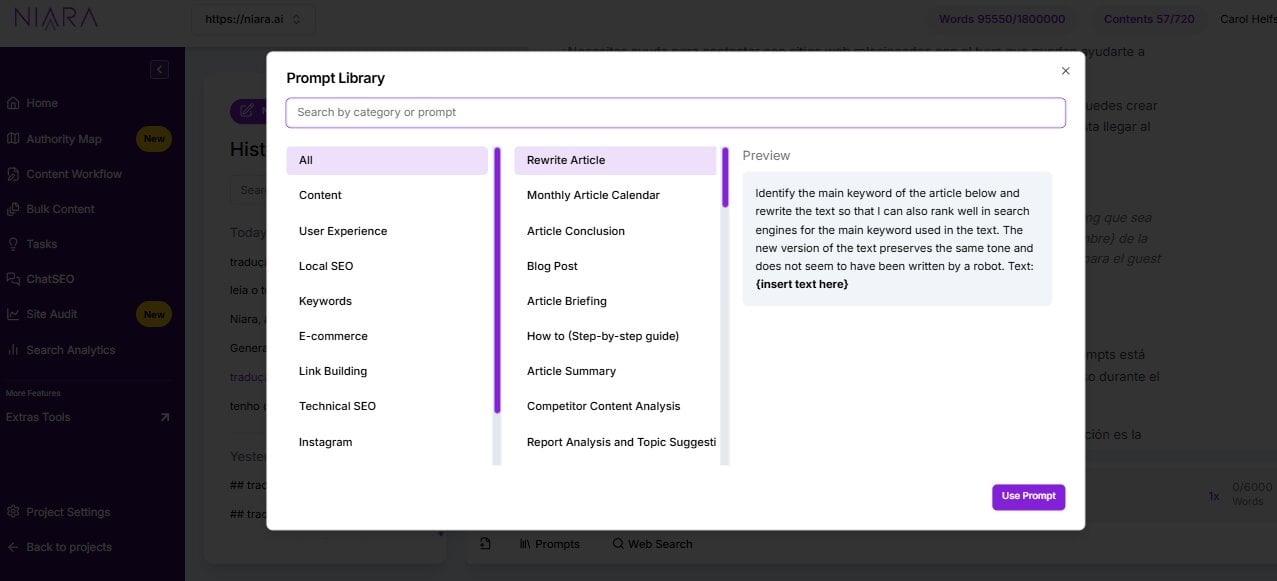
Think of ChatSEO as your semantic research assistant. You can ask it to:
- Extract the main entities from this text.
- Suggest subtopics to increase the topical depth of this article.
It also includes a library of over 50 prompts to help you with everything from keyword clustering to advanced report analysis, making it easier to talk to your data without complex spreadsheets.
Action: Strengthen technical foundations. Solution: Technical SEO Agent
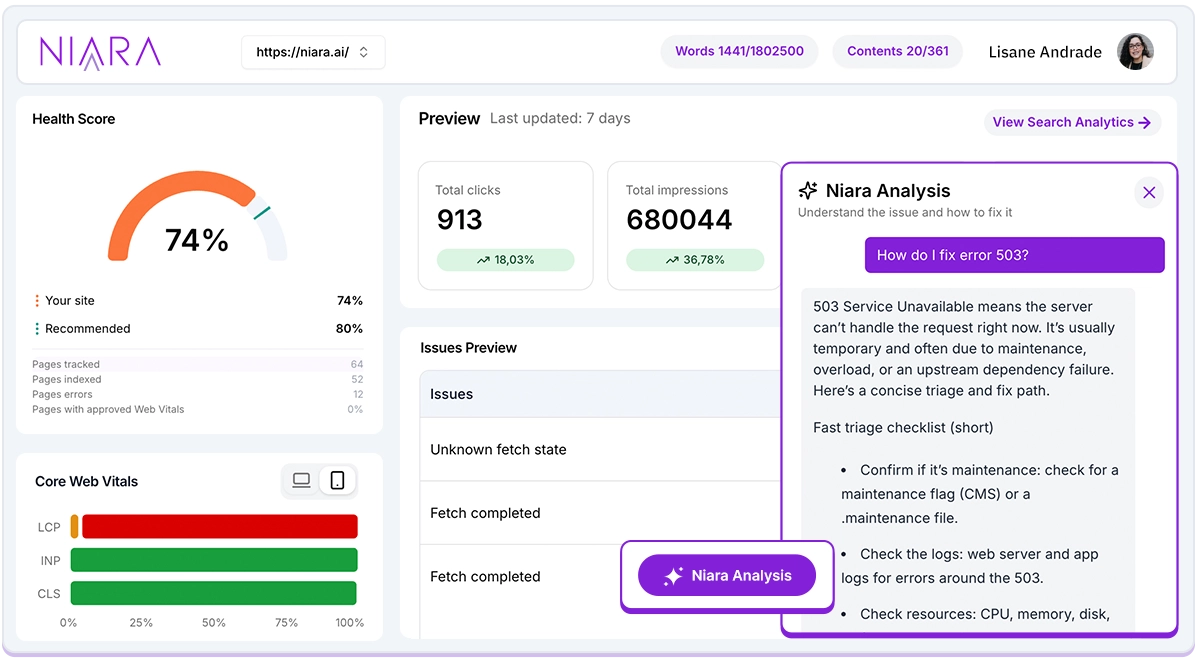
Before you can be semantically relevant, you must be technically sound. Our agent monitors your site’s health, ensuring your architecture is clean and your pages are perfectly indexed. It provides specific recommendations tailored to your CMS, centralizing your site’s technical health and Core Web Vitals into one conversational interface.
Action: connect entities with Schema. Solution: Structured Data Generator
Don’t waste time coding JSON-LD by hand. Use our dedicated generator to create flawless schema for articles, products, and reviews. If you have highly custom needs, ChatSEO can output advanced, tailored code to ensure your entities are correctly connected and recognized by search engines.
Try Structured Data Generator for free.
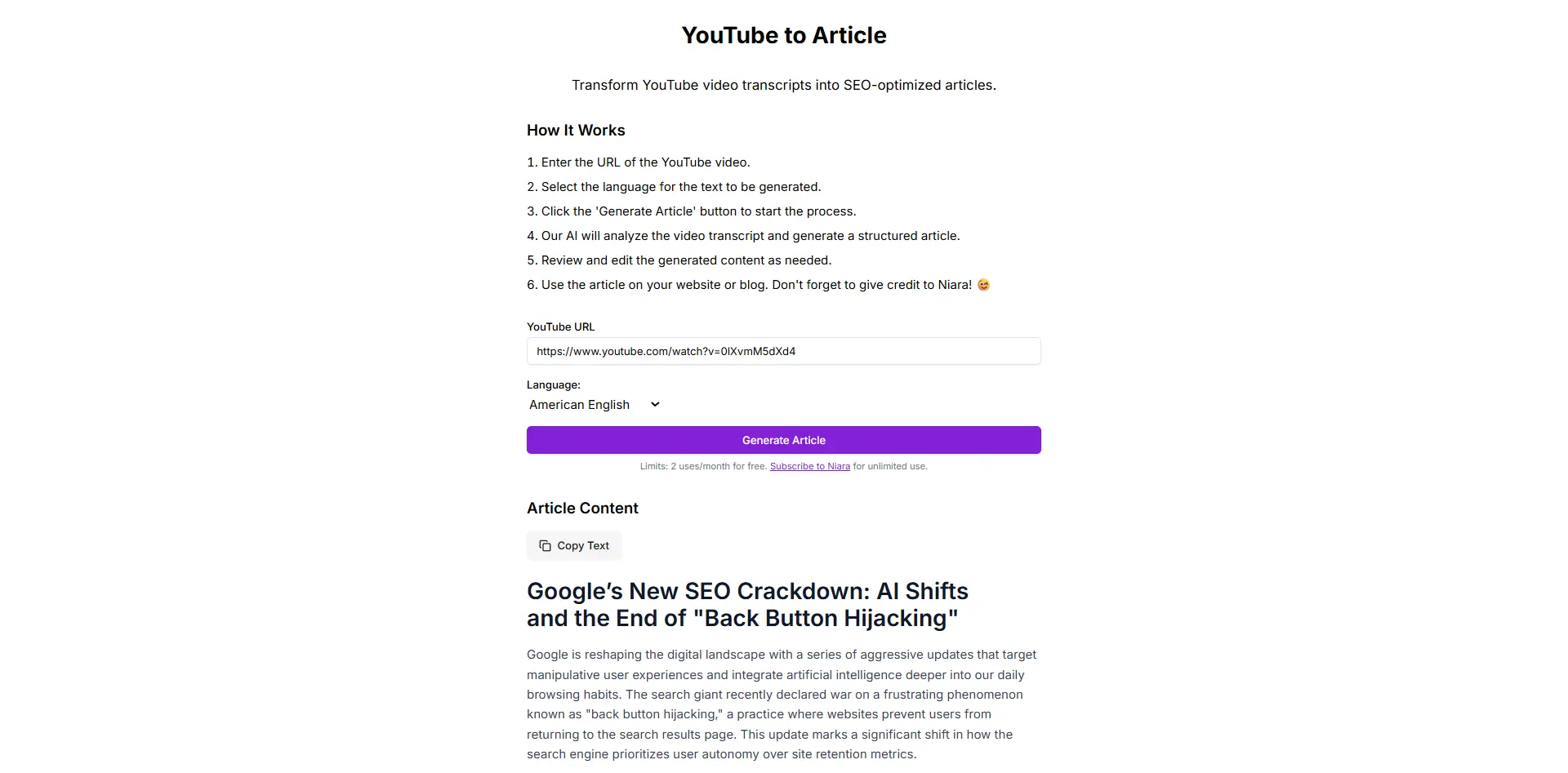
Action: dominate multimodal search. Solution: YouTube to Article
Modern algorithms like MUM prioritize various content formats. Use our YouTube to Article feature or ChatSEO to transform written articles into video scripts. This allows you to dominate multiple formats, satisfying the multimodal requirements of modern search and reaching users across different platforms.
Try YouTube to Article for free.
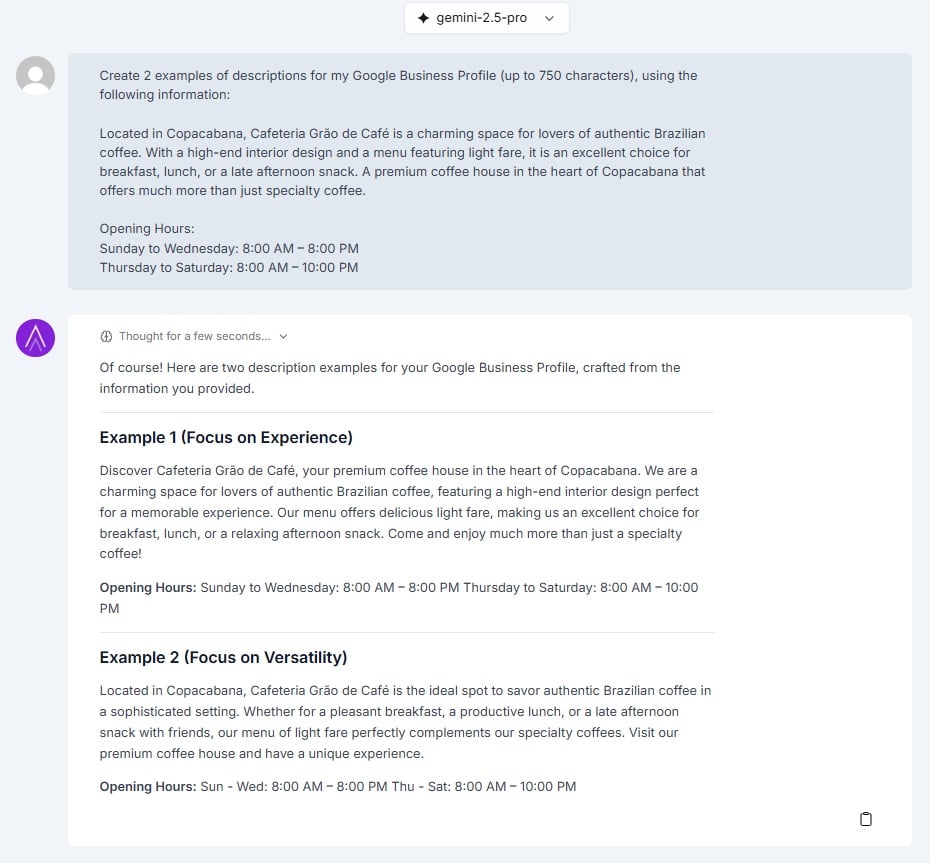
Action: boost regional relevance. Solution: ChatSEO
Get specialized recommendations for Local SEO and optimize your Google Business Profile directly through Niara’s ChatSEO insights to boost your regional entity presence and ensure you appear in the local map pack for relevant queries.
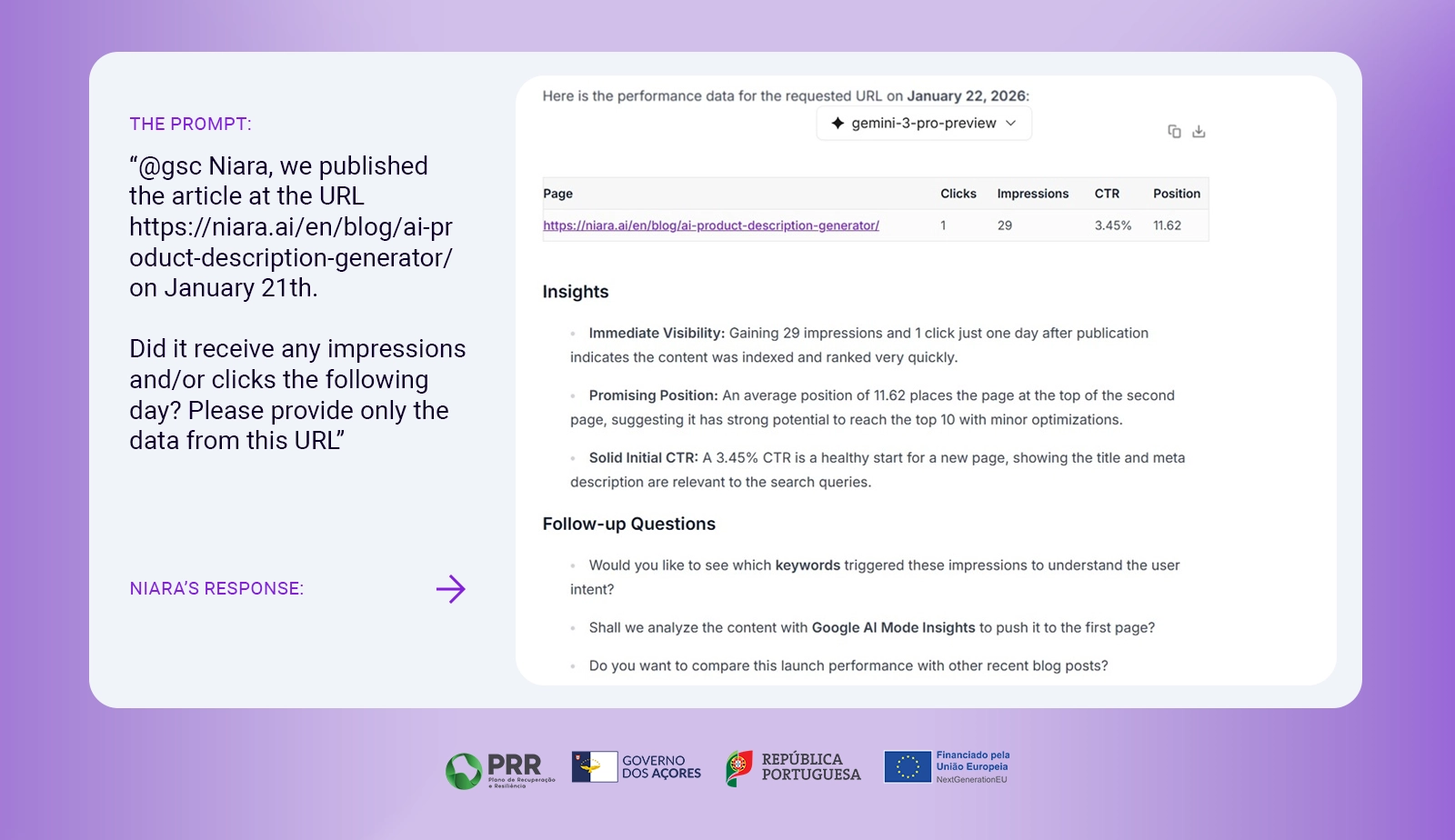
Action: monitor performance. Solution: Search Analytics and Conversational Analytics
Data is only valuable if you can act on it quickly. With Niara’s Search Analytics, you get 5x more data than the standard Google Search Console, allowing you to track how your editorial clusters are performing in real-time.
Instead of getting lost in complex spreadsheets, use Conversational Analytics within ChatSEO. You can simply ask, “Which news articles gained the most clicks in the last 24 hours?” or “List the keywords where our CTR dropped today.”
This allows editorial teams to pivot their strategy instantly, identifying which topics are gaining traction and where the semantic gaps lie.
Future-proofing your strategy with Niara
The shift from strings to things it is the current reality of search. To win in this new era, your SEO strategy must move beyond individual keywords and embrace the complexity of topics, intent, and entities.
By focusing on semantic depth and technical excellence, you build a resilient brand that search engines can trust. You are creating a digital footprint that is clear, authoritative, and impossible to ignore.
With Niara, this transition becomes seamless.
We’ve automated the boring and complex parts of SEO so you can focus on what matters: your strategy and your brand’s voice.
From identifying semantic gaps with our Authority Map to generating technical markups and multimodal content, we provide the tools you need to scale your expertise 10x faster.
Ready to dominate the SERPs? Simplify your SEO and start building your semantic authority with Niara today. Try it for free!
