
With the rise of Google’s AI Mode and generative assistants, the buyer’s journey no longer starts with just a list of links. It begins with conversations that demand immediate, technically precise answers. For brands, the challenge now is to become the “source of truth” that feeds these algorithms.
To understand how the market is pivoting, we used Niara’s Google AI Mode Insights to audit three retail giants: Target, Ulta Beauty, and Williams-Sonoma.
The takeaway is clear: having authority doesn’t guarantee AI visibility if your data isn’t structured to solve complex user queries.
Below is the technical verdict for each brand, the main gaps identified, and how you can apply these lessons to ensure your brand is the definitive answer in the new era of search.
Analysis summary: is e-commerce ready for the AI era?
- The winning strategy: success in AI Mode isn’t about keywords; it’s about extreme utility. Brands that answer specific long-tail questions directly on the page are winning the AI concierge’s recommendation.
- The critical gap: most brands fail at Semantic Depth. They list what a product is, but forget to explain how it works in a broader ecosystem (e.g., styling, technical troubleshooting, or dietary specifics).
- The technical barrier: a significant portion of the web is still “invisible” to AI diagnostics due to legacy bot-blocking, potentially hindering how LLMs crawl and index high-value commercial data.
What is Niara’s Google AI Mode Insights?
Google AI Mode Insights is a health check for the future of search. It’s a diagnostic tool that audits your pages based on Google’s official generative search guidelines. It deep-dives into:
- Optimization Score: a 0-to-10 metric that quantifies content quality and completeness regarding the core topic for AI Mode.
- Fan-out query analysis: the tool simulates how Google’s AI “branches out” a topic, predicting the sub-questions the algorithm generates. It identifies if your current content covers, partially covers, or completely ignores these follow-up queries.
- Topic gap identification: based on those fan-out queries, the diagnostic reveals specific information gaps. Filling these gaps is what allows your content to be recognized as an authority and selected for synthesized AI responses.
- Actionable recommendations: delivers “straight-to-the-point” suggestions, such as topic structuring and strategic FAQ creation, to boost visibility across AI assistants like ChatGPT, Gemini, and Perplexity.
Methodology
Our analysis focused on three market-leading e-commerce brands in United States, representing different niches to provide a holistic view of modern SEO. The audit covered: the homepage, the most recent blog post, and randomly selected product pages.
During the process, some major players blocked Niara’s bots, likely due to server configurations or robots.txt files that restrict AI crawlers. This prevented the Google AI Mode Insights tool from completing the analysis for those specific brands.
The brands analyzed below were selected because they allow crawling, enabling a real-world diagnostic of how content is or isn’t prepared for the age of artificial intelligence.
Target
Overall audit score: 5/10
Target is the quintessential American one-stop shop, beloved for its “Tar-zhay” aesthetic and its ability to blend trendy design with everyday essentials. While its digital presence is massive, our Google AI Mode Insights audit reveals that even a retail titan has gaps to fill when it comes to capturing the answer engine era.
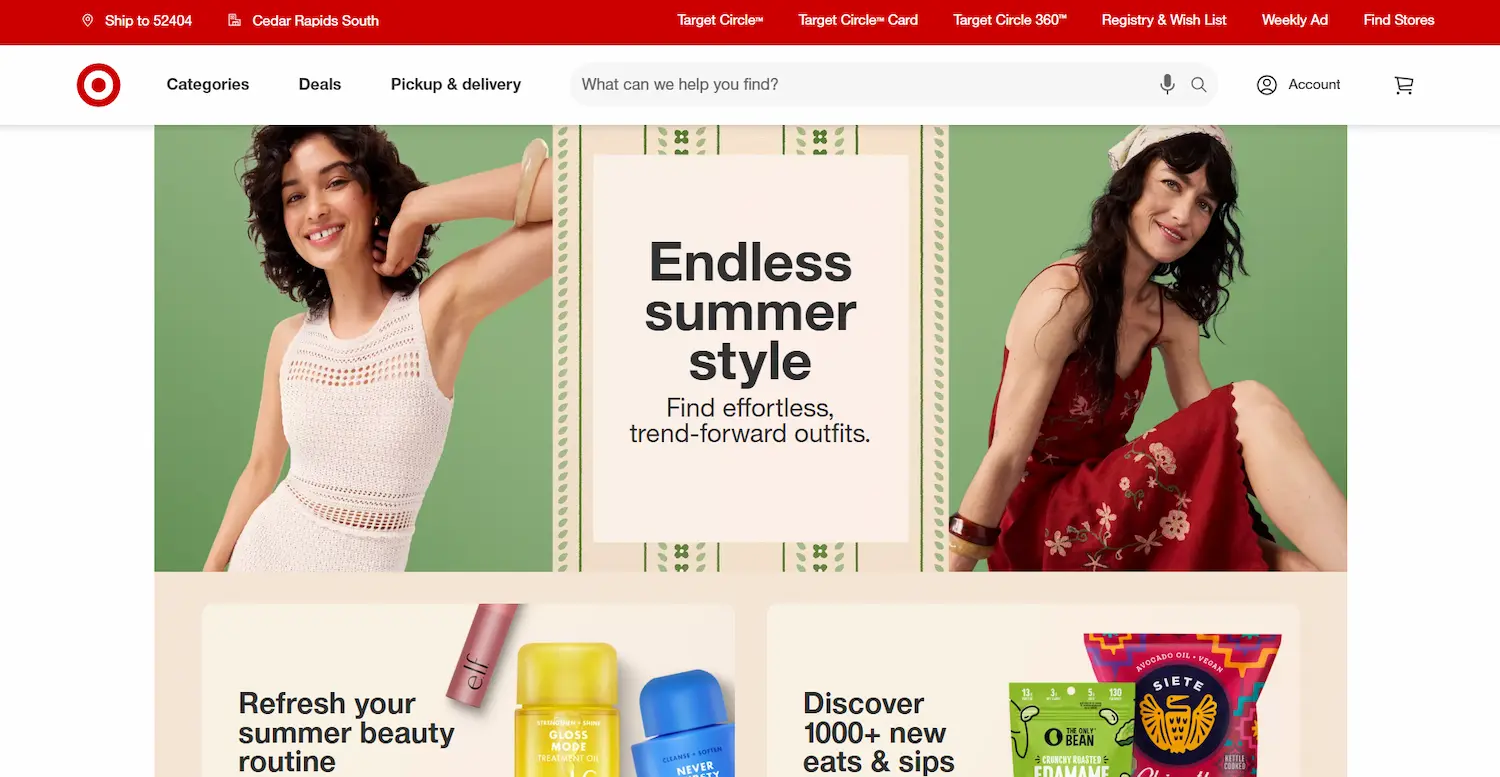
Homepage: a seasonal powerhouse with navigational gaps
AI Mode Score: 7/10
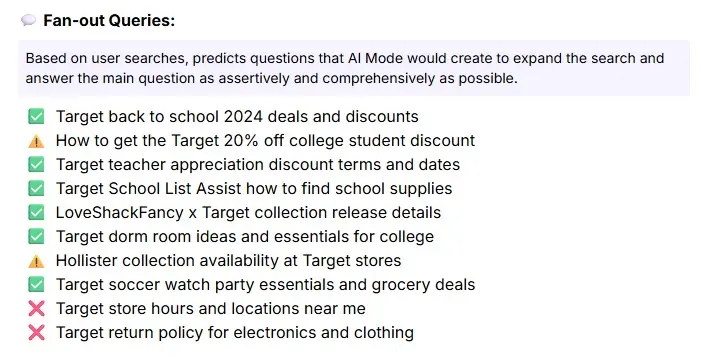
Target’s homepage is a masterclass in seasonal merchandising. The analysis shows it excels at capturing high-volume, timely queries like “Back to School deals” and “college dorm essentials”. It effectively communicates its value proposition as the go-to destination for seasonal shifts.
Despite this visual strength, the Niara AI Mode Insights diagnostic identified a major opportunity. While Target promotes its discounts, it leaves a series of topic gaps unanswered — specific questions that AI assistants prioritize when generating a response.
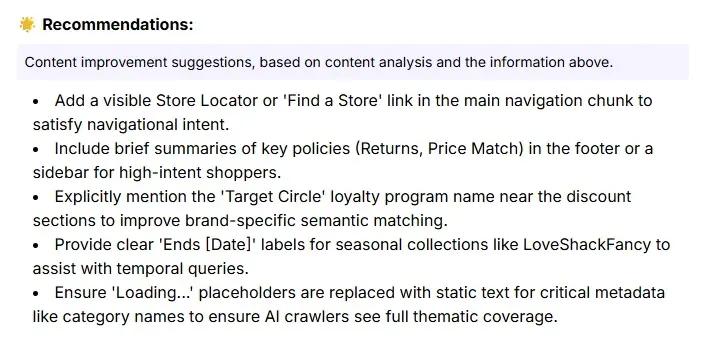
Beyond content, the audit flagged a surprising lack of low-hanging fruit information. Critical data like store hours, locations, and return policies are buried or missing from the main content chunks.
Adding a visible Store Locator and clear policy summaries in the footer would “move the needle” for navigational intent, ensuring the AI can confidently recommend Target as the most convenient option.
Product Page: the Owala FreeSip challenge
AI Mode Score: 4/10
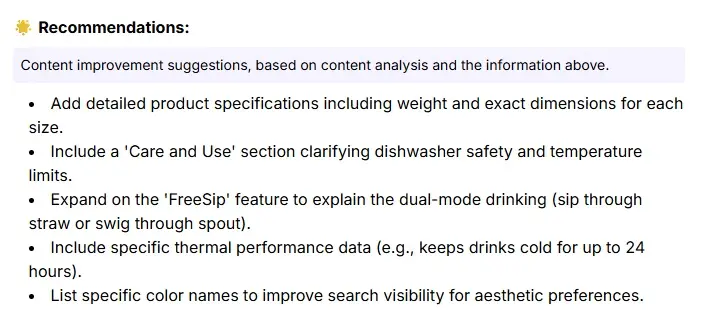
The product page for the popular Owala FreeSip water bottle is where we see a significant disconnect between “listing a product” and “answering a query.” While the basics are there, the content remains too surface-level for a generative search world.
Niara’s audit revealed a major execution flaw. While the structure for a FAQ exists, the answers are missing. There are questions from users, but no official responses. Having the question visible without a clear, structured answer is a strategic blind spot.
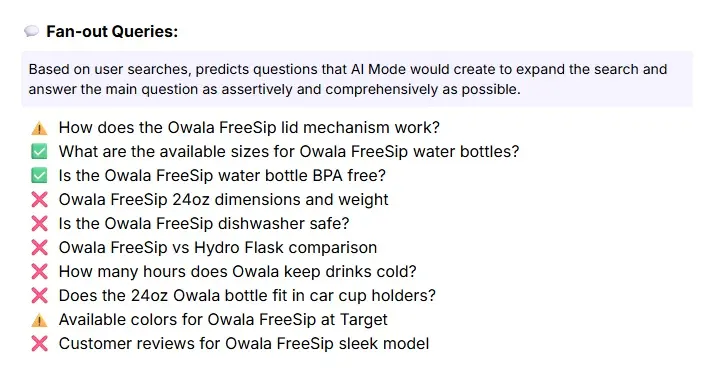
If your page doesn’t explicitly state the thermal performance (e.g., “keeps drinks cold for 24 hours”) or deep-cleaning instructions, the AI might pass over your link in favor of a detailed review site or a competitor’s page that answers those specific fan-out queries.
Corporate blog: high-level strategy, low-level clarity
AI Mode Score: 4/10
Target’s corporate blog is a hub for major announcements like the Target Plus marketplace expansion. While effective for PR, our Google AI Mode Insights diagnostic reveals a corporate speak trap: the content prioritizes high-level strategy over the granular details AI assistants crave.
A score of 4/10 indicates that while the blog covers “digital growth”, it misses the fan-out queries that drive generative search. Google’s AI Mode acts as a concierge: it needs to know how it functions for the end user.
There are several strategic blind spots where Target is losing ground to competitors:
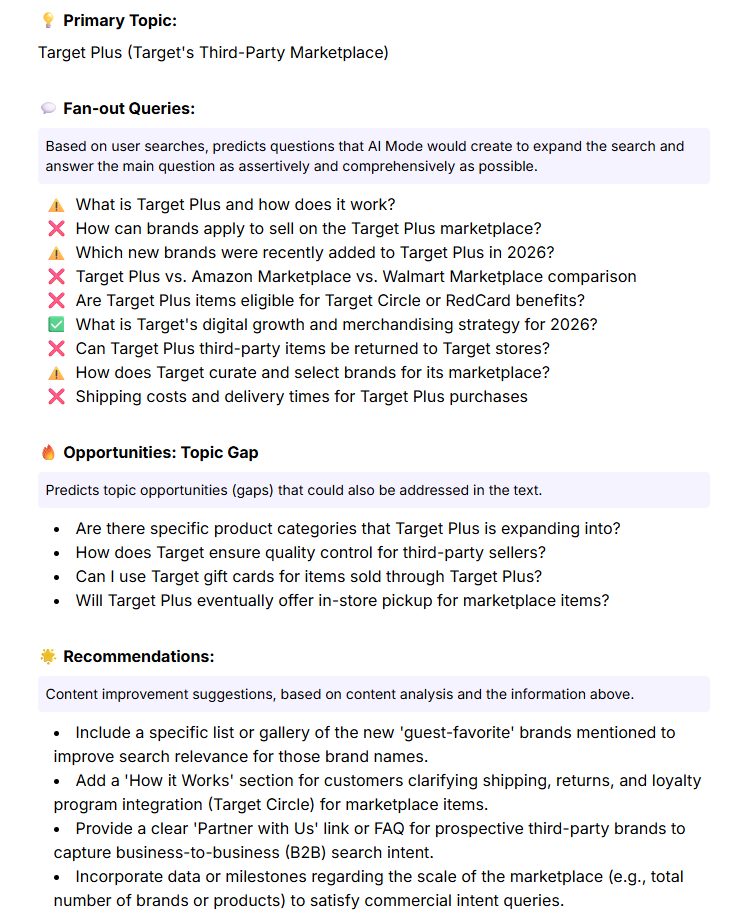
By bridging the gap between strategy and clarity, Target ensures its voice remains authoritative for both humans and AI.
Ulta Beauty
Overall audit score: 7.5/10
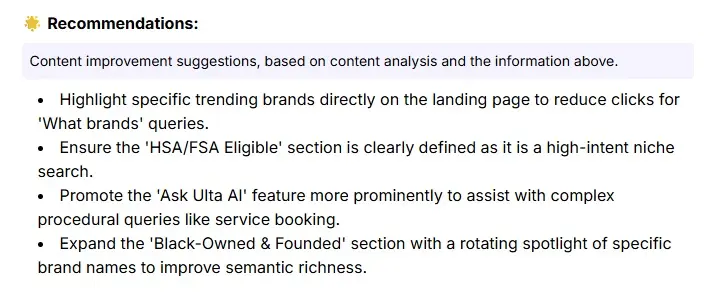
Ulta Beauty is the powerhouse of “All Things Beauty”, successfully bridging the gap between drugstore favorites and prestige brands. While Target struggles with granular details, Ulta’s digital strategy is far more AI-ready. However, our Google AI Mode Insights audit shows that even a category leader has blind spots when it comes to service-based intent and technical product clarity.
Homepage: a high-density discovery engine
AI Mode Score: 9/10
Ulta’s homepage is a benchmark for fact-density. The analysis shows it perfectly captures high-intent queries like “Black-owned beauty brands” and “K-Beauty at Ulta”, providing the structured data AI assistants crave to build comprehensive summaries.
Despite the high score, the audit flagged a navigational friction issue: while Ulta excels at product discovery, it falters on service-based fan-out queries. Questions like “How to book hair services” or “Where is an Ulta near me” are secondary to product carousels.
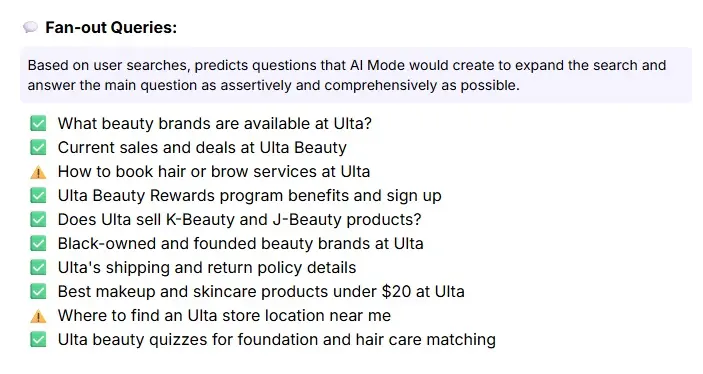
To hit a perfect 10, Ulta should promote its “Ask Ulta AI” feature and service menu more aggressively on the landing page, ensuring the AI sees Ulta as a service provider, not just a retailer.
Product page: the clean beauty clarity challenge
AI Mode Score: 6/10
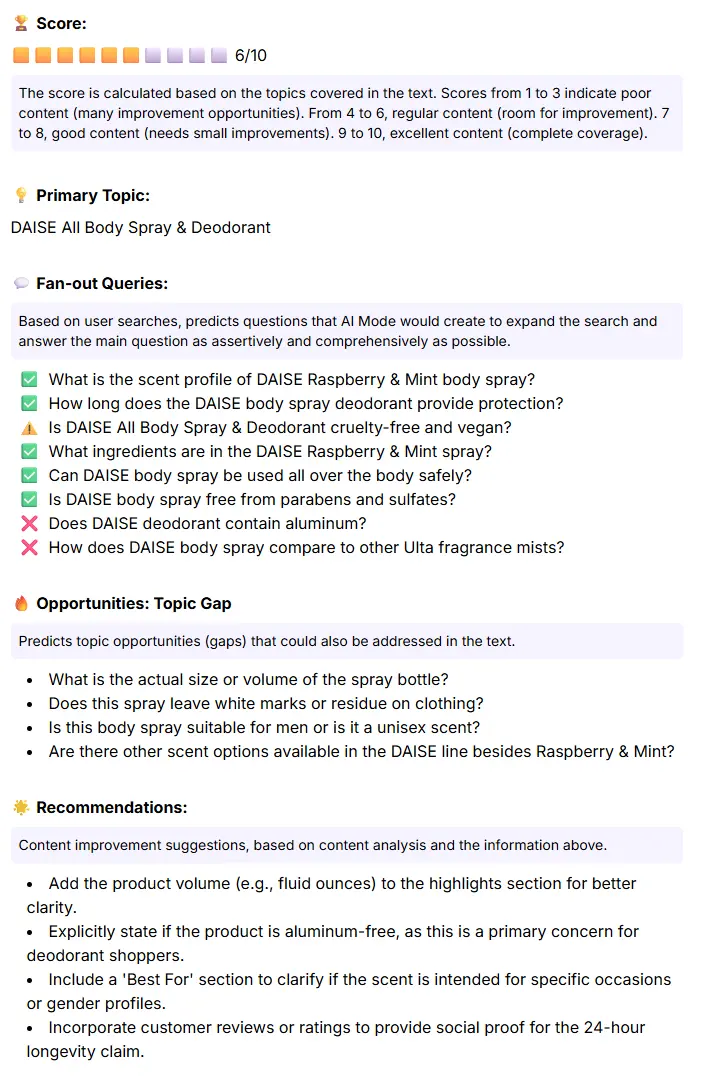
Analyzing the DAISE All Body Spray page, we see a dip in performance. While the page covers the basics (scent profile and ingredients), it misses the extreme utility required for modern generative search.
Niara’s Google AI Mode Insights audit identified critical topic gaps that trigger buyer friction. The AI flagged a lack of explicit information on whether the product is aluminum-free or if it leaves white marks on clothing. In the deodorant category, these are primary search drivers.
Corporate blog: analysis unavailable
During our audit, we encountered a Request Timeout (408) error when attempting to access the editorial content section (Blog) and specific areas of the site.
As a result, this section was excluded from the current AI Mode performance analysis.
Williams-Sonoma
Overall audit score: 7.8/10
Williams-Sonoma stands as the gold standard for the gourmet lifestyle. Unlike other e-commerce retailers, the brand sells the experience of hospitality.
Our audit via Google AI Mode Insights reveals that the brand has a very robust content foundation. However, it still hides crucial information that AI needs to close the conversion loop without the user ever having to leave the search results page.
Homepage: the culinary authority hub
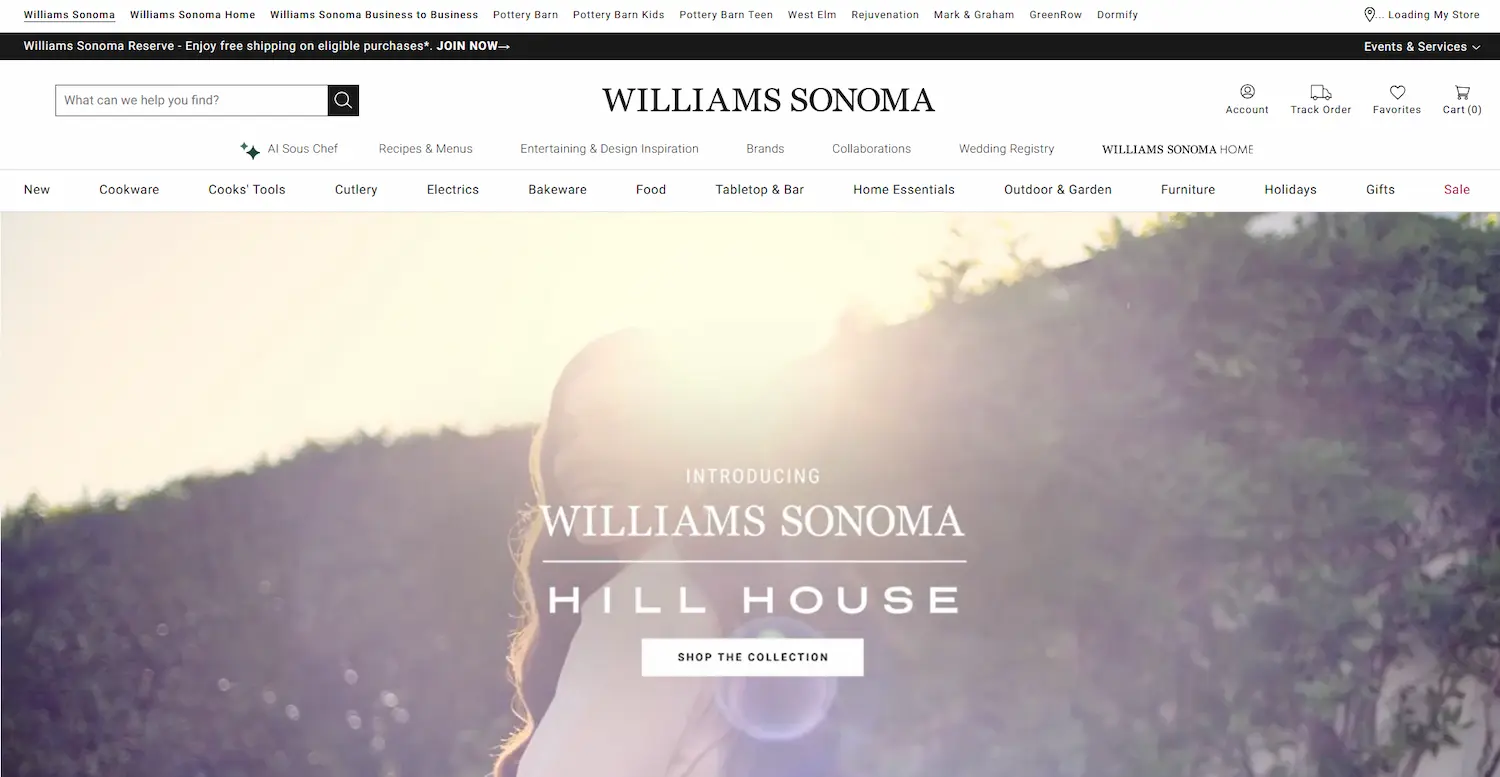
AI Mode Score: 8/10
Williams-Sonoma’s homepage is the digital embodiment of gourmet lifestyle. Our Google AI Mode Insights analysis shows a highly sophisticated content foundation that excels at capturing the essence of the brand. It successfully addresses high-intent queries regarding wedding registries, interior design services, and its corporate brand family (Pottery Barn, West Elm, etc.).
While the page is visually stunning, it leaves several fan-out queries partially unanswered or buried in the sub-navigation.
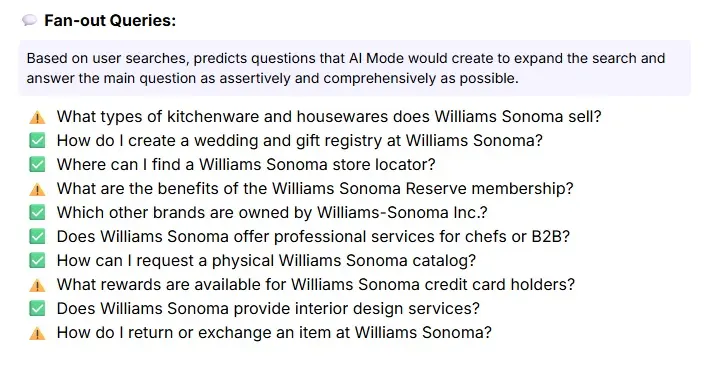
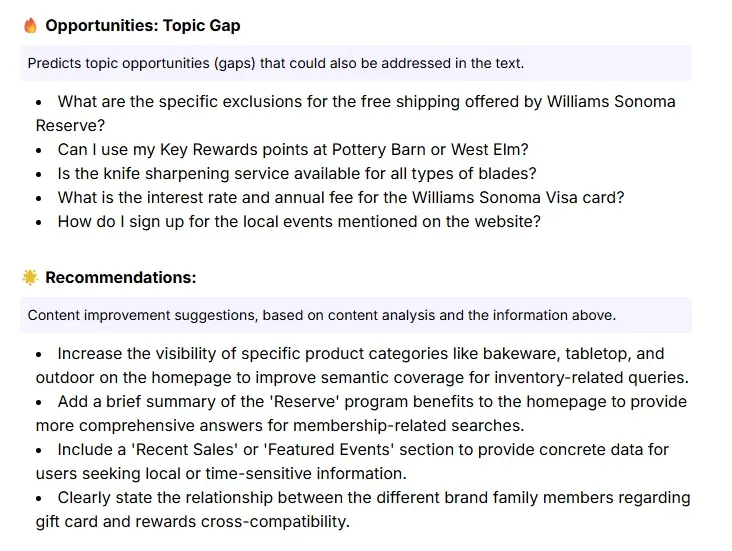
The audit flagged a surprising lack of information regarding the Reserve Membership and Credit Card rewards. While these are core loyalty drivers, the specific exclusions for free shipping and interest rates are treated as secondary technicalities rather than primary content. This prevents the AI from confidently recommending the program as a total value solution.
Product page: merging heritage with high-intent precision
AI Mode Score: 8.5/10
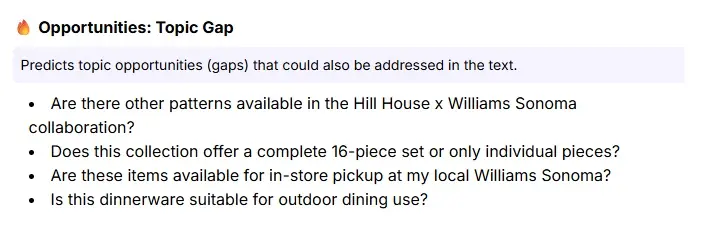
The product page for the Hill House x Williams Sonoma collection is a benchmark for collaborative storytelling. The page is highly optimized for technical specifications, successfully answering critical questions about material, dishwasher safety, and pricing tiers. It creates a robust data footprint that allows AI assistants to confidently categorize these items as premium, durable tabletop goods.
But, the page misses the opportunity to connect the product to the broader lifestyle ecosystem, a key factor for AI-driven discovery.
To push this page to a perfect 10 and dominate answer-based shopping, Williams-Sonoma should strengthen semantic connections.
Recipe blog: bridging utility and brand authority
AI Mode Score: 7/10
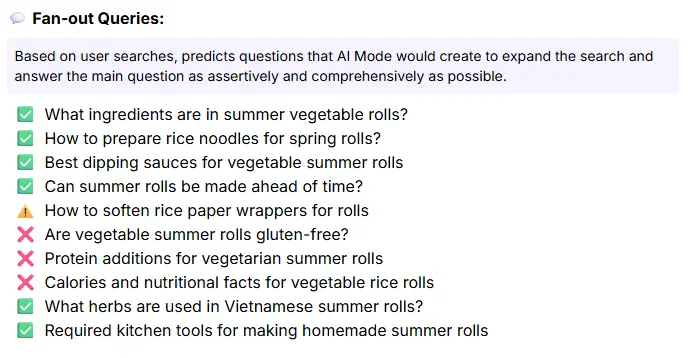
The Summer Vegetable Rolls recipe is a strategic top of funnel asset. The page excels at listing core ingredients and tools, positioning Williams-Sonoma as a helpful culinary guide.
The audit revealed gaps in nutritional transparency and technical troubleshooting. Critical queries regarding gluten-free status, protein substitutions, and caloric info are missing. It also lacks pro-tips for handling delicate rice paper — a high-value topic for AI discovery.
For an AI to recommend Williams-Sonoma as the definitive authority, the page must transition from a basic recipe to a comprehensive knowledge hub. Filling these gaps ensures the LLMs (Large Language Models) recognize the content as a primary source for complex, multi-layered culinary intent, preventing high-authority traffic from leaking to more granular niche competitors.
Final veredict: what Niara’s AI diagnostic reveals for US e-commerces
After auditing thousands of data points across these retail leaders, the pattern is clear: Google’s AI attempts to “understand” your utility. To dominate the Answer Engine era, brands must move from being mere catalogs to becoming authoritative knowledge hubs.
What’s working (the AI green flags)
- Semantic depth and discovery hubs: successful brands are moving beyond flat product lists. By creating fact-dense categories, like curated lifestyle hubs or specific technical collections, they provide the structured context LLMs need to synthesize complex answers.
- Predictive intent coverage: the top performers anticipate fan-out queries. They don’t just list a product; they answer the unspoken questions about compatibility, durability, and real-world usage (e.g., “Does this fit in a standard cup holder?”).
- Relational storytelling: linking products to a complete look or a broader ecosystem helps AI build a semantic map. This shifts your brand from being a search result to a proactive recommendation.
Common pitfalls (the AI red flags)
- The corporate speak trap: using high-level marketing jargon instead of granular details. AI Mode needs facts, not fluff.
- The answer vacuum: having an FAQ structure but leaving questions unanswered or providing generic responses. This creates a strategic gap that competitors with better semantic depth will fill.
- Invisible data silos: burying critical info (return policies, store hours, or program exclusions) in deep sub-menus. If a crawler can’t find it in a main content block, the AI won’t know it.
- The editorial void (missing blog): without a blog to provide expert guides and insights, you lose the opportunity to connect with users during their journey. This absence forces the AI to source answers from niche publishers or competitors, effectively severing the relationship between your brand and the consumer before the transaction even begins.
- Technical gatekeeping: restrictive robots.txt or server configurations that block AI crawlers. You cannot be the source of truth if the algorithms aren’t allowed to read your data.
From search results to the source of truth
The shift from a search engine to an answer engine is a fundamental transformation of the digital storefront. As our analysis reveals, a legacy brand name is no longer a shield against invisibility. In the AI era, the winner isn’t the brand with the biggest marketing budget, but the one that provides the most digestible utility.
If your data is siloed, your technical specs are missing, or your brand voice is buried in corporate jargon, you are losing your seat at the table. And, when you leave a void, the AI simply fills that silence with information from whoever provides the clearest, most granular facts, whether that’s a niche competitor or a third-party review site.
The question for every marketing leader now is this: is your website a closed catalog or an open knowledge hub? When the AI concierge looks for a reason to recommend your product, will it find a definitive source of truth or a strategic data void?
Don’t leave your AI visibility to chance
The transition to Generative Search is happening in real-time. Stop guessing how algorithms perceive your authority and start measuring it.
Use Niara’s Google AI Mode Insights to audit your URLs, identify your fan-out query gaps, and ensure your brand is the one providing the answers.
Try Niara’s Google AI Mode Insights for free and transform your SEO strategy today.
