
To grow your business, you need a dedicated strategy to turn clicks into customers. Learning how to create a high-converting landing page is one of the most effective way to lower your customer acquisition costs and boost your ROI.
Unlike a standard homepage, a landing page is a laser-focused tool designed with one specific goal: driving your visitors toward a single, irresistible call to action. To do this properly, you need to balance persuasive copywriting with technical precision, ensuring that every element works in harmony to reduce friction and build immediate trust with your audience.
In this guide, we will break down the essential frameworks used by top growth marketers when making a landing page. Read on to discover the step-by-step blueprint for building landing pages that dominate the SERP and maximize your lead generation.
Also read: AI for Copywriting: What it is, How to Use it, and Benefits (Bonus: Effective Prompt Tips!)
How to create a landing page from scratch: your step-by-step guide
Stop thinking about design and start thinking about strategy. A pretty page that doesn’t speak to a specific pain point is just digital noise. To make a good landing page, you must follow a structured process that aligns your business goals with your user’s needs.
Step 1: define your objective and target audience
Every successful landing page starts with a single, uncompromising objective. You must determine exactly what action defines success for this specific URL. A lead capture page for a B2B whitepaper requires a completely different architecture than a direct-sale page.
Establish your KPIs before writing a single word of copy. These should include conversion rate, cost per acquisition (if it’s going to be used as an ad) and form abandonment rate.
Next, map your buyer personas to their specific stage in the journey. A user from a general search has different intent than one clicking a retargeting ad. You must identify their exact pain points to make them feel immediately understood.
To simplify this, use Niara’s “Understand Your Audience” AI Agent. By entering your product or service, the agent generates a comprehensive profile, including:
- Demographics and interests: identify their age, income, and aesthetic tastes.
- Buying habits: know where they shop and which platforms they use for inspiration.
- The “Why”: understand their core motivation, such as maximizing ROI or achieving “Superhost” status.
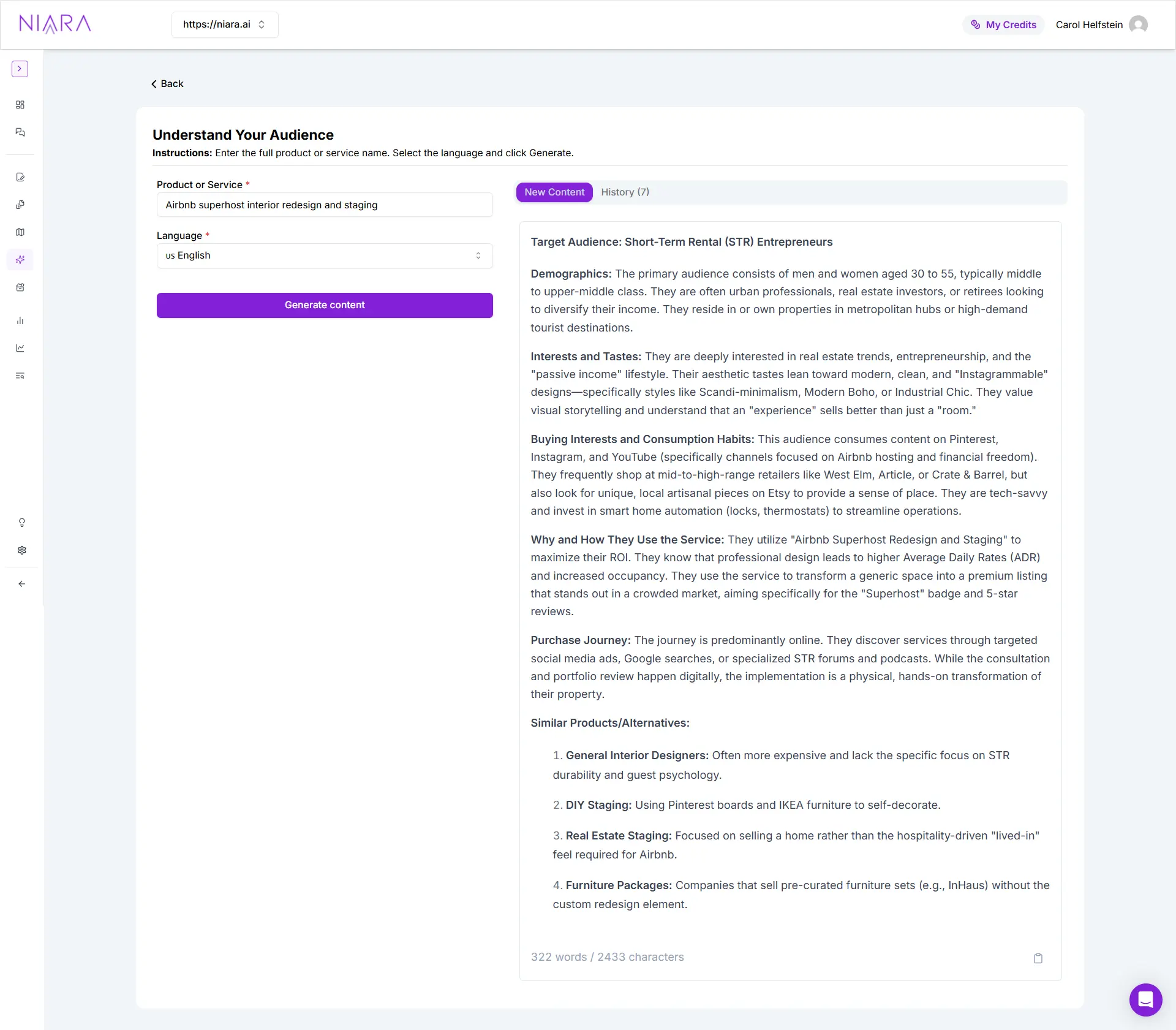
This psychological connection is what drives high conversion rates. Once identified, document these parameters in your Niara Brand Guide. This ensures every headline and CTA generated by the AI aligns perfectly with your audience’s specific goals and challenges.
Also read: How to maintain a consistent brand voice at scale using AI beyond prompting
Step 2: craft AI-powered headlines and value propositions
Your headline determines whether a user stays or bounces. AI landing page copywriting accelerates this process, allowing you to generate dozens of variations based on proven frameworks. Instead of staring at a blank page, use Niara’s specialized AI Agents for PAS (Problem-Agitation-Solution) or AIDA (Attention-Interest-Desire-Action).
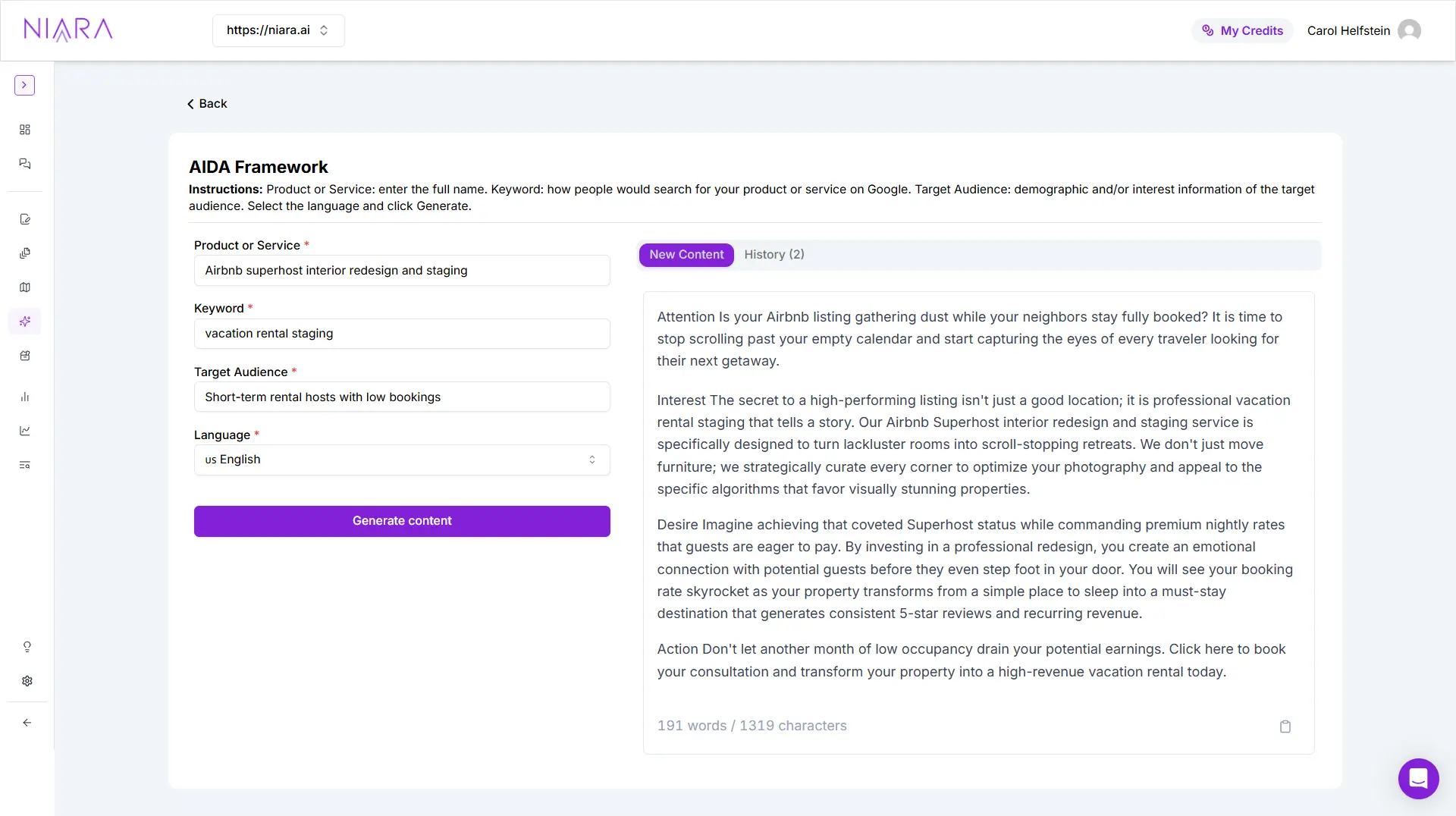
While these agents provide a powerful strategic north star, you can refine your hooks further using ChatSEO or the Content Workflow.
Use ChatSEO to brainstorm specific headlines that prioritize clarity over cleverness. Instead of a vague claim like “We improve listings”, select a high-converting headline like: “Turn your lackluster room into a scroll-stopping retreat that commands 5-star reviews“.
Always evaluate AI-generated copy for specificity, making sure it doesn’t sound like commodity content. The AI acts as your high-speed drafting assistant, but your human curation ensures the claims are factually accurate. This blend of AI speed and human strategy is what creates a truly high-converting landing page.
Step 3: design for speed, clarity, and mobile-first UX
Modern landing page design must be mobile-first. Since over half of all web traffic is mobile, your mobile-friendly landing pages are your primary storefront.
Technical performance directly impacts user behavior and conversion rates. You must monitor your Core Web Vitals meticulously to prevent technical friction from sabotaging your offer. Focus on optimizing your Largest Contentful Paint (LCP) by compressing hero images and ensuring your Time to Interactive (TTI) is nearly instantaneous.
To simplify this, use Niara’s Technical SEO Agent. It allows you to instantly identify pages with poor Core Web Vitals that are hurting your performance.
Coming soon: we are launching a new feature that crosses performance data with revenue metrics. This will pinpoint slow pages that are driving up your ad costs, allowing you to optimize your UX, lower your bids, and drastically reduce your ad spend.
Also read: Landing page experience below average on Google Ads? It’s likely a technical SEO issue
Step 4: copy and social proof that convert
Effective landing page copywriting requires aggressive editing. Your writing must be concise, benefit-driven, and entirely focused on the user’s outcome. Instead of listing a technical feature like “Professional 4K photography included”, highlight the tangible benefit: “Get more clicks and higher nightly rates with scroll-stopping imagery“.
To ensure your page beats the competition, use Niara’s Content Workflow. This tool generates complete landing pages based on real-time SERP data and exports the content directly into your WordPress.
It is specifically optimized for Google’s AI Overviews and AI Mode, ensuring your content is structured as a factual source rather than sales fluff.
To make your page a primary source for AI assistants, follow these GEO (Generative Engine Optimization) checklist:
| DO | DON’T |
|---|---|
| Be specific: Boost occupancy by 25% in 30 days. | Use fluff: We offer the best results in the industry. |
| Answer directly: How much does staging cost? Our plans start at… | Be vague: Our pricing is competitive and flexible. |
| Use entities: mention “Short-Term Rental”, “ROI”, and “ADR”. | Keyword stuff: repeat “Airbnb staging” in every sentence. |
| Cite data: Based on 2026 hospitality trends… | Make unverified claims: Everyone loves our designs. |
Finally, integrate social proof strategically. Don’t hide testimonials in a carousel. Place a powerful, one-sentence quote directly next to your CTA. Use specific trust signals, such as “Trusted by 150+ Superhosts“, to prove your authority to both users and AI engines.
This shift toward factual, high-density content is part of a broader SEO chunking strategy, where breaking information into digestible, modular pieces helps both humans and LLMs process your value proposition faster.
Step 5: optimize forms, calls to action and micro-interactions
Optimizing your lead capture form is an exercise in risk management. Every extra field you add decreases your conversion rate. Only ask for the information you absolutely need to move the lead forward. If you are offering a free “Airbnb Revenue Calculator”, an email address is enough — don’t scare users away by asking for their phone number upfront.
For more complex services, like a full property redesign, use progressive disclosure. Break your form into short, easy steps. Start with low-friction questions like “How many bedrooms is your property?” before asking for contact details on the final screen.
Your call to action (CTA) must be bold and action-oriented. Effective button copy should complete the mental phrase “I want to…”. Instead of a passive “Submit” use high-intent phrases like:
- Get my staging quote
- Boost my occupancy now
- See my redesign potential
Finally, use subtle micro-interactions to provide immediate feedback. A button that changes color when hovered over or a progress bar on your multi-step form reassures the user that the page is responsive. These small details, combined with clear privacy links, build the trust necessary for a user to hit that final button.
Step 6: SEO and accessibility considerations for landing pages
While many landing pages rely on paid ads, SEO for landing pages provides a sustainable pipeline of high-intent organic visitors. To win at organic search, you must use a logical semantic HTML to help search engine crawlers and AI assistants understand your content’s context.
Accessibility is equally critical. It impacts both user experience and search visibility. To save time and ensure compliance, leverage Niara’s specialized tools:
- Alt Text Generator: automatically analyze your images (like your staging “before and afters”) to create descriptive, SEO-friendly alt text. Image SEO ensures that your visual assets contribute to your rankings rather than just being decorative elements that slow down your load speed.
- Structured Data Generator: easily create JSON-LD schema markup. This clearly defines your Service, Reviews, or FAQ sections for search engines, helping you earn rich snippets.
Ensure your page is keyboard-navigable and has sufficient color contrast. A well-structured, accessible page satisfies Google’s technical requirements while providing a frictionless experience for every potential customer.
Also read: Why is ads CPA high? Fixing technical friction and restoring ROI
Step 7: testing, analytics, and iteration
To maintain high performance, you must embrace a continuous testing methodology. A/B testing allows you to isolate variables and see exactly what drives your audience to act. Always start with a clear hypothesis.
For example: “Changing the CTA from ‘Book Now’ to ‘See My Custom Design’ will reduce friction and increase clicks by 15%“. By testing one major element at a time, you ensure your results are statistically significant.
Go beyond basic conversion rates and look at the why behind user behavior. Heatmaps can reveal if users are clicking on unlinked images or where they lose interest and scroll away.
To make sense of this data without the headache of complex spreadsheets, use Niara’s Conversational Analytics. This tool simplifies your entire reporting workflow, giving you a crystal-clear view of:
- Performance metrics: instantly see impressions, clicks, CTR, and average position.
- Actionable recommendations: Niara doesn’t just show you what is happening. It tells you what to do next.
- Strategic guidance: receive clear advice on whether you need a content tweak or a technical fix to maintain your competitive edge.
Iteration based on hard data transforms an average page into a highly efficient conversion engine. With these insights, you ensure your premium offer continues to command the search results and the revenue it deserves.
Step 8: GEO analysis with Google AI Mode Insights
If you already have a page live but it’s not converting, don’t play the guessing game. You need to know how the “new” Google (the one driven by AI Overviews) perceives your page. That’s when Google AI Mode Insights come into play.
Enter your landing page URL into Google AI Mode Insights. Niara analyzes your page using official Google documentation and SEO best practices to see how it aligns with AI Overview requirements. After the analysis, you’ll get a detailed diagnosis of content gaps, SEO recommendations, and what’s missing for your page to be recognized as a topical authority.
It tells you exactly how to optimize your content so that AI-driven search engines recommend your landing page to users, including UX and multimodal suggestions.
Niara in action: real-world landing page analysis and optimization examples
Theory is essential, but seeing optimization in action is where the real learning happens. To show you the power of Niara’s Google AI Mode Insights, we’ve selected two distinct landing pages across different industries for a deep-dive analysis.
Also read: Why Your SEO Team Is Wasting Time with ChatGPT (And How Niara Helps)
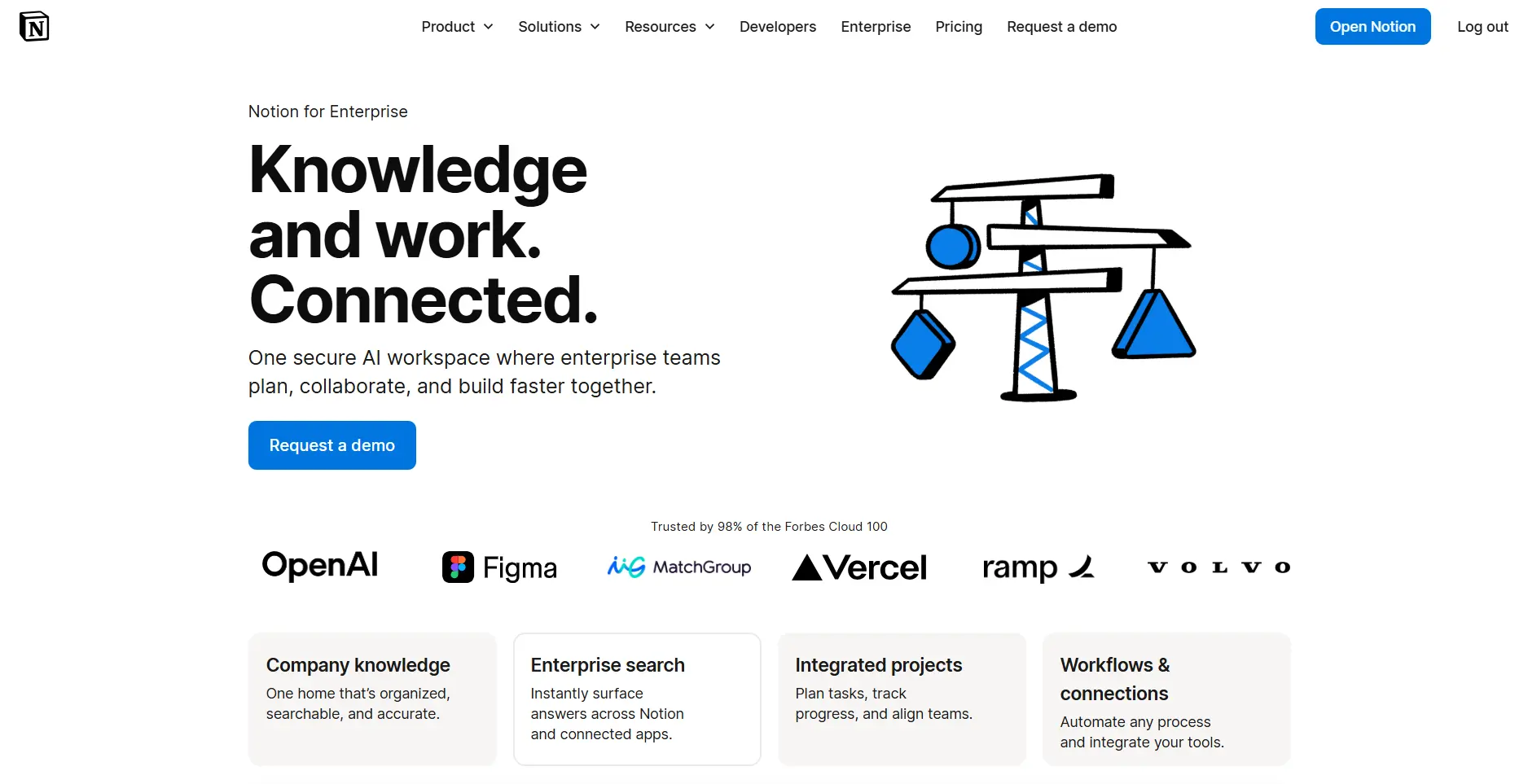
1. Notion B2B Enterprise page
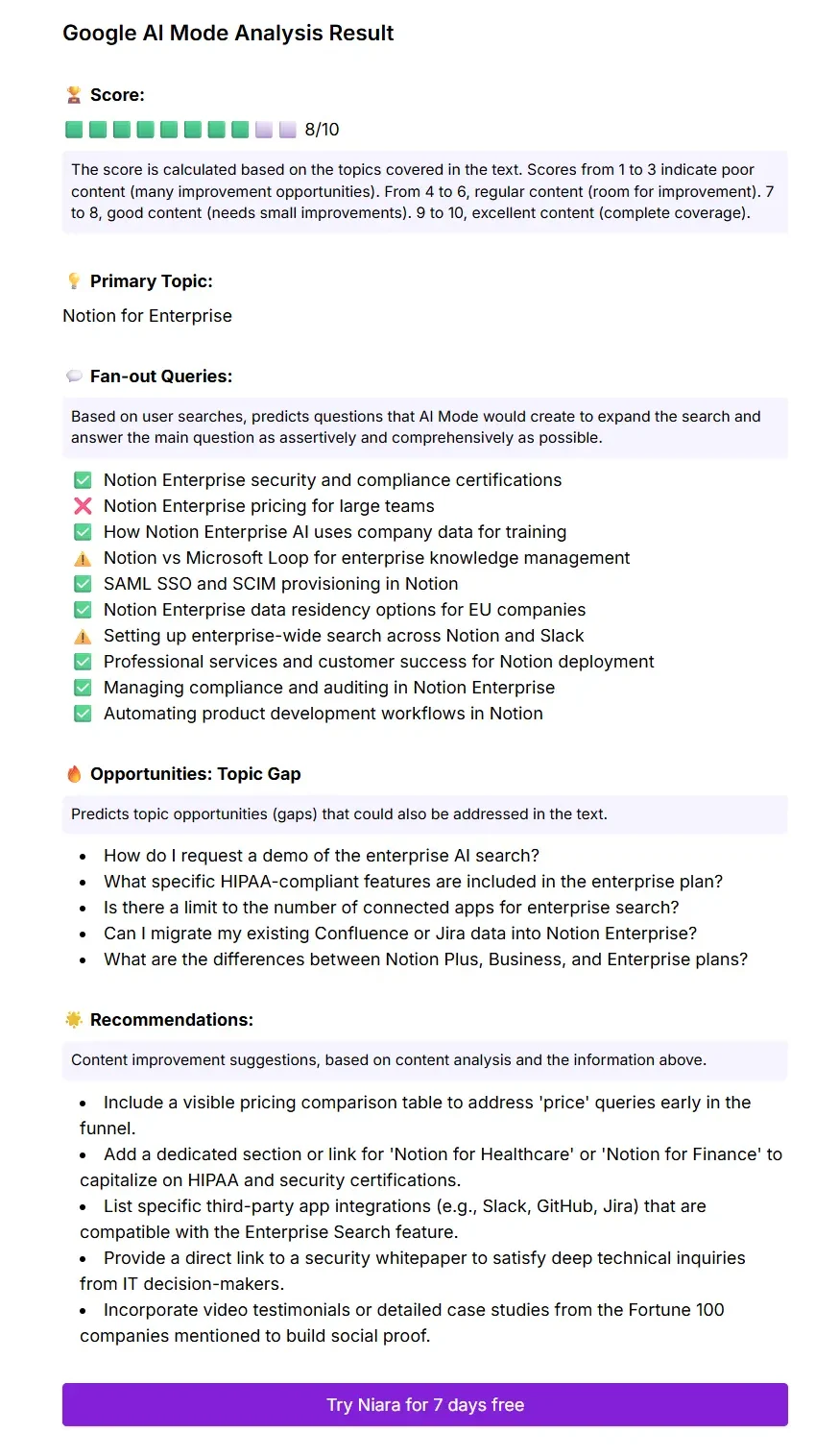
Niara’s Google AI Mode analysis gave the Notion B2B Enterprise landing page a solid 8/10, identifying it as high-quality content that effectively covers technical essentials like SAML SSO and compliance.
However, the diagnosis revealed critical “Topic Gaps” that could hinder conversions, such as the lack of clear plan comparisons and specific details on data migration from competitors like Confluence.
By identifying these hidden opportunities, Niara ensures your content doesn’t just inform, but actively answers the high-intent questions that enterprise decision-makers are searching for.
To bridge these gaps, Niara recommends strategic enhancements including a visible pricing table, dedicated industry-specific sections (like Healthcare and Finance), and direct access to security whitepapers.
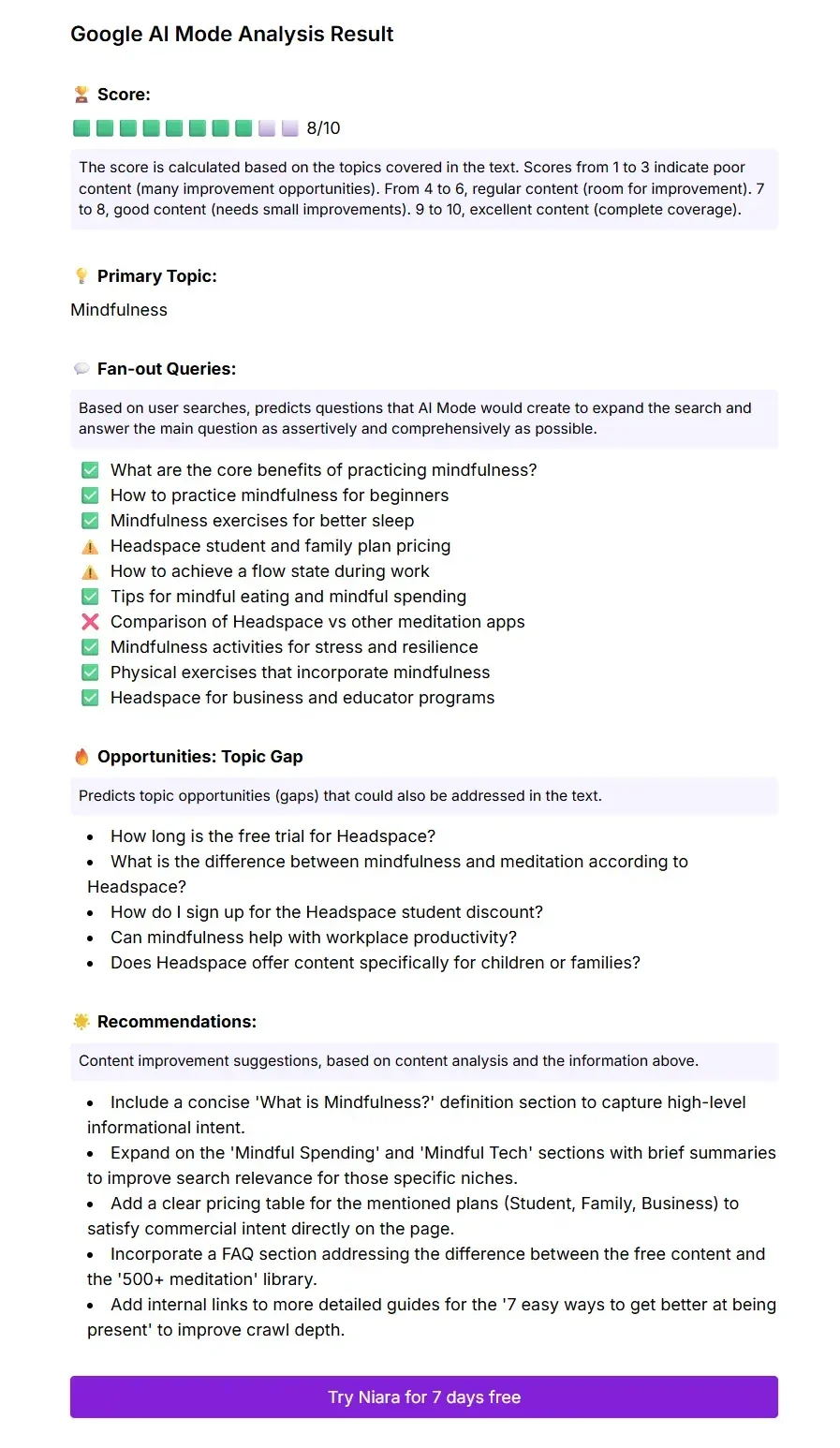
2. Headspace App B2C page
Niara’s Google AI Mode analysis clocked the Headspace mindfulness page at a solid 8/10. It’s doing a great job covering the basics and getting beginners started with exercises, but there’s a real opportunity here to turn “readers” into “subscribers.”
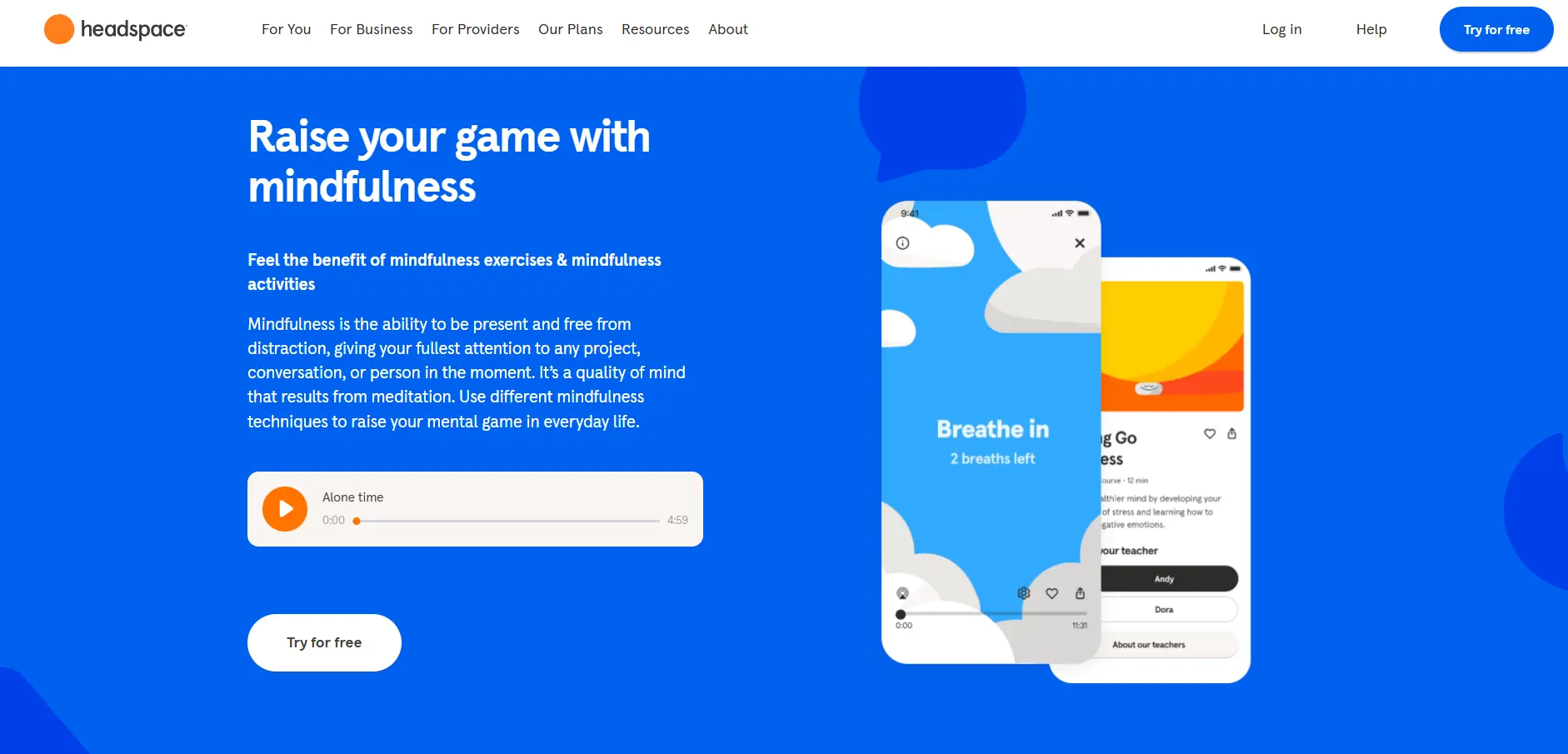
The diagnosis found some gaps, like clear details on student discounts and a simple explanation of how mindfulness actually differs from meditation.
To get that perfect 10, Niara suggests adding a quick FAQ to clear up the different subscription plans and a “Mindfulness 101” definition right at the top to catch those early-stage searches. Adding a clear pricing table for families and students would also keep people from jumping back to Google to find costs elsewhere.
Building a digital handshake that lasts
At the end of the day, a landing page is much more than just a mix of pixels and persuasive copy. But, in an era where search is becoming a conversation and users are more skeptical than ever, just being good doesn’t cut it anymore. You need a page that is truly understood by both your audience and the AI algorithms that now guide them.
The real secret to scaling your results is about choosing where to spend your energy. Niara can help you with that.
Whether you’re managing an enterprise giant or building your first solo project, the goal is the same: turning every single click into a real connection. The tools to dominate this new search landscape are ready for you. The only question left is: are you ready to stop guessing and start growing?
Want to see your page through the eyes of the Google AI?
Don’t leave your rankings to chance. You can use our Google AI Mode Insights for free right now to spot your content gaps before your competitors do.
