
When opening Google today to solve a doubt or understand a concept, users often don’t even need to scroll to see the first organic result. A text block generated by artificial intelligence (Google’s AI Overview) already delivers the complete, ready-to-consume answer. The user closes the tab satisfied without having clicked a single link.
What seems like a convenience for the searcher has become a major turning point for creators. This shift in user behavior doesn’t signal the end of an era, but the beginning of a time where differentiation and authenticity rule the game.
Organic traffic isn’t dead, but traffic for generic content (so-called commodity content) is on borrowed time. For brands that want to survive algorithm updates and maintain market share, transitioning to high-value (non-commodity) content is no longer optional—it’s the only viable path forward.
Is your brand stuck in “more of the same”? Discover how to identify commodity content and how to break the cycle to elevate your digital strategy.
Also read: The Definitive Guide to Zero-Click Searches: Dominating the New AI Search Funnel
What is Commodity vs. Non-Commodity Content?
In economics, a commodity is a standardized, essential raw material whose value is determined by global market rates rather than brand differentiation. This means one unit is virtually identical to another, regardless of who produced it.
In digital marketing, the term follows the same logic. We say commodity content is that generic, informative, and purely descriptive text that offers no new perspective.
In contrast, non-commodity content is the opposite of generic. It is the “premium product,” the technical specialty, the narrative that no one else can tell. It is based on original niche content, proprietary data, or lived experiences.
This distinction gained official traction in April 2026, during the first Google Search Central Live held in Toronto, Canada. On that occasion, Danny Sullivan (Director on the Google Search team) and other Search team experts emphasized that commodity content is losing the most ground with the evolution of AI.
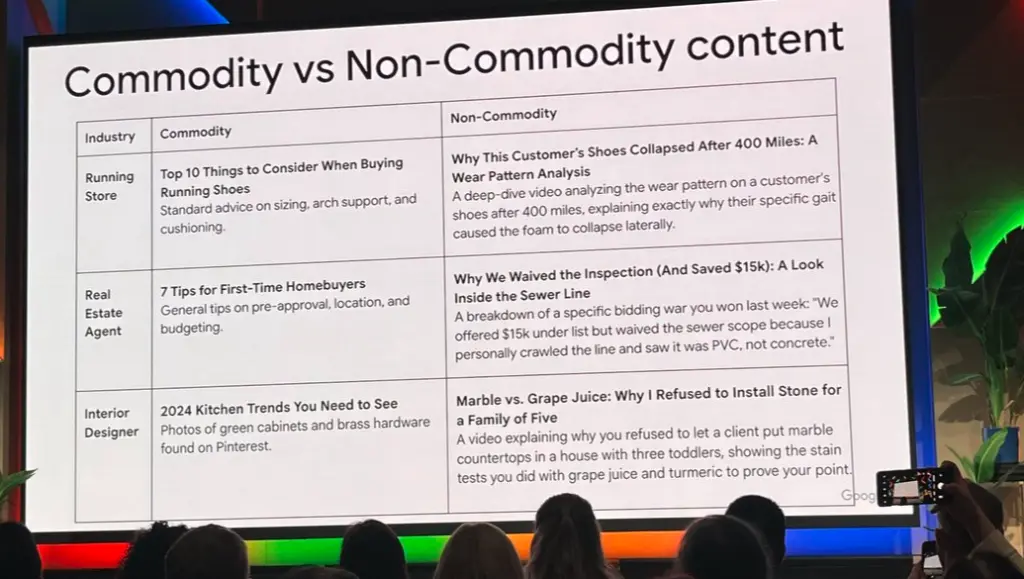
Instead of writing about “how to save money,” you might write about “how I saved $50,000 in 12 months using strategy X and the mistakes that almost made me go bankrupt.” The first is commodity; the second is non-commodity.
This approach is the foundation of semantic SEO, where the focus shifts from isolated keywords to building a network of meaningful topical depth.
Typical Characteristics of Commodity Content
- Encyclopedic definitions: Texts focusing only on “What is X” or “How to do Y” at a basic level.
- Lack of brand voice: If you removed the company logo, any competitor could have signed the piece.
- Based solely on keyword research: The content exists only because search volume is high, not because the brand has something unique to say.
- Predictable structure: Follows the exact same topics as the top 10 results on the SERP (Search Engine Results Page).
This content usually serves a top-of-funnel purpose to attract initial organic traffic, but its effectiveness is plummeting. Why? Because AI does it better, faster, and for free.
In other words: if your article is just a summary of what already exists on the internet, Google has no reason to prioritize it over an AI-generated summary.
To stay ahead, you must learn how to optimize content for search intent beyond the surface level, ensuring your page offers value that an AI summary cannot replicate.
Characteristics and Added Value of Non-Commodity Content
- Radical originality: Provides information found nowhere else on the web.
- Original data and research: Proprietary case studies, team experiments, or anonymized internal data.
- Expert opinion: Doesn’t just report facts but analyzes the implications of those facts for the market.
- Focus on E-E-A-T: Clearly demonstrates Experience and Expertise, a crucial ranking factor for Google.
Non-commodity content builds authority. It turns a visitor into a fan or customer because the user realizes you possess knowledge that cannot be replicated by a simple AI prompt.
This strategy is vital for establishing topical authority for LLMs, helping AI models recognize your brand as a primary source of information.
Main Differences Between Commodity and Non-Commodity Content
| Feature | Commodity Content | Non-Commodity Content |
|---|---|---|
| Goal | Focuses on traffic volume and impressions. | Seeks authority, conversion, and retention. |
| Originality | Low (re-hash of existing content). | High (unique insights and perspectives). |
| Data | Based on public data and known facts. | Uses original research and exclusive cases. |
| Format | Simple lists, definitions, generic guides. | Dense narratives, whitepapers, in-depth analysis. |
| Scalability | Easy and fast (often AI-automated). | Requires time, strategy, and human curation. |
| Production Cost | Low and fast execution. | Higher initial cost, but sustainable long-term ROI. |
| Ranking Impact | Vulnerable to Google’s Helpful Content updates. | Tends to gain and consolidate evergreen positions. |
10 Real-World Examples of Commodity and Non-Commodity Content
| Topic | Commodity Type | Scope (Generalist) | Non-Commodity Type | Scope (Deep-Dive/Experience) |
|---|---|---|---|---|
| Education | SAT Exam 2026: Dates and Registration | Deadlines, registration fees, and required identification documents. | How I Scored 1500+ on the SAT While Working Part-Time | My exact study schedule, specific prep books used, and mental health tips. |
| SEO | What are Meta Descriptions? | Technical definition, character limits, and basic importance for CTR. | We Analyzed 1,000 Metas: What Actually Boosted CTR at Niara | Real A/B test data, patterns found in top-performing pages, and unique insights. |
| Cooking | Easy Homemade Bread Recipe | Standard ingredients (flour, water, yeast) and basic kneading instructions. | Why Your Bread Isn’t Rising: 3 Mistakes I Fixed After a Year of Sourdough | Temperature analysis, flour brand comparisons, and pro-baker secrets. |
| Finance | What is a 401(k) and How It Works | Basic explanation of retirement accounts, employer matching, and tax benefits. | How I Saved My First $10k in 12 Months: My Exact Budget Spreadsheet | Real breakdown of expenses, sacrifices made, and the specific tracking tool used. |
| Well-being | 5 Benefits of Daily Walking | Generic list: improves circulation, reduces stress, and aids weight loss. | How a 20-Minute Morning Walk Cured My Creative Block | Personal story on routine change and its specific impact on work productivity. |
Is Your Brand an “Echo” or a “Voice”?
Many companies believe they are doing a great SEO job because they publish four articles a week. But if those articles only repeat what market leaders say, they are an “echo”—merely reverberating what has already been said.
If a competitor says the trend is X, the echo writes an article saying the trend is X—this is the peak of commodity content.
A “voice,” however, has identity. It questions, validates, or brings new layers to the discussion. To be a “voice,” you need content authenticity. You need a subject matter expert (SME) collaborating directly with the writer.
Signs Your Content is Purely Commodity
- Your only information sources are the top 3 Google results.
- You don’t use tool screenshots, real photos, or proprietary charts.
- The text is full of vague filler phrases like “it is important to consider several factors.”
- Bounce rate is high because the user finds the answer quickly and sees no reason to stay.
It’s worth noting that Google has been updating its documentation to encourage creators to focus on unique, non-commoditized content. The goal is clear: to tackle the explosion of AI-generated texts that, while grammatically correct, fail to deliver what Google values most now: an original human perspective.
The Non-Commodity Framework: The Experience Layer (E-E-A-T in Practice)
To ensure content is unique, one pillar of E-E-A-T stands out: Experience. AI can simulate Expertise, but it lacks Experience. It hasn’t sat in a meeting with a difficult client, it hasn’t seen a server crash at 3 AM, and it hasn’t felt the frustration of a campaign that didn’t convert.
At Niara, for example, we don’t just say AI saves time. We show how our Authority Map reduces a 3-day analysis task to minutes, connecting it directly to the pain of an overwhelmed SEO professional. We also share real case studies from professionals who have used the tool.
This is applying real experience to the product and content.
How to Create High-Value Non-Commodity Content
The transition requires a shift in workflow. Break the belief that you need to write more. We are living in a time where you need to think more before writing anything. Here are some guidelines:
1. Change the Initial Question
Instead of limiting your strategy to what keyword tools suggest, focus your research on:
- “What has my company done recently that no one else has experienced?”
- “What was the most difficult or specific problem we solved in the last 6 months?”
If you’re struggling to move beyond the basics, checking content briefing examples can help you structure your requirements to demand more depth and originality
2. Include Evidence and Visuals
Look for proof of your work. It could be a Search Console chart showing an unexpected error, a photo of an internal process, or a screenshot of a difficult decision-making conversation (anonymized).
If you are writing about Technical SEO, don’t just say “page speed is important.” Show a PageSpeed Insights screenshot before and after an optimization and explain exactly what improved.
3. Replace Generic Tips with Concrete Explanations
Commodity content gives standard advice like “use keywords in the title.” Non-commodity explains why you chose Path B when everyone expected Path A.
4. Evaluate Authenticity
Before publishing, do a critical final read:
If I removed my company name from this article, could a competitor publish it exactly as is?
If yes, it’s commodity. Revise it. If no, because it contains a narrative only you own, congratulations: you’ve created non-commodity content.
5. Use AI to Structure and Refine
You can use AI to speed up the process as an efficient editorial assistant. Use it to:
- Organize your train of thought;
- Create outlines based on your real insights;
- Generate attention-grabbing title variations.
With Niara, you can draft your real-case notes and paste them into ChatSEO with this prompt:
“Niara, here are the details of a project I executed [paste notes]. Transform this into a non-commodity article outline focused on ‘Experience (E-E-A-T)’, highlighting technical decision points and suggesting where to include data to prove authority.”
Scaling this level of quality is possible. Check how content scaling works when you combine human expertise with the right AI frameworks.
Content Formats That Continue to Perform
If you want to escape “commodity mode,” here are several format suggestions that are performing well. Google is prioritizing content that offers a rich user experience, which includes:
- Original Data and Research: Survey your customer base (ethically and anonymously) or conduct public experiments. One original chart is worth more than a thousand generic words.
- Process Infographics: Move beyond pretty illustrations; create diagrams that explain complex workflows or frameworks.
- Deep-Dive Content: Comprehensive guides that cover a topic exhaustively from a unique perspective, serving as the “pillar pages” of your strategy.
- Detailed Case Studies: Forget the simple “what we did.” Focus on “how we solved problem X with budget Y and what we learned from our mistakes.”
How Niara Helps You Create Non-Commodity Content
Niara is your ultimate partner. Beyond ChatSEO, you can use our Content Workflow to draft articles from scratch. It automates briefings and writing, ensuring the final text has an information hierarchy that makes sense for both users and Google.
One of Niara’s biggest advantages is alignment with your brand identity. You can configure your Brand Voice settings to teach Niara your tone, style, and writing preferences.
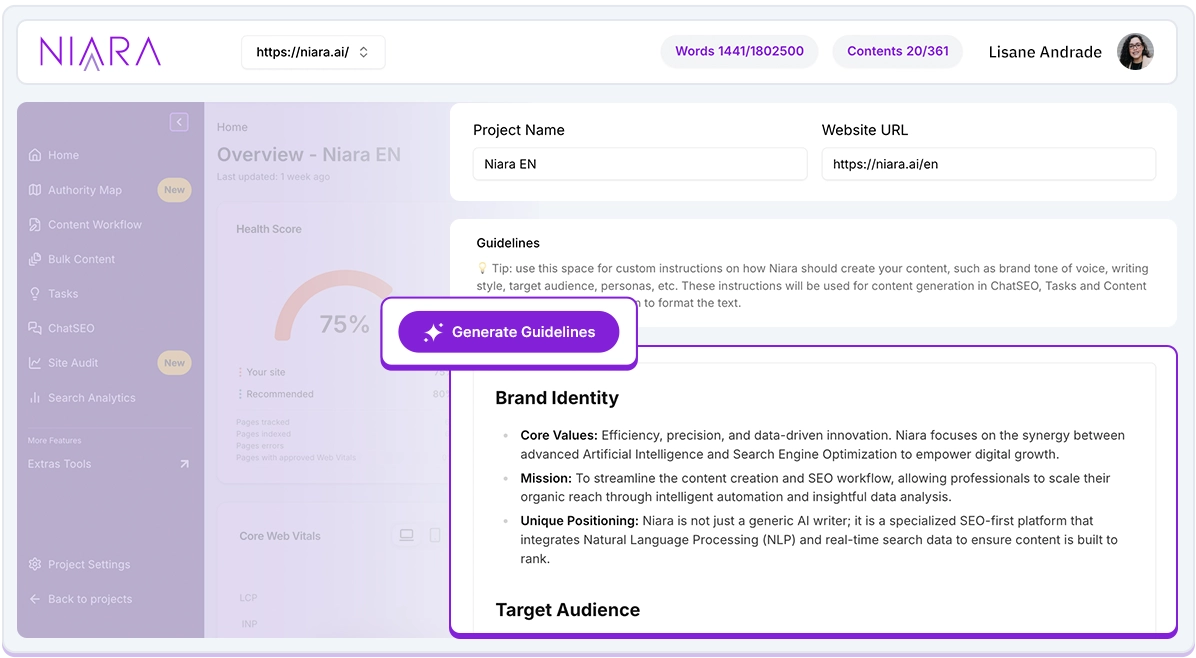
With this, the content generated across the entire platform doesn’t feel like it was written by a generic robot. It adopts your company’s persona, ensuring consistency across all channels and saving you the time you’d otherwise spend manually adapting text to your style.
Check out the step-by-step guide: How to create your first high-performance article in Niara to dominate SERPs and AI Overviews.
Empower your human experience with Niara’s technology
To stay relevant, your content must evolve into a curated experience. The true competitive advantage doesn’t lie in the volume that technology can replicate, but in the depth that only human experience and a critical eye can provide.
By integrating AI tools to optimize processes, you stop competing for generic clicks and start building a legacy of trust.
Ready to create better content? Count on Niara, the AI and SEO platform designed to simplify your workflow.
Sign up now to explore our features firsthand and dive into a complete ecosystem, developed exclusively to streamline the routine of SEO professionals and automate operational tasks.
Stop wasting time on manual processes. Discover how Niara can transform your digital strategy!
