
SEO is no longer an island. As Google’s AI Mode and platforms like Perplexity or ChatGPT evolve, they crawl and synthesize information from the entire digital ecosystem — which means search optimization must now extend far beyond your domain and into your social channels.
Social platforms have evolved into more than just engagement hubs. They are now critical sources of data and authority. It is through the interconnection of your site, LinkedIn, Instagram, and YouTube that AI crawlers build a Knowledge Graph of your brand. This web of connections is what allows AI to assimilate who you are, who the experts behind your brand are, and how you relate to your industry.
In this new reality, your social presence and your website are indissociable. Understanding this interconnection is the first step toward reclaiming your brand’s narrative.
Let’s explore how to align your social strategy with the specific signals that AI engines trust and cite.
Read more: What is Google AI Mode and how it works? Adapting your SEO strategies
Where search meets social media
According to recent research and industry surveys, AI platforms leverage social media in diverse and specialized ways:
- Facebook: with 19.5 million citations in US AI Overviews, Facebook is the king of local SEO. It is the go-to source for “is it open” or “used items for sale” queries. Crucially, it serves as an after-sale surface, cited frequently for troubleshooting and returns.
- YouTube and Reddit: together, they represent nearly 80% of social citations. They provide the “how-to” depth and peer-to-peer validation that AI engines crave for complex research. Data shows that, long-form, reference-style videos spanning 10 to 20 minutes account for 94% of all AI citations originating from YouTube.
- Instagram: Instagram is cited at the bottom of the funnel. 90% of its AI citations relate to buying intent, such as price, aesthetics, and availability. It is where AI goes to “see” if a product is worth the hype.
- TikTok: TikTok citations have increased fivefold as AI engines begin to index short-form video transcripts to answer “trending” or “how-to” questions for younger demographics.
But why AI trusts social media?
AI engines use social media to verify the reality behind the marketing. While a website tells the AI what a brand claims to be, social platforms show the AI what the world experiences.
To understand the relationship between social presence and search visibility, we must look at the four pillars of generative trust:
- Lived experience over corporate content: under the E-E-A-T framework, AI prioritizes first-hand human content. A community thread troubleshooting a specific technical error or a raw product review offers a new level of lived experience.
- Cross-platform calidation: Large Language Models (LLMs) rely on a verification logic known as co-occurrence. Before an AI cites a brand as an authority, it looks for digital echoes across the web. If independent discussions on LinkedIn, Reddit, and YouTube align on a specific solution or trend, the AI identifies this as a consensus signal.
- Filling the Information Gaps: social media thrives on granular interactions. Community-driven platforms act as the “last mile” of information, providing the only documented answers to complex, long-tail questions that mainstream media overlooks.
- Synthesizing ambient context: the AI treats social threads as the context surrounding a fact. This allows generative engines to summarize what people are saying, transforming a dry, automated response into a grounded, human-centric answer.
Also read: To Reddit or not to Reddit? The rise, fall and AI Slop crisis
How to create social media content and optimize them for generative engines?
Generative Engine Optimization requires a fundamental shift: you are now writing and optimizing for citations. To convince an LLM that your brand is the definitive source, you must provide the fact-blocks and digital echoes it seeks.
However, creating this level of cross-channel authority manually is an operational bottleneck. This is where Niara transforms your strategy. We built an engine for you that centralizes your semantic authority, ensuring that every piece of content, from a technical blog post to a TikTok caption, is engineered to be cited.
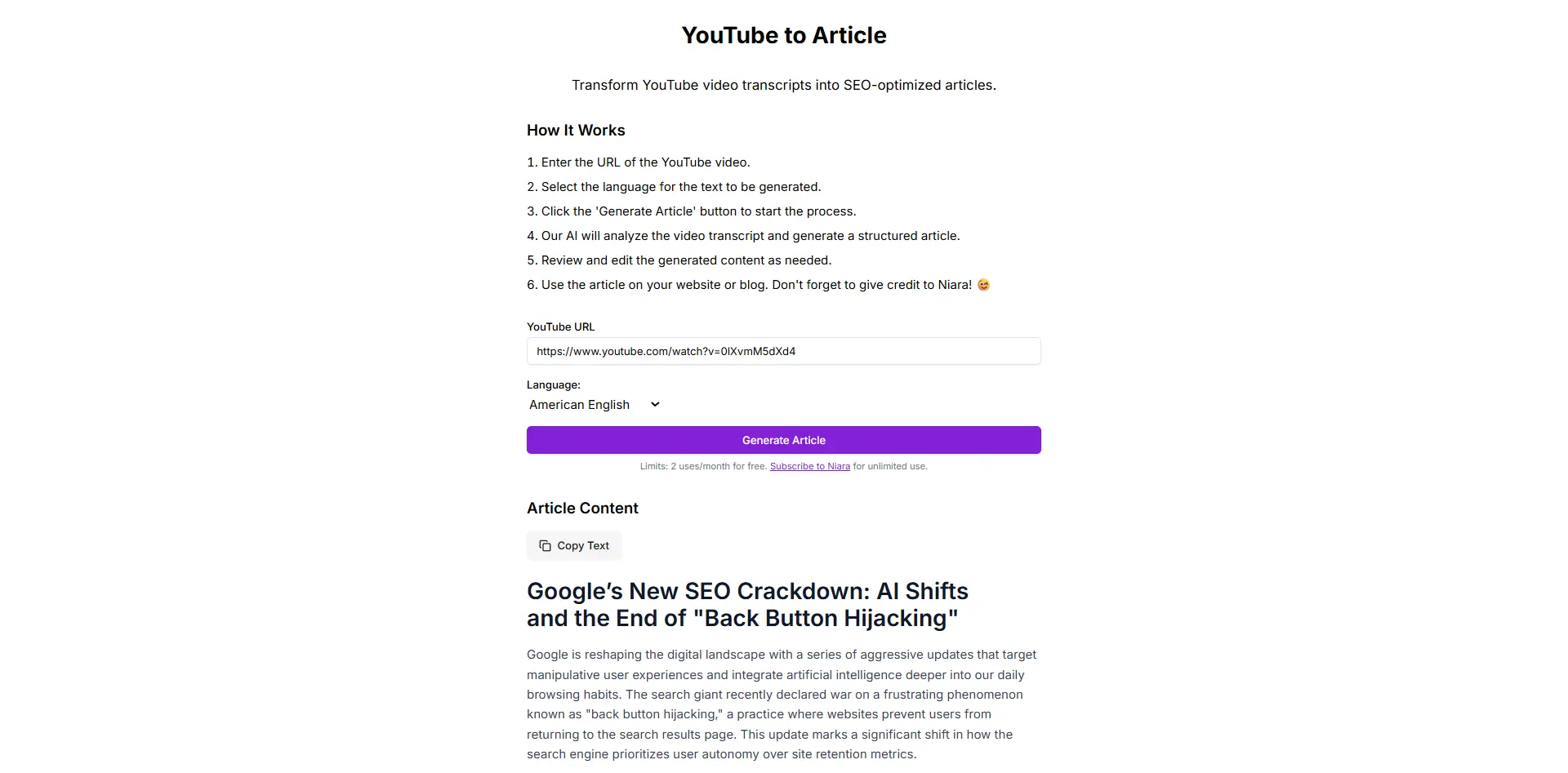
1. Creating digital echoes with YouTube to Article
AI engines crave the consensus signal. When Niara’s YouTube to Article tool converts your expert-led videos into structured, SEO-optimized blog posts, it creates a powerful validation loop. By having the same factual data on YouTube (which AI loves for instructions) and on your domain (which AI uses for depth), you create the digital echo that LLMs need to verify your authority and trigger a citation.
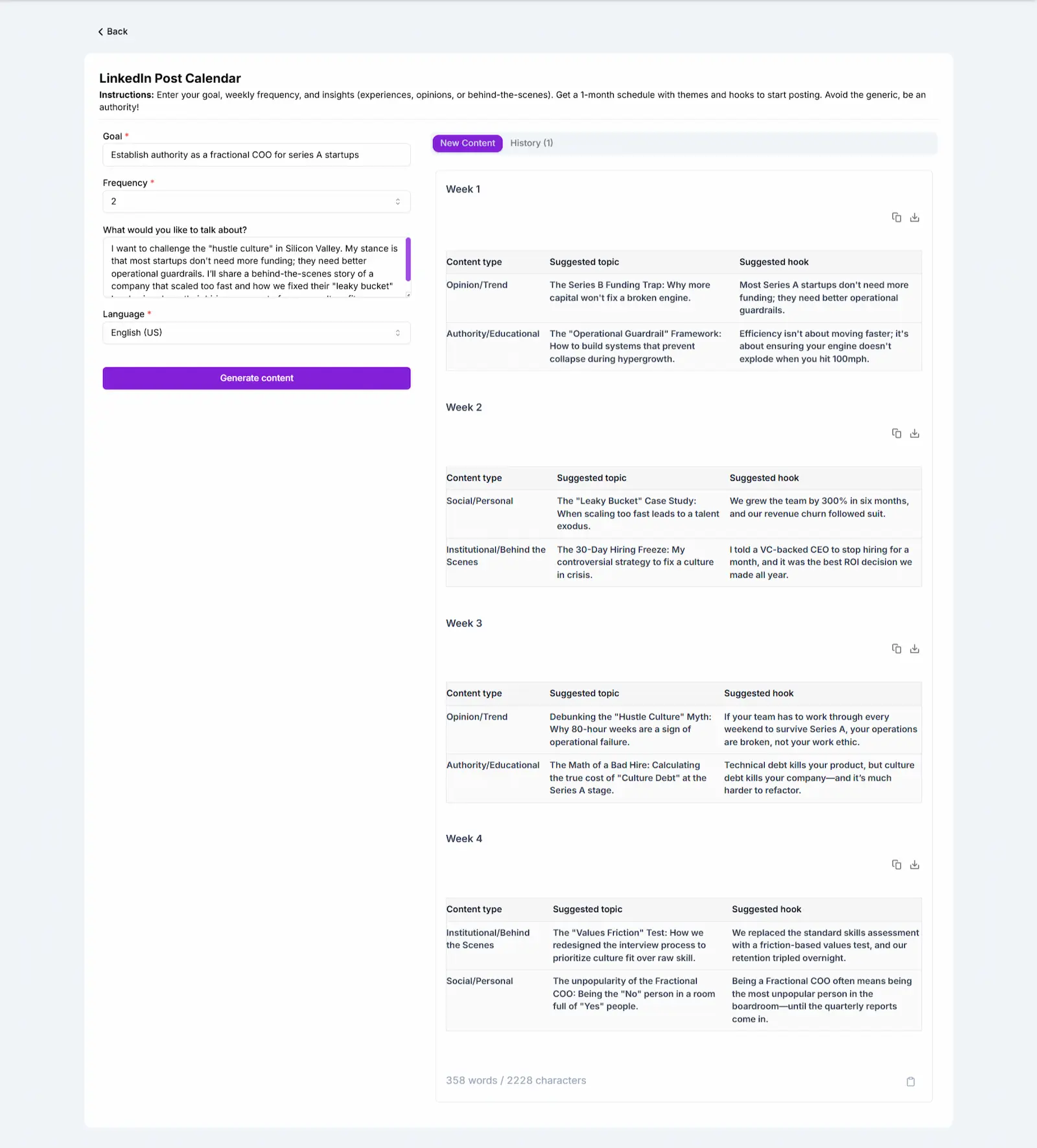
2. Engineering fact-clocks with AI Agents
AI rewards specific, data-backed lines, not broad corporate takes. Niara’s AI Agents are trained to strip away the fluff. Whether you are generating a LinkedIn editorial calendar or a TikTok script, our agents focus on the habits that get you cited: leading with numbers, turning stories into data-rich case studies, and ensuring every post answers a specific long-tail problem. That’s why we ask you what would you like to talk about, your own angles and insights.
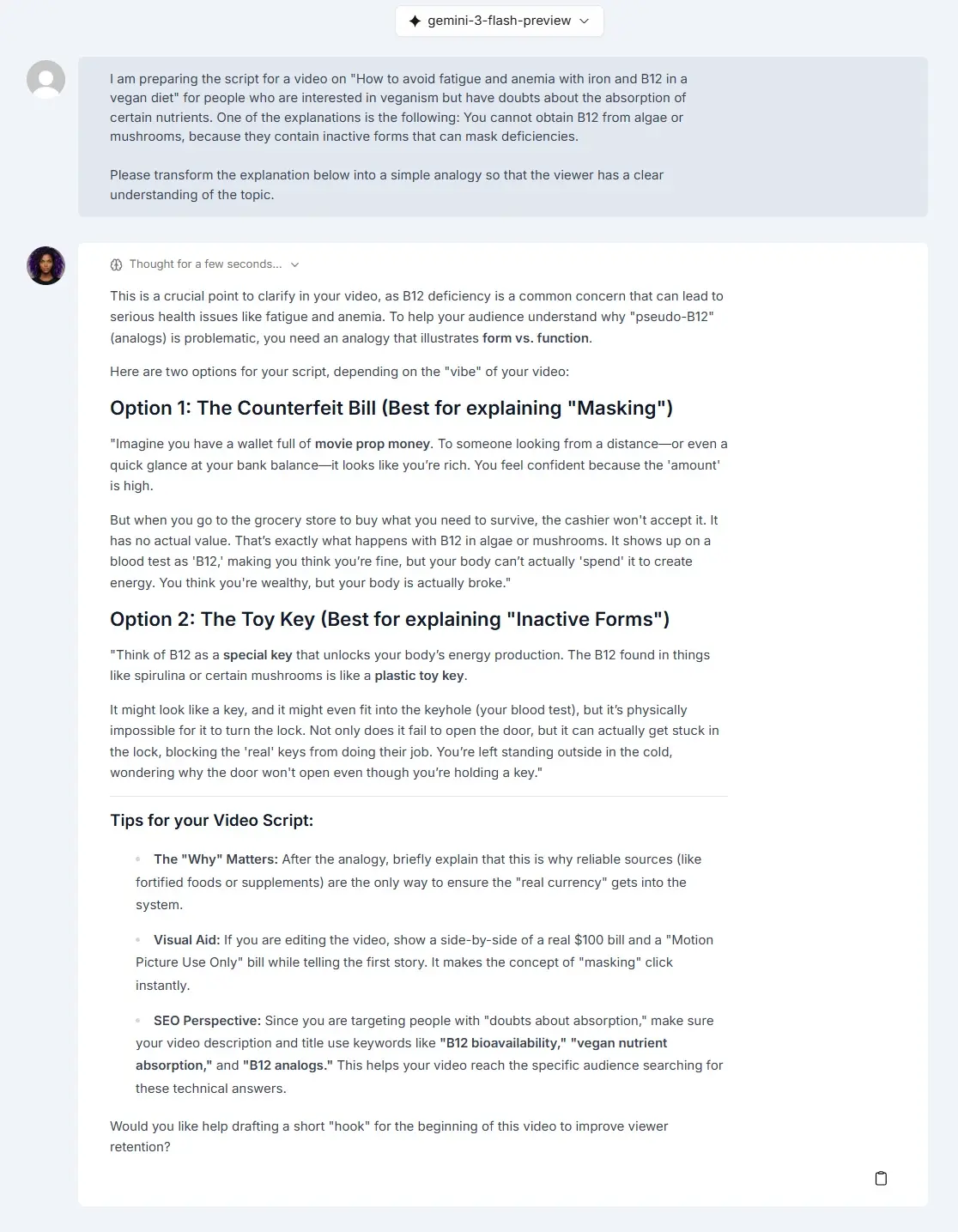
3. Intent-based content with ChatSEO and Prompt Library
To win the “Intent Split” (like Instagram for buying and TikTok for how-to), your copy must provide the exact contextual clues AI crawlers look for. Our Prompt Library contains specialized models for Instagram Reels and YouTube descriptions that are pre-engineered for SEO. They assist you in crafting semantic anchors that enable AI to categorize your content as the go-to source for specific market questions.
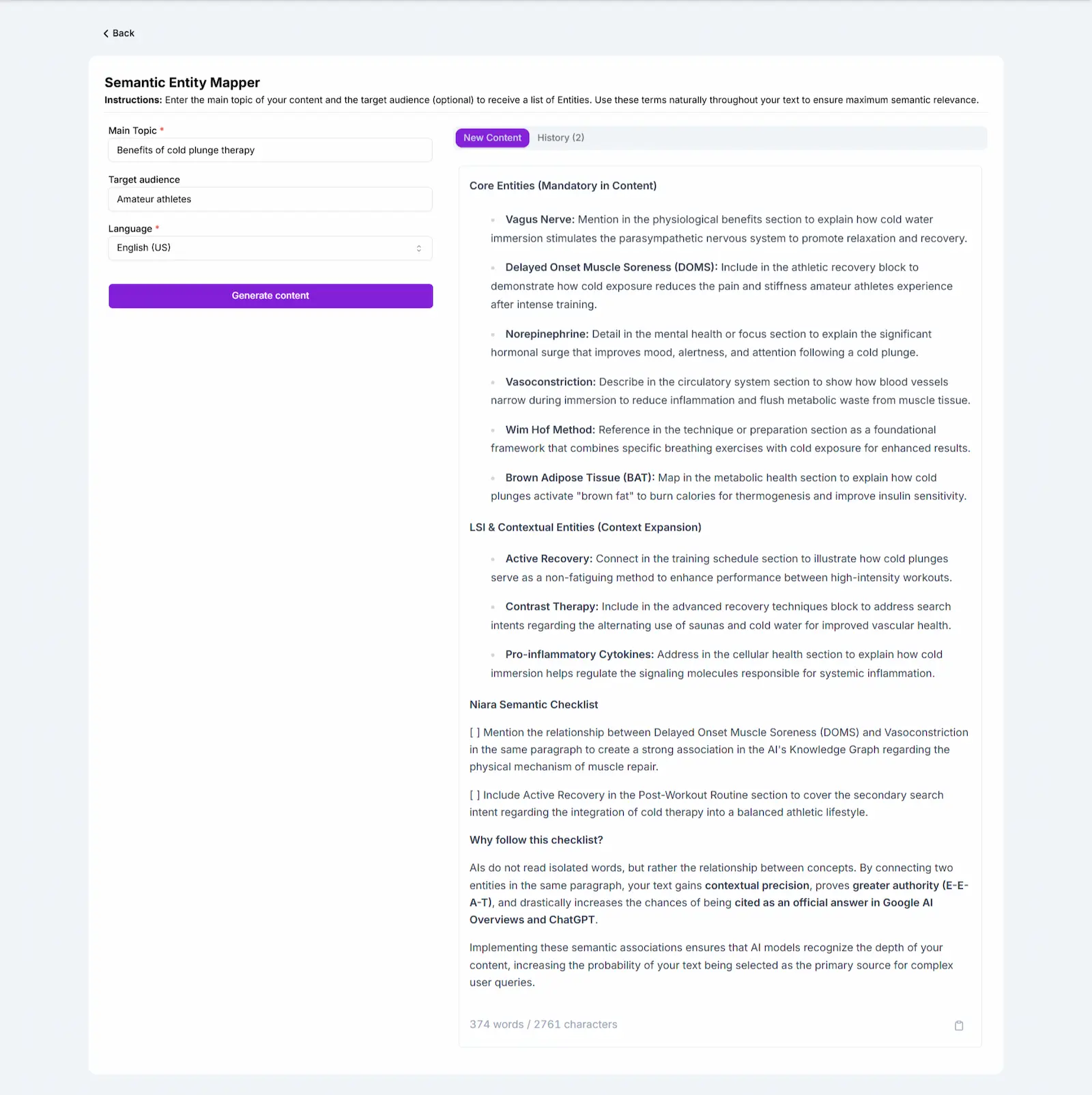
4. Building the DNA of your content with the Semantic Entity Mapper
AI maps entities. To be cited as an authority, your content must contain the specific semantic markers that LLMs expect to find within a topic. Niara’s AI Agent Semantic Entity Mapper analyzes your target theme and lists the core entities (people, places, technical terms, and concepts) that must be present to establish topical depth.
Since Google and other AI crawlers now ingest audio and video transcripts as easily as text, this mapping is critical for your multi-channel strategy. By using these entities in your YouTube scripts and Podcast outlines, you ensure that even your ambient conversation is packed with the data points that trigger AI citations and strengthen your brand’s Knowledge Graph.
5. Consolidating the entity map with Brand Guidelines
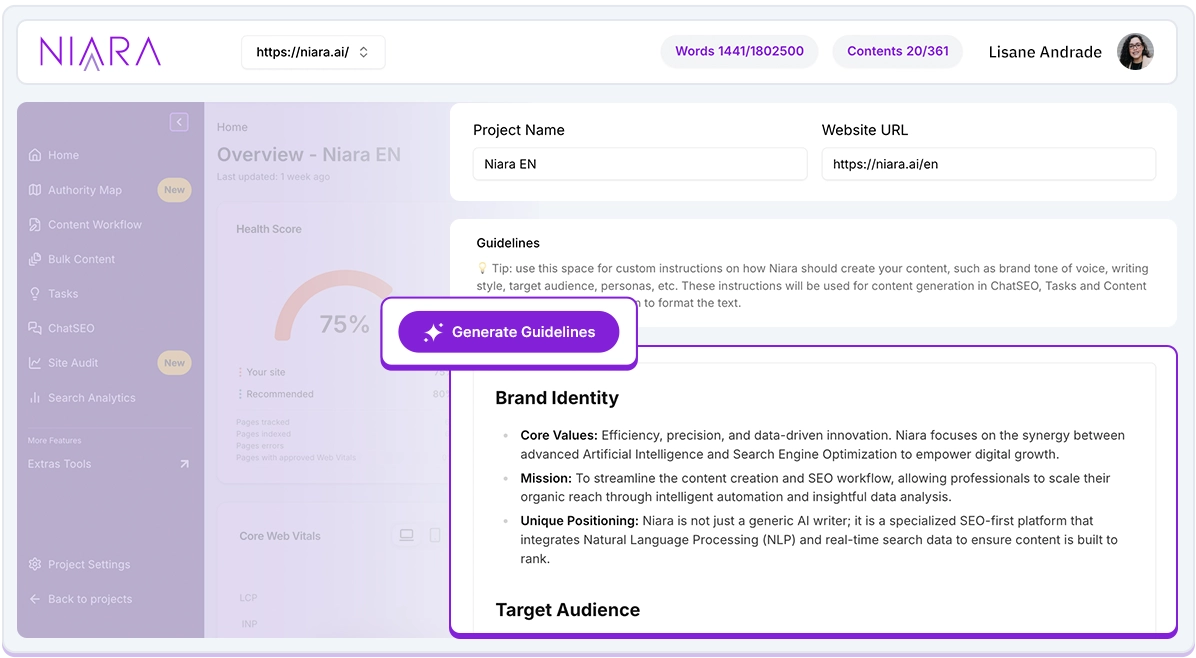
Consistency is the ultimate trust signal. If your brand voice fluctuates between platforms, AI engines struggle to build a reliable Knowledge Graph of your brand. With Niara’s Brand Guidelines, your persona and expertise are locked in once. This ensures that every piece of content generated across all tools reinforces a unified, authoritative Entity Map, making it significantly easier for AI to verify your E-E-A-T.
Extra tips: advanced optimization for social media visibility
Optimizing for the AI era requires more than just posting. It requires a disciplined approach to Entity Resolution and Content Governance. To ensure AI engines don’t just see your content but actually trust and cite it, follow these strategic pillars:
1. Mastering entity resolution: connecting the dots
AI engines need to be 100% certain that your LinkedIn profile, your YouTube channel, and your website all belong to the same authoritative entity. You can facilitate this through Entity Resolution:
- The GSC connection: use Google Search Console to monitor which social-heavy queries are already driving impressions for your brand.
- Schema and social linking: ensure your website’s Organization Schema explicitly links to your social profiles. This creates a “SameAs” signal, helping the Google Knowledge Graph and LLMs like ChatGPT map your social expertise directly back to your domain.
2. Adopting a fact-first writing style
AI agents are data hungry. They cite extractions. To become a citable source, adjust your writing habit:
- Lead with the number: don’t bury the lead. Put the result, the percentage, or the core fact in the very first sentence.
- Structured case studies: use storytelling to provide the human context and lived experience that AI values, but anchor it with rigorous documentation. Turn your social threads into case studies that feature a clear method, data point, and outcome. This ensures your content is engaging for users while remaining highly extractable for AI agents.
3. E-E-A-T filter: your social governance
Google’s E-E-A-T (Experience, Expertise, Authoritativeness, and Trustworthiness) framework is the exact lens through which AI evaluates social signals. If your social channels are filled with unverified claims, AI engines will actively filter your brand out to protect users from misinformation.
Align your social output with Helpful Content guidelines by running these concrete checks on your workflow:
- Does your Facebook or LinkedIn post cite a verifiable source or original data?
- Does your social “About” section feature a bio that highlights real-world, first-hand experience?
- Are you linking back to authoritative data points or whitepapers to ground your claims?
Measuring success in the age of click loss
As the zero-click search reality matures, traditional metrics like click-through rate (CTR) are becoming incomplete. If your success is only measured by website visits, you are ignoring the massive influence your brand exerts directly within the AI interface. To thrive, marketing leaders must evolve their framework to address the shift from traffic to generative visibility.
While organic traffic remains important, it is no longer the only indicator of health. You must begin tracking Share of Model (SoM) and Generative Visibility. Use Google Search Console to identify which of your pages are being referenced as authoritative nodes, and use Bing Webmaster Tools to pinpoint the exact conversational queries that are triggering your brand’s citations. Even when a user doesn’t click through, appearing as the cited authority builds the mental availability that drives future conversions.
30-day actionable playbook to kickstart SMO for AI Search
Transitioning to a Social Media Optimization (SMO) strategy for the AI-powered search era doesn’t happen overnight. It requires a systematic shift from engagement-first to entity-first content. Follow this 4-week sprint to align your social channels with semantic SEO principles and start triggering AI discovery.
Week 1: entity foundation and resolution
- Audit your “SameAs” signals: update your website’s Organization Schema to include links to all active social profiles. Ensure your handles, bios, and descriptions are identical across platforms to facilitate Entity Optimization.
- Bio refresh: rewrite your “About” sections on LinkedIn, YouTube, and Instagram. Instead of marketing fluff, focus on E-E-A-T signals: list credentials, years of experience, and specific industry niches.
- GSC analysis: use Niara’s Search Analytics to easily identify conversational queries already driving impressions. Map them to your upcoming social content calendar.
Week 2: building topic authority
- Launch the fact-first habit: for every social post this week, lead with a data point, a specific result, or a verified statistic.
- Structured case studies: convert one past success story into a social thread using the Storytelling + Documentation model: Method > Data Point > Outcome.
- Niara integration: use the YouTube to Article tool to repurpose your top-performing video into a blog post, creating that crucial digital ech that AI engines use for verification.
Week 3: strengthening trust signals and UGC
- UGC signals in AI search: encourage and highlight User-Generated Content (UGC). AI engines treat customer reviews and public troubleshooting threads as high-value trust signals.
- Source citation: every time you make a claim on social media, link to an authoritative whitepaper, a government study, or your own original research.
- Semantic anchoring: Use Niara’s Semantic Entity Mapper to ensure your articles, captions and video transcripts include the technical terms and concepts that LLMs expect for your specific topic authority.
Week 4: content governance and measurement
- Social data cleanup: ensure all high-value videos have keyword-rich, text-accessible transcripts. AI crawlers cannot see your expertise if it’s locked inside a video without metadata.
- Unified model check: run a consistency check. Does your LinkedIn voice match your YouTube expertise? AI interprets inconsistency as a lack of authority.
- Establish your SoM baseline: Check Bing Webmaster Tools and Google Search Console to see if your brand is appearing in conversational queries. This is your new starting point for measuring AI Visibility.
Dominating the generative landscape
AI will continue to do more of the heavy lifting in research, ultimately recommending fewer, more authoritative brands to the end user. Being the trusted source is the only sustainable strategy to maintain market share in this ecosystem.
Every LinkedIn post, YouTube transcript, and Instagram caption feeds the Large Language Models that decide whether you are a trusted leader or a background noise.
When your website and social media work in harmony, you can stop chasing every single click and start building a presence that grows on its own.
From mapping your core entities to transforming your expert videos into citable articles, Niara simplifies the technical burden of SEO and SMO. We provide the tools to ensure that when an AI engine crawls the web, it finds a unified, authoritative, and trustworthy brand narrative that is impossible to ignore.
The AI era is here. Become the source the world cites.
Test Niara’s platform for free and start optimizing for the future of search today.
