
The 2026 holiday season is a game-changer for e-commerce. We’ve officially entered the AI-first era, where generative engines are rewriting the rules of discovery. Shoppers have moved beyond simple keywords to ask complex, multi-layered questions that demand instant, curated answers.
This shift means your old SEO for e-commerce playbook needs an upgrade. It’s no longer just about ranking on a static list. To win, your brand must become one of the AI’s trusted source by providing deep context and flawless technical data.
Retailers sticking to legacy tactics risk losing their market share to more agile competitors, because success now depends on how well you feed AI algorithms with specificity and real-time accuracy.
Ready to outpace the competition? Let’s dive into the holiday SEO strategies that will make your store the top choice for AI search engines this year.
Also read: Prepare Your E-commerce for Agentic Commerce: SEO Strategies
The Christmas in July mindset: why early is the only way
Waiting until October to prepare for the holiday rush is a recipe for failure. Search engines need months to crawl, index, and trust your seasonal pages. That said, a winning strategy requires a clear roadmap that starts while your competitors are still off the clock.
Let’s think about Cyber Monday and Black Friday. To properly index and rank during this season, you need to build a month-by-month execution plan. You can use this timeline example for that:
| Month | Focus area | Key actions |
|---|---|---|
| August | Technical foundation | Run audits and fix site structure. |
| September | Content and on-page | Create blog posts with seasonal content ideas, seasonal landing pages and optimize e-commerce strategic pages (such as product and category). |
| October | Indexing | Verify if everyhting is properly indexed and keep optimizing. |
| November | Performance and CRO | Monitor speed and maximize conversions. |
Apply this execution calendar to any major seasonal date by simply adjusting the months. Early planning gives both organic and generative search engines enough time to understand your brand, products, and deals. This foundation is essential for building the trust required to appear in AI-generated recommendations.
Furthermore, remember that shoppers don’t wait until November to start looking, for example. Most users spend days or weeks researching and comparing the best promotions before they buy. From some years now, AI has made this process even easier by doing the heavy lifting of research and comparison for them.
Now, it’s your turn. You must ensure your site is optimized for both the human experience and AI bots.
For that, we recommend Niara’s AI Mode Insights to get a detailed diagnosis of how to optimize your content for AI Overviews. This tool identifies gaps and provides specific recommendations to increase your visibility in the new search landscape.
Enter your URL and choose a search intent. Niara instantly rates your current SEO optimization on a scale of 1 to 10.
Try AIM Insights for free here!
Holiday SEO in the AI-driven search age
The way people shop during the holidays has changed, it’s no longer a straight line from search to purchase. Today, AI-driven search engines guide users through complex, multi-layered journeys, requiring professionals to optimize their websites for Generative Engine Optimization (GEO) and Answer Engine Optimization (AEO). Both strategies share a singular goal: positioning brands as the definitive source of information for AI assistants.
Since these terms gained popularity, you need to include these specifics in your SEO strategy:
Query fan-out
Query fan-out is the process of expanding a single search into a series of highly specific follow-up questions. Modern holiday shopping is no longer a straight line. Instead, users start with one idea and quickly dive into a rabbit hole of personalized details.
Imagine a customer searching for a “small apartment sofa with over 10% discount”. The generative assistant will instantly break this down into multiple sub-searches like “small sofas”, “sofas for small apartments”, and “sofas with 10% discount” to scan the web in real-time and find specific bundled products.. The AI then delivers a curated set of answers, allowing the user to immediately convert or keep searching, comparing shipping costs, color availability, fabric types, or dimensions.
To rise your chances to succeed in both scenarios, your content needs to be ready for this shift, what in practice means:
- Provide granular details gives the AI the necessary context to match your product with the specific characteristics a shopper values most.
- Write a complete and data-rich page to increase the chances of capturing the ideal customer right at the moment of decision.
For high-priority items, the Content Workflow now creates descriptions optimized specifically according to Google’s official AI documentation.
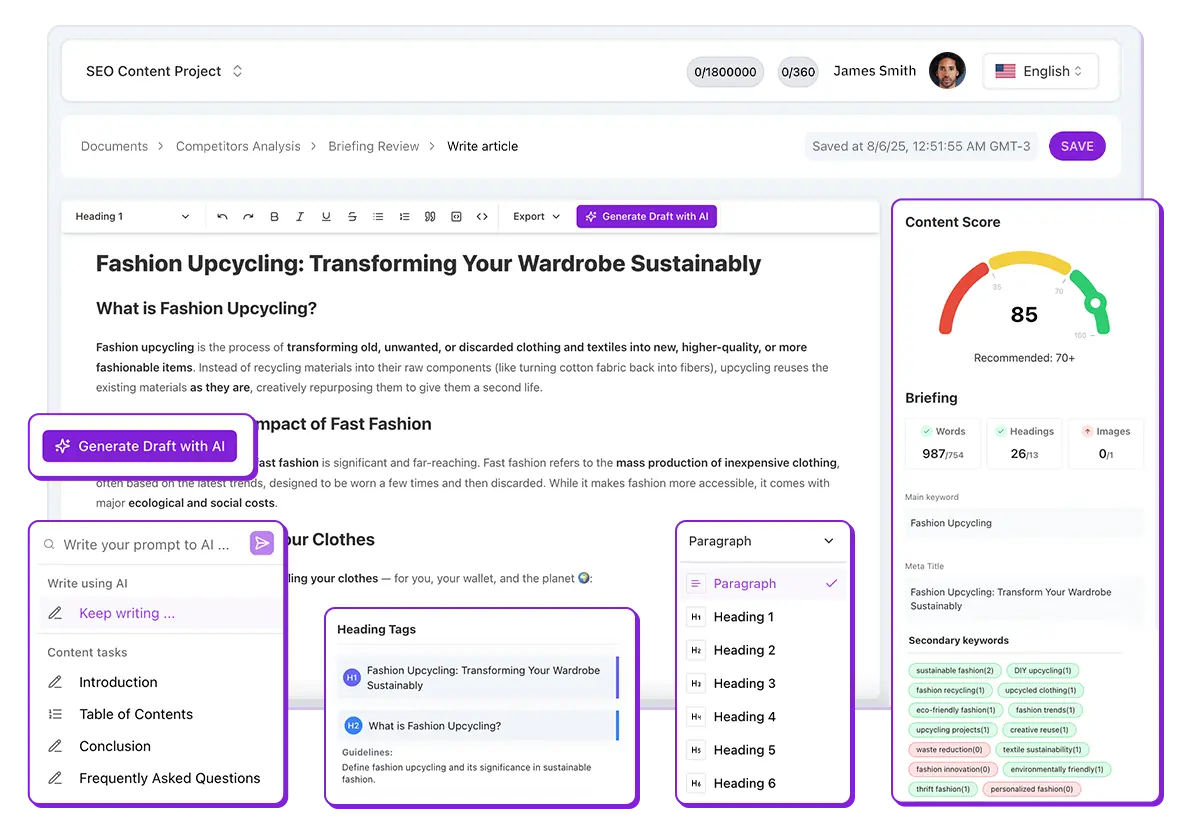
Both tools automatically apply your Brand Guide settings, ensuring every generated text maintains your unique brand voice while feeding the AI exactly what it needs to rank.
Structured data
Structured data is the technical language that allows AI engines to verify your product facts and generate rich snippets. For e-commerce, the most critical markups are Product, AggregateRating, LocalBusiness (for retailers with physical storefronts), Organization and Offer, schema for promotions.
These tags feed the AI with real-time data it needs to confirm your claims. When an AI Overview recommends a product, it prioritizes pages with clear pricing, stock availability, and verified reviews. If the AI cannot validate this data through your code, it won’t risk recommending your store to the user.
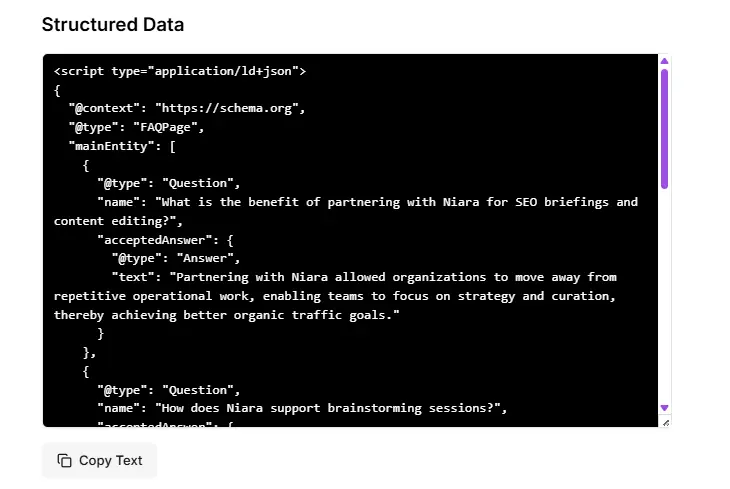
To ensure your technical foundation is ready for the holiday rush, you can use Niara’s Structured Data Generator. Simply insert your URL and choose the type of schema you need (Product, Review, or Article). Niara will generate the correct JSON-LD code for you to implement.
Try Structured Data Generator for free!
Long-tail keyword (conversational SEO)
Long-tail keywords are highly specific search queries that reflect a clear, conversational intent from the shopper. Data from Google shows that AI-driven searches are now three times longer and significantly more conversational than standard queries. Shoppers now ask complex, multi-layered questions like “gifts for a 40-year-old male architect under $100”.
This shift is driven by the advanced reasoning and natural language processing of modern AI. Unlike traditional search engines that often struggle with complex phrasing, generative assistants can analyze long, detailed requests with high accuracy. This gives consumers the freedom to be incredibly specific, trusting that the AI will understand the nuances of their needs and deliver a perfectly tailored recommendation.
Now, your strategy should focus on:
- Answering multi-layered questions: create content that resolves the user’s search intent by breaking down value propositions and specific use cases.
- Identifying content gaps: find the topics your competitors are ignoring but that AI engines are looking for to satisfy complex queries.
You can use Niara’s Content Workflow to automate this entire process. Simply input your target term and location, and the tool will analyze the SERP to generate a briefing with GEO recommendations.
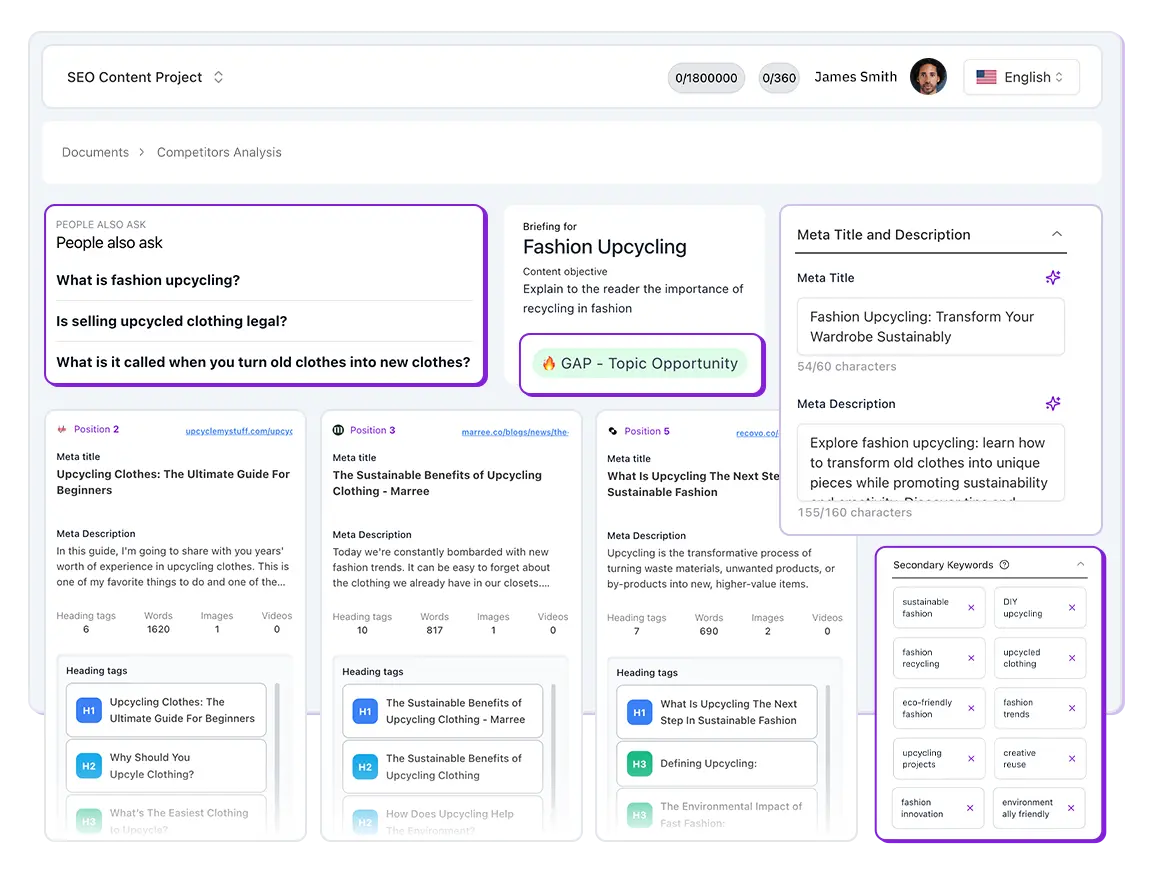
The AI identifies exactly what is missing from the current results and generates a complete article based on your Brand Guide and main goal. This ensures your content is not only data-rich but also perfectly aligned with your brand voice, making it the ideal answer for both users and AI assistants.
Repurpose content
Content creation is resource-intensive, making repurposing a mandatory strategy for maximizing ROI. A single high-quality asset should fuel multiple channels, as both demand gen campaigns and organic search benefit from diversified formats. Video, in particular, has become the highest-converting asset this year for product demonstrations and unboxing experiences.
While repurposing has always been a core SEO tactic, it is now more critical than ever due to the multimodal and multi-channel capabilities of AI. Modern generative assistants now knows how to “watch” videos and “listen” to audio to understand context. Furthermore, they are multi-channel by nature, pulling references from beyond the traditional Google SERP — which is why we now see YouTube, Instagram, LinkedIn, and Reddit being cited directly in generative results.
For e-commerce, this means bridging the gap between social proof and search visibility through a multi-platform approach. A single high-quality production can start as a long-form video on YouTube, be sliced into quick, engaging reels for Instagram or TikTok, and then be transformed into a detailed blog post. Just ensure that your product demonstrations, day in the life usage clips, or unboxing videos reach the user in their preferred format while providing the granular data that AI engines crave.
Niara’s YouTube to Article helps you turn your holiday gift videos or tutorials into SEO-optimized blog posts in seconds. Simply paste the YouTube URL, and Niara will extract the transcript, analyze the core concepts, and generate a fully formatted and optimized article.
Try YouTube to Article for free!
Technical SEO (speed and indexing)
Your technical infrastructure is the foundation of a successful holiday e-commerce SEO strategy. During peak events like Black Friday, a site that takes four seconds to load will bleed conversions. Since Google uses mobile-first indexing, your site’s performance on mobile devices is the primary benchmark for rankings.
To handle massive traffic spikes without buckling, you must optimize your Core Web Vitals through aggressive caching, image compression, and by minimizing scripts that block the main thread.
For omni-channel retailers, technical readiness also means bridging the gap between digital discovery and physical fulfillment. A winning holiday SEO strategy requires real-time updates to your Google Business Profiles, including holiday hours, special closures, and local in-stock inventory feeds — that also needs to be reflected in your website’s structured data.
When a user searches for a last-minute gift, Google prioritizes local listings that explicitly confirm the item is available for immediate pickup nearby.
To stay ahead of these technical demands, you can easily consult Niara’s Technical SEO Agent 24/7. This agent integrates data from Google Search Console and Page Speed Insights to monitor indexing errors and Core Web Vitals health in real-time.
Through a conversational interface, you receive personalized recommendations and specific fixes to your CMS. This centralizes your entire technical health workflow within Niara, ensuring your store remains fast, indexed, and ready for the holiday rush.
On-page optimization for holiday pages in bulk
Optimizing thousands of SKUs for seasonal promotions is a massive operational bottleneck. E-commerce retailers often resort to generic, duplicated copy when faced with scaling their on-page optimization for holiday pages, which destroys your chances of ranking for promotion keywords.
Beyond the ranking struggle, generic information simply doesn’t perform. When your product descriptions are identical to dozens of other sites, Google has no reason to prioritize your store. According to E-E-A-T guidelines, the search engine rewards content that demonstrates unique value and helpfulness.
That’s why every product page, category page, and promotional landing page requires unique, intent-driven content that highlights the specific value of the holiday offer while maintaining your brand’s unique identity.
Bulk optimization is necessary, but it must be executed without losing brand voice. Standardizing title tags, meta descriptions, and product features across a massive inventory requires a system that understands context.
Leverage Bulk Content for mass-generating meta tags and product descriptions. This feature allows you to generate hundreds of descriptions, titles, and meta tags in minutes. Because it connects directly to your Brand Guide, every piece of content generated adheres strictly to your persona, tone of voice, and brand rules, making it ideal for enterprise e-commerce operations.
Local SEO and GBP optimization holidays
For retailers with physical storefronts, the final weeks of the holiday season are dominated by local search. As shipping deadlines pass, shoppers pivot from traditional e-commerce to local holiday search terms. Capturing this last-minute demand requires a flawless strategy for pickup, delivery, and store localization.
- Highlight BOPIS availability: clearly state “Buy Online, Pick Up In Store” options and real-time inventory levels on local landing pages.
- Leverage Google Posts: use frequent updates to highlight daily deals and urgent inventory status to increase visibility in the “Local Pack”.
- Ensure technical consistency: maintain identical NAP (Name, Address, Phone) data across all directories and implement LocalBusiness schema.
Data-driven agility: pivoting in real-time
As seasonal dates are volatile, you need data-driven agility with your holiday marketing plan. Through the period you must leverage first-party data — like purchase history and site search behavior — to fuel AI campaigns with accurate signals, reducing wasted spend and sharpening your organic targeting.
Speed is essential, which means moving away from static spreadsheets. Conversational Analytics allows you to interact with your data naturally. Instead of manual filtering, you can simply ask which products are losing visibility and pivot your strategy before peak shopping days arrive.
With Niara’s Search Analytics, you get 5x more data than GSC and can use ChatSEO to identify top-performing pages instantly. You can speak directly with your data (for example, asking for the “top 10 keywords with the most clicks in the last 7 days”), eliminating complex analysis and allowing for rapid, informed decisions when every second counts.
Post-holiday evergreen strategy
The holiday season doesn’t end on December 26th. A robust post-holiday evergreen strategy is essential to protect your rankings and prepare for the following year.
One golden rule: never delete a high-performing holiday page. Deleting these URLs leads to 404 errors and the total loss of the link equity you worked so hard to build. Instead, implement a strategic archive plan to keep that authority alive.
- Once the promotions conclude, transition your pages by removing seasonal messaging and replacing it with evergreen content or an “early access” sign-up form for next year.
- If a specific product is permanently discontinued, use a 301 redirect to the most relevant category page to0 preserve your SEO value.
Finally, every successful seasonal SEO should include a teardown phase. Review which elements performed best and consolidate those insights into your core category pages. This cycle of creation, optimization, and consolidation ensures that your site’s overall authority grows stronger with each passing season, turning temporary spikes into long-term growth.
Your AI-powered competitive edge
Succeeding in the holiday season requires a flawless execution of technical health, intent-driven content, and real-time agility. As AI-driven search becomes the norm, the margin for error during the Golden Quarter is zero.
Your holiday SEO strategy must evolve from static pages to a dynamic ecosystem where seasonal landing pages and gift guides are optimized not just for keywords, but for the complex, conversational queries of modern shoppers.
While AI provides the scale necessary to manage massive e-commerce operations — from Black Friday SEO to Cyber Monday SEO, and other important events — human strategy remains the decisive factor. AI can generate thousands of unique descriptions for holiday bundles, but you are the one who defines the persona and the unique value proposition.
Simplify your holiday SEO with Niara. Centralize your workflows, automate your technical monitoring, and scale your content production without sacrificing quality.
Try Niara for free and transform you holiday strategy today!
