
In online retail, technical errors are rarely isolated incidents. The primary challenge of e-commerce technical SEO is scale. A single bug within a product detail page (PDP) template can instantly compromise tens of thousands of URLs, turning a minor oversight into a site-wide crisis.
When developers push a minor update to a global header or a faceted navigation filter, a misconfigured canonical tag or a broken script cascades across the entire catalog. This domino effect turns minor code adjustments into catastrophic visibility drops.
Managing crawl budget e-commerce efficiency becomes impossible when search engine bots are trapped in infinite loops generated by poorly parameterized URLs or duplicate content e-commerce issues stemming from dynamic tracking variables. Effective indexation management is the only way to ensure your most profitable pages stay visible.
The problem is that most marketing and development teams only become aware of massive technical failures days or weeks after the fact, usually when organic traffic and revenue have already plummeted.
Don’t let a single line of code tank your annual revenue. In this guide, we move beyond the what-ifs to provide a battle-tested roadmap for securing your site’s infrastructure with Niara’s Technical SEO Agent.
Let’s dive in.
Also read: Technical SEO for E-commerce: Critical Errors Killing Your Online Store’s Visibility
Why manual technical SEO monitoring fails at scale for e-commerce
Template complexity is the defining characteristic of modern e-commerce platforms. A standard storefront relies on a complex web of dynamic scripts, recommendation blocks, third-party widgets, and localized content delivery networks. Small changes to any of these elements can trigger template-wide errors that are hard to track manually.
For example, technical glitches can quickly escalate:
- Performance: a new review widget might inject render-blocking JavaScript that destroys page speed metrics site-wide.
- Indexability: a slight modification to sitemap logic might accidentally exclude high-priority category pages.
- Mobile experience: a CSS update could suddenly break your mobile friendly e-commerce layout across thousands of SKUs.
- Data Integrity: human auditors cannot manually verify schema markup across 100,000 SKUs every time a team pushes a sprint release.
Manual monitoring simply cannot keep pace with the velocity of code deployments and content updates in an enterprise environment. The cost of being reactive is measured not just in lost revenue, but in the sheer exhaustion of the teams maintaining the site’s organic footprint.
Firefighting technical debt consumes bandwidth that should be allocated to strategic internal linking or content expansion. When SEO managers spend weeks diagnosing faceted navigation traps or hunting rogue canonical tags, they are operating inefficiently.
Automated e-commerce audits are essential because:
- Proactive detection: they monitor the underlying infrastructure to catch anomalies in code execution.
- Efficiency: preventing errors at the template level far outweighs the cost of fixing them post-deployment.
- Ranking protection: they identify issues before search engine crawlers process errors and adjust rankings accordingly.
Niara’s Technical SEO Agent: your 24/7 consultant
Niara’s Technical SEO Agent functions as a dedicated, always-on technical consultant tailored specifically for the complexities of large catalogs. It delivers unified intelligence by seamlessly integrating raw data from Google Search Console and PageSpeed Insights into a single, cohesive dashboard.
This eliminates the friction of toggling between multiple diagnostic tools and manually correlating performance metrics with indexation status.
The Agent goes beyond simple data visualization. It interprets the reports provided by Google, helping you identify if a spike in errors suggests a structural template issue rather than a one-off anomaly.
By analyzing the GSC data through a conversational interface, you can quickly pinpoint which groups of URLs are failing. This allows your team to address the root cause in the CMS or template, rather than investigating individual links.
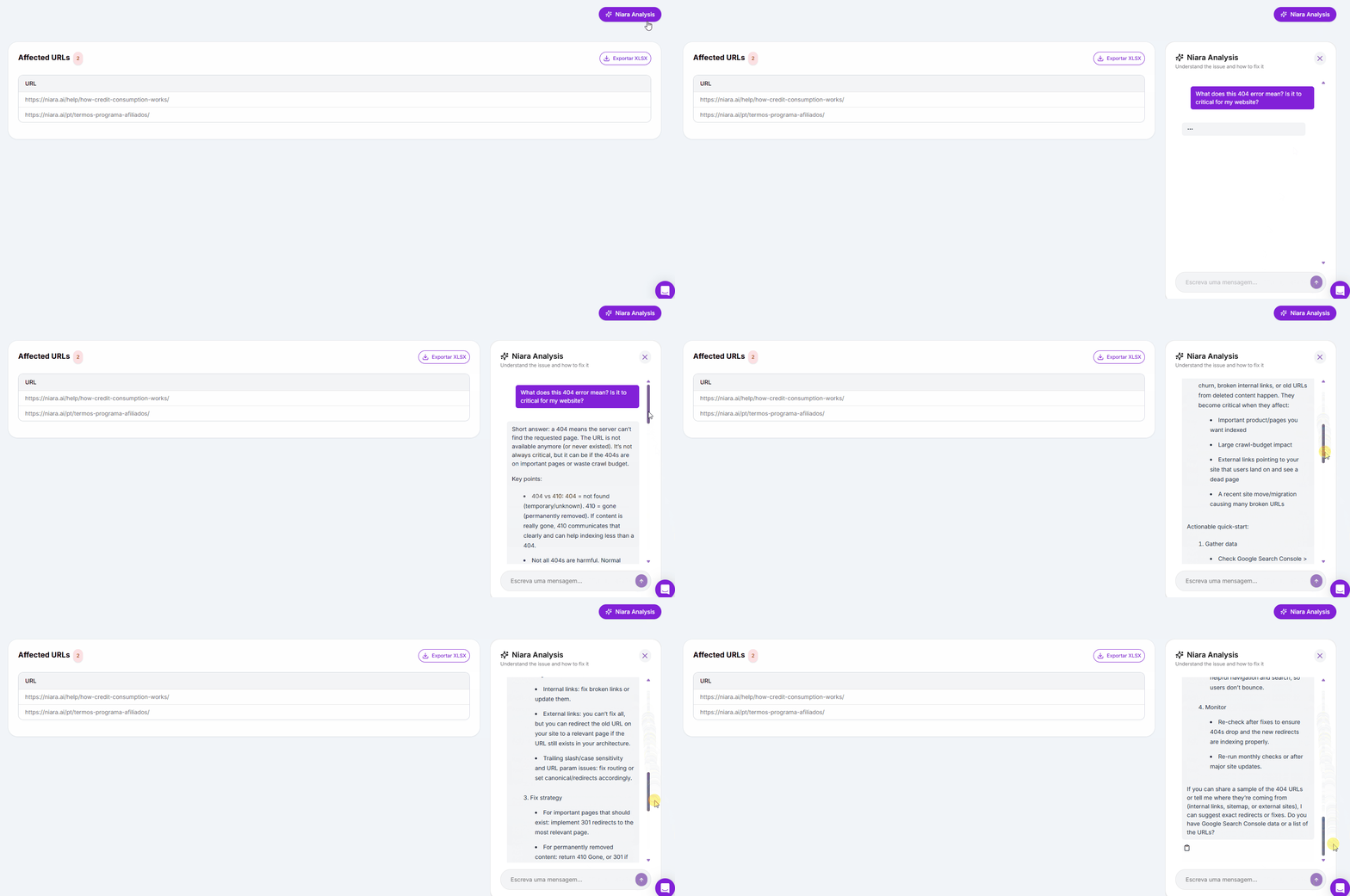
In addiction, Niara offers CMS-specific recommendations. Whether a store is built on Shopify, Magento, or Salesforce Commerce Cloud, Niara understands the unique architectural quirks of each platform. The Technical SEO Agent provides targeted, actionable fixes that align with the specific templating language and routing rules of the underlying CMS.
Technical optimization is no longer an afterthought when teams use Niara. The platform accelerates the path from raw SEO data to engineering execution, enabling the rapid resolution of infrastructure issues and fostering a more efficient development environment.
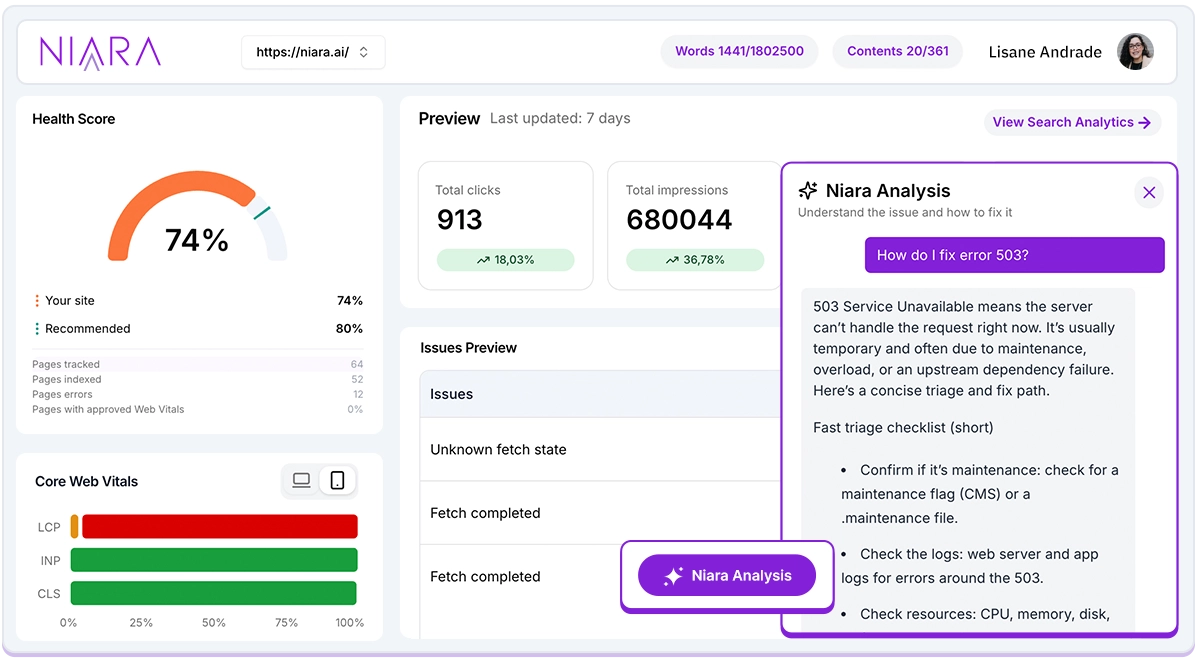
Future-proofing performance (Core Web Vitals)
Scaling user experience requires continuous vigilance over Core Web Vitals across the entire catalog. As marketing teams add new site features, promotional banners, or third-party tracking scripts, the cumulative impact on rendering speed and layout stability can be severe.
Niara monitors these changes too, ensuring that new deployments do not compromise the site’s performance baseline.
Proactive health checks are critical for maintaining a solid SEO floor, especially during high-traffic, high-stakes periods like Black Friday or Cyber Monday. By continuously auditing the infrastructure, Niara ensures that the e-commerce platform remains fast, stable, and fully optimized for both users and search engine crawlers, regardless of catalog size or traffic volume.
Proactive fix workflow with Niara
Executing a proactive workflow relies on turning diagnostic data into engineering action. Niara’s Conversational Analytics and Technical SEO Agent revolutionize this process, moving you from manual data mining to strategic decision-making.
Instead of exporting endless CSVs, e-commerce SEO professionals can follow this streamlined workflow:
- Identify and prioritize critical issues: access the dashboard to see all errors automatically categorized. Niara separates critical issues from minor warnings, so you know exactly which template failures to prioritize for maximum ROI.
- Analyze affected URL clusters: click on any diagnosed problem to instantly view the full list of affected URLs. This allows you to identify if a bug is isolated or a widespread structural issue across your product or category pages.
- Consult Niara: use the conversational interface to ask: “What is causing this error and how do I fix it on Shopify?”. Niara explains the root cause, suggests fixes tailored to your specific CMS, and offers follow-up questions to clear up any doubts.
- Bridge the gap with developers: copy the AI-generated technical instructions or request a step-by-step guide directly in the ChatSEO. This provides your engineering team with the exact context needed to deploy a rapid, accurate solution at the template level.
Mastering Core Web Vitals
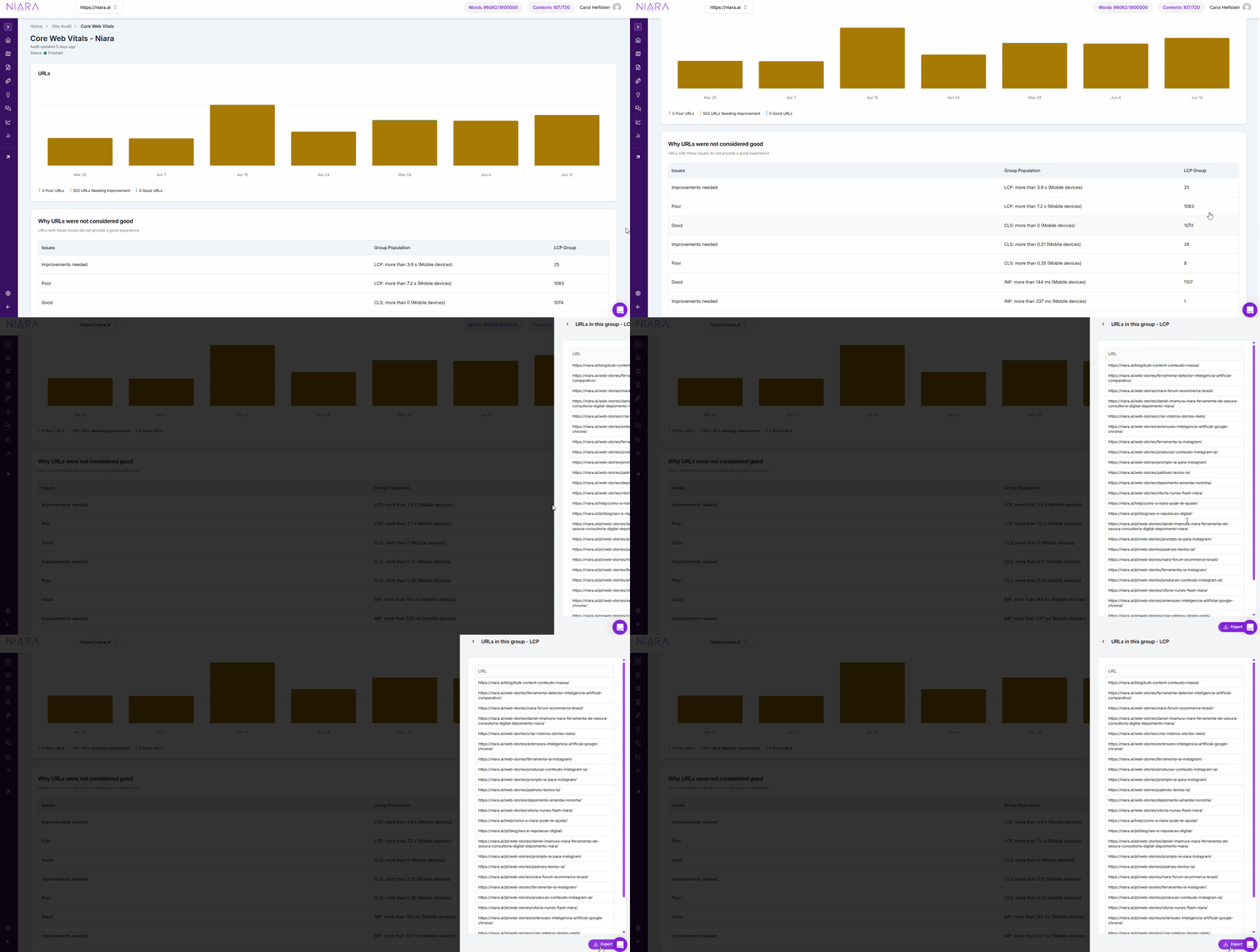
Scaling user experience requires continuous vigilance over performance metrics. Niara’s CWV panel simplifies this by automatically segmenting your catalog into Poor, Needs Improvement, and Good performance buckets.
- Metric-specific analysis: the system divides pages by LCP (Largest Contentful Paint), CLS (Cumulative Layout Shift), and INP (Interaction to Next Paint).
- Actionable insights: click any metric to see the impacted pages and export the list.
- Dev-ready instructions: ask the ChatSEO for specific optimization steps for high-priority pages and pass those requirements straight to your development team to ensure a fast, stable shopping experience.
Technical SEO in the age of Generative AI and Agentic Commerce
It’s important to emphazise that the role of technical SEO has evolved beyond traditional search engine rankings. We are entering the era of agentic commerce, where AI agents (not just humans) will be responsible for discovering, comparing, and even purchasing products.
For an AI agent or a generative search engine to recommend your store, your technical foundation must be flawless. If your site’s infrastructure is broken, your products effectively cease to exist for the next generation of shoppers.
- Data clarity for LLMs: Large Language Models (LLMs) rely on clean, structured data to understand product attributes. Technical errors in your schema markup or messy HTML templates prevent AI from accurately reading your catalog, leading to missed opportunities in AI-driven recommendations.
- The speed of discovery: in a world of agentic workflows, latency is a conversion killer. AI agents prioritize high-performance sites that allow for rapid data extraction. Niara’s focus on Core Web Vitals ensures your infrastructure is fast enough to serve both human users and AI crawlers.
- Indexation as a competitive edge: with the rise of AI Overviews, being indexed is only the first step. You need a clean, error-free site architecture so AI can crawl your deepest product layers.
Leveraging Niara to maintain a robust technical baseline ensures your brand is future-ready. In today’s AI-centric marketplace, technical precision is the key to staying competitive and driving long-term growth.
Read more: We analyzed Target, Ulta Beauty and Williams-Sonoma: who’s ready for the AI era?

Treat SEO as infrastructure, not a checklist
Scaling SEO requires tools built for scale. When managing an e-commerce platform with thousands of dynamic URLs, traditional manual audits and reactive troubleshooting simply cannot protect your organic visibility. Technical SEO must be integrated into the foundation of your site’s architecture, monitored continuously, and managed as critical infrastructure rather than a periodic checklist of tasks.
Stop reacting to traffic drops. Start predicting failures.
Try Niara’s Technical SEO Agent for 7 days free and take control of your store’s health.
