
Many professionals have fallen into the trap of treating AI like a content vending machine: insert a keyword, pull a lever, and wait for a top-ranking article to pop out. It’s done! But let me tell you… it can feel efficient, but this more is better mindset is currently the fastest route to digital invisibility.
Scale without curation is now just sophisticated spam, specially in a scenario where anyone can generate a thousand words in seconds. Volume has lost its value.
SEO success was never measured by how much you publish, but by the unique perspective and human value you add to the machine. That is a rule set before the rise of AI. Actually, one of the biggest benefits of this technology is that it gives us the power to think more critically and review our digital strategies.
It’s time to reorganize yours.
What separates a penalized website from one that grows organic traffic by 110% using AI? The answer isn’t in the tool, but in the methodology. Below, you’ll learn Google’s new survival rules, how to avoid thin content traps, and the real-world case study of how Ânima Educação used Niara to scale 18 brands simultaneously without sacrificing content quality
Read more: Content Scaling: How to Do It Without Losing Quality
What the data says about raw AI content
According to the “AI in Content Marketing Report 2025” by Hookline, 82% of users can spot AI-generated content within the first few paragraphs. This detection directly impacts brand perception, with 40% of people stating they think less of a brand that uses AI without care.
Trust is the currency of digital conversion, and raw AI content actively bankrupts that trust.
Users are looking for actionable insights, proprietary data, and nuanced industry perspectives that a prompt alone cannot generate.
Using AI to scale content without a final human touch drives potential customers away when they are most ready to buy. You don’t want to push users away, right?
Google actions against AI Slop
One thing needs to be clarified: Google doesn’t care if a human or an AI wrote the content. The real issue that is evolving is the volume-first trap that has emerged since AI became a household tool.
Since AI went mainstream (even among those who don’t work in marketing) a dangerous logic has taken hold: “If AI models need web content to answer users, then I just need to flood the web with content so the machine cites me.” Many believe this massive scale is the ultimate shortcut to dominating generative search.
But it isn’t. In fact, flooding the index with generic, automated pages is exactly what Google is now hunting. Recent events from July and August 2026 prove that point.
- The thin content manual action: in July, a major forum saw over half a million posts suppressed overnight. Google issued a manual action for “Thin content with little or no added value”. The problem was cause by an AI chatbot acting as a staff member that had posted more than 100,000 responses. Because AI deals in received knowledge rather than actual human experience, Google judged the mass-produced answers as unworthy of ranking.
- The rise of the S-CTS: during the August Spam Update, reports surfaced about a new weapon in Google’s arsenal, the Scalable Cluster Termination System (S-CTS). This system is specifically designed to identify and terminate entire networks of mass-generated AI spam. It targets the malicious method of production, like creating thousands of pages primarily to manipulate rankings rather than help users.
Data from the latest updates shows that sites created with full automation from day one are being filtered across the board. Additionally, SEOs are reporting that content with AI Slop formatting (templated subheadings, repetitive bullet points, and 500-word articles expanded from a single sentence) is losing visibility.
Google is now effectively distinguishing between using AI as a writing assistant and using it as an unsupervised factory — which is a ranking risk. If you’ve been following the premise of mass publishing without curation and noticed your competitors are winning in generative search while your brand is not, it’s time to rethink your content creation process.
It needs to be clear: the problem is not the AI, but the method of production
Recent algorithm updates aren’t actually targeting AI tools. Instead, they’re cracking down on the malicious use of mass-produced content that clutters search results without adding real value.
Google defines this as generating a large number of pages primarily to manipulate search rankings rather than to support users. If your site looks like AI Slop, you are essentially creating the new doorway pages.
The logic of “publish more to be cited more” only works if the content is worth citing.
You can use AI to scale your insights and increase your volume of quality, not just your word count. Every piece of content needs to add something new to the conversation and to achieve this, human-in-the-loop is a must-have to provide the unique value that raw AI simply cannot replicate.
Scale vs. relevance: where success lives
As the SEO field is evolving with AI being implemented into processes, it’s important to work smarter. Scalable production should defeat the blank page syndrome and accelerate operations, but it must never replace the specialist’s clinical eye.
The gap between a winning strategy and a site-wide penalty comes down to intentionality. We must distinguish between “filling the index” and “building authority”, as the difference between modern spam and a sophisticated AI strategy has never been more defined:
| Feature | Spam approach (The Slop Factory) | Strategic approach (scalable authority) |
|---|---|---|
| Output | 500 generic articles with zero unique insights. | 500 structured pages powered by AI research. |
| Value add | Regurgitated “received knowledge” found elsewhere. | High information gain with original data or opinions. |
| Structure | No internal links; poor, robotic formatting. | Fully optimized architecture refined by brand identity. |
| Human role | None (Full automation/Unsupervised). | Human-in-the-loop for editorial oversight. |
| Google’s view | Flagged as “Thin Content” or “Doorway Pages.” | Recognized as a trustworthy, authoritative source. |
Think of AI as a powerful engine and the SEO specialist as the driver. The engine provides the speed (scale), but the driver provides the direction (relevance).
When you use AI strategically, you are building a content ecosystem.
Relevance is the only currency that Google accepts, and curation is the only way to mint it.
Also read: Does AI Content Rank? The Truth + Case Study (2x Market Share)
What Google rewards? Helpful, brand-aligned content (E-E-A-T)
Google’s recent updates have solidified a major paradigm shift: the algorithm now actively demotes content created for search engines. Instead, it rewards domains that demonstrate genuine Experience, Expertise, Authoritativeness, and Trustworthiness (our always beloved, E-E-A-T).
To signal authority effectively, your content must move beyond generic definitions:
- Experience: requires showing first-hand involvement
- Expertise: demands explaining complex mechanisms, like detailing exactly how a specific software feature reduces churn for e-commerce platforms.
- Authoritativeness: is built through industry recognition
- Trustworthiness: remains the foundation, requiring transparent authorship and factual accuracy.
The most overlooked signal, however, is brand alignment. When every article and landing page shares a consistent identity, search engines recognize a cohesive entity rather than a disparate collection of keywords. Practical execution includes:
- Verified authorship: bios with verifiable credentials and real-world experience.
- Information gain: original research or proprietary data that AI cannot scrape elsewhere.
- Contextual depth: moving past what something is to explain the “how” and “why” within your specific industry.
So, how do I scale without becoming slop? Meet Niara!
Scaling your content operations requires a unified system that eliminates operational bottlenecks without compromising the depth of your content. Niara provides a centralized platform that integrates AI-driven efficiency with strict brand governance, allowing teams to multiply their output while maintaining absolute quality control.
Also read: [GUIDE] Master GEO/AEO with Niara: Step-by-Step Optimization
Pillar 1: the Brand Guidelines
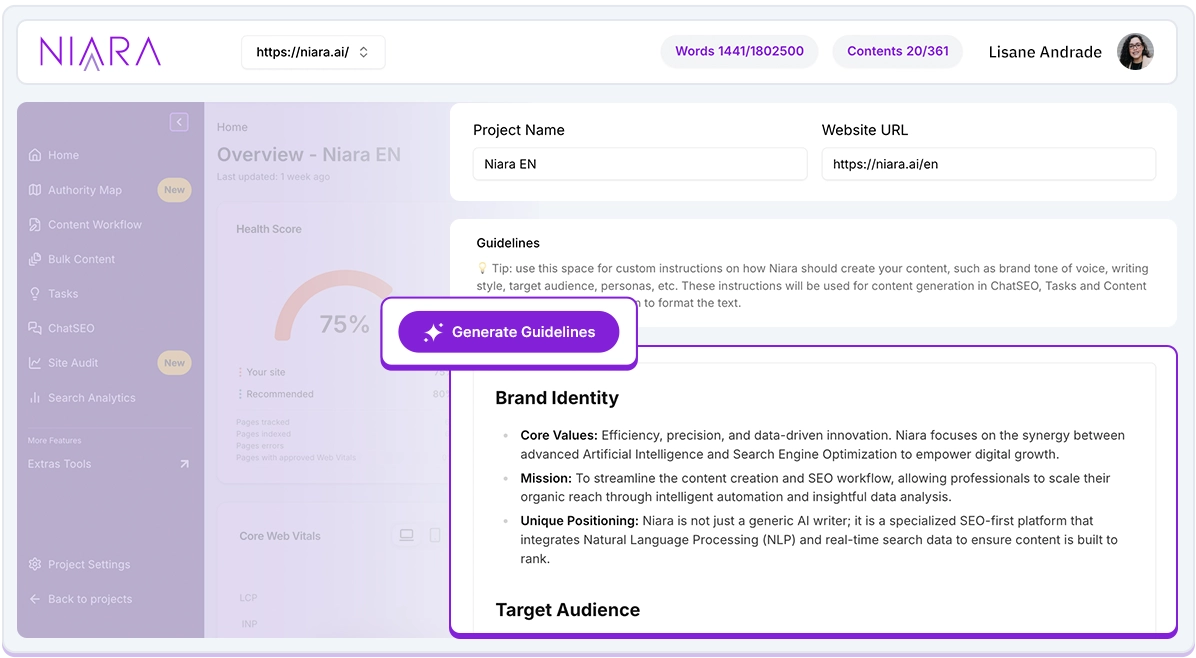
Setting up your tone of voice and persona is the mandatory first step in any successful SEO campaign. With Niara’s Brand Guidelines, you configure these rules, constraints, and stylistic preferences a single time within your project settings.
The platform automatically applies this context across all tools, ensuring absolute consistency and a unique verbal identity for every asset generated.
This eliminates the need for massive, repetitive prompts and saves manual editing time later, as the initial output already sounds like your brand.
Pillar 2: Bulk Content for the heavy lifting
Once the brain is established, you need the muscle to execute at scale. Using Bulk Content, teams can generate content in bulk in seconds (titles, descriptions or product descriptions).
Unlike generic generators, our bulk process is highly structured and data-driven. You simply fill out our spreadsheet with specific product attributes, unique features, or targeted keywords, and Niara generates hundreds of personalized content based exactly on the data you provided.
- Efficiency at scale: whether you are managing an enterprise e-commerce site or a massive directory, Niara can generate 500 unique product descriptions in 15 minutes.
- Total control: because it’s based on your specific spreadsheet data, the AI doesn’t hallucinate. It follows your lead.
Are you part of an enterprise company? For larger teams with complex workflows, we can fully customize the Bulk Content tool (and our other agents) to fit perfectly into your existing production line, ensuring a seamless integration between your data and our AI.
Pillar 3: the specialist layer (you!)
The time Niara saves you must be reinvested into the elements that actually move the needle. This is the specialist layer.
Human editors take the brand-aligned, AI-generated drafts and add exclusive industry insights that only a practitioner would know. They ensure technical accuracy, verifying claims against current industry standards.
Finally, they execute strategic internal linking, connecting the new asset to existing high-authority pages to build a robust semantic SEO strategy.
Case study: how Ânima Educação scaled SEO for 18 brands with Niara
Managing SEO for a single brand is challenging, but orchestrating 18 distinct higher education brands during the year’s most competitive search window is a massive operational hurdle. This was the reality for Ânima Educação during Brazil’s national exam cycle (ENEM). They needed to maintain regional relevance and brand consistency across 18 domains while competing for visibility in both traditional SERPs and emerging AI Overviews.
By leveraging Niara’s Enterprise technology, Ânima transformed their SEO workflow. Instead of getting bogged down in the manual production of thousands of pages, the team used Niara as an efficiency engine.
Our Authority Map and Bulk Content tools allowed them to automate the foundational drafting process, ensuring every piece of content was technically optimized and aligned with each brand’s unique voice. This shift allowed their specialists to move from writing to strategic curation.
The impact of this AI-powered scale was decisive: the team surpassed their organic channel goals by 110%, achieving a 16% year-over-year traffic increase.
With Niara, Ânima ensured that all 18 institutions remained authoritative sources, proving that with the right technology, you can scale without sacrificing the human expertise that search engines (and students) demand.
Read the full case: Case Study: How Ânima Educação Scaled SEO for 18 Brands with Niara and Exceeded Organic Goals by 110%
Transition plan: from volume-first to value-first SEO step-by-step
If you are ready to stop the volume trap and start building real authority, you need a structured roadmap. Here is how to recalibrate your content machine:
Step 1: establish your brand governance
Before generating a single word, lock in your identity. Use Niara’s Brand Guidelines to define your persona, tone, and stylistic constraints. This ensures that every asset is a cohesive extension of your brand, not just a random collection of keywords.
Step 2: implement a human-in-the-loop audit
Don’t let AI run on autopilot. Every piece of content must pass through a rigorous content governance quality framework:
- Factual accuracy: cross-reference all data and claims against primary sources.
- Information gain: inject micro-stories, original research, or proprietary data that AI cannot scrape elsewhere.
- Content depth: ensure the page answers the user’s pain points comprehensively, moving past generic definitions to explain how and why.
Step 3: align content with technical UX
Quality content fails on a broken page. High E-E-A-T requires a frictionless experience. Use Niara’s Technical SEO Agent to monitor Core Web Vitals and ensure your pages load instantly.
Then, use our Structured Data Generator to help search engines instantly identify the entities and context within your optimized text.
Step 4: measure what actually matters
Stop obsessing over vanity metrics like raw pageviews. A value-first strategy tracks:
- Engagement and retention: are users staying on the page and consuming the content?
- Topic coverage: are there semantic gaps in your clusters?
- Micro-conversions: is the content valuable enough to drive newsletter sign-ups or downloads?
You are still the pilot
As generative search continues to evolve, the gap between those who use AI as a factory and those who use it as a laboratory will only widen.
Success in this new landscape requires a delicate balance: you need the speed to remain competitive and the substance to remain authoritative.
Niara was built for this exact moment. Whether you are managing a single blog or dozens of complex domains like Ânima Educação, our platform ensures that your scale always follows your strategy.
Don’t let your brand become another statistic in the next spam update. It’s time to move beyond generic automation and start building a content ecosystem that both search engines and humans actually want to read.
The future of SEO is scalable, curated, and brand-aligned. Are you ready to lead the way?
Start your Niara journey today and simplify your SEO for good.
