
More than ten years ago, SEO professionals primarily used alt-text as a bridge to help search engines understand visual content. While these descriptions have always been—and remain—a vital pillar of web accessibility, they were once the only way a search bot could categorize an image. Today, the technology has evolved far beyond simple translation and search engines have become visual thinkers.
By leveraging multimodal AI, they now analyze pixels, context, and intent with sophisticated clarity. With the explosion of Google Lens and AI-driven discovery, images have transitioned from decorative assets to foundational ranking signals.
Thriving in this new era requires a shift from basic compression to multimodal image optimization. This involves anchoring visuals in reality to prevent AI hallucinations or even omissions and ensuring every pixel serves as a clear data point for models like Gemini and GPT-4o. By leveraging advanced workflows and tools like Niara, businesses can bridge the gap between raw imagery and machine intelligence.
Transforming how the world perceives a brand is essential for success. It is time to explore the future of visual search.
How Search Engines Interpret Visual Content
To master image SEO, you first need to understand how modern search engines process visual data. We are now in the era of neural networks that look at pixels.
From Pixels to Tokens
Think of an image not as a static picture, but as a collection of data points. When an AI agent or a search engine crawler “sees” an image, it breaks the visual field down into small patches and tokens. These tokens are then processed through layers of a neural network that identify patterns, like edges, colors, textures, and eventually, concepts.
This process allows the AI to understand that a specific arrangement of pixels represents a “vintage leather armchair” even if you haven’t explicitly labeled it. However, the AI’s understanding is only as good as the data it can extract. This is why the technical quality of your images is a direct SEO factor.
The Concept of Grounding
In AI terminology, “grounding” refers to the process of linking abstract concepts (text) to real-world objects or visual representations. For SEOs, grounding is the bridge between your copy and your imagery. When your text and images tell the same story, you provide “grounded” evidence to the search engine that your content is high-quality and trustworthy.
Multimodal AI evaluates grounding by cross-referencing visual data with text. For instance, a “vegan meal prep” guide paired with a photo of a steak creates an immediate relevance conflict.
Inconsistent imagery can lead to AI hallucinations, where the search engine misinterprets your page’s intent, leading to poor rankings or exclusion from AI-generated summaries.
Resolution Matters
A low-quality, blurry, or pixelated image confuses the AI. Low pixel density and compression artifacts introduce digital noise into the grid, forcing the AI to work with distorted vectors. Instead of accurately mapping the scene, the model may experience hallucinations, where it confidently misidentifies objects or text simply because the underlying visual tokens were too blurred to decode.
If an image is too pixelated for an AI agent to index with high confidence, the system will likely exclude it from prominent features like AI Overviews or visual Knowledge Panels.
Maintaining high resolution ensures that your visual content remains “machine-readable,” allowing AI to verify and recommend your data without the risk of misinterpretation.
Where Images Appear in Search
The Image Search tab is just the tip of the iceberg. Visual content is now woven into the entire search experience.
- Google Images: the traditional home for visual search, but now heavily influenced by Google Lens technology.
- Main SERP (Organic Results): Google frequently displays “Image Packs” or individual thumbnails next to organic listings to increase click-through rate (CTR).
- AI Overviews & AI Mode: AI-generated answers often pull images to illustrate points. Being the source of that image is a massive authority signal.
- Knowledge Panels: For brands, people, or specific products, images in Knowledge Panels are the first thing a user sees.
- Google Lens & Visual Match: Users can now search with an image. If your product photo is optimized, it can appear as a “visual match” when someone snaps a photo of a similar item in the real world.
- Social Previews (Open Graph): While not a direct ranking factor for Google, how your images appear on LinkedIn, X, or Facebook drives the social signals and traffic that indirectly boost SEO.
8 Key Elements of Image SEO
To compete in this multimodal world, you need a rigorous approach to the technical and semantic elements of your images. Here are the essential components of a modern image SEO strategy.
Image File Naming
The file name is the first clue you give a search engine. “IMG_8821.jpg” tells Google nothing. “men-waterproof-hiking-boots-brown.webp” tells Google exactly what the image is, its purpose, and its attributes.
Best Practices:
- Use hyphens to separate words (Google treats hyphens as spaces; it treats underscores as single words).
- Be descriptive but concise.
- Include your main keyword only if it’s genuinely relevant to the image. Avoid keyword stuffing.
- Keep it human-readable.
Semantic Alt Text and Accessibility
Alt text (alternative text) serves two critical masters: accessibility (for screen readers used by visually impaired users) and search engine crawlers.
In the era of AI, we should aim for Semantic Alt Text. This means moving beyond a list of keywords to “anchoring” the image in its specific context. Instead of alt=”coffee cup”, use alt=”A steaming cup of artisanal espresso on a wooden cafe table with latte art”. This provides the grounding we discussed earlier, helping the AI understand the setting, the mood, and the specific entity.
Alt text best practices include:
- Aim for Semantic Descriptions: Move beyond simple keyword lists and “anchor” the image in its specific context to help AI understand the setting and mood.
- Provide Grounding Details: Include specific entities and environmental factors.
- Prioritize Clarity and Relevance: Ensure the description serves the same informational purpose as the image itself.
- Avoid Redundant Phrases: Do not start with “image of” or “photo of,” as screen readers already identify the element as an image.
- Be Concise yet Descriptive: Maintain a tone that is brief but descriptive enough to integrate naturally with your page’s SEO strategy.
- Focus on Accessibility: Write descriptions that provide visually impaired users with the necessary context to understand the content.
- Enhance Search Engine Indexing: Use the alt text to provide search engines with the specific context needed to accurately index your visual content.
Captions, Titles, and Context
Image captions, title attributes, and semantic context are critical pillars for both SEO and User Experience (UX). While alt text serves the primary purpose of accessibility by describing an image’s contents, captions and titles provide the narrative bridge that explains why a visual matters to the reader and how it relates to the surrounding content.
The Value of Captions and Semantic Proximity
Captions are among the most-read elements on a webpage, often capturing the user’s attention before the body text. Search engines leverage these captions to establish semantic proximity—the contextual relationship between the visual and the text. By providing detailed descriptions, you help search crawlers confirm the relevance of your media.
- Weak Caption: “A graph of sales.”
- SEO-Optimized Caption: “Quarterly revenue growth showing a 15% increase following the Q3 product launch.”
Using captions to add context transforms ambiguous visuals into high-value information. For example, a generic image of an office becomes a powerful branding tool when captioned: “Our sustainable headquarters in Berlin, designed to reduce carbon emissions by 40%.”
Improving Navigation with Title Attributes
The title attribute functions as a secondary layer of the user experience. It creates a tooltip that appears when a user hovers over an image, providing non-essential but helpful guidance without cluttering the visual interface. This is particularly effective for improving site navigation and interaction.
- Functional Example: On a small thumbnail, a title attribute like “Click to expand technical blueprint” clarifies the image’s purpose and encourages user interaction.
Contextual Placement
Algorithms also analyze the environment surrounding it to understand its purpose. When you place an image of a moist carrot cake within a detailed discussion about cream cheese frosting, warm spices, or baking techniques, you provide search crawlers with a clear semantic map.
This is known as contextual signaling, reinforcing the image’s identity beyond just the file name or alt text.
By ensuring your images are “anchored” by relevant descriptions, you bridge the gap between visual content and search engine algorithms. Strategically saying, aligning images with relevant text can boost search rankings, establish topical authority, and enhance user engagement.
Structured Data for Images
To truly stand out, you must use image structured data. By implementing the ImageObject schema via JSON-LD, you provide explicit metadata to Google. This can include the image’s creator, license information, and its relationship to a product or recipe.
Structured data makes your images eligible for “Rich Results,” such as badges in Google features, like Images and Shopping, which significantly boosts visibility.
Image Formats
WebP has emerged as the industry standard for web images, offering a more efficient alternative to traditional formats like JPEG and PNG. When compared to JPEG, which has been the standard for complex photographs for decades, WebP provides superior lossy compression. On average, WebP images are 25% to 34% smaller than comparable JPEG files at the same quality index, significantly improving page load speeds and overall site performance without sacrificing visual clarity.
Similarly, WebP is a more efficient choice than PNG for graphics requiring transparency (an alpha channel). While PNG often results in large, unoptimized files, WebP supports lossless compression and transparency with a much smaller footprint—typically 26% smaller.
By switching to WebP, you gain the best of both worlds: the rich detail of a JPEG and the transparency features of a PNG, all while maintaining a much higher level of performance for SEO and user experience.
Sizing, Compression, and Quality
Large, unoptimized images are the #1 cause of slow page speeds. You must balance visual fidelity with file size.
- Dimensions: Never upload a 4000px wide image if it’s only going to be displayed at 800px. Resize images to their maximum display size before uploading.
- Compression: Use tools to compress the file. Aim for images under 100KB whenever possible, without sacrificing clarity.
- Core Web Vitals: Large images often trigger issues with LCP (Largest Contentful Paint). Prioritizing LCP optimization by compressing media files and utilizing modern formats like WebP is essential for improving page load speeds and enhancing your overall SEO performance.
Responsive Images and Lazy Loading
Users access your site from devices of all sizes. Srcset attribute is a HTML tool designed to enhance responsive web design and performance and using it enables the browser to intelligently choose and download the most suitable image size based on the user’s screen resolution and device width. It reduces page weight and speeds up loading times by ensuring mobile users don’t download unnecessarily large desktop-sized files.
To maximize the impact of your responsive images add the lazy loading attribute to your images. This delays the download of images until they are near the viewport, significantly improving your Core Web Vitals, specifically the Largest Contentful Paint (LCP) score.
Image SEO Strategies for AI Agents
As we move toward a web populated by AI agents (like Perplexity or OpenAI’s ChatGPT), we need to think about how these agents “consume” visuals. AI agents are always looking for images that provide data-rich evidence for the claims made in the text.
To optimize for these agents:
- Prioritize Originality: AI agents are trained on existing data. Original photography or unique data visualizations (infographics) provide “new” information that agents are more likely to cite and display.
- Use Informative Graphics: Instead of stock photos, use diagrams that explain a process. AI agents excel at extracting information from structured visuals.
- Consistency is Key: Ensure your image metadata, surrounding text, and schema all point to the same conclusion. AI agents are designed to spot inconsistencies and may disregard “noisy” data.
OCR and On-Image Text
Optical Character Recognition (OCR) is a technology that allows search engines like Google to “read” and convert text found within images—such as infographics, menus, and product labels—into searchable data. This means the text inside your visuals now directly impacts your SEO and how your page is indexed.
To maximize the benefits of OCR, you must ensure your visual content is machine-readable. As Google’s AI actively scans images to extract text use high-contrast colors and clean, sans-serif fonts. Avoid placing critical text over “busy” or cluttered backgrounds to ensure the AI can parse the characters accurately.
- Why it matters: If your font is too decorative or the contrast is low, the AI might fail to transcribe the text. By using high-contrast, sans-serif fonts, you are essentially “hand-delivering” readable data to the search engine, ensuring it understands the context of your visual content without needing human intervention.
Blurry or overly decorative fonts create ambiguity. If the algorithm misinterprets a product name or price, your site may be excluded from relevant visual shopping results. The AI era has ushered in a “zero-tolerance” policy for ambiguity, especially in e-commerce.
- Why it matters: Google’s AI uses the text it finds in images to categorize products in Google Shopping and Visual Search. If a blurry font causes the AI to misread a price or a brand name, your product might be categorized incorrectly or flagged as “low quality”. Clear imagery minimizes the risk of being excluded from high-converting visual search results because the algorithm can verify your content with 100% confidence.
Entity Association and Visual Co-occurrence
Modern image SEO leverages the synergy between an Entity—a brand’s unique digital identity—and Visual Co-occurrence, the algorithmic process of categorizing a brand based on the recurring objects and themes found within its imagery.
By strategically placing brand assets alongside industry-specific symbols, businesses can influence how search engines perceive their “brand DNA”, helping Google’s Knowledge Graph establish a clear connection between the company and its niche. This sophisticated approach moves beyond traditional keywords, utilizing visual context to build topical authority and enhance search visibility, ensuring that the brand is accurately identified and prioritized for relevant audience queries.
- Entity Association: AI categorizes your brand or product based on the objects and settings surrounding it. For example, photographing a watch alongside luxury cars and premium materials signals to the AI that your “Entity” belongs in the “Luxury” category.
- Visual Sentiment Analysis: Search engines now analyze the emotional tone of images to better match user intent. Imagery that conveys “trust” and “professionalism” is crucial for YMYL (Your Money Your Life) websites, as AI uses this sentiment to rank pages that align with a user’s search for stability or authority.
- Strategic Staging: Every element within a photo serves as a potential ranking signal. It is essential to ensure your visuals reflect your written message to avoid a “semantic gap”. For instance, a travel blog about budget backpacking should feature realistic imagery rather than luxury settings to maintain topical consistency for AI crawlers.
Did You Know Niara Simplifies Your Daily Optimization Workflow?
Scaling these requirements manually is a Herculean task. This is where Niara becomes your most valuable partner. We’ve built our platform to handle the heavy lifting of image SEO, allowing you to focus on strategy.
Automated Alt Text Generation
Writing alt text for thousands of images is a major bottleneck for any SEO or content team. Niara’s Alt Text Generator eliminates this hurdle by using advanced AI to analyze your image, creating context-aware, descriptive alt text instantly.
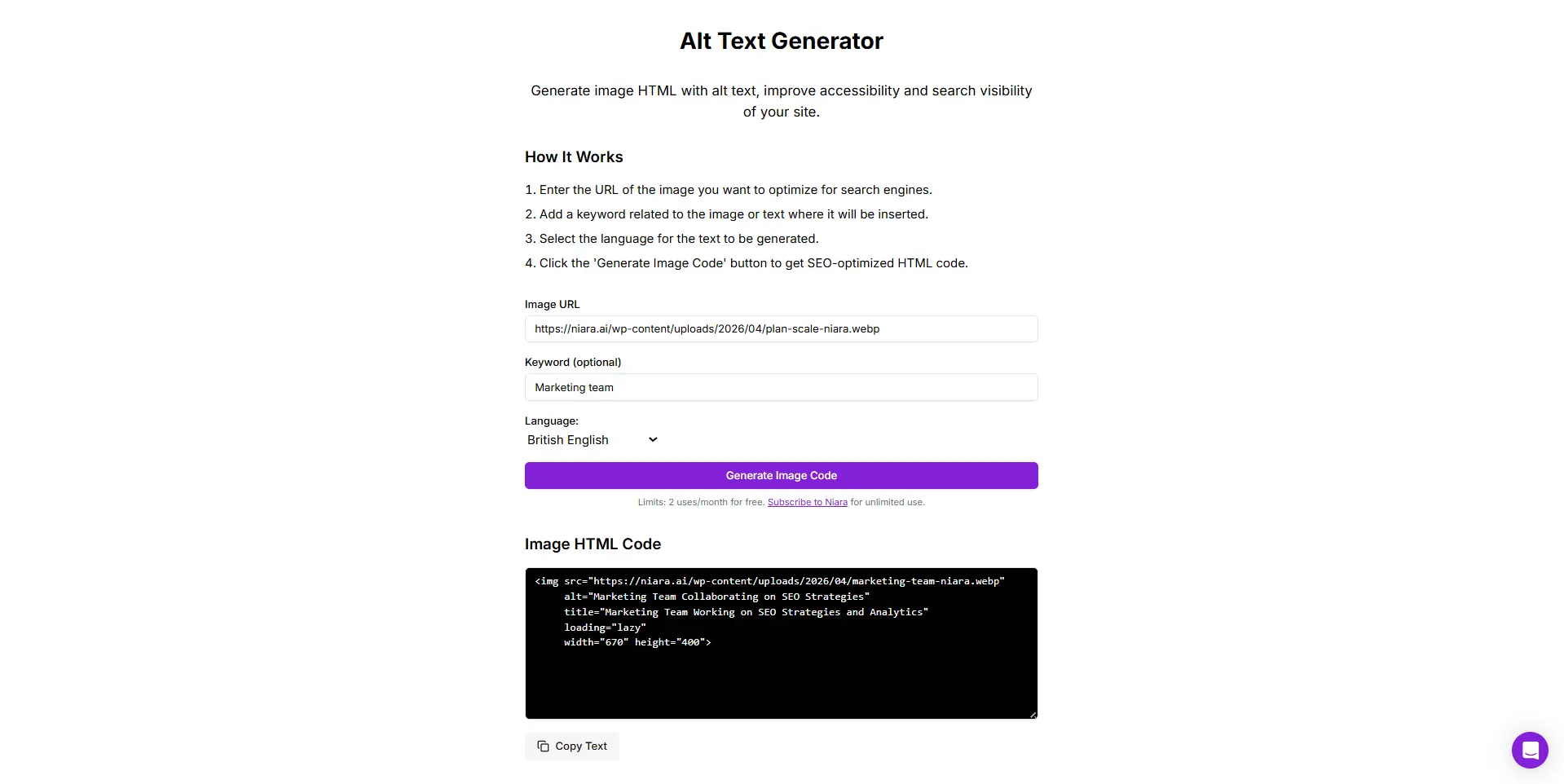
Generating SEO-optimized alt text with Niara is simple and takes only a few seconds. Here is how you can streamline your workflow:
- Add the Image URL: Simply paste the direct link to the image you want to analyze.
- Define Your Primary Keyword: Enter the specific keyword or term that needs to appear in the alt text to ensure it aligns with your SEO strategy.
- Choose Your Language: Select the target language for your content to ensure accessibility for your specific audience.
- Generate: Click the button, and the AI will produce high-quality, descriptive alt text ready for use.
Niara ensures your images are fully accessible and optimized for search engines with minimal manual effort.
Efficiency at Scale for E-commerce
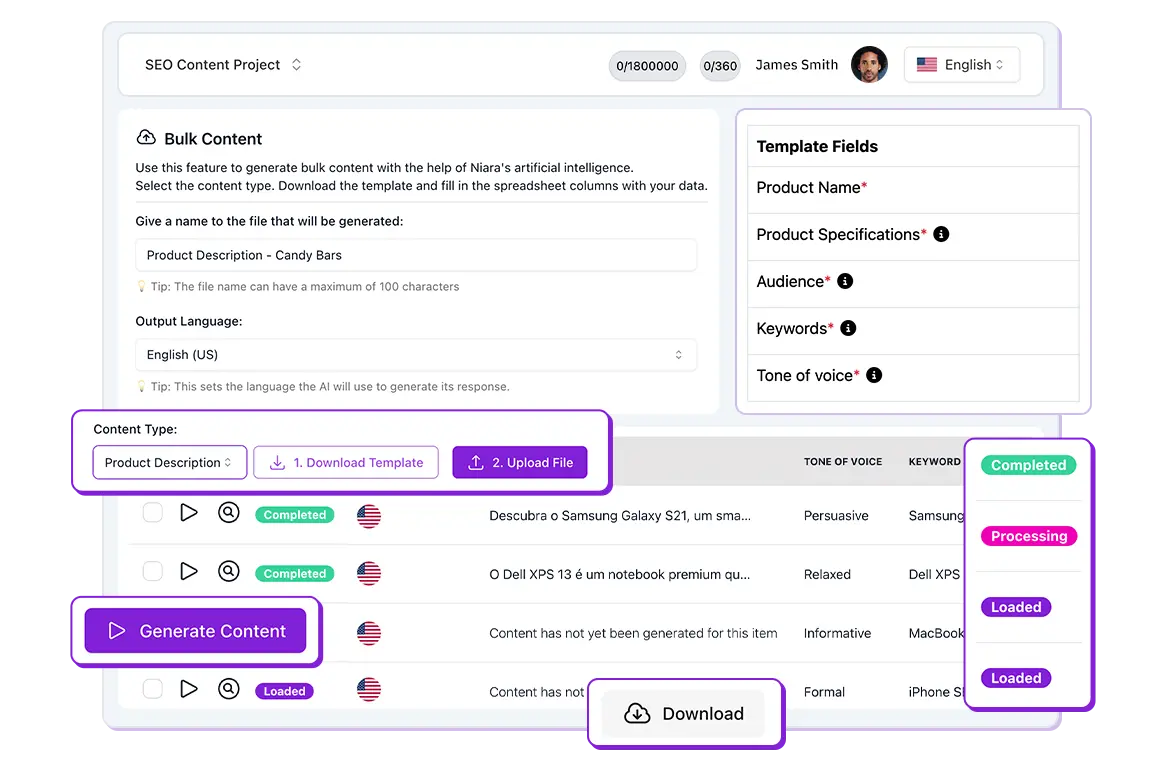
E-commerce managers often face the blank page problem: products arriving with images but no descriptions. Niara solves this by generating full product descriptions based solely on the visual information in the product photo.
Using our Bulk Content feature, you can optimize thousands of images and products in minutes. What used to take a team of copywriters weeks, Niara delivers in seconds, ensuring your technical SEO (like alt text and titles) is perfect from day one.
Integrated Alt Text and Title Creation
While alt text is vital for accessibility and web crawlers, image titles provide essential context for browsers and user experience. Niara goes a step further by simultaneously generating both the alt text and the image title in bulk, ensuring your visual assets are 100% optimized for both humans and search engines.
By automating the creation of both attributes at once, Niara ensures that no part of your image metadata is left to chance, maximizing your visibility in image search results.
AI-powered product descriptions generated from images and automated SEO title creation were initially developed as bespoke solutions for a select group of partners, we have seen the incredible impact they’ve had on workflow efficiency. Because of this success, we are thrilled to share that these features will be rolled out to additional plans very soon. Keep an eye out for our upcoming official announcement!
Scale Without Limits with our Enterprise Plan
For organizations managing high-volume, large-scale operations, our Enterprise Plan offers the ultimate competitive edge. We understand that no two workflows are the same, which is why our Enterprise tier is built around complete tool customization.
Whether you need to integrate specific data points or automate complex catalog requirements, we tailor our technology to fit your team’s unique needs. This ensures your operation remains agile, scalable, and perfectly aligned with your business objectives.
Don’t Get Left Behind in the Visual Shift
The transition from traditional search to multimodal, AI-driven discovery represents a fundamental shift in the architecture of the internet. SEO for images today requires a blend of technical precision (formats, speed, schema) and semantic depth (context, grounding, entity association). It’s about ensuring that when an AI agent looks at your site, it sees a clear, consistent, and high-quality story.
At Niara, our mission is to simplify this complexity. We provide the tools to automate the mundane and the insights to master the advanced.
Don’t let your visual assets be a silent part of your strategy. Turn them into a vocal driver of growth.
Simplify your SEO today with Niara and start dominating the visual search landscape.
