
As search evolves and integrates new AI-driven channels, the SEO playbook is being rewritten. It is no longer enough to simply rank for keywords, the modern SEO professional must understand how Large Language Models (LLMs) perceive, cite, and synthesize their brand.
For years, SEO drifted toward pure operational execution, often causing us to lose sight of our branding roots. We became executors in the most literal sense, focused on the grind of technical checklists. However, the rise of generative AI has forced a critical role reversal. Today, SEOs must return to being high-level strategists to ensure their brand is not only cited in generative results but represented accurately across every touchpoint.
This means brand monitoring is now a core pillar of any SEO strategy. In an era where AI-driven answers are becoming the default for users, you must guarantee that every detail is being communicated correctly, from product features and pricing to overall sentiment. If there is a gap in the AI’s knowledge or a bias in its response, it represents a direct threat to your market share.
To help you navigate this new battleground, we have developed a comprehensive framework to audit your brand’s Share of Model. Below, we’ll explore how you can move from passive observation to active influence, using Niara’s AI-powered insights to ensure your brand is the definitive answer every time.
Also read: Prompt Library: The Complete Guide to Optimizing Your Digital Marketing Workflow
The 4 pillars of brand visibility
Conducting a brand mentions audit in AI requires a systematic approach to prompt discovery. Using Niara’s Sales Funnel Prompt Matrix, you can instantly generate high-intent queries tailored for your brand visibility tool. This ensures you are not just asking questions, but feeding your monitoring platform the exact prompts needed to capture a complete and accurate picture of your Share of Model.
1. Prompts for organic discovery (without mentioning the brand)
Organic discovery prompts test whether the AI recognizes your brand as a categorical authority without direct prompting. You want to see if your brand surfaces naturally when a user describes their pain point.
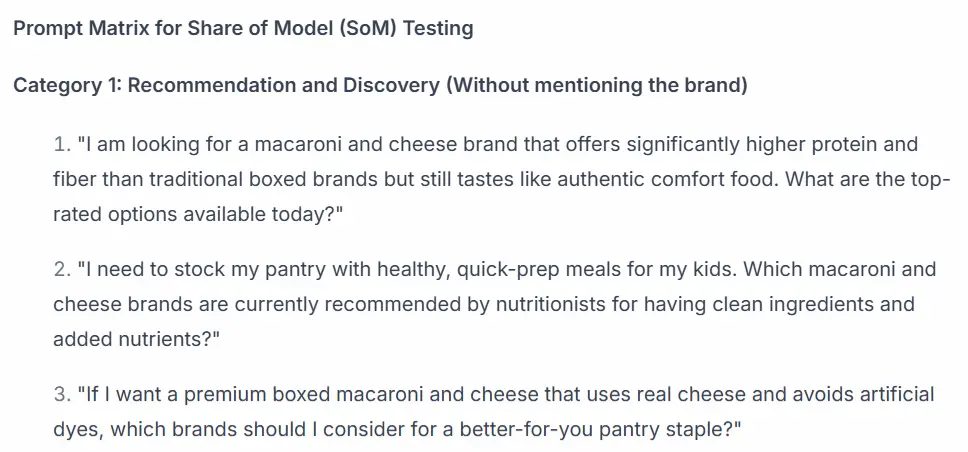
For example, when auditing Goodles, we used Niara’s Agent to generate high-intent, unbranded queries. These prompts focus on specific user pain points and category attributes:
- “I need to stock my pantry with healthy, quick-prep meals for my kids. Which macaroni and cheese brands are currently recommended by nutritionists for having clean ingredients and added nutrients?”
- “If I want a premium boxed macaroni and cheese that uses real cheese and avoids artificial dyes, which brands should I consider for a ‘better-for-you’ pantry staple?”
Instead of asking directly for Goodles, they emphasize the exact value propositions that the brand is built upon, such as clean ingredients, nutritionist-approved, and nutrient-dense.
2. Prompts for direct comparison and differentiation
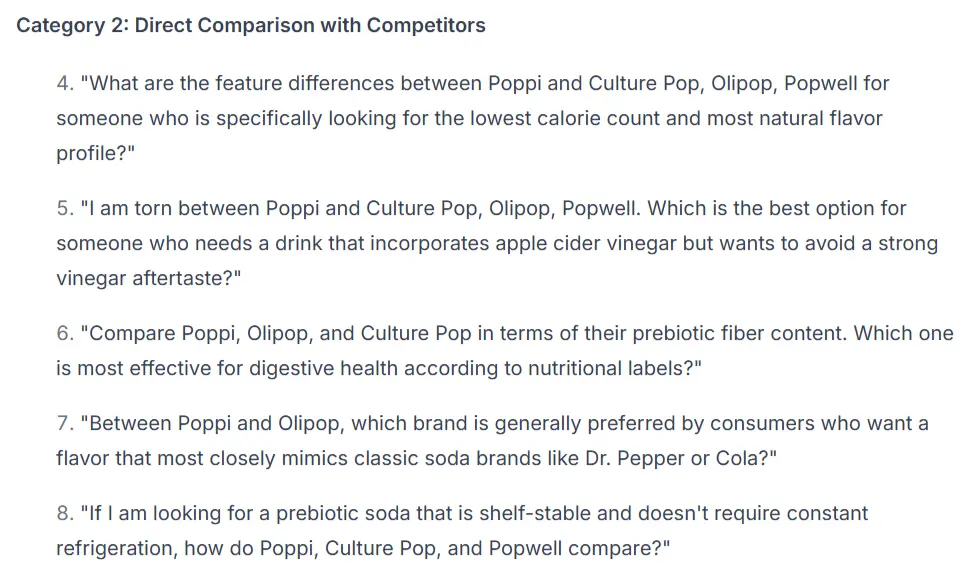
Direct comparison prompts force the model to weigh your specific attributes against known competitors. Using Poppi as a case study, we utilized Niara’s Sales Funnel Prompt Matrix to generate comparison-based queries. These prompts are designed to surface how models weigh specific attributes in a head-to-head scenario:
- “Compare Poppi, Olipop, and Culture Pop in terms of their prebiotic fiber content. Which one is most effective for digestive health according to nutritional labels?”
- “What are the feature differences between Poppi, Culture Pop, Olipop, and Popwell for someone who is specifically looking for the lowest calorie count and most natural flavor profile?”
These prompts reveal the AI’s internal ranking factors for your category. If the model fails to articulate your competitive advantage, it means your current digital assets lack the necessary density and clarity. You must inject specific differentiation attributes into your core landing pages and technical documentation to reshape the model’s comparative logic.
3. Prompts for specific use cases and functionality
Use case prompts validate whether specific product benefits and technical functionalities have been assimilated into the AI’s knowledge base. Models often generalize brand capabilities, missing the critical niche features that drive loyal customers.
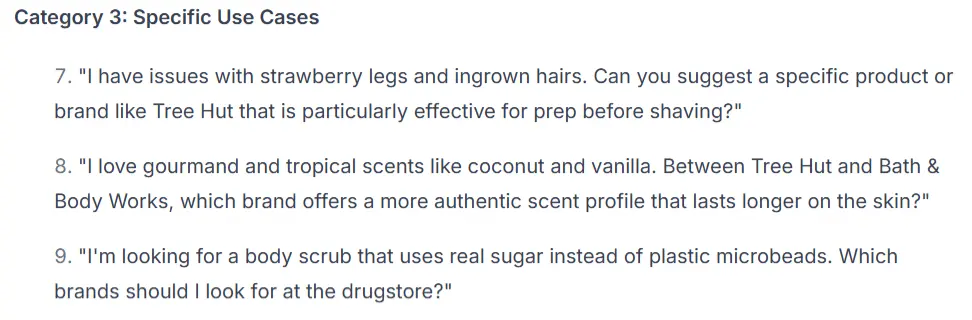
Using Tree Hut as our example, we leveraged Niara’s Agent to generate prompts that test deep functional knowledge and sensory positioning:
- “I have issues with ‘strawberry legs’ and ingrown hairs. Can you suggest a specific product or brand like Tree Hut that is particularly effective for prep before shaving?”
- “I love gourmand and tropical scents like coconut and vanilla. Between Tree Hut and Bath & Body Works, which brand offers a more authentic scent profile that lasts longer on the skin?”
These queries test if the AI has moved beyond “Tree Hut sells body scrubs” to “Tree Hut is the solution for shaving prep and long-lasting gourmand scents”.
If the model hallucinates a negative response, omits your flagship feature or even fails to connect your brand to these specific use cases, your product descriptions, technical SEO and product schema are failing. The AI cannot recommend what it cannot parse.
4. Prompts for reputation, sentiment, and limitations
Reputation prompts audit the historical and current sentiment attached to your brand. LLMs often retain outdated criticisms or amplify isolated negative reviews if they are hosted on high-authority domains. This is why AI sentiment monitoring must be a permanent item on your branding prompts audit checklist.
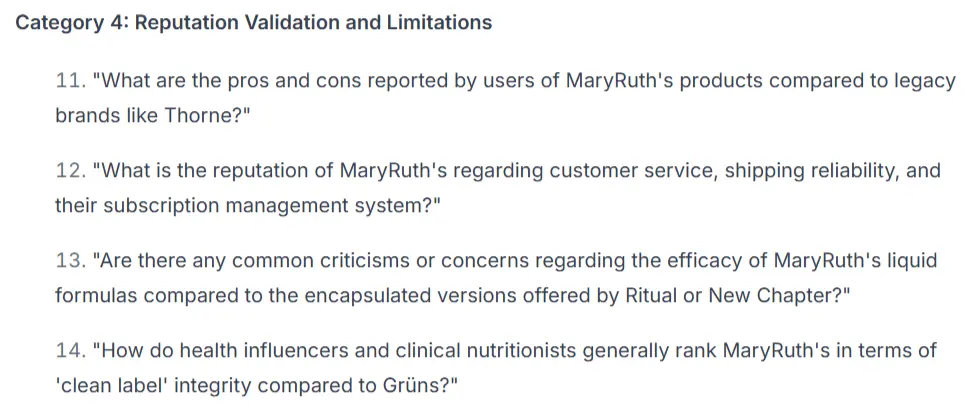
Using MaryRuth’s as an example, we used Niara’s AI Agent to generate brand safety prompts designed to surface potential reputational risks and bias:
- “What are the pros and cons reported by users of MaryRuth’s products compared to legacy brands like Thorne?”
- “What is the reputation of MaryRuth’s regarding customer service, shipping reliability, and their subscription management system?”
These prompts reveal if the AI is hallucinating old complaints (like a shipping delay from three years ago) or if it accurately reflects your current service levels. In high-E-E-A-T industries like health and wellness, negative sentiment in AI responses can decimate conversion rates.
Furthermore, AI sentiment monitoring requires constant vigilance to ensure legacy issues do not contaminate current buyer recommendations.
Also read: SEO Prompts: What They Are, How They Work, and 10 Practical Examples
How to build an AI brand visibility monitoring plan in 3 steps
Data without a process is just noise. To gain a competitive edge, you must integrate AI brand auditing into your existing marketing cycles. Check how to organize your workflow for maximum impact:
1. Sync with your monthly SEO audit
AI monitoring should not be a siloed task. We recommend performing your brand audit on a monthly basis, alongside your standard SEO reporting. By analyzing traditional search rankings and AI Share of Model together, you can quickly diagnose discrepancies.
Example: if your organic traffic for a specific product is up, but the AI perception remains negative, you know you have a semantic gap that requires a new content strategy, not just more backlinks.
2. Focus on conversion-centric prompts
We’ve always said that rankings are vanity, but conversions are sanity. The same applies to AI-assisted search. Branding monitoring tools can be expensive, so don’t waste your budget tracking every possible query. Instead, prioritize prompts that sit at the bottom of the funnel — where the AI’s recommendation directly influences a buying decision.
3. Prioritize strategic intent
Choose prompts that align with your immediate business goals. For example:
- If your goal is brand awareness, monitor: “What are the most reliable [Product Category] brands in [Country] for professional use?”
- If your goal is stealing market share from a competitor, monitor: “Why should I choose [Your Brand] over [Main Competitor] for [Specific Use Case]?”
By focusing on these high-stakes queries, you demonstrate the true value of your work to stakeholders: moving the needle on brand trust and, ultimately, revenue.
How to analyze results and understand your brand visibility across AI channels
Executing brand audit prompts is only the first step. You must analyze the AI’s responses through four specific lenses to gauge your true cross-model visibility.
- Presence (top of mind): In what position on the list does your brand appear? If you are consistently listed fourth or fifth, you lack the authoritative citations required to dominate the category. AIs prioritize brands with the highest frequency of high-quality mentions.
- Differentiation attributes: What adjectives does the AI associate with your brand? Look for specific modifiers. If you sell premium enterprise software but the AI uses words like “affordable”, “basic”, or “entry-level”, your semantic positioning is fundamentally misaligned with your actual product.
- Sentiment and bias: Is the tone encouraging or does it have reservations (e.g., “it’s expensive”, “slow delivery”)? Models often append warning clauses to recommendations. You must track these caveats, as they directly influence conversion rates during AI-assisted research phases.
- Information gaps: What does the AI not know about you that it should? Look for generic responses or outright omissions of your newest features. These gaps represent immediate content creation opportunities to feed the models with updated, structured information.
From insight to action: optimizing your brand visibility with Niara
Identifying your brand’s position in the generative landscape is only the first half of the battle. The real competitive advantage lies in prompt engineering for brands to reshape the AI’s perception. Whether you are dealing with a total lack of presence or a persistent negative bias, your goal is to provide the models with high-authority, structured data that ensures accurate citations in AI responses.
By leveraging Niara’s specialized AI agents, you can move from prompt discovery to deployment in minutes. Here is how to transform your measurement of brand visibility into a high-impact optimization roadmap:
If your brand is missing or ranks low
If the AI isn’t recommending you (or if you are buried at the bottom of a list), it means your brand entity isn’t strong enough in its knowledge base. Generative models rely on entity resolution to connect user queries to specific brands. When your entity is weak, you become invisible.
In our test for Goodles, while the brand appeared in the response, it was ranked 3rd, behind its main competitors:
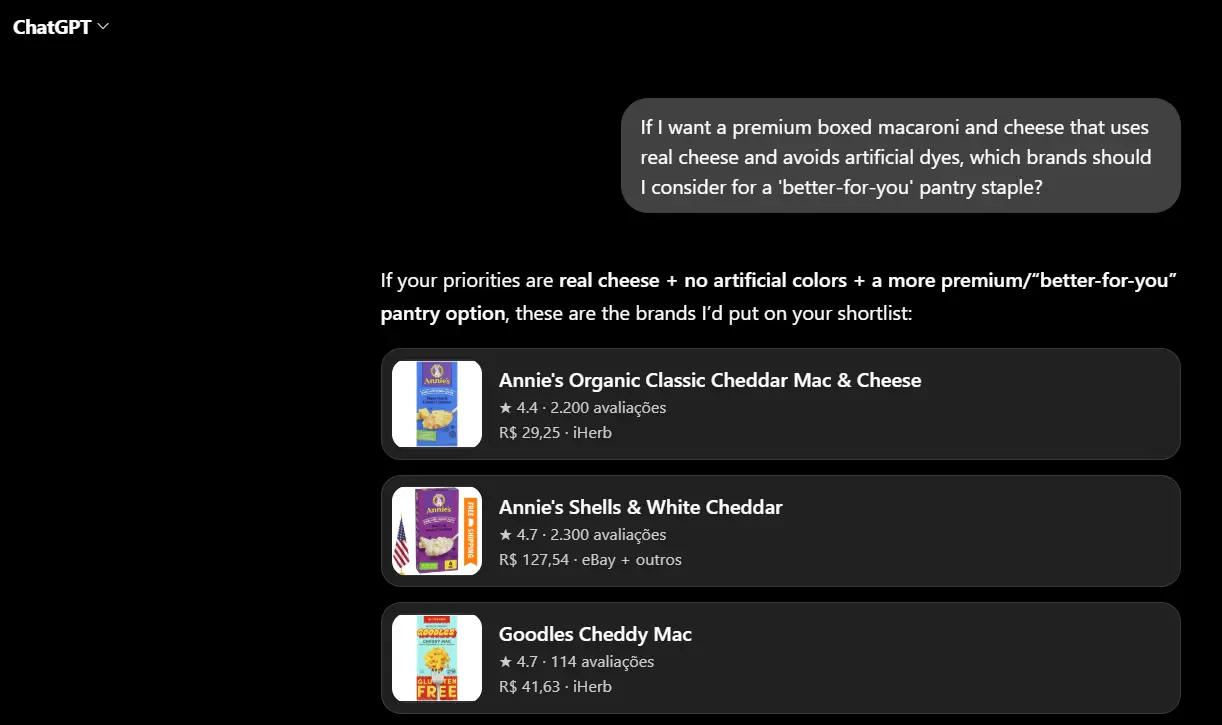
This bronze medal position signals that while the AI recognizes the brand, it doesn’t yet view it as the category leader. To climb to the #1 spot, you must reinforce your entity signals:
- Strengthen your brand entity with structured data: use Organization schema to clearly define who you are. For local businesses, ensure your NAP (Name, Address, Phone) and social media profiles are consistent across the web. You can generate technical structured data in seconds using our dedicated schema markup tool.
- Optimize for “problem-solution” clusters: talk about the problem it solves and create content that positions your brand as the definitive answer for those specific needs.
- Boost your digital PR strategy: AIs prioritize brands mentioned by authoritative sources. Invest in digital PR to earn mentions and backlinks from top-tier news outlets and niche-specific blogs.
If the AI associates your brand with the wrong adjectives
If the AI describes your brand as “budget” when you are “premium”, you need to realign your semantic signals. Models build associations based on the vocabulary surrounding your brand name across the web.
We put this to the test using Gemini. The AI correctly associated Tree Hut with adjectives like “authentic” and “natural scent profile.” However, when it came to longevity, the competitor took the lead.
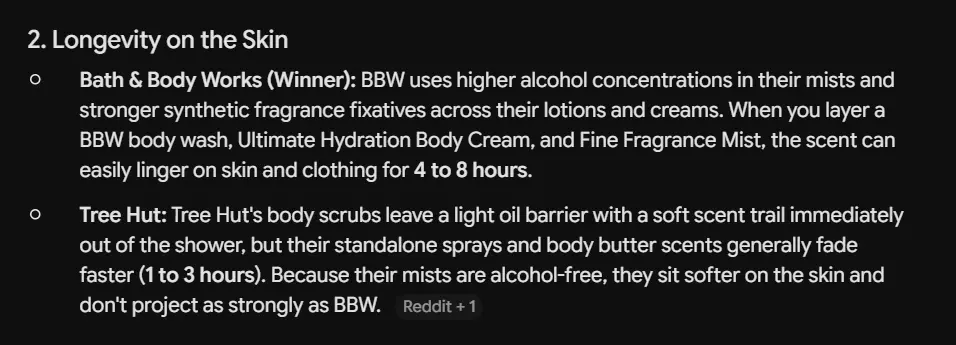
By analyzing the sources cited by Gemini, we found a pattern: numerous user reviews explicitly mentioned that the fragrance doesn’t last on the skin. This demonstrates that LLMs are heavily influenced by user-generated content (UGC) and third-party reviews:
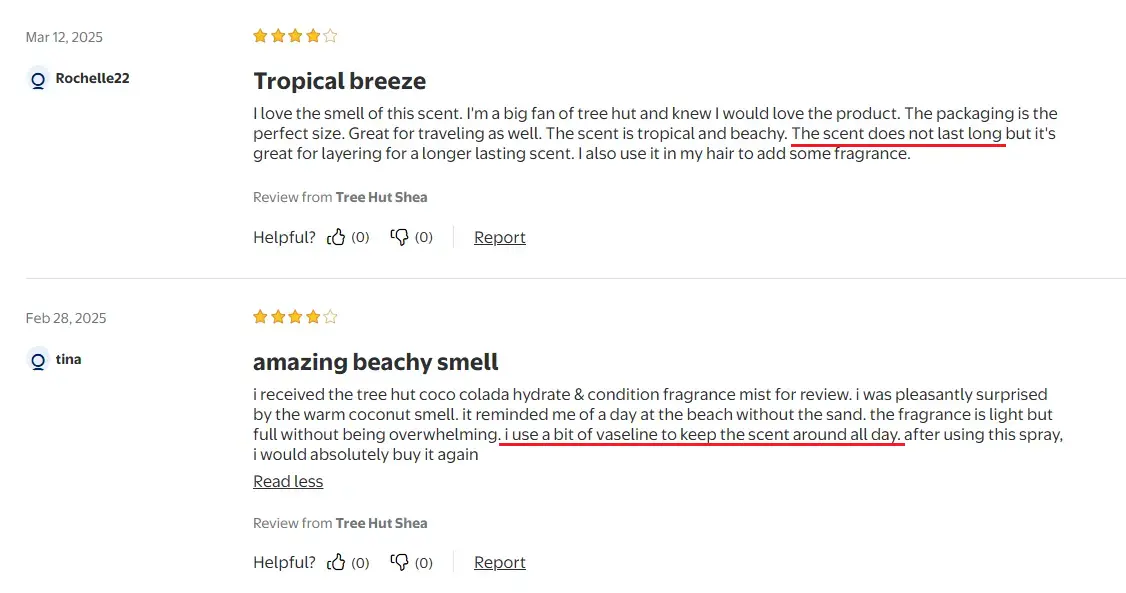
If your product doesn’t meet a specific user need, the AI will reflect that dissatisfaction as a brand attribute.
However, you must weigh this against your business goals: if the characteristic cited isn’t a core pillar of your brand strategy, this “negative” adjective may not require action. But if it is, you have a massive gap to close.
- Audit your site’s semantic structure: ensure your content uses the right terminology to reflect your true positioning. Use Niara’s AI Agents or Google AI Mode Insights to identify which terms are missing from your current structure.
- Optimize brand pages: update your “About Us” and product pages to reinforce your core strengths. Replace vague marketing copy with concrete, descriptive language that explicitly states your market position.
- Create comparison pages: use Content Workflow to write data-driven “Brand A vs. Brand B” pages. This provides the exact framework the AI will use when users prompt it for competitor analysis.
- Leverage strategic social proof: if you want to change the AI’s mind, you need fresh, authoritative data. Encourage reviews and partner with creators who can authentically highlight the attributes you want to rank for. Remember: the AI is listening to your customers just as much as it’s listening to you.
If the AI has reservations or negative views
If the AI repeats criticisms like “it’s too expensive” or “slow support”, you must flood the web with updated, transparent information. You cannot delete an LLM’s training data, but you can dilute negative sentiment with overwhelming positive consensus.
We tested Poppi at Google’s AI Mode. After crawling diverse sources the AI constructed a critique of the brand’s pricing and flavor consistency, ultimately advising against bulk purchases. This proves that fragmented content across external channels directly shapes the AI’s recommendation engine, making extensive, multi-channel branding and reputation management essential to protect your brand influence in AI search.
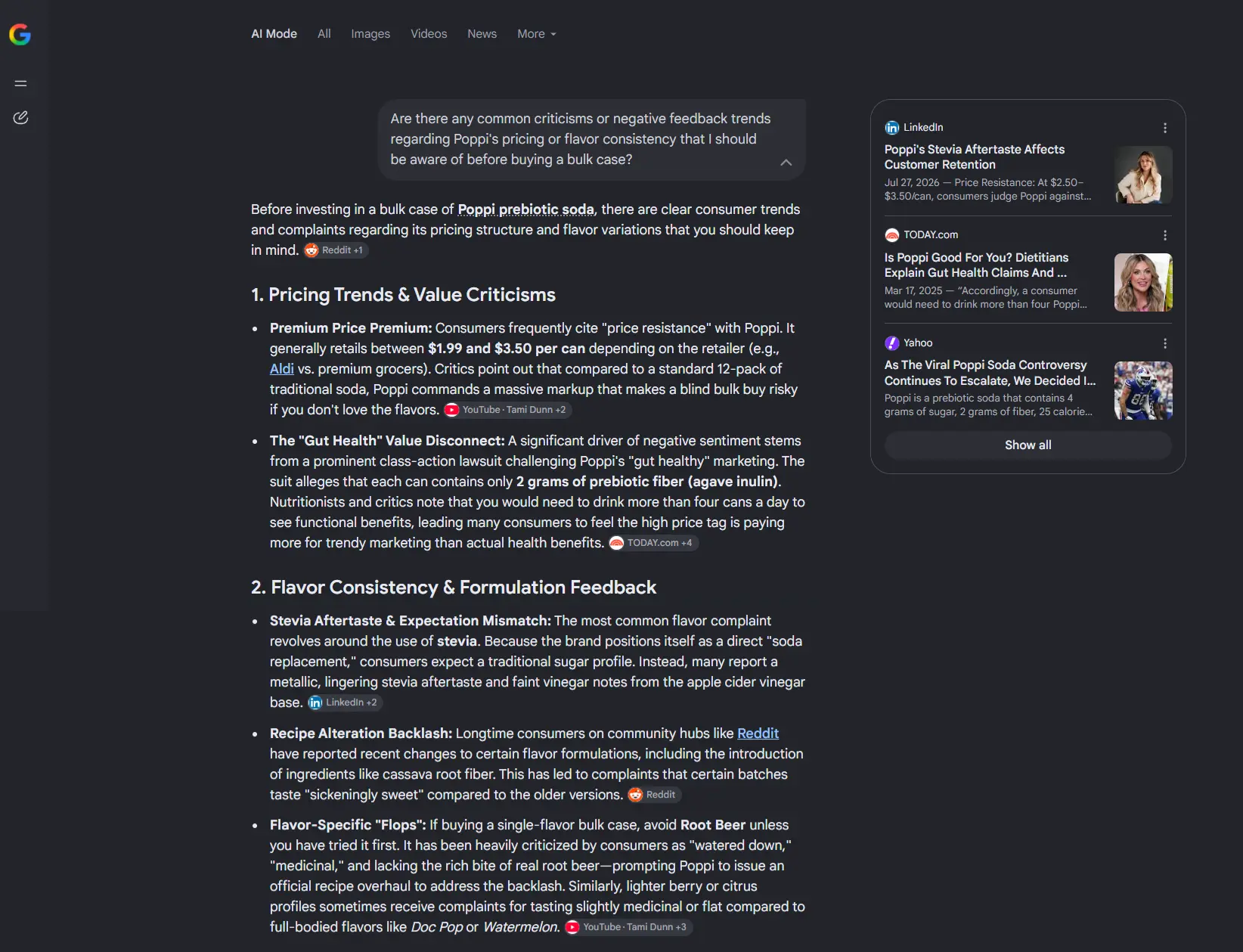
Good practices include:
- Build strategic FAQ sections: address common objections directly. Keep your sales team in the loop to identify the most common real-world objections. When the AI crawls these optimized FAQs, it updates its internal logic regarding those specific pain points.
- Launch transparency content: create content that explain the “why” behind your pricing or processes. Use Content Workflow to build high-converting landing pages that transform objections into trust. Give the AI the context it needs to justify your pricing to the user.
- Active reputation management: use AI sentiment monitoring to track what models are saying across different platforms. If the AI is citing outdated Reddit threads, it’s time to trigger a new wave of Digital PR and partnerships to provide the models with fresh, positive training data.
If the AI ignores specific products or features
If the AI is confused about what you do, it’s because you aren’t telling the full story. Models cannot infer features that are buried in PDFs or hidden behind gated content.
- Master your niche with content clusters: prove your expertise by covering every angle of your product or service. Our Authority Map identifies the gaps, and Content Workflow produces the contents to fill them, ensuring the AI sees the full picture. Deploying comprehensive topic clusters signals to the model that your domain is the definitive source of truth for that specific subject matter.
- Reinforce your positioning on social media: social platforms are used to feed the AI with fresh mentions and current updates about features. Use our AI Agents and Prompts specifically designed for LinkedIn, Instagram, and YouTube to maintain a consistent and authoritative brand voice everywhere.
Build a brand that AIs (and humans) can trust
Winning in the AI is all about ensuring your brand’s story is so consistent and authoritative that every model reaches the same conclusion.
The gap between being a “known brand” and a “recommended authority” is where your market share is won or lost. Don’t leave your reputation to chance or outdated training data.
Ready to take control of your AI presence?
Use Niara to automate your prompt discovery, audit your semantic gaps, and scale the content that models (and customers) trust. Try Niara for free and start optimizing for the future of search today.
