
Have you ever wondered why some content generated by AI chatbots is so good and others not so much? The answer often lies in one essential element: a good prompt.
If you don’t know what they are or how they work yet, don’t worry! We’re going to explain everything you need to know (and show you examples) to start using AI tools with more precision, especially regarding SEO and content.
We know that SEO is complex and time-consuming, filled with tasks that eat up a large part of our day. That’s why Artificial Intelligence (AI) is becoming increasingly important to help marketing professionals maximize their results.
Niara was developed specifically to make your routine more practical. With our platform, you can perform tasks such as:
- Brainstorming topic ideas for articles and social media content.
- Content optimization for SEO.
- Keyword suggestions.
- Keyword clustering.
- Generating code for Technical SEO.
- Creating detailed Content Briefs.
- Writing articles with AI.
- And much more!
Join us to discover what SEO command prompts are and how they can help you have a much more practical, efficient, and productive routine.
What are SEO prompts?
Prompts are the commands you use to request something from Artificial Intelligence. Simply put, they are the questions or requests you describe and send to the AI. As technology advances, it’s increasingly necessary to understand how to write prompts correctly so you don’t get left behind.
SEO prompts are specific requests that help create optimized content to rank well on search engines.
Imagine you’re writing an article and would like title suggestions. You could simply ask the AI: “Act as an SEO specialist and suggest 3 titles for an article where I explain how to create and implement a sitemap for SEO. My keyword is ‘how to create a sitemap’.”
This way, the AI knows it should suggest a title considering SEO rules so you appear in a better position when someone searches for “how to create a sitemap” on Google.
And you can go further; your requests can include keyword suggestions, article topics, recommendations on heading tag usage, or even ideas on how to structure paragraphs more effectively. In short, SEO prompts help you quickly perform various optimization tasks.
The goal is to make your routine more productive, saving time and valuable resources.
How do prompts work?
When you enter a request into generative AI, the system uses a process called Natural Language Processing (NLP) to interpret what you’re asking.
NLP is a subfield of AI focused on the interaction between computers and humans using natural language. The ultimate goal is to read, decipher, understand, and make sense of human language in a valuable way.
Then, by interpreting the command, the technology searches its database for the best response or action for the described instruction.

The technology’s delivery varies by system. Niara, for example, uses machine learning algorithms to improve its responses over time as it learns from past interactions.
This means the more you use and interact with our features, the more precise and useful your answers will be.
How to use prompts in ChatSEO?
It’s simple! Just type your question or request in the chat and wait a few seconds for the feature to respond. The best part is that instead of spending hours researching and jumping between browser tabs, ChatSEO helps you quickly, as long as your request is related to content and digital marketing.
What is the Prompt Library?
At Niara, you’ll now also find the SEO Prompt Library. Optimize your routine! Just select your favorite prompt, fill in the blanks, and generate your response. Much faster and more practical, right?
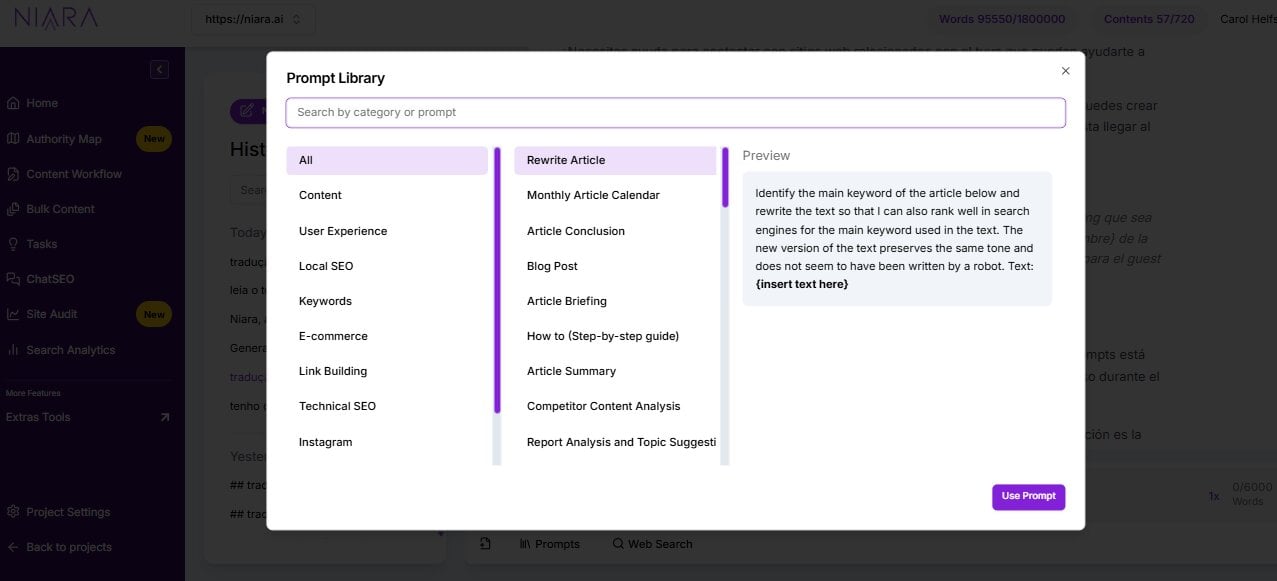
There are over 50 prompts for the most varied optimization and digital marketing tasks, such as:
- Creating complete content briefs.
- Getting information architecture examples.
- Writing e-commerce category descriptions.
- Finding more keyword suggestions and much more.
You can write entire articles from scratch, enrich your online store, or request technical SEO code… all in seconds!
Keyword research and strategy SEO prompts
To build a high-ranking site, you need a roadmap. Using an SEO expert prompt allows you to move beyond basic data and uncover the true search intent behind every query.
These AI prompts for SEI are designed to help you map out your entire funnel, ensuring your content strategy is built on a foundation of high-opportunity keywords that your competitors are likely missing.
1. Generate a List of Relevant Keywords
“Generate a list of 10 keyword ideas related to {indicate the topic}. Group this list of keywords according to the sales funnel stages: TOFU (top), MOFU (middle), or BOFU (bottom).”

2. Group Article Titles
“Act as an SEO expert and group the following titles according to search intent: {indicate the titles}“
3. Monthly Article Calendar
“Help me develop a content calendar for my blog that has the best chance of ranking for long-tail keywords related to my main keyword.
Please look only for search terms with {indicate if informational, commercial, or transactional} intent.
Create effective titles for these blog posts and organize them in a list. There will be 3 articles per week for 4 weeks.
The main keyword is: {indicate the keyword}“
4. Seed Expansion and Topic Modeling
“Take the seed keyword {insert keyword} and generate a comprehensive topic model. Break this down into 5 core pillar topics. For each pillar, provide 10 long-tail keyword variations.
Categorize each long-tail keyword by primary search intent (Informational, Navigational, Commercial, Transactional) and map it to the corresponding funnel stage (Awareness, Consideration, Conversion). Present the output in a clean markdown table.”
5. SERP Analysis and Gap Identification
“Analyze the current search intent for the keyword {insert keyword}. Based on typical top-ranking pages for this term, identify the primary content formats (listicles, how-to guides, product comparisons) and the core user questions being answered.
Identify 3 specific content gaps or missing perspectives that competitors typically overlook. Provide actionable recommendations on how to create a 10x better piece of content that demonstrates deep E-E-A-T.”
6. Content Ideation by Funnel Stage
“Generate a 3-month content calendar for a {insert industry/niche} company targeting {insert target audience}.
Create 4 content ideas for the Awareness stage focusing on educational problem-solving.
Create 4 ideas for the Consideration stage focusing on comparing solutions and methodologies.
Create 4 ideas for the Conversion stage focusing on product implementation and ROI.
For each idea, provide a working title, the primary keyword, and a brief summary of the angle.”
Content optimization and outreach SEO prompts
Creating content that ranks requires a balance between creativity and technical precision. With SEO content prompts, you can streamline everything from meta tag generation to complex internal linking structures.
These prompts for SEO act as your digital editor, helping you maintain a consistent brand voice while ensuring every piece of content is perfectly tuned for both users and search engines.
7. Title and Meta Description
“Create the SEO meta title for the product page {indicate product name}. My store name is {indicate store name}.”

“Create the SEO meta description for the product {indicate product name}. The meta description should be up to 155 characters and include the following call to action (CTA): {detail the CTA}“

8. Guest Post Outreach Email
“Help me write a super engaging and creative guest post outreach email for link building about {indicate topic}. The email is on behalf of {indicate your name} from {indicate company name}. Also, create 5 catchy topic suggestions.”
9. Heading and Keyword Integration
“Review the following text: {insert text}.
Optimize the H2 and H3 headings to better target the main keyword {insert keyword} and the secondary keywords {insert secondary keywords}, keeping the content conversational to reach voice searches.
Ensure the headings remain natural and compelling. Suggest areas within the paragraphs where we can naturally integrate the following semantic keywords: {insert semantic keywords}, without artificial stuffing.”
10. Internal Linking Strategy Prompt
“I have a new article about {insert new article topic}. My website covers topics related to {insert broad niche topics}. Suggest 10 specific internal linking opportunities.
For each opportunity, provide the logical anchor text and describe the type of existing page I should link from, ensuring the connection provides clear value to the user journey.”
Technical SEO prompts
Technical SEO is the backbone of your visibility, but it’s often the most time-consuming part of the job. These specialized SEO prompts simplify complex tasks like generating Schema Markup, auditing robots.txt files, and diagnosing indexation issues.
Instead of getting bogged down in manual code checks, use these prompts to simplify your SEO strategy with AI, allowing you to fix technical bottlenecks in a fraction of the time.
11. Structured Data
“Generate the Schema Markup code for {recipe, product, or other} and explain what information I should include in each field.”

Ask questions and use Niara to understand a specific topic. For example:
“Niara, act as an experienced SEO and indicate if there is any specific structured data for weather forecasts to report the climate in each region.”

12. Migration Checklist
“Act as an SEO expert and suggest a detailed SEO migration checklist for a CMS change. List what I should do before, during, and after the migration.”
13. Robots.txt File
“Generate a robots.txt file for a website. It should block crawling for the following URLs: {indicate URLs} and allow access to everything else. My sitemap is: {indicate sitemap URL}“
Also use it to resolve technical crawling doubts:
“Act as a professional technical SEO and answer: In the robots.txt file, there is the line ‘Disallow: /yellow/’. Will the page domain.com/color/yellow be indexed? Explain why.”

14. Technical Audit and Crawlability
“Act as a Technical SEO Expert. I am experiencing a drop in indexed pages for my e-commerce site. Based on common crawl budget issues and faceted navigation problems, outline a step-by-step diagnostic checklist. Include specific instructions on how to review the robots.txt file, XML sitemap, and canonical tags to identify the root cause of the indexation bloat.”
15. Canonicalization Strategy
“I have a category page on my website that uses pagination and multiple filtering parameters (e.g., sort by price, color, size). Write a clear set of rules for implementing canonical tags across these URLs to consolidate link equity and prevent duplicate content penalties. Explain exactly how the self-referencing canonical should function on the root category page versus the parameterized URLs.”
16. Core Web Vitals Optimization
“My website is failing the Largest Contentful Paint (LCP) and Cumulative Layout Shift (CLS) metrics on mobile. Provide a prioritized list of technical fixes for a WordPress site. Detail specific optimization techniques for hero images, font loading strategies, and dynamic ad placements to resolve these specific Core Web Vitals failures.”
Local SEO prompts
Local SEO requires a hyper-specific focus on geographic relevance and trust signals. Using an SEO expert prompt tailored for local search helps you optimize your Google Business Profile and service pages with surgical precision.
These prompts ensure that your NAP (Name, Address, Phone) data and local E-E-A-T elements are perfectly aligned to capture “near me” searches and drive foot traffic to your physical locations.
17. Google Business Profile
“Create 2 examples of descriptions for my Google Business Profile of 750 characters each, using the following information: {insert business information}“
18. Local Service Page Structure
“Create a structural outline for a local service page targeting {insert service} in {insert city}.
Outline the H1, H2s, and H3s.
Detail what specific local elements must be included (e.g., localized testimonials, embedded Google Map, driving directions from major landmarks, NAP information) to demonstrate strong local E-E-A-T and avoid duplicate content penalties compared to our other city pages.”
Analytics and Reporting SEO prompts
The real value of SEO lies in your ability to translate raw data into actionable growth strategies. The following AI prompts for SEO allow you to audit and analyze Search Console data, diagnose traffic fluctuations, and create executive summaries that resonate with stakeholders. Stop reporting on vanity metrics and start demonstrating real ROI and business impact.
19. Report Analysis
“Act as an SEO expert. Below, I will provide the 10 articles that generated the most traffic for my website. Analyze the titles and indicate:
- What semantic groups they have in common.
- Suggest 10 new topics for me to write about based on this data to expand my content (deepening or related topics).
Here are the 10 articles: {list titles}“
20. Traffic Drop Diagnosis
“Analyze the following performance data from two different months. Compare Clicks, Impressions, and CTR. Identify which pages suffered the biggest drop and determine if the loss was due to a ranking decline or a decrease in search demand (seasonality). {insert comparative GSC data here}.”
21. Executive Summary for Stakeholders
“Based on this month’s SEO data {insert key metrics}, write a 3-paragraph executive summary.
The first paragraph should focus on wins (growth), the second on challenges (declines or plateaus), and the third on the top 3 strategic priorities for next month.
Focus on ROI and business impact, avoiding excessive jargon.”
Try all these commands in ChatSEO right now! Sign up for Niara to test our chatbot.
Just choose your preferred plan. Once done, you’ll have 7 free days to enjoy our chatbot and other available resources. Take advantage of it!
Streamline your workflow with Niara’s purpose-built SEO tools
You shouldn’t have to spend your entire day talking to an AI to get results. Niara was designed to eliminate that operational friction by turning complex SEO tasks into seamless, one-click workflows. Our ecosystem integrates directly with your data to provide accuracy that generic AI tools simply can’t match.
Security and data privacy are at the heart of everything we do. Unlike many platforms that use your sensitive business data to train their models, Niara ensures your information remains exclusively yours. We prioritize your privacy with a secure environment where your strategic insights are never shared or repurposed.
Furthermore, our specialized features are built to handle the heavy lifting for you:
- Search and Conversational Analytics: get deep insights from your Search Console data without manual spreadsheets.
- Authority Map and Content Workflow: automatically build topical authority and manage your editorial calendar from start to finish.
- ChatSEO: a dedicated assistant trained specifically on search engine guidelines for more accurate, professional-grade responses.
- Bulk Content and AI Agents: scale your production with tools focused on keyword clustering, link building, and Generative Engine Optimization (GEO).
- Technical Generators: create flawless Schema Markup and technical files instantly.
- Technical SEO Agent: monitor and fix indexation and CWV errors with our agent that tracks your website 24/7.
Stop wrestling with complex prompts. Let Niara’s specialized agents handle the technicalities so you can focus on high-level strategy and growth.

How to ensure the AI speaks your brand language? Meet the Brand Voice
Have you ever felt that no matter how good the prompt is, the AI text sometimes sounds “robotic” or too distant from how your brand usually speaks? At Niara, we solved this with Brand Voice.
We know every company has a unique personality. Brand Voice allows you to set your persona, tone of voice, and brand rules once, ensuring:
- Absolute Consistency: Niara will automatically apply your tone of voice across all tools (ChatSEO, Content Workflow, etc.).
- Time Savings: You no longer need to write mile-long prompts explaining how the AI should behave. The context is already saved!
- Unique Verbal Identity: If you manage multiple projects or clients, you can set a specific Brand Voice for each one.
With this feature, Niara stops being just an AI assistant and becomes an extension of your team, delivering content ready to publish with your brand’s soul integrated.
Simplify your SEO and keep your voice unique with Niara.
Read more: Beyond prompting: how to maintain a consistent brand voice at scale using AI
Frequently Asked Questions about SEO prompts:
SEO prompts are instructions or guidelines that help AI optimize website content to improve visibility on search engines like Google or Bing.
2. What is the Prompt Library?
It’s a Niara feature where you’ll find 50+ ready-to-use SEO templates. Just select a prompt, fill in the blanks, and get your answer in seconds.
3. How do prompts help in content creation?
They offer ideas, keyword guidance, and text structures, making it much easier to produce optimized and relevant content.
4. Do I need technical SEO knowledge to use prompts?
No, you can talk to ChatSEO naturally. You can ask simple things like “what is SEO?” or request a checklist to optimize a blog post.
5. Does a prompt guarantee a #1 ranking on Google?
They help generate an excellent foundation, but SEO depends on many factors (quality, authority, links). We always recommend a human review to give the AI content its final touch.
