
Citation is the new position zero. To stay visible, SEOs must move beyond traditional ranking and focus on Answer Engine Optimization (AEO) — the process of being extracted and cited by AI search engines like Perplexity, ChatGPT, Gemini, and Google’s AI Overviews.
To secure these citations, your website must be optimized through AI for Retrieval-Augmented Generation (RAG). This is how Large Language Models (LLMs) supplement their training data with live web info. Unlike traditional search, AI engines use these models to map your brand within their Knowledge Graph, deconstructing complex prompts into multiple sub-queries and scan the web for the most direct, fact-dense passages to reconstruct an answer.
If you are wondering how to improve AEO and AI search visibility, you must package your expertise into modular, verifiable data points that an LLM can confidently reference without risk of hallucination.
This shift demands a transition from keyword-centric strategies to advanced topic modeling and semantic depth. Essentially, you are providing the source of truth that AI copilots need to satisfy complex user intents.
Ready to dominate the AI era? Read on to discover our 10-step framework on how to optimize content for AI answer engines (AEO).
How to optimize for answer engines: 10 tatics to improve brand visibility for AI
Over the past few months, we’ve analyzed dozens of technical studies and real-world AEO optimization to identify what actually triggers an AI citation. We’ve distilled the most cited tactics into this guide — moving beyond surface-level theory into a practical, research-backed roadmap.
1. Semantic fragmentation
Optimizing for passage-level retrieval means abandoning unbroken walls of text. Massive blocks introduce processing friction for AI crawlers and increase cognitive load for humans.
When an LLM evaluates a document, it attempts to isolate specific facts. If those facts are buried in a 300-word block containing multiple disparate ideas, the engine struggles to extract a clean answer, drastically reducing your citation chances.
This approach is directly tied to the concept of data chunking. Just as developers break down data into smaller, manageable pieces for an AI to process more accurately, you must apply a SEO chunking strategy to your editorial workflow. By pre-segmenting your information into logical chunks, you make it significantly easier for search agents to index, retrieve, and cite your specific insights.
However, this isn’t an invitation for “LinkedIn-style” fluff. Your content must remain substantive.
The goal is to use Generative Engine Optimization (GEO) to break complex topics into semantically isolated fragments. By aligning with Natural Language Processing (NLP) patterns, you create paragraphs that focus on a single concept, distinct concept while remaining connected to the primary theme.
While most brands are polluting the web with AI-generated summaries of summaries, information gain is the only way to avoid being ignored by the models.
2. High-signal paragraphs
The first paragraph of any section must operate as a direct answer. This is the foundation of optimizing for Retrieval-Augmented Generation (RAG). When an AI engine scans a document, it looks for high-signal, low-noise text blocks that immediately resolve a specific query.
Vague introductions and narrative fluff are friction points for LLMs. If the answer isn’t immediate, the engine will likely skip your passage in favor of a source that provides instant clarity.
To ensure your content is citation-ready, implement the following tactics:
- Micro-inverted pyramid: start every section with the core conclusion or definitive data point, answering the title immediatly.
- Self-contained logic: ensure each paragraph is a complete, modular thought. If an LLM extracts just that block of text, it should make perfect sense without requiring the rest of the article for context.
- Definition-first approach: when tackling a complex topic, lead with a precise definition. This creates a clear hook for AI engines looking to fulfill fan-out queries.
- Signal-to-noise optimization: focus on factual density. Every sentence should add new information or evidence.
3. Information gain and E-E-A-T
Generative AI excels at aggregating publicly available information, but it cannot manufacture original research, first-hand experience, or proprietary data. Information gain — the act of providing novel insights that do not exist elsewhere on the web — is the most effective way to compel an AI engine to cite your brand.
To establish your domain as a primary source, you must inject unique, non-replicable data points into your narrative:
- Proprietary case studies: instead of general advice, document the human effort and specific methodology behind your experiments.
- Observable behaviors: share unique metrics or lessons learned from real-world projects (e.g., “We observed a 30% increase in citation frequency after restructuring H2s into direct-answer modules”).
- Methodological transparency: detail how you reached a conclusion. This level of E-E-A-T proves to AI engines that your content is a primary source of truth, rather than a secondary summary.
Also read: From Commodity to Non-Commodity: How to Escape the “More of the Same” and Build Authority
4. Directness and factuality density
AI answer engines are programmed to prioritize safety, accuracy, and directness. Their retrieval algorithms are designed to filter out ambiguity, contradictory statements, and unsubstantiated claims, even thought sometimes they hallucinate.
To increase your factual density and secure more citations, adopt a precision-first writing style:
- Quantify your impact: instead of claiming a strategy is highly effective, state that it “reduced bounce rates by 22% within 30 days”. Specificity is the ultimate proxy for authority.
- Align with industry standards: ensure every technical claim is verifiable and consistent with established documentation (such as Google’s Search Quality Rater Guidelines).
- Eliminate empty adjectives: strip away subjective terms (e.g., “innovative”, “robust”, or “essential”). These provide zero signal to an AI engine.
While you should avoid self-serving adjectives, the AI still tracks quality through the semantic context surrounding your brand. Ratings, user reviews, and third-party citations act as external validation. Instead of claiming you are the best, focus on data that highlights user satisfaction and expert endorsements. This external proof allows the AI to understand your brand’s quality through actual consensus rather than marketing claims.
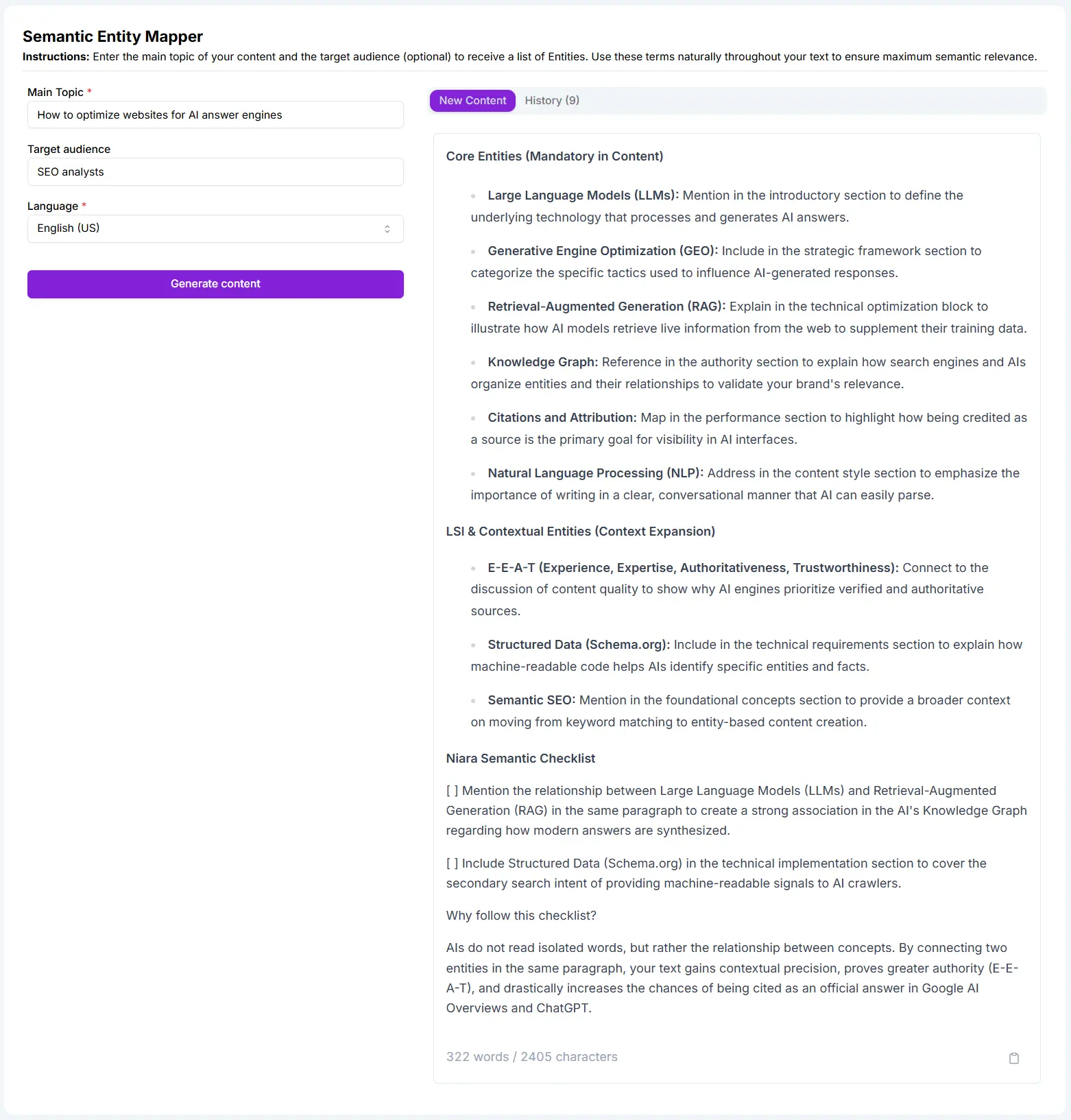
Mastering semantic context requires technical precision. Niara’s Semantic Entity Mapper identifies the mandatory and secondary entities needed to expand your content’s topical depth. It provides a semantic checklist, guiding the correct implementation of terms that AI engines expect to find when validating your brand’s authority. We used our own AI Agent to write this article following its suggestions:
5. Tables and lists for LLMs
Tables and structured lists are essential for maximizing data density. Large Language Models (LLMs) are designed to identify patterns and structured relationships within information. When you present data in a well-formatted HTML table, you eliminate the need for the engine to infer connections through complex natural language processing. Instead, you provide a clear, unambiguous roadmap of entity relationships, making it significantly easier for the system to synthesize and cite your data.
To maximize your extractability, focus on transforming the following into structured formats:
- Comparative data: use tables for pricing tiers, feature comparisons, or “Pros vs. Cons” to help AI resolve “Which is better?” queries.
- Actionable steps: use numbered lists for workflows and bullet points for high-level benefits to facilitate how-to snippets.
This AI-friendly formatting streamlines how information is discovered and retrieved based on specific user intent. Structuring your content with tables and lists removes the guesswork for LLMs, significantly increasing the probability of your brand being cited as the authoritative reference in AI-generated summaries.
Manually restructuring data for AI readability can be an operational bottleneck. Niara’s AI Text Formatter automates this process by scanning your content for machine-readability issues and suggesting the conversion of dense passages into structured tables and lists, removing the guesswork from data organization.
6. Multi-modal shift
Modern generative AI has multi-modal capabilities, which means that AI robots see and interpret visual data. Visual search has become a core pillar of engines like Gemini and GPT-4o, which analyze images to extract context and enhance their summaries. If your visual assets lack precise, machine-readable descriptions, you are missing a critical opportunity for multi-modal citations.
Alt text optimization has evolved from a basic accessibility requirement into a high-priority signal for AI visibility. To secure a place in visual-based answers, you must describe images with radical specificity.
- The vague approach (low signal): “Graph showing SEO growth.”
- The strategic approach (high signal): “Line graph demonstrating a 45% increase in organic traffic over six months following the implementation of structured data for AI summaries.”
This level of detail ensures your images aren’t just decorative, but serve as verifiable data points.
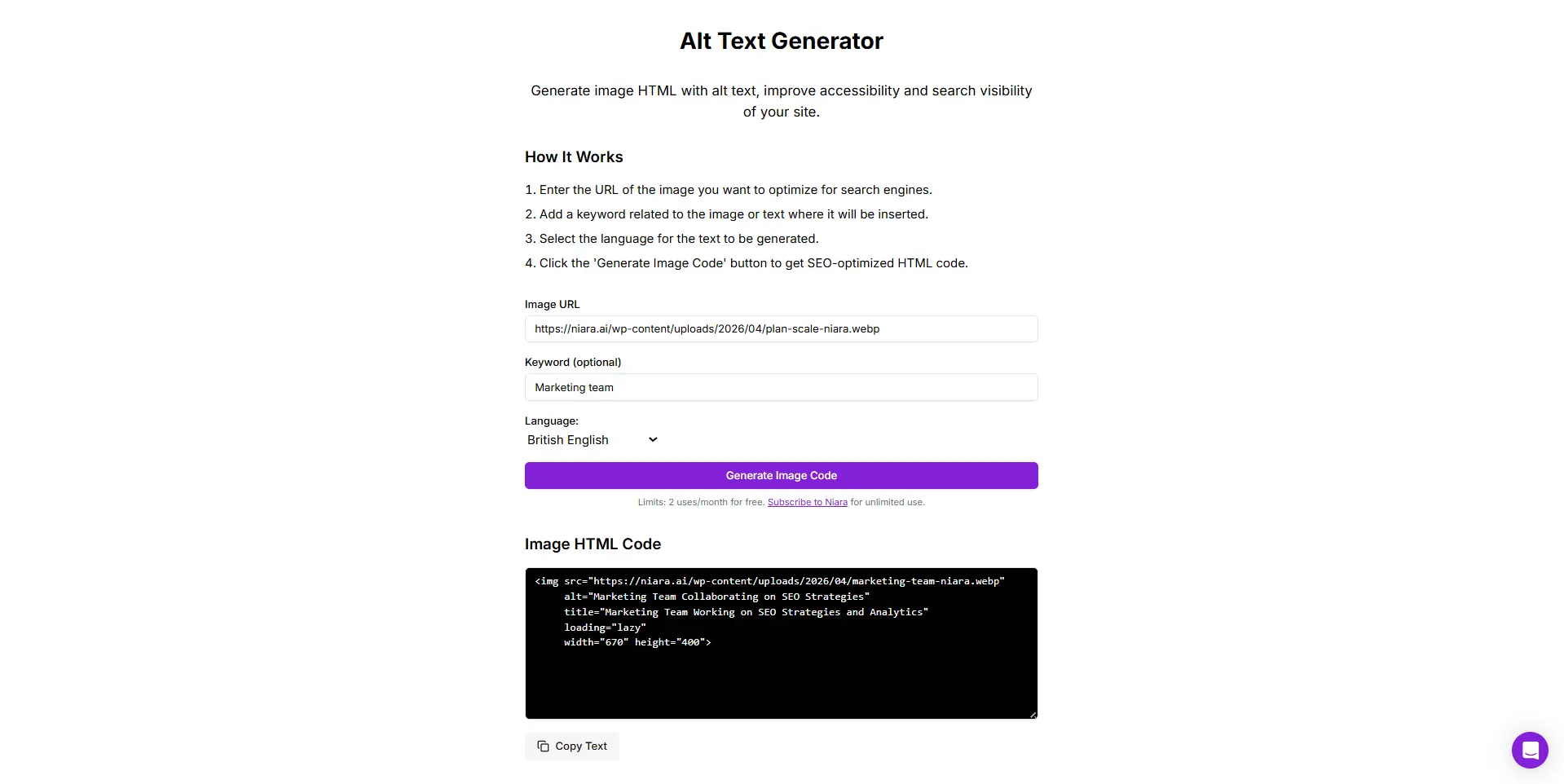
Scaling visual optimization is seamless with Niara’s Alt Text Generator. The tool analyzes your URL and automatically generates the HTML and alt text with the radical specificity that AI engines demand, transforming decorative images into powerful, searchable data assets in seconds.
7. Schema markup
As a pillar of semantic SEO, Schema.org bridge the gap between your content and an AI’s comprehension. While traditional search engines might toggle the visibility of rich snippets, AI crawlers rely heavily on structured data to categorize information and map entity relationships. This markup tells the engine exactly what a page represents without the need for resource-heavy natural language analysis.
To maximize your visibility, implement specific schema types that highlight your most authoritative data, such as FAQ, Article and Product.
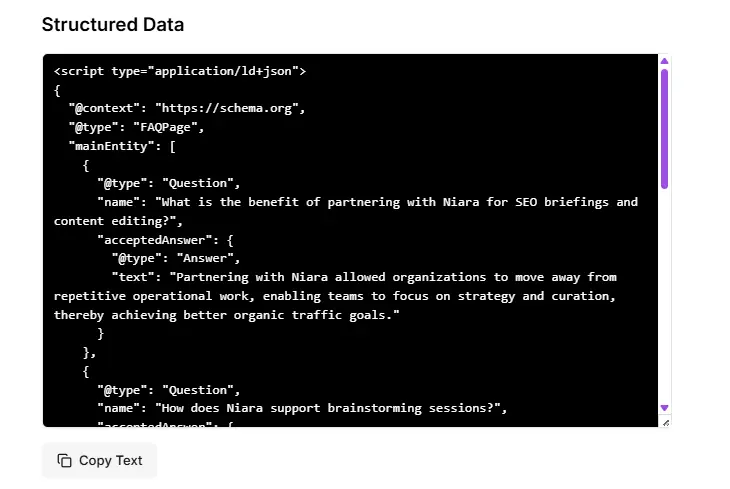
To execute this technical layer flawlessly, utilize Niara’s Structured Data Generator. Simply insert your URL and select the required data type (article, product, or review) to generate the exact JSON-LD code needed to make your brand instantly digestible for AI engines.
8. Clear HTML semantic structure
Semantic HTML serves as the skeletal framework that guides AI crawlers through your content’s hierarchy. Large Language Models rely on structured code and a strict, logical progression of heading tags (H1, H2, H3) to interpret the relationship between broad themes and specific sub-topics. This structural clarity ensures that when an AI engine performs passage-level retrieval, it understands exactly where a specific fragment fits within the broader scope of the page.
A strict, logical progression of heading tags is essential for high-performance indexing:
- H2 tags: use these to represent major topic clusters.
- H3 and H4 tags: use these to drill down into specific facets of those clusters.
- Functional tags: correct use of <nav>, <article>, <section>, and <aside> helps engines distinguish between primary content and secondary information.
9. JavaScript optimization
Even with their advanced processing power, AI crawlers face constraints when rendering heavy, client-side JavaScript. If critical information — such as product pricing, unique brand descriptions, or proprietary data points — depends on script execution to appear, you risk being invisible to the engine.
For Answer Engine Optimization, your most valuable signals must be accessible in the initial HTML payload. If the AI cannot retrieve these facts instantly, it cannot cite them.
Focus on these technical priorities:
- Server-side rendering (SSR): use SSR for your most important editorial content to guarantee immediate visibility.
- Graceful degradation: if interactive elements are necessary, ensure the underlying text remains accessible to bots without requiring script execution.
10. Citation gap
The citation gap represents the specific information missing from current AI-generated answers. When you prompt engines like Perplexity or Gemini with your target queries, you must analyze the output critically: What nuances are they missing? What proprietary data points do the currently cited competitors fail to provide?
Identifying these voids ensures you aren’t just competing for existing space, but rather expanding the AI’s knowledge base. To exploit content gaps, perform a targeted AI content audit:
- Detect generic patterns: look for areas where the AI provides a consensus-only answer due to a lack of deep, specialized sources.
- Fill the information void: create content that specifically addresses these missing layers. If an AI overview for “semantic mapping for SEO” lacks real-world implementation data, publish a comprehensive guide detailing the exact methodology and results.
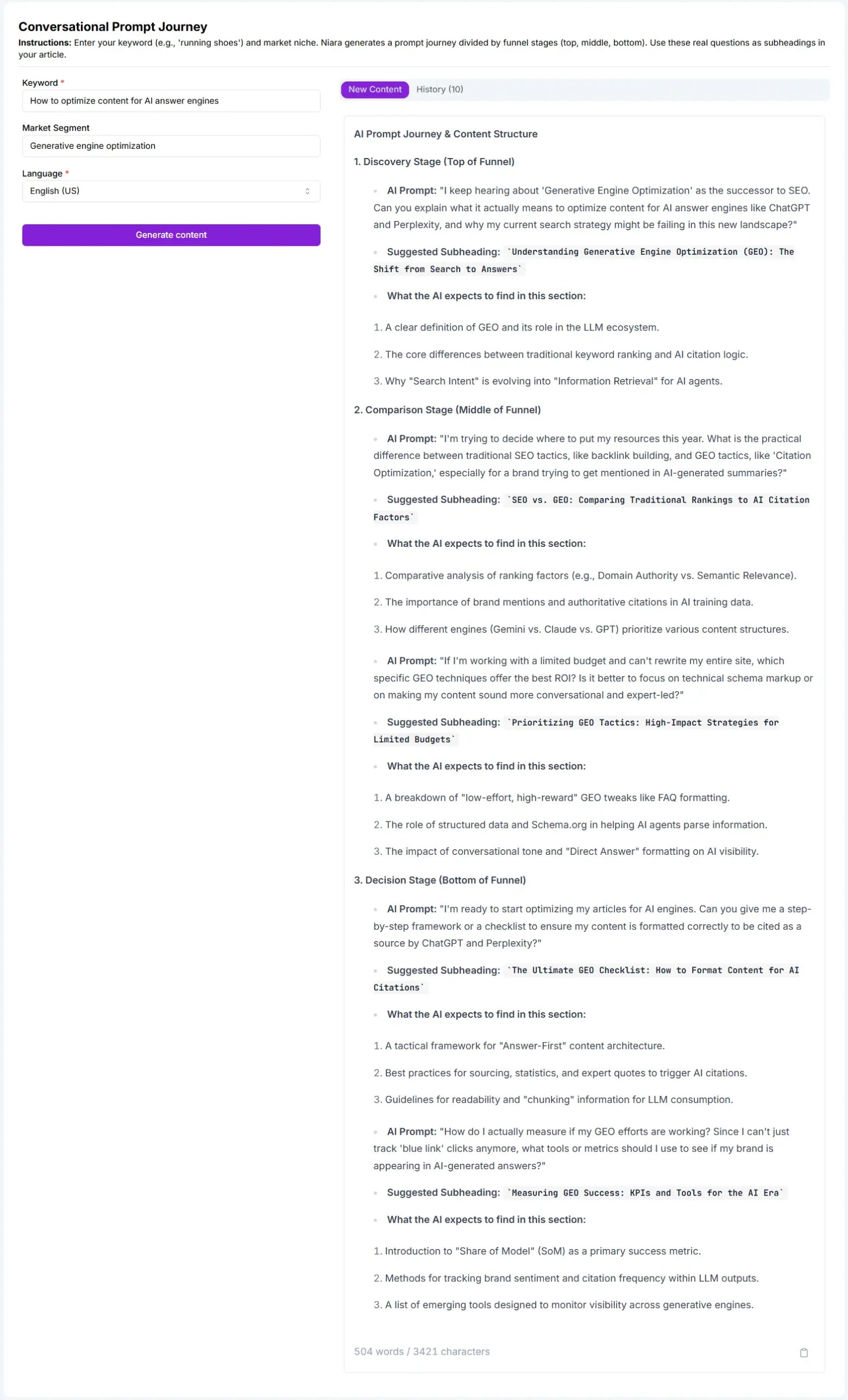
Identifying the gap is only the first step. Filling it with strategic depth is what secures the citation. Niara’s Conversational Prompt Journey helps you move beyond the obvious by generating prompt ideas based on your specific keywords and market. These prompts can be integrated into your content to anticipate and resolve the exact follow-up queries users ask AI agents, ensuring your brand remains the definitive source.
We even used our AI SEO Agent to determine the essential topics for this content:
Niara’s Answer Engine Optimization framework: discovery, expansion and structuring (DES)
Optimizing for the AI era requires a unified workflow that eliminates operational bottlenecks while enforcing strict, machine-friendly formatting. Niara provides a centralized platform designed to orchestrate this process through the GEO triad: Discovery, Expansion, and Structuring (DES).
1. Discovery
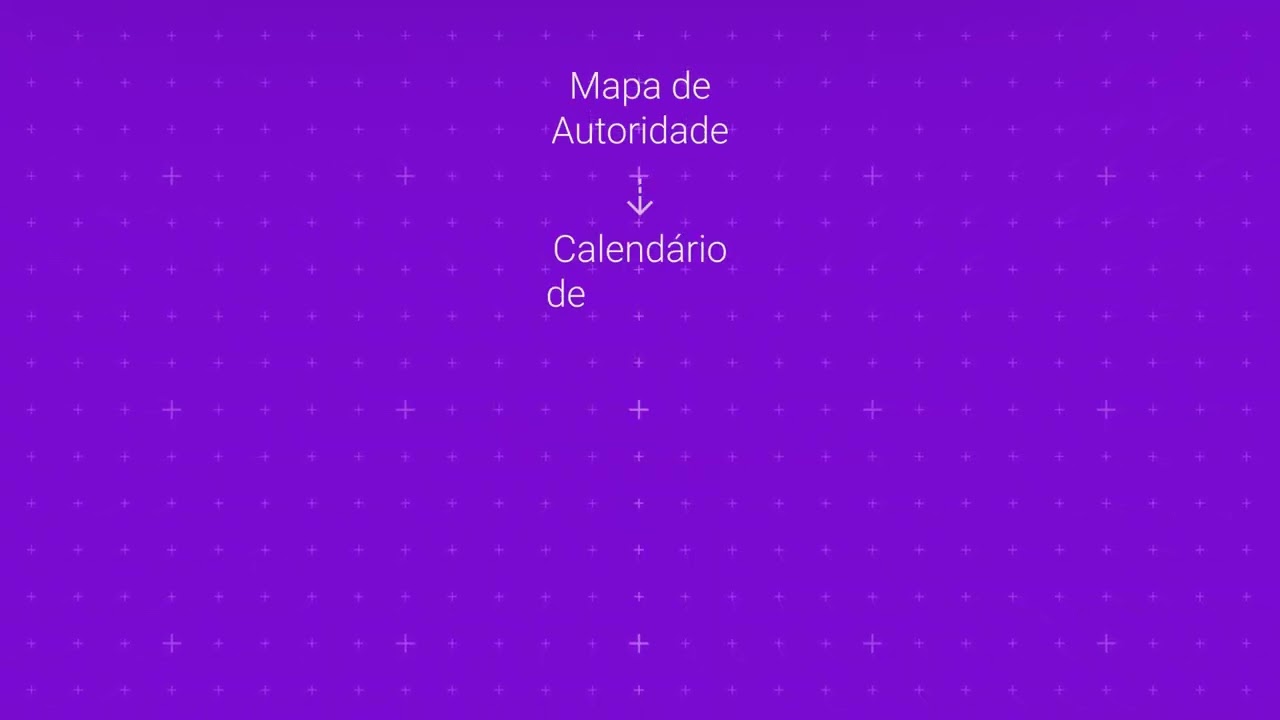
The foundation of GEO is identifying where your brand has the highest potential for authority. This phase is powered by Niara’s Authority Map, which transforms Google Search Console data into a strategic growth roadmap in seconds.
Instead of manual spreadsheet analysis, the tool identifies dominant clusters and pinpoints exact content gaps. With a single click, it generates a 3-month editorial calendar, mapping out a cohesive knowledge graph that ensures your domain covers every facet of a topic. This discovery phase ensures you aren’t just creating content, but building a definitive territory for AI engines to index.
2. Expansion
Once the territory is defined, the goal is to provide information gain. This is where the Content Workflow and Conversational Prompt Journey come into play. By analyzing the SERP and organic competitors, Niara generates briefings that highlight critical content gaps—topics your competitors have missed.
To further expand this context, Niara suggests conversational prompts based on real-world user intent. This allows you to anticipate fan-out queries, ensuring your content provides the specific, nuanced answers that LLMs prioritize for citations.
3. Structuring
The structuring pillar ensure that your insights are perfectly formatted for AI extraction. Even the best content will fail if it introduces processing friction. Niara’s AI Text Formatter and Specialized Generators (Schema, Alt Text, and Structured Data) act as the final layer of optimization.
This phase focuses on making data digestible for crawlers by converting dense blocks into structured tables, lists, and semantic HTML. To validate the result, the Google AI Mode Insights feature cross-references your URL against official AI Overview documentation to provide a final diagnostic. The goal is ensure your technical structure and content density are perfectly aligned for maximum visibility in AI-generated summaries.
7 KPIs for the generative search era
The traditional metrics of clicks are no longer sufficient to measure SEO success in an environment dominated by AI answer engines. As generative assistents synthesize answers directly on the interface, zero-click searches will inevitably rise. To understand your true market penetration, you must adopt new KPIs that reflect brand authority and AI visibility, including Share of Model (SoM), general impressions and branded search impressions.
While AI visibility is the starting point, the ultimate goal remains business impact. To understand the quality of the traffic driven by your AEO strategy, you must cross-reference AI signals with GA4 behavioral metrics, such as sessions, new users, average engagement time and conversions.
Furthermore, utilize the native generative reporting now available in major search consoles. Both Google Search Console (GSC) and Bing Webmaster Tools have introduced specific reports for AI-driven performance. These dashboards provide a high-level overview of how often your brand appears in AI Overviews and Copilot responses, offering a critical baseline for your total generative reach.
To elevate your strategy, leverage Niara’s Search Analytics and Conversational Analytics. You gain access to 5x more data, specialized intent filters, and the ability to interact directly with your performance metrics. Instead of navigating endless spreadsheets, you can use ChatSEO to query your data — for example, “list the top 10 conversational queries with more than 4 words that had the highest click growth in the last 30 days”.
This turns raw data into immediate, actionable strategy.
Will your brand be the answer?
The era of optimizing for clicks is being replaced by citations and attribution, we’re now in the era of optimizing for trust. The real competitive advantage now belongs to those who can transform their institutional knowledge into a structured, authoritative source of truth that AI models can’t afford to ignore.
You have a choice: remain a passive observer of the zero-click rise or become the definitive entity that fuels the AI’s response.
Niara was built to bridge this gap, giving you the AI-driven tools to automate the technical precision while you focus on the unique insights only a human can provide.
The future of search is conversational, immediate, and authoritative. Is your content ready to be cited?
Try Niara for free today and start building your brand’s authority in the AI era.
Frequently asked questions
Why my current AI search strategy might be failing in this new landscape?
Your strategy likely relies on outdated keyword stuffing instead of building comprehensive topic clusters for AI visibility. If your content lacks semantic HTML, structured data, and high-signal paragraphs, AI engines cannot efficiently extract and cite your information.
If I’m working with a limited budget and can’t rewrite my entire site, which specific AEO techniques offer the best ROI?
Focus immediately on optimizing your first paragraphs for direct answers and implementing Schema markup on your highest-converting pages. Restructuring existing content into bulleted lists and adding highly descriptive alt text via tools like Niara’s Alt Text Generator requires minimal budget but drastically improves passage-level retrieval.
Which Answer Engine Optimization tool should I use?
You need a platform that centralizes semantic mapping, technical health, and content generation, which is exactly what Niara provides. By utilizing features like Google AI Mode Insights, Content Workflow, and the Technical SEO Agent, you unify your entire AEO workflow in one secure, efficient environment.
