
Thin content in SEO refers to any page that offers little to no unique value to the user. These pages fail to satisfy search intent because they lack depth, original information, or helpful insights.
Search engines want to reward expertise and trust. When your site is full of thin content, you waste your crawl budget on pages that won’t convert. And this lack of depth is a massive barrier to AI visibility. Modern search bots and AI models hunt for high-quality data to satisfy complex user needs. As shallow pages provide any valuable content, these systems will skip over your site in favor of more comprehensive sources.
In a long-term scenario, thin content can cause penalties and dilute your overall authority. It makes it harder for your truly valuable content to stand out in a crowded search result.
Common thin content types and quick checks
The central issue with thin content is a total lack of original utility. These pages exist to capture search traffic rather than provide actual help to a human reader. Identifying these red flags requires looking past word counts to see if the page offers anything that cannot be found elsewhere.
Unoriginal affiliate pages
Thin affiliate content often happens when a site owner copies technical specs directly from a manufacturer and calls it a review. If your page lists the same features found on a product box without adding personal testing or unique insights, search engines see no reason to rank it.
Imagine a “Best Coffee Makers” guide that only lists the machine’s size and price. A high-quality alternative would describe how the coffee actually tastes or how loud the machine runs during a morning routine.
Low-quality AI output
Using AI to pump out unedited text is a fast track to losing your rankings. While these tools can help draft ideas, publishing them without human oversight results in generic, repetitive fluff that fails to solve specific user problems.
You might notice articles that talk in circles for several paragraphs without ever giving a straight answer or a unique perspective. This lack of depth signals to search engines that the page is just filler.
A quick visual check involves reading the first three paragraphs. If the text relies entirely on empty adjectives and fails to state a clear premise or answer, it is likely thin.
Also read: Does AI Content Rank on Google? The Truth + Flash Benefícios Case Study (2x Market Share)
Doorway pages
Doorway pages are built to trick search engines into ranking a site for many different locations or keywords using nearly identical templates. This is common in local services where the only difference between fifty pages is the name of the town.
Real-world example: A locksmith website might create separate URLs for “Locksmith in Brooklyn”, “Locksmith in Queens” and “Locksmith in Bronx”. If the text on every page is exactly the same, it provides no specific value to the people living in those neighborhoods.
Duplicate and scraped content
Duplicate content occurs when multiple pages on your site serve the exact same purpose or when your text heavily overlaps with external sources. You can spot this during a routine audit by checking your content governance documentation for overlapping target keywords across different URLs.
If your guide to “How to Fix a Leaky Pipe” uses the same steps and photos as the top result on Google, you are not giving the user a reason to click your link. True value comes from providing a better explanation, clearer photos or a more efficient method than what is already available.
Scraped content is a more severe violation, where text is copied directly from other domains without adding any original commentary or citation quality.
Pages with ads
Pages with ads on page that push the actual content below the fold or obscure the text entirely are treated as thin content because they severely degrade the user experience. Red flags for these categories include high impression volumes with disproportionately low click-through rates and poor engagement metrics.
How to spot thin content pages?
Open Google Search Console and go to Indexing > Pages and check for the “Discovered – Currently Not Indexed” status. It’s important to emphasize that not every page here is bad. But, if you see important URLs stuck in this status is a major warning sign regarding two specific areas:
- Site quality: if Google previously crawled several pages and found them thin, repetitive or low-value, it starts to assume new pages will follow the same pattern. As a result, it stops wasting resources on your new content.
- Server performance: if your server is slow, Google will reduce its crawl rate. This leaves your newest pages trapped in the “Discovered” stage indefinitely.
You can also check Performance > Pages. Look for URLs with high impressions but zero or near-zero clicks, especially those in positions 20 or lower. These pages are visible to Google but probably fail to satisfy users. They are prime candidates for a rewrite or a content merge.
To the final veredict, validate if everything is ok with your website through Security and Manual Actions > Manual actions.
This section flags direct penalties for doorway pages and thin affiliate templates. If this tab is empty, your traffic issues are likely caused by automated quality algorithms rather than a human-issued penalty.
From detection to resolution in Niara’s ecosystem
What if you could move from identifying thin content to fixing it without leaving your workflow? Niara unifies every stage of SEO by connecting data analysis with content production. When dealing with this kind of problem, you can follow this path to clean up your site and recover your rankings.
Phase 1: Detection
The goal of detection is to find URLs that search engines recognize but users probably find unhelpful. By identifying where your visibility fails to turn into traffic, you can pinpoint exactly which pages are dragging down your site’s overall authority.
Identify underperforming pages with Search Analytics
Niara’s Search Analytics connects to your GSC data to find pages that Google sees but users ignore. When you access the panel, filter your URLs by high impressions and low CTR, or look for those that recently slipped in average position.
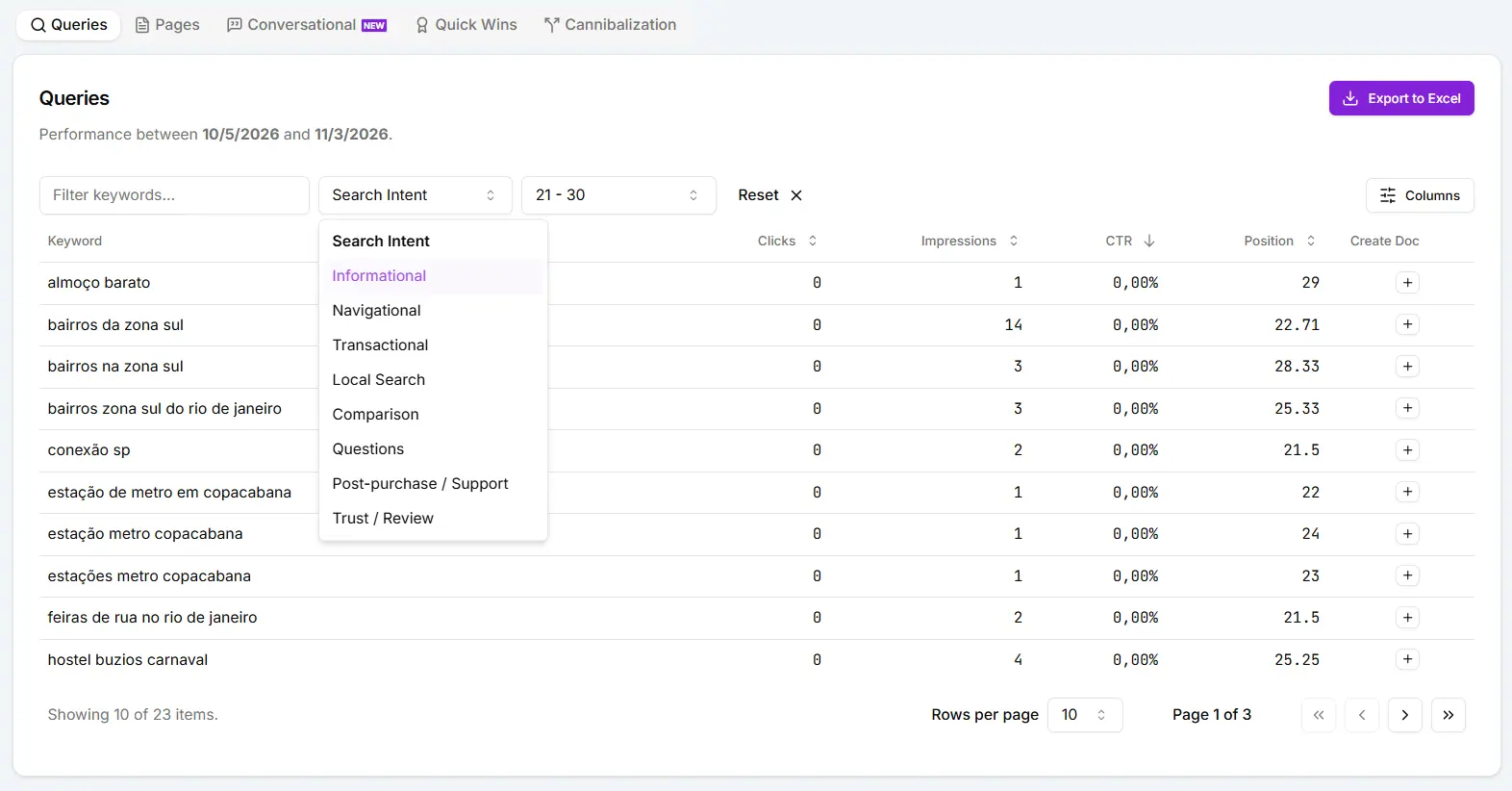
To speed up your audit, use Conversational Analytics through ChatSEO to ask direct questions like: “Which pages kept impressions over 5k with less than 2% CTR over the last 90 days?“.
Niara automatically pulls the requested pages based on your prompt, making it easy to spot assets falling below expected performance levels. While not every result will be a thin content case, this list gives you a clear starting point for deeper investigation. Niara provides an overview of the situation, improvement suggestions and follow-up questions to keep your analysis moving.
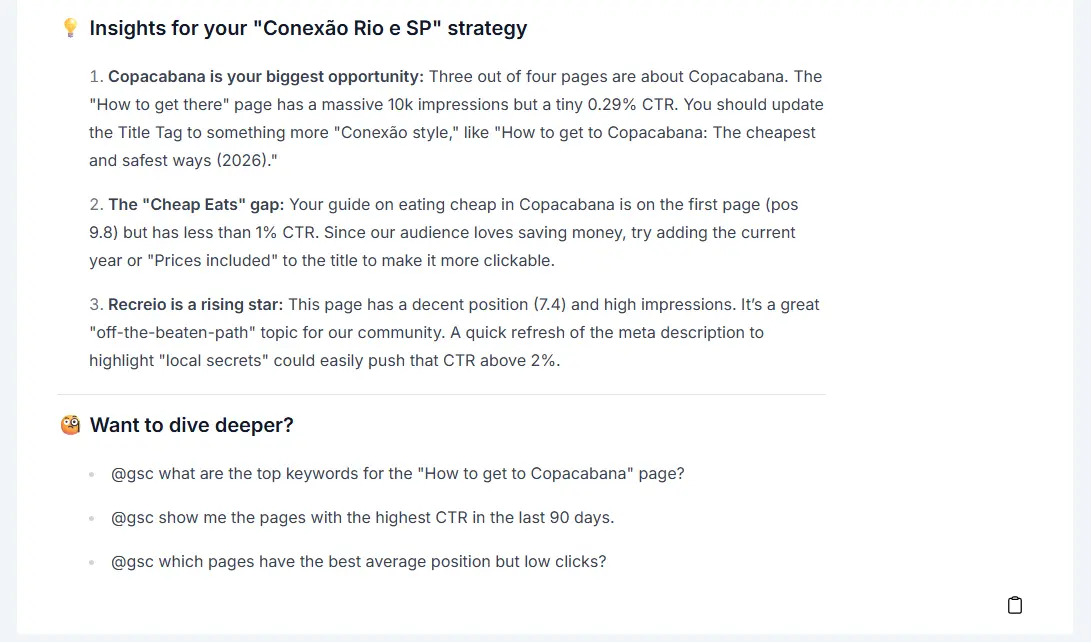
You can also take a specific URL into the chat to request a deep dive, provided the page allows bot access and has its main content rendered on the server side via HTML.
Diagnose quality gaps with Google AI Mode Insights
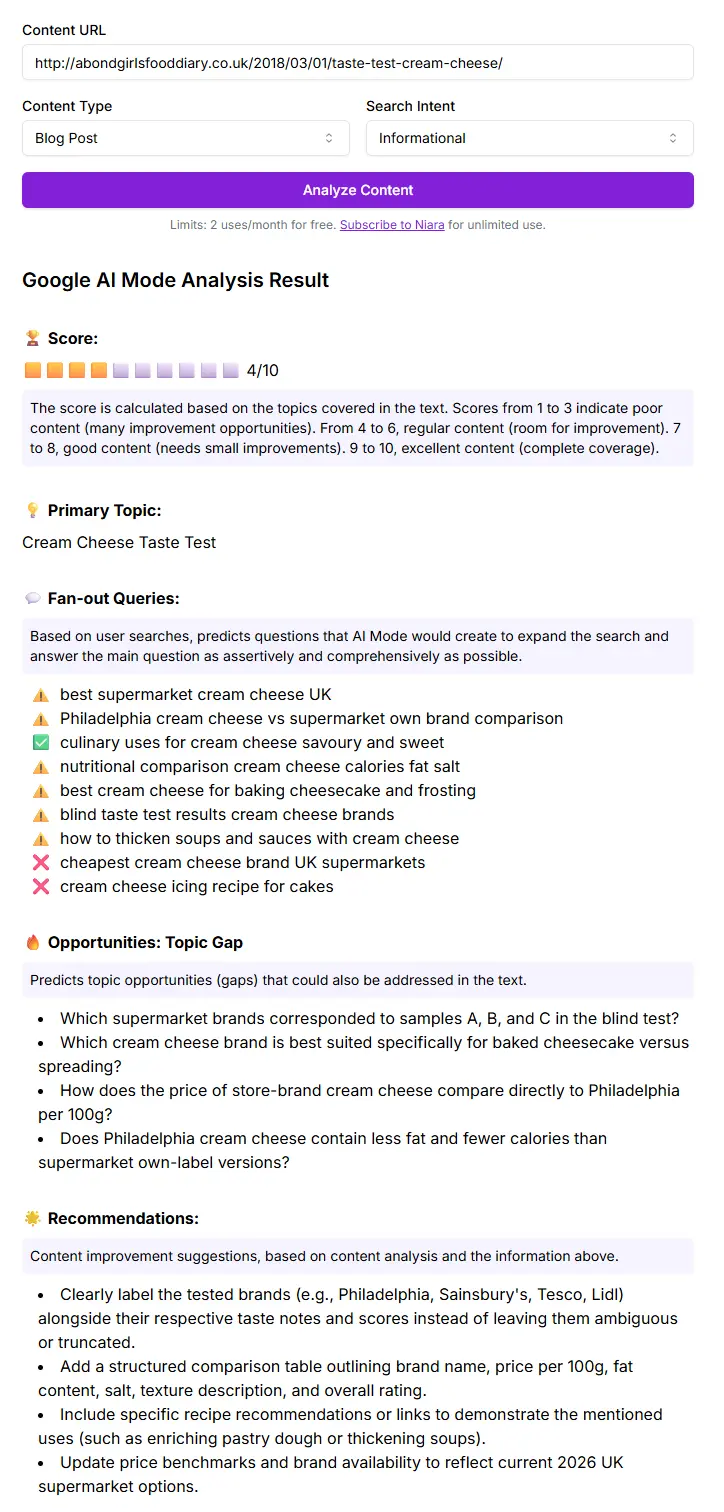
Once you have a list of suspicious URLs, run them through Google AI Mode Insights to see why they are underperforming. Throught this tool, Niara analyzes your page against modern search requirements.
Google AI Mode Insights identifies your query fan-out and specific content gaps. If Niara points out several unanswered questions related to your topic, you have proof that the content is too shallow to compete.
Check for keyword cannibalization
Thin content often manifests as multiple weak pages competing for the same search term. Within Search Analytics, you can access the Cannibalization report to find pages that are fighting each other in the search results.
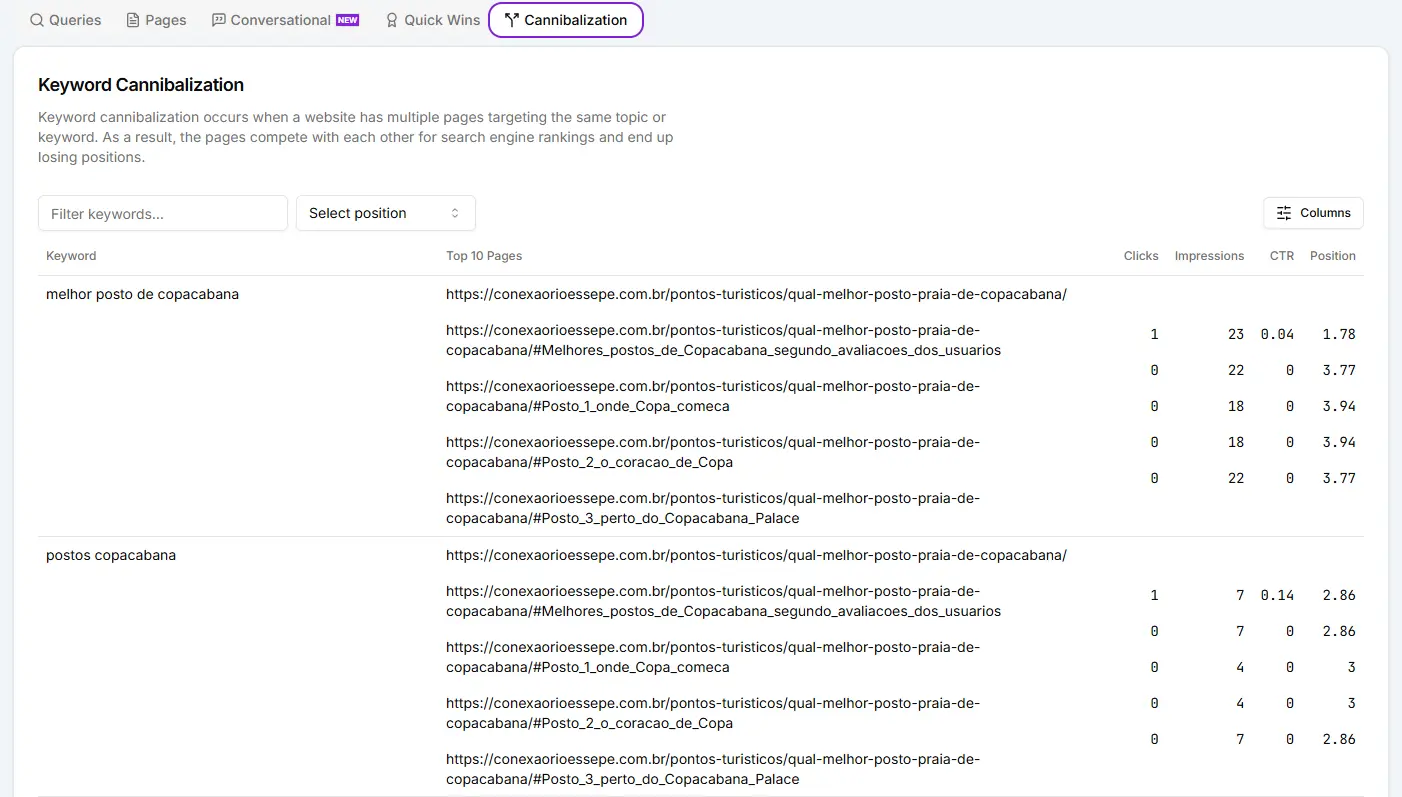
This validation helps you decide which page is your strongest asset and which ones are thin and redundant. Once you identify these overlapping URLs, you can choose to merge them into a single authoritative guide, redirect the weaker versions or delete them entirely to clear up your site structure.
Phase 2: Action
Once you identify your low-quality pages, the next step is to either improve them or replace them entirely. This phase focuses on turning weak URLs into high-performing assets that satisfy both users and search algorithms.
Rewrite content with Content Workflow
Content Workflow helps you rewrite shallow pages using data from top Google results. The tool analyzes page 1 competitors, rich snippets and content gaps to generate a new brief. Following your Brand Guide and brief instructions, Niara helps you write all you content in one click only.
This ensures your new version covers the topics search engines expect while providing a high quality content that enhance the experience for the reader.
Use YouTube to Article for depth
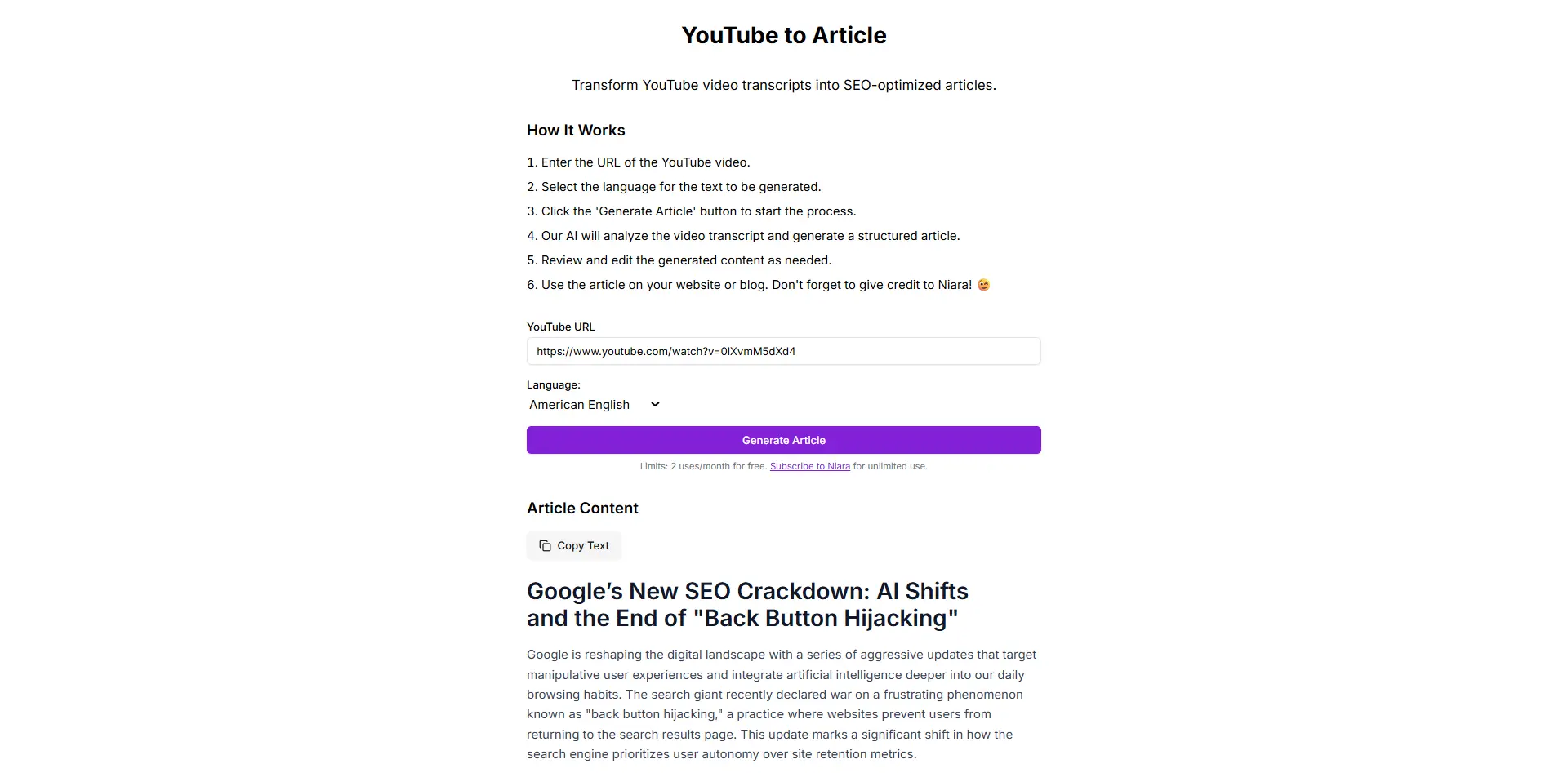
You can also use video content to build more authority. The YouTube to Article tool converts video transcripts into SEO-optimized text that can complement your rewrites.
Including the video embed itself is a smart move because search engines and AI models now look for multimodal elements when ranking helpful content.
Fix thin content and scale production with Bulk Content
For large-scale projects, the Bulk Content tool removes the need for months of manual labor. You can optimize metadata and product descriptions across your entire site in a fraction of the time. For you to know, Niara can generate 100 unique product descriptions in three minutes!

To prevent generic results, the tool follows your Brand Guide to keep every generation aligned with your specific voice.
Strategic factors to evaluate before taking action
Not every piece of underperforming content deserves a complete rewrite. Applying a keep, kill or combine framework ensures you allocate your resources where they actually drive growth.
| Action | What it is | When to do it |
|---|---|---|
| Kill: delete or noindex | Removing the page from the index or the site entirely. | For outdated pages or content with zero authority signals. |
| Combine: content pruning | Merging several weak pages into one power page. | For duplicate content, keyword cannibalization or overlapping topics. |
| Keep: upgrade | Deepening the existing content with new data and insights. | For high-value keywords, commercial intent or core product pages. |
| Keep: support | Keeping the content as is while improving its authority. | For high-quality pages that only need better internal or external linking. |
Once you decide which pages to save, remember that word count is a vanity metric. Search engines prioritize usefulness and extractability over length. A precise 100-word answer often provides more value than a 1,500-word essay that buries the information. To determine exactly how much depth your page needs, you must analyze what is already working for your competitors. Within Niara, you can do this in two ways:
- Content Workflow: automatically analyze page 1 results to identify rich snippets and content gaps.
- ChatSEO: enable “Web Search” and paste the URLs of the top-ranking competitors. Ask Niara to analyze their content and search intent to identify recurring topics that your page cannot miss.
This analysis ensures your content covers everything the user expects while adding your unique expertise.
To measure real value, look at behavioral signals and entity clarity. A high-value page includes first-party data like real implementation timelines or roadblocks specific to your industry. This shift from generic aggregation to experience-based answering is what separates commodity pages from true authority content.
Future-proofing your content strategy
Solving thin content problems is not a one-time fix but a shift toward active content governance. As search engines and AI models evolve, the penalty for maintaining filler pages will only increase. Your goal now is to build a lean, authoritative digital ecosystem where every URL serves a distinct purpose and provides measurable value.
Stop guessing and start optimizing.
Use Niara to audit your site, identify the dead weight, and turn your thin pages into ranking machines through data-driven workflows and specialized AI agents. Try our tools for free today!