
Are U.S. e-commerce giants already adapting their digital strategies for the era of generative search?
In this study, we put two major players in the pet industry to the test: Chewy and PetSmart. We investigated whether their current content is robust enough to feed new generative engines or if they are still anchored to a traditional digital catalog model.
Using Niara’s Google AI Mode Insights, we mapped exactly where these brands shine and where information gaps are leaving the door open for the competition.
Below, we present a strategic breakdown of content quality in the U.S. pet e-commerce sector. More than just a comparison, this diagnostic will help you understand what it takes to transform your blog into an authority asset.
The goal is clear: when AI is asked a question, your site should be the final answer.
General summary: e-commerces authority diagnostic in the AI era
While Chewy and PetSmart operate with a higher level of digital maturity compared to studies in Spanish and Portuguese, data from Google AI Mode Insights reveals that Chewy takes the lead in building the tactical utility that AIs prioritize.
| Analysis Criteria (AI Mode) | Chewy | PetSmart | Impact on Search Experience |
|---|---|---|---|
| Query fan-out coverage percentage | 84% | 68% | How well content anticipates subsequent questions from pet owners. |
| Technical depth | High | Medium | Precision in biological and safety topics (YMYL) makes AI trust the brand as a primary source. |
| Topic gap coverage | Minimal | Moderate | Gaps (such as dosage and safety) force users to search elsewhere, signaling incomplete content. |
| Multimodality and structure | Excellent | Insufficient | The use of tables and images (multimodality) facilitates data extraction for Google AI Overviews. |
| Final Average Google AI Mode Insights | 8.9 | 8 | Measures information quality based on Google’s AI documentation via Niara’s AI Mode Insights. |
While Chewy already positions itself as a technical consulting ecosystem, solving complex journeys with biological and visual precision, PetSmart still presents gaps in multimodality, as we will see below. For generative searches, this difference defines who will be the cited source and who will be just another link in the SERP.
In the current landscape, authority is not measured only by what the brand sells, but by the ability to be the final destination for the user’s doubt, eliminating any need for a new search.
Strengths and successes in content strategies
Based on analysis from Niara’s Google AI Mode Insights, we observed that U.S. pet e-commerces Chewy and PetSmart already operate under the logic of “content as a service.”
For search AIs, authority comes not just from word volume, but from the ability to solve the pet owner’s complete journey in a single destination, anticipating the ramifications of each doubt (what we call query fan-out). In this regard, both brands perform very well, offering depth, connection, and structured answers.
1. Depth in technical and biological nuances
The greatest competitive advantage identified, especially in Chewy’s content, is the deep dive into topics requiring technical precision. Instead of just listing symptoms, the brands explore the “why” and “how” in a granular way.
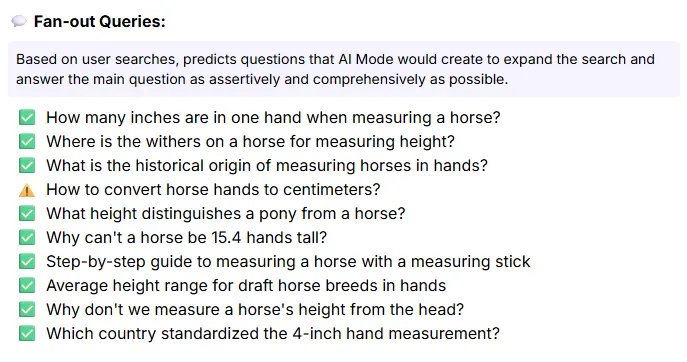
When discussing flea infestations or measuring horses, for example, the content is not limited to the obvious. It answers predictive questions like “the visual difference between flea dirt and common dirt” or “why a horse cannot be 15.4 hands high.”
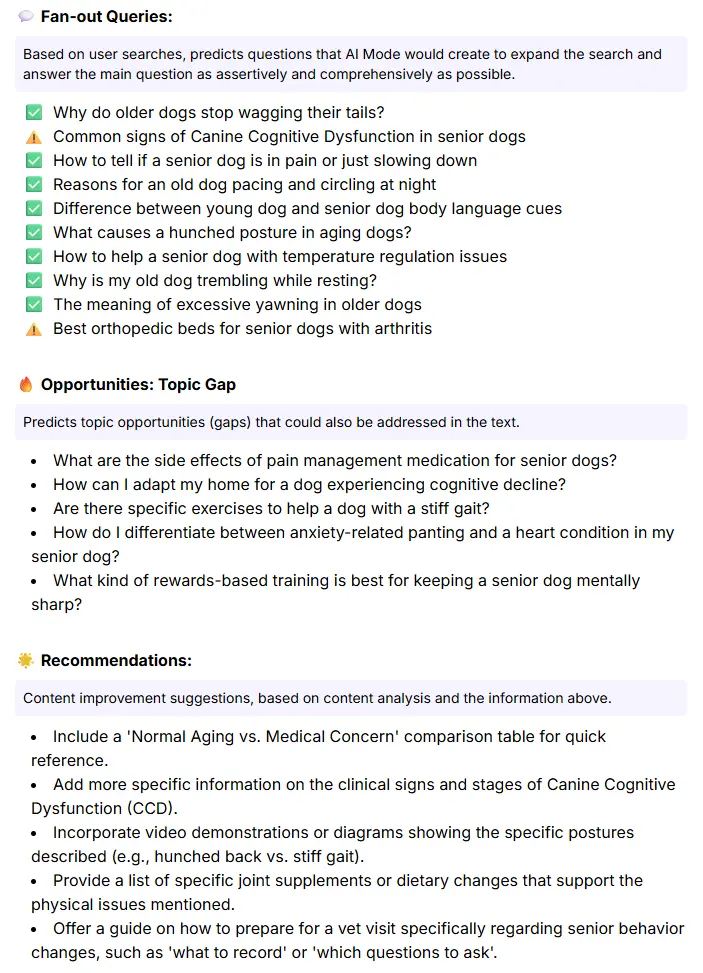
Another strength is the ability to detail specific behaviors, such as the arched posture in senior dogs. In this content, Chewy not only details how senior dogs act but also provides images exemplifying the animal’s state and guidance on what to do — something PetSmart does not do in any blog post.
Both written content and visual elements are fundamental, as search is becoming multimodal. Images, videos, and audio bring more clarity to AIs regarding the subject matter. Therefore, by enriching content beyond text, it is as if Chewy provides complementary evidence to attest to the content covered.
Consequently, this increases the brand’s chances of being referenced in generative results, not only through text but also through images.
2. Segmentation by life cycle and species
Unlike generalist strategies, there is a clear structure of knowledge hubs that separates needs by life stage and less common species.
This clustering is what crawlers use to identify a domain’s topical authority. Dividing themes within the same universe signals that the domain possesses depth of knowledge, transforming the e-commerce site into a complete reference source covering everything from basic questions to the rarest nuances of a niche.
Additionally, organized clustering helps crawlers understand the site’s information hierarchy. If PetSmart has an entire interconnected section about senior dogs, the AI understands that it is an authoritative entity on the subject, making it easier for Google AIO to extract direct answers from there, as confidence in the data’s precision is higher.
3. Connection between education and the loyalty ecosystem
The blog stops being just a repository of tips and acts as the central link between the brand and the user at all stages of the journey. By integrating middle and bottom-of-the-funnel content, such as detailing loyalty programs and grooming services, the brand ensures the user doesn’t need to leave its ecosystem to make a decision.
This clarity regarding promotion rules, point accumulation, and practical benefits is what we call fact anchoring.
For AI, structured data and direct explanations of proprietary services are fundamental to avoid hallucinations: when information is ambiguous, the algorithm might invent rules or values.
By reducing the pet owner’s anxiety with calorie calculators or appointment preparations, this communication strategy transforms the blog into a consultative tool.
This signals to the AI that the domain not only attracts traffic but offers secure transactional utility, connecting search intent to real conversion without communication noise.
4. Predictive response structure
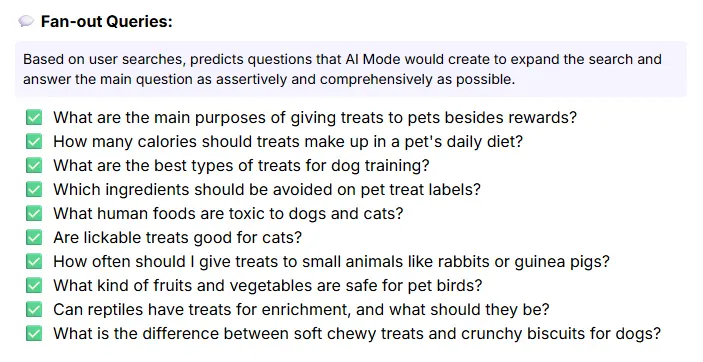
Chewy and PetSmart use a structure that facilitates data extraction by AI systems. The use of lists, comparative tables, and coverage of subsequent questions (query fan-out) provides Google with the necessary nuances to cite these brands as authoritative sources in direct answers.
Where the search experience still fails: gaps and improvement opportunities
Although both brands demonstrate technical authority, Google AI Mode Insights diagnostics reveal a mismatch between “comprehensive content” and “immediate tactical utility.” In a generative search ecosystem, it is no longer enough to be an encyclopedia; brands must evolve to become decision-making tools.
1. Gap in safety and dosage
Even for industry leaders, there is a recurring omission of critical safety details that AI algorithms classify as “high risk” (YMYL).
At PetSmart, for example, content frequently mentions treatments but ignores “danger zone” details. The e-commerce’s flea and tick guides lack explicit warnings about permethrin sensitivity in cats when using dog products—a common and fatal mistake in multi-pet households.
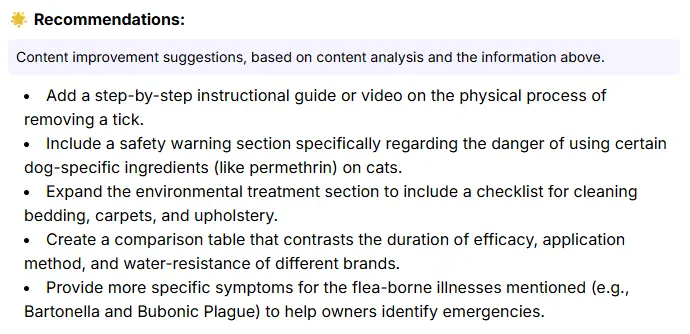
When official information is absent, AI may “hallucinate” safety protocols or extract data from other sites.
2. Lack of visual multimodality
The absence of visual items is a problem found especially in PetSmart’s content. Of the five blog posts analyzed, none had images or videos throughout.
Tópicos como “Horse measurement in hands” are inherently visual. Although there is a table on the page that helps the user, other elements could be included to further facilitate the journey.
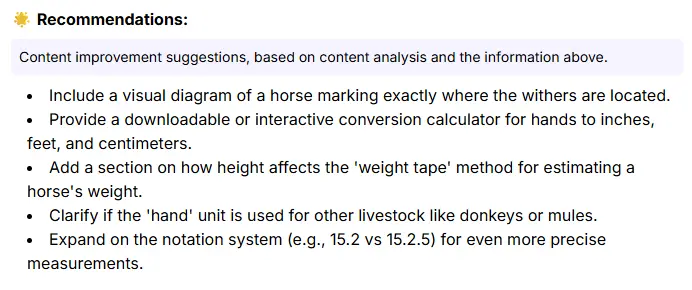
Multimodality is not just for UX; it is a signal to the AI that the page is the “final destination” to solve the problem, eliminating the need for a user to perform a second search on YouTube.
Content as a strategic asset in the generative era
Google AI Mode Insights diagnostics make one thing clear: in the era of generative search, content has ceased to be just SEO support and has become the central product.
Among all brands analyzed globally, including e-commerces in Brazil and Spain, Chewy and PetSmart stand out as the most prepared for the AI-first world.
To lead generative answers today, brands must stop writing for old algorithms and start solving complete technical journeys.
Authority is no longer born from word volume. It comes from data precision, visual clarity, and the courage to deliver real utility, such as calculators and specific safety protocols.
Is your content ready for the future of search?
Just as we analyzed the strengths and gaps of Chewy and PetSmart, you can also discover exactly what is missing from your content to dominate generative results on platforms like AI Overviews, ChatGPT, and Perplexity.
The difference between being a cited authority or being ignored lies in the details that only a deep diagnostic can reveal.
Test Niara’s Google AI Mode Insights today and receive an instant technical diagnostic.
Simplify your SEO with Niara!