
Stop thinking of Google Maps as just a digital map or a glorified GPS. That era is officially over. With the rollout of Ask Maps, the familiar “blue dot” has evolved into a conversational concierge that doesn’t just show you where a business is—it explains why that business is the right choice for you.
We’ve officially crossed the threshold into the Generative AI era of local search. In this new reality, visibility is a reward for being the most reliable solution. It’s no longer enough to be “on the list.” You have to be the trusted answer that Google’s Gemini-powered AI feels confident recommending to a real person with a specific, nuanced need.
At Niara, we’ve moved past traditional optimization to focus on what we call trust engineering. Every detail you share—from the specific vibe mentioned in your reviews to the granular attributes in your Google Business Profile (GBP)—is a data point the AI uses to build a case for your business. To win today, you have to stop acting like a static directory listing and start acting like a dynamic entity.
Let’s look at how you can master this new conversational frontier and ensure your business is the one the AI chooses to talk about.
Read more: Mastering Local SEO in the Age of Generative AI
What Ask Maps Teaches Us: From Curation to Personalization
Google’s Ask Maps represents a transformative shift in local discovery, integrating Gemini AI into the Google Maps ecosystem to create a conversational search experience. Unlike traditional navigation tools that rely on rigid keywords, Ask Maps utilizes generative AI to process natural-language queries. Users can now ask complex questions, such as finding a “quiet dinner spot with a vintage vibe”, receiving curated recommendations synthesized from billions of reviews, photos, and business details.
The official public launch of the Ask Maps feature occurred in March 2026, rolling out initially to Android and iOS users across the U.S. and India. As of mid-2026, the rollout continues to progress dynamically, with regional expansions currently being deployed across Europe alongside a wider release for desktop users.
This integration marks a move away from simple keyword matching toward semantic and contextual understanding. By interpreting the nuance of human intent, Ask Maps provides personalized responses rather than a standard list of links.
Google is redefining how we interact with our surroundings. For businesses and consumers, Ask Maps signifies the end of the keyword era and the beginning of a sophisticated, AI-powered era of discovery.
AI as a Curator
In traditional search, a user might see a list of twenty coffee shops. It was up to the user to click through, read reviews, and decide which one fits.
Ask Maps changes the dynamic. It acts as a curator, summarizing the best fits tailored to the specific user’s prompt.
If a user asks for “a quiet place to work with good espresso and vegan pastries,” the AI filters out the noisy shops and those without oat milk, ensuring every result is personalized based on the user’s historical preferences.
The Trust Factor
Visibility now depends on how well your business is understood by the algorithm. Beyond mere quality, your goal is to cultivate the relevance necessary for AI algorithms to validate you as the ideal match for a user’s unique requirements.
This confidence is built through consistency across the web. If your GBP says you have outdoor seating, but your website doesn’t mention it and your photos don’t show it, the AI’s confidence in that attribute drops. Trust engineering is about eliminating these gaps.
Unstructured Data Becomes Answers
Perhaps the most revolutionary aspect of Ask Maps is its ability to “read” unstructured data. Information that was previously “hidden” in the background of photos or buried in the middle of a 200-word review is now indexed.
Gemini can analyze a photo of your restaurant and identify that you have high chairs for babies or that your lighting is dim and romantic. This means your visual and narrative content is now as important as your technical metadata.
The Pillars of Brand Definition: Positioning for AI
To be “chosen” by Ask Maps, your brand must be more than a pin on a map. You must clearly define three core areas to ensure the AI understands your business context.
1. Utility & Services
You must be painfully specific about what you do. The AI needs to know exactly who you help and what every available amenity is.
In the local space, this means tagging every possible attribute: Wi-Fi speed, parking availability, wheelchair accessibility, and even the “vibe” of the establishment. The more granular the data, the more likely you are to appear in long-tail conversational queries.
To put this into practice, here are two examples of how SEOs should (and shouldn’t) handle local business data:
- Vague & Generic: Listing your business as a “Modern Italian restaurant with great food and a nice atmosphere”. This fails because it lacks the searchable attributes AI needs to answer specific user intent, missing out on queries for “Italian restaurants with high-speed Wi-Fi”, “wheelchair-accessible patios”, or “quiet dinner spots for business meetings”.
- Granular & Actionable: Updating your Google Business Profile and your site with Local Schema to specify: “Authentic Italian trattoria in SoHo featuring 100Mbps guest Wi-Fi, heated outdoor pet-friendly seating, ADA-compliant entrances, and validated valet parking”. This level of detail ensures you capture conversational traffic from users asking for hyper-specific amenities.
2. Detailed Social Proof
We are moving beyond the era of the five-star rating. A “Great service!” review is nearly useless for Ask Maps optimization. AI thrives on descriptive, situational feedback.
When a customer says, “I came here for a last-minute anniversary dinner, and they sat us in a quiet corner and even brought out a complimentary dessert”, they are providing the AI with dozens of data points: “anniversary,” “quiet,” “romantic,” “good service,” and “complimentary dessert.” Your strategy must shift toward encouraging these narrative-rich reviews.
Reviews are essential not just for generative algorithms, but for the very people they serve. Even in the AI era, we still rely on them to make informed, confident decisions.
Just last week, for example, I wanted to try somewhere new for dinner. Without a second thought, I pulled out my phone and searched for nearby restaurants. Since Ask Maps hasn’t rolled out to my account yet, I found myself scrolling through that long, traditional list of recommendations—the “old-fashioned” way.
To pick the right spot, I didn’t just look at the stars; I dove into the reviews. I noticed that the more detailed the feedback was—whether positive or negative—the faster I was able to make a decision. The specifics gave me the confidence I needed.
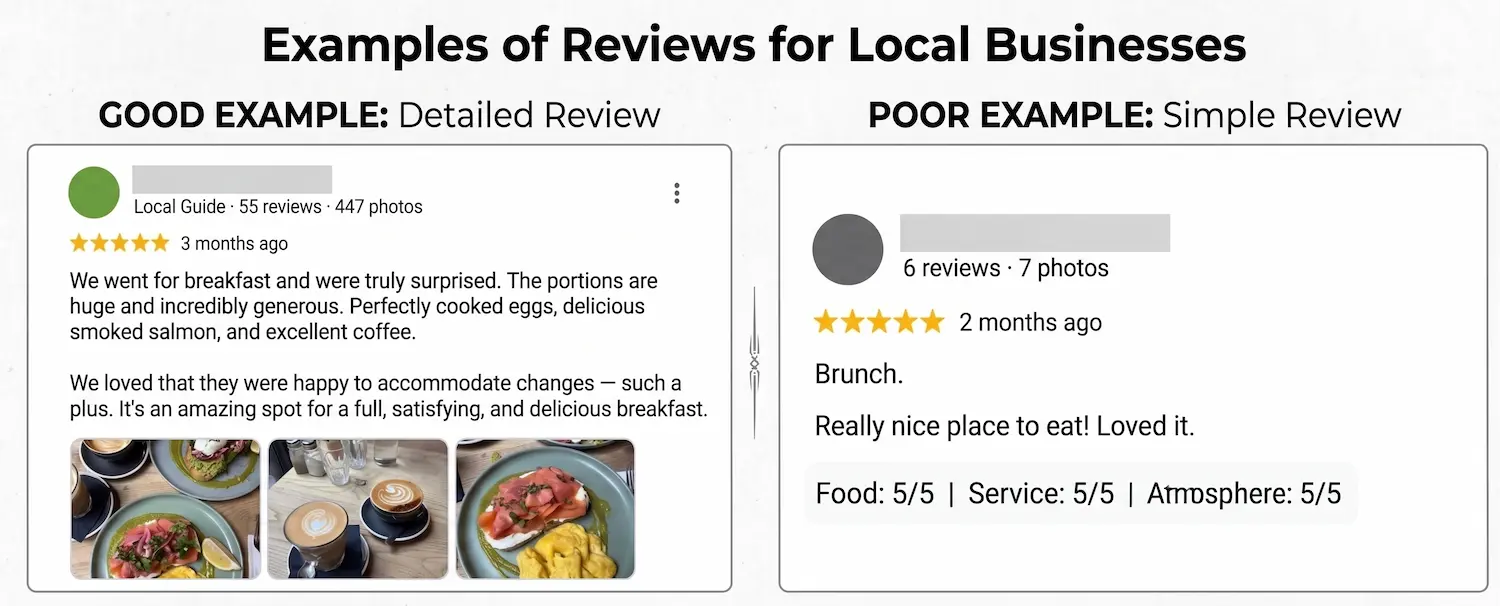
Improve your local search presence by encouraging customers to share their stories rather than just leaving a star rating. Specificity is the new currency of trust.
Detailed feedback on the “why” and “how” of their visit creates a powerful SEO asset that drives visibility and builds immediate trust with potential customers.
3. General Brand Positioning
Your brand needs a clear identity that tells Google exactly what niche you dominate. At Niara, we emphasize the importance of a custom brand voice. If your brand identity is consistent across your website, social media, and GBP, the AI can more easily categorize your business.
If you are the “luxury” option in your city, every piece of content—from your image alt text to your blog posts—should reflect that luxury positioning.
From “Near Me” to “Ideal for Me”: How Ask Maps Works
The user journey has evolved from geographic proximity to situational relevance. Understand how Ask Maps works
Hyper-specific Searches
Users are no longer typing “gyms near me”. They are asking: “Which gym offers child care on weekday mornings and has a sauna for post-workout recovery?”.
This query requires the AI to utilize grounding indexing to synthesize location data, review sentiment, and menu information in real-time.
If your digital footprint doesn’t explicitly answer those sub-questions, you won’t appear in the response, regardless of how close you are to the user.
The Problem-Solution Journey
Users now use search to move through a compressed funnel:
- Understand a problem: “Where can I find a mechanic who specializes in European cars?”
- Evaluate hyper-specific options: “Do they have loaner cars available?”
- Decide on the immediate next step: “Can I book an appointment through the app?”
Your goal is to provide the answers to every stage of this journey within your local ecosystem. To align with this behavior, SEOs must shift from broad keyword targeting to intent-based mapping. This involves:
- Optimizing for Long-Tail and Conversational Queries: Create content that mirrors specific user pain points. Create FAQs to provide direct answers to “hyper-specific” questions.
- Leveraging Local Entity Attributes: Ensure your Google Business Profile (GBP) is fully optimized with specific attributes—such as “on-site services”, “online appointments”, or “amenities”—to trigger filters in the Local Pack.
- Reducing Conversion Friction: Align the technical experience with the user’s decision-making speed. Implement clear, action-oriented CTAs (e.g., “Book Now”, “Get a Quote”) and ensure deep-linking to specific service pages so users don’t have to hunt for the final step.
- Providing Data-Rich Content: Use structured data (LocalBusiness and Product markup) to feed search engines the precise details—like availability, pricing, and specific features—that users require to move from evaluation to decision instantly.
Ask Maps and Google Maps Optimization Roadmap
Winning in the age of AI-driven local discovery requires a structured, industry-agnostic plan. Here is how you can blend essential signals with AI opportunities.
1. Elevate Your Google Business Profile From “Listing” to “Entity”
The GBP is the primary data source for Ask Maps. If the information isn’t there, the AI cannot cite you.
- Granular Optimization: Don’t just fill out the basics. Use every available attribute. Upload high-quality photos that show different “situations” (e.g., people working, people celebrating, the exterior at night).
- Identity Communication: Use the “Description” field not for keyword stuffing, but to communicate a clear brand identity. Tell the AI exactly who you are for.
2. Turn Reviews Into AI-Readable Proof
Reviews are now data attributes that define your business’s real-world application.
- Situational Reviews: Instead of just asking for a review, ask customers to describe their experience. “What did you order? How was the atmosphere?”.
- The Strategy: Use sentiment analytics to understand what your customers are naturally highlighting. If people keep mentioning your “fast Wi-Fi,” make sure that is a prominent attribute on your profile.
3. Construct a Strong and Reliable Brand
Establishing trust and confidence is the primary currency for earning both algorithmic favor and user loyalty. To be recognized as the best answer, your brand must project unwavering reliability through high-quality content and authoritative SEO strategies.
- Prioritize E-E-A-T: Demonstrate Experience, Expertise, Authoritativeness, and Trustworthiness by highlighting author credentials and verified brand history.
- Focus on Information Gain: Produce unique insights, original data, or personal case studies that provide value beyond what AI models can synthesize from existing web data.
- Maintain Content Integrity: Fact-check all outputs rigorously and cite reputable, high-authority sources to build a foundation of accuracy.
- Cultivate Social Proof: Actively manage and showcase genuine user reviews, testimonials, and third-party endorsements to validate your reliability.
- Optimize for Technical Trust: Secure your site with HTTPS, improve page speed, and ensure a transparent privacy policy to satisfy both users and search crawlers.
- Revitalize Legacy Content: Consistently update older articles with current data and fresh insights to reinforce your brand’s position as an active industry leader. Beyond maintaining relevance, keeping your archives accurate is essential for mitigating the risk of AI hallucinations and ensures your brand is represented accurately across generative search engines and LLMs.
4. Align Your Website with Conversational Local Intent
Your website and your GBP must speak the same language.
- Cohesive Communication: Ensure your brand voice and messaging are consistent across all touchpoints. The tone used in your GBP updates should flow seamlessly into your website and social media copys. If your profile promises a “friendly, neighborhood vibe”, your landing pages must reflect that same personality to maintain trust and satisfy the user’s intent.
- On-Page FAQs: Create FAQ sections that mirror the prompts users are giving Ask Maps. Instead of “Our Classes,” try “Master the art of self-defense and build unstoppable confidence with our elite fighting programs.”
- Location Page Optimization: Each location page should have unique, conversational content that reflects the specific neighborhood and the unique qualities of that branch.
5. Enhance Multi-Channel and Multimodal Consistency
Trust isn’t built in a silo. Google’s algorithms perform external searches to verify your brand’s legitimacy.
- Unified Communication: Ensure your NAP (Name, Address, Phone) and your brand story are identical across third-party directories like Yelp, TripAdvisor, and social media.
- Multimodal Data: Google “reads” your brand through text, images, and mentions. Use our Alt Text Generator to ensure every image on your site provides descriptive context to the AI.
- External Mentions: High-quality citations from local news sites or niche blogs act as a “vote of confidence” for the AI, increasing your authority score.
Read more: Multimodal SEO: Your Guide to Mastering Search
6. Bridge the Conversion Gap with Real-Time Conversational Commerce
To succeed in the era of agentics and AI-driven local search, businesses must provide a frictionless transition from discovery to direct communication. By treating your profile as an active service desk rather than a static listing, you signal high value to Google’s ecosystem and effectively convert map views into measurable revenue.
- Link Your Contact Information to Your Google Business Profile: Google has recently updated its messaging features to allow for direct integration with your WhatsApp number or SMS. This redesign enables potential customers to initiate a conversation instantly from your Google Search profile or Google Maps, streamlining the communication process by using the messaging platforms they already know and trust.
- Utilize Booking Buttons: If your industry allows, enable direct call-to-action buttons. Removing the extra step of a phone call or a website visit reduces friction and captures high-intent leads who are ready to buy right now.
7. Strategic Sentiment Guarding to Shape AI Brand Perception
AI search engines and LLMs distill recurring sentiment into permanent brand attributes within their knowledge graphs. By proactively neutralizing negative feedback loops, you prevent unfavorable traits—like “unreliable” or “overpriced”—from becoming hard-coded into your AI-generated reputation.
- Deploy NLP Monitoring: Use Natural Language Processing tools to identify emerging negative clusters before they reach the critical mass required for AI training sets.
- Execute Narrative Pivots: Once an operational fix is made, launch a targeted review campaign to flood the data pool with specific keywords that contradict the old AI-encoded bias.
- Audit AI Summaries: Regularly prompt major LLMs about your brand to detect lingering negative associations and adjust your customer feedback strategy accordingly.
Mastering Ask Maps Search with Niara’s AI Tools
To maintain a competitive edge, it is essential to stay one step ahead of evolving algorithms. Niara centralizes the complex workflows of Local SEO into a single, AI-powered ecosystem. Here is how you can leverage Niara to dominate local search:
1. Optimizing Your GBP with Precision Prompts
Your Google Business Profile (GBP) is the primary data source for Ask Maps. Niara’s ChatSEO features a dedicated Prompt Library with templates specifically engineered for Local SEO and GBP optimization. Simply select a prompt, input your business details, and within seconds, you’ll have optimized business descriptions, and updates that speak directly to Google’s generative intent.
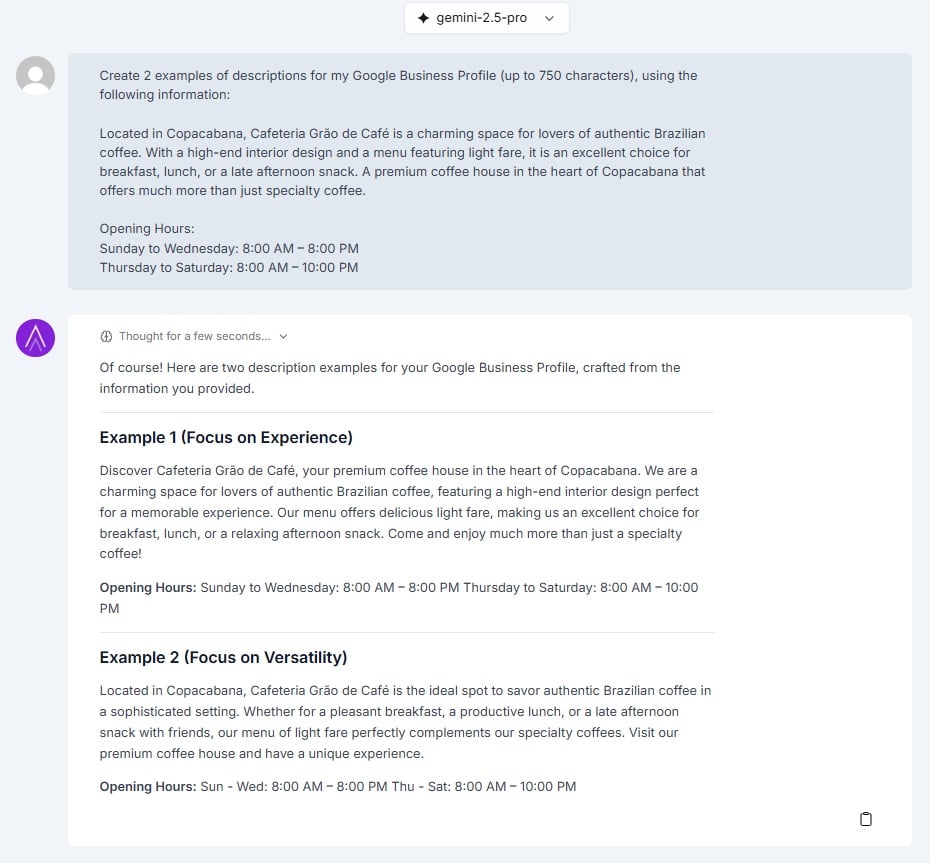
2. Turning Reviews into Strategic Insights
Reviews are the “AI fuel” that defines your brand’s positioning. With ChatSEO, you can upload or paste customer feedback to perform a deep sentiment analysis. Use it to identify recurring pain points or highlight what customers love most. For example, you can ask ChatSEO to:
- “Summarize the top 3 reasons customers give us 5 stars and turn them into a ‘Why Choose Us’ section for our local landing page.”
- “Identify common complaints in 1-star reviews and draft a professional response plan to mitigate negative sentiment.”
3. On-Page Optimization with Google AI Mode Insights
How well does your local landing page perform in the eyes of an AI? Niara’s Google AI Mode Insights tool provides a one-click diagnosis.
Based on official Google documentation and the query fan-out logic, it evaluates how well your content answers the complex questions asked in AI Overviews and Ask Maps, giving you clear recommendations to bridge the gap between “good” and “AI-optimized”.
4. Scaling Multimodal SEO
Trust is built across channels. Niara’s YouTube to Article tool allows you to transform local video content—like store tours or customer testimonials—into fully optimized blog posts in seconds.
Furthermore, you can use ChatSEO to repurpose a single piece of content into multiple formats, ensuring your brand’s message is consistent across the web, which is a key signal for AI confidence.
5. Instant Structured Data Generation
To help AI agents understand your site’s hierarchy, technical clarity is non-negotiable. Niara’s Structured Data Generator creates error-free JSON-LD code for your local pages with a single click. Whether it’s Product or Review schema, you can ensure that Google’s crawlers have a clear, structured map of your most important business data.
6. Conversational Monitoring with Search Analytics
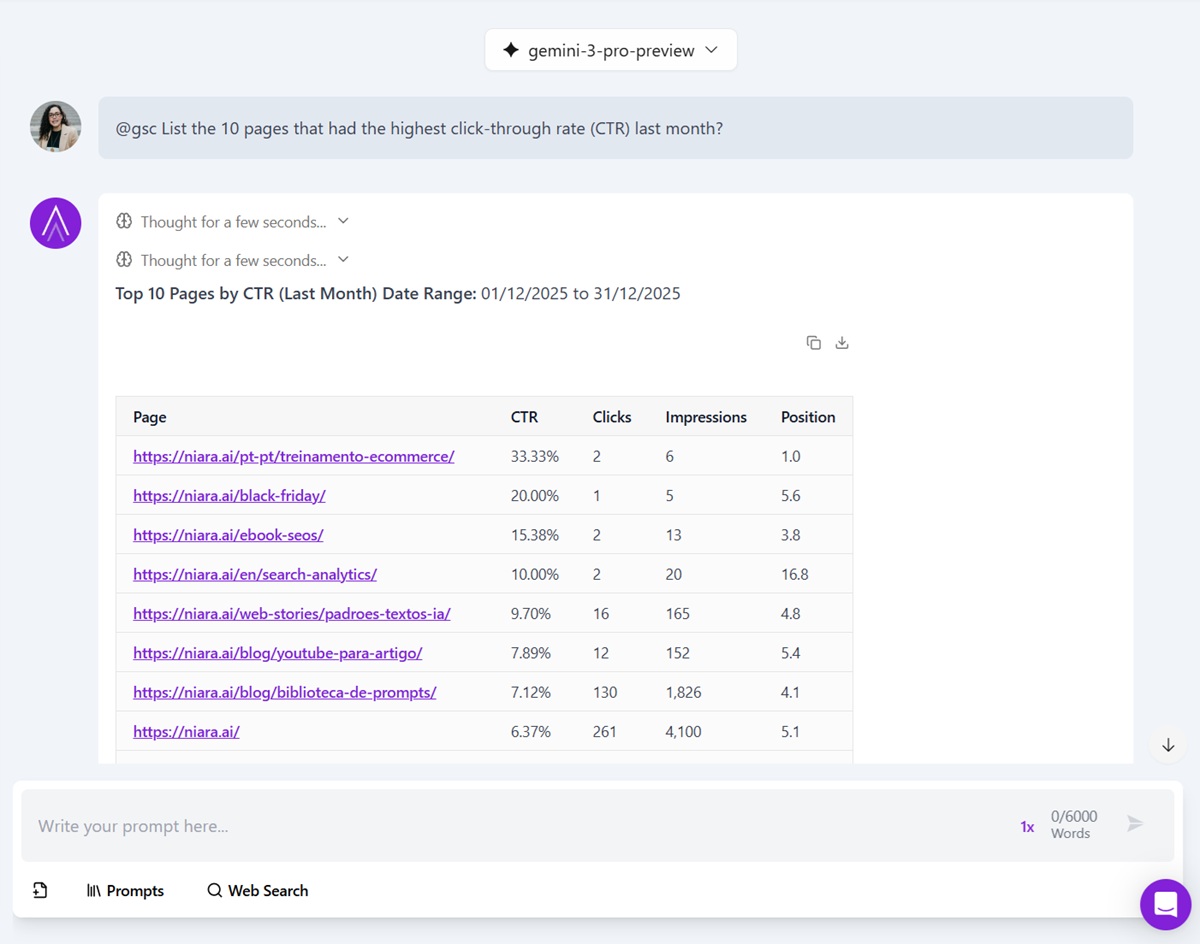
Ditch the spreadsheets. Niara’s Search Analytics includes specific filters for local search performance.
By using Conversational Analytics, you can simply “talk” to your data. Ask questions like, “Which local searches had the highest click-through rate last month?” to get instant insights and adjust your strategy faster than manual reporting allows.
7. Technical Health and Brand Confidence
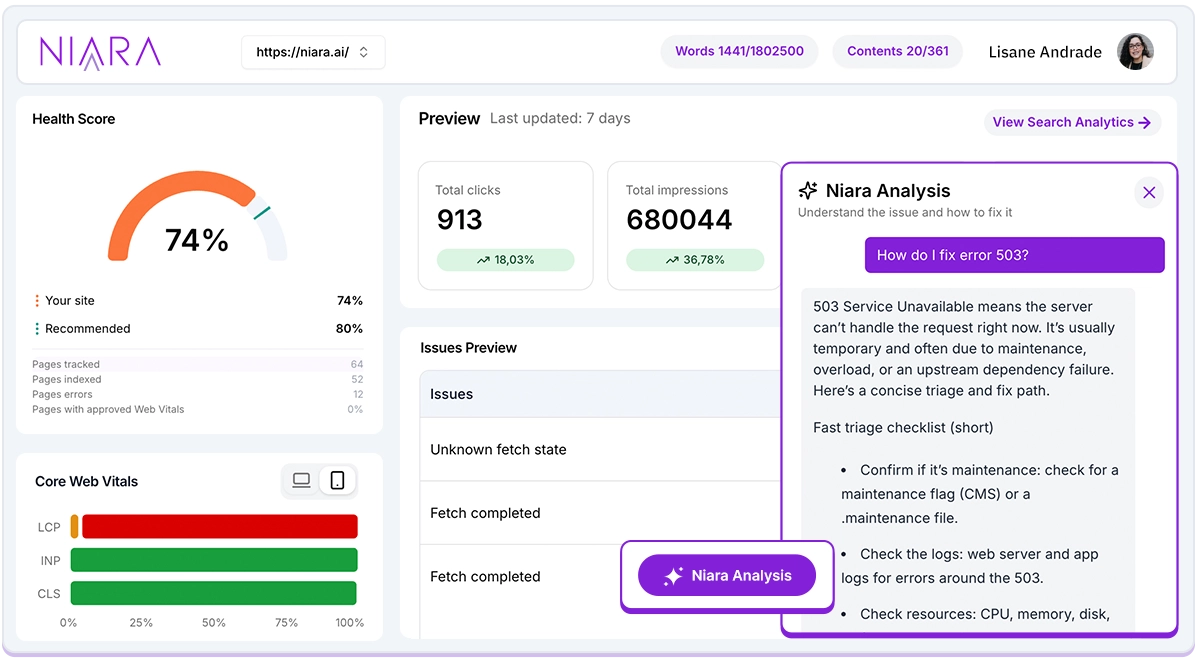
A slow or broken site erodes user trust and confuses algorithms. Niara’s Technical SEO Agent acts as your 24/7 consultant, monitoring site performance and Core Web Vitals. By ensuring your site is technically flawless, you make it easier for AI agents to crawl, index, and confidently recommend your brand to users.
8. Dominating Your Niche with the Authority Map
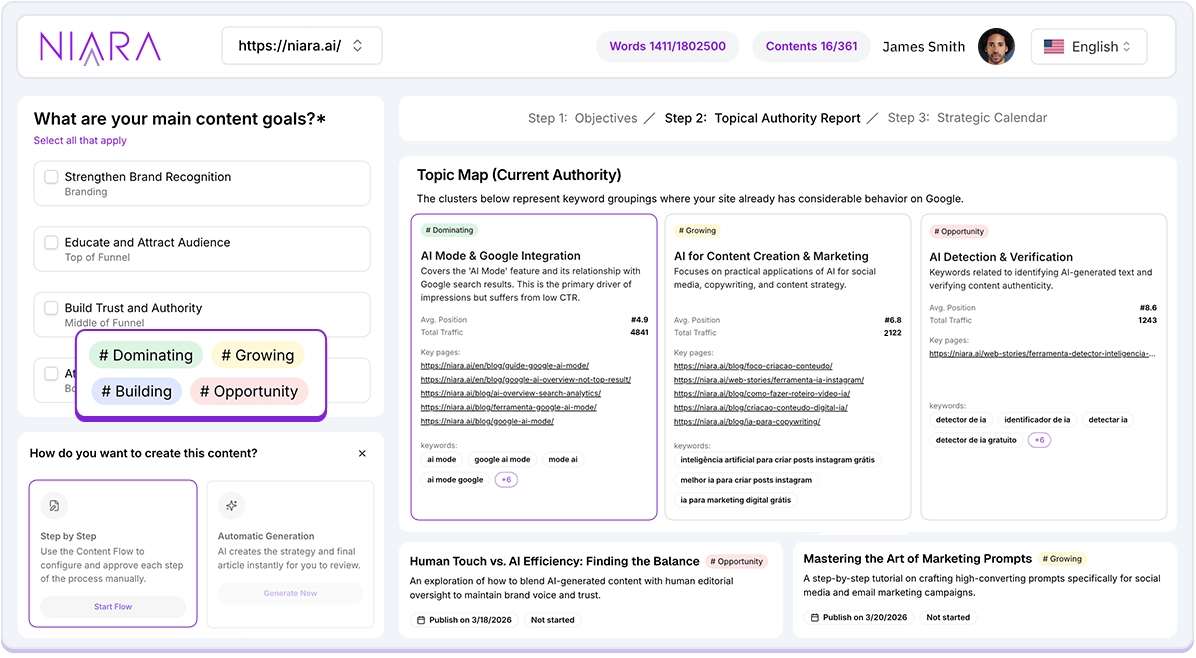
To be the “trusted answer,” you must own your niche. Niara’s Authority Map identifies exactly which content clusters are driving your local authority and where the gaps lie. For example, if you dominate “organic gardening” in your city, the Authority Map will automatically generate a 3-month editorial calendar to deepen that dominance, ensuring you remain the go-to reference for both users and AI.
Mastering the Transition to Conversational Authority
The shift toward Ask Maps signals a critical transition: your business must evolve into the most trusted, contextually relevant answer to earn AI recommendations. Your digital presence is the primary data source that powers Gemini and other conversational search engines.
At Niara, we simplify this technological evolution so you can focus on strategy rather than manual labor. Our platform automates the complexities of the new SEO era—from generating structured data to identifying authority gaps—ensuring your brand speaks the language of modern search. We handle the technical heavy lifting, allowing you to build the authentic connections and narrative-driven social proof that define true authority.
As local search becomes more human-centric, are you prepared to be the definitive answer or just another set of coordinates? The future of SEO belongs to those who master intent with AI precision.
Simplify your SEO and lead the conversation with Niara today!
