
For most startups, SEO feels like a luxury. You are in the trenches, fighting for product-market fit, managing a burn rate that keeps you up at night, and trying to close your next round of funding. In this high-stakes environment, organic growth often takes a backseat to paid ads because “SEO takes too long”.
But here is the truth: the moment you stop paying for paid acquisition, the traffic stops flowing. If you want to build a sustainable business with a defensive moat, you need organic search. Traditional SEO processes are often too manual to keep pace with a startup’s speed, creating the misconception that the channel itself is slow.
You don’t have six months to wait for a consultant to deliver a 100-page audit that no one will ever implement. You need results now. This is where AI automation changes the game. At Niara, we built our platform specifically to help you. We wanted to give small, agile teams the power of an enterprise SEO department.
Ready to transform your workflow? Keep reading to discover how you can scale your organic growth without scaling your headcount.
The Startup SEO Paradox in AI Era
There is a fundamental paradox in startup growth: organic traffic provides the highest long-term ROI, yet most startups fail because they treat SEO like a marathon while only having fuel for a sprint. In the early stages, resources—time, money, and talent—are extremely limited. You cannot out-spend industry giants with decade-old domains and massive budgets. To win, you must abandon the traditional “create and wait” playbook in favor of lean SEO.
Lean SEO is the strategic art of identifying the 20% of actions that drive 80% of your results. To execute this effectively, you must avoid two critical traps that frequently derail early-stage growth:
- The “Build vs. Buy” Bottleneck: Engineering custom SEO scripts or internal platforms is a noble distraction that drains your most precious resource: development hours. In the startup ecosystem, speed is your primary advantage. Utilizing ready-to-use platforms like Niara allows you to bypass the development phase and move directly into execution. Your team’s expertise is far better spent interpreting data and driving strategy than building the pipes to move it.
- The AI Security Gap: While general-purpose AI models are convenient, they pose a significant security risk to your intellectual property. Sharing proprietary keyword strategies or internal roadmaps with public AI means your “secret sauce” could eventually be synthesized and handed to a competitor. Niara eliminates these concerns by providing enterprise-grade protection. With a strict privacy policy ensuring your proprietary data is never used to train public models, your strategic insights remain entirely confidential.
By shifting to a lean SEO framework with a trustworthy AI tool, you stop wasting resources on infrastructure and security vulnerabilities, allowing you to focus on what truly matters: sustainable, organic scaling.
Read more: 10 Benefits of AI for Your Business
Startup SEO Fundamentals (The Quick-Start Guide)
Before diving into automation, it’s essential to master the fundamentals. Even the most advanced AI tools can’t compensate for a weak technical or strategic base. If your site’s architecture is flawed, no amount of content will drive results.
To ensure your startup is ready to scale, ask yourself these critical questions to assess your core SEO pillars:
- Is your site “readable” for search and AI engines? Are your individual pages optimized to rank higher? Have you structured your titles, headings, and information in a way that allows Google to immediately understand the value you offer?
- Are you building topical authority? Do you have a cohesive plan, or are you just publishing random blog posts? Are you covering your niche from every angle to prove to Google that you are an expert in your field?
- Do you have a “vote of confidence” from the web? Backlinks and mentions act as digital recommendations. Do you have a strategy to get other reputable sites to talk about you, proving to search engines that your startup is a trusted authority?
- Are you looking beyond search volume? It isn’t just about finding high-traffic words. Do you truly understand the “intent” behind the search? Are you targeting the specific terms people use when looking for the exact solution your startup provides?
- Is your “plumbing” solid? Can Google’s bots crawl and index your site without issues? If your site takes more than a few seconds to load or has broken pathways, are you prepared for the fact that you’ve already lost the visitor?
To get you moving, here is a One-Page Starter Checklist:
- Install Google Search Console (GSC) and Google Analytics 4 (GA4).
- Verify your sitemap.xml is submitted to GSC.
- Ensure your site is mobile-friendly.
- Identify your top 5 “money” keywords (the ones that lead to sales).
- Check your site speed using PageSpeed Insights.
Spoiler alert: Niara identifies your site’s strengths and weaknesses while handling the heavy lifting of technical monitoring for you.
Avoid These 3 Roadblocks to Progress
Achieving long-term organic success demands a strategic framework that prioritizes efficiency over ego. To build a search presence that truly scales, you must pivot from broad tactics to high-impact, sustainable actions.
Before you invest more into your content engine, ensure you aren’t being held back by these three common strategic errors.
- Ignoring Technical Debt: You wouldn’t launch a product with a broken checkout flow, so don’t launch a website with broken SEO. Many startups ignore technical SEO until it’s too late. If your site has indexing errors or slow load times, Google will penalize you. Use automation to keep a pulse on your site’s health so you don’t have to be a technical expert to stay compliant.
- Chasing Volume Over Intent: Relying solely on high search volume is a trap. In the era of AI-driven search and zero-click results, big numbers don’t guarantee actual traffic or leads. High-volume terms are often too broad, leading to high bounce rates and low conversions. Instead, prioritize search intent. Focus on long-tail keywords that address specific pain points—like “automated CRM for boutique agencies”—where the volume is lower, but the relevance and conversion potential are significantly higher.
- The “Post and Pray” Method: Publishing a blog post and hoping it ranks is not a strategy. Content marketing for startups requires a feedback loop. You need to know what’s working and what isn’t. If you aren’t measuring your SEO metrics, you are flying blind.
6 SEO Steps for Startups
Now, let’s get into the “how-to”. This is the framework we recommend for any early-stage or scaling company looking to dominate organic search using the Niara engine.
Phase 1: Set Clear Goals and Objectives
You can’t hit a target you haven’t set. For a startup, SEO goals must be SMART: Specific, Measurable, Achievable, Relevant, and Time-bound.
Don’t just say, “We want more traffic”.
Say, “We want to increase organic leads by 20% in the next quarter.” Align your SEO objectives with your business metrics.
If you are a SaaS, focus on keywords that drive sign-ups. If you are an e-commerce startup, focus on product-related queries.
SEO is an investment, and you need to be able to show the ROI to your stakeholders.
Starting an SEO strategy without goals is like embarking on a journey without a map; you’ll certainly move, but you likely won’t end up where you need to be.
Establish your “North Star” first, and the tactical path will become significantly clearer.
Phase 2: Foundational SEO
In the startup world, we talk about the Minimum Viable Product (MVP). For SEO, you need a Minimum Viable Foundation.
Technical Health
Website performance has evolved from a simple user experience metric into a critical requirement for AI discoverability. As artificial intelligence reshapes how information is gathered and processed, speed now serves as the primary gateway for your content to be integrated into the global AI knowledge base.
The impact of speed on AI is three-fold:
- AI crawlers operate on strict crawl budgets; a sluggish server forces these bots to abandon your site prematurely, leaving valuable content unindexed.
- Perplexity and ChatGPT rely heavily on real-time retrieval for time-sensitive searches. To provide accurate, instantaneous answers through grounding indexing during these specific instances, these tools favor high-performance sites, often bypassing slower competitors to ensure a seamless and reliable response.
- Site speed determines your long-term presence in Large Language Model (LLM) training sets. AI data pipelines frequently flag high-latency sites as unreliable or low-quality. If your site suffers from frequent timeouts, you risk being excluded from the foundational datasets that power future AI updates.
Optimizing for speed is a strategic necessity to ensure your brand remains visible, indexable, and authoritative in an AI-driven world. By prioritizing a fast digital foundation, you ensure that your expertise is not just seen by humans, but effectively consumed and cited by the AI agents dominating the new search landscape.
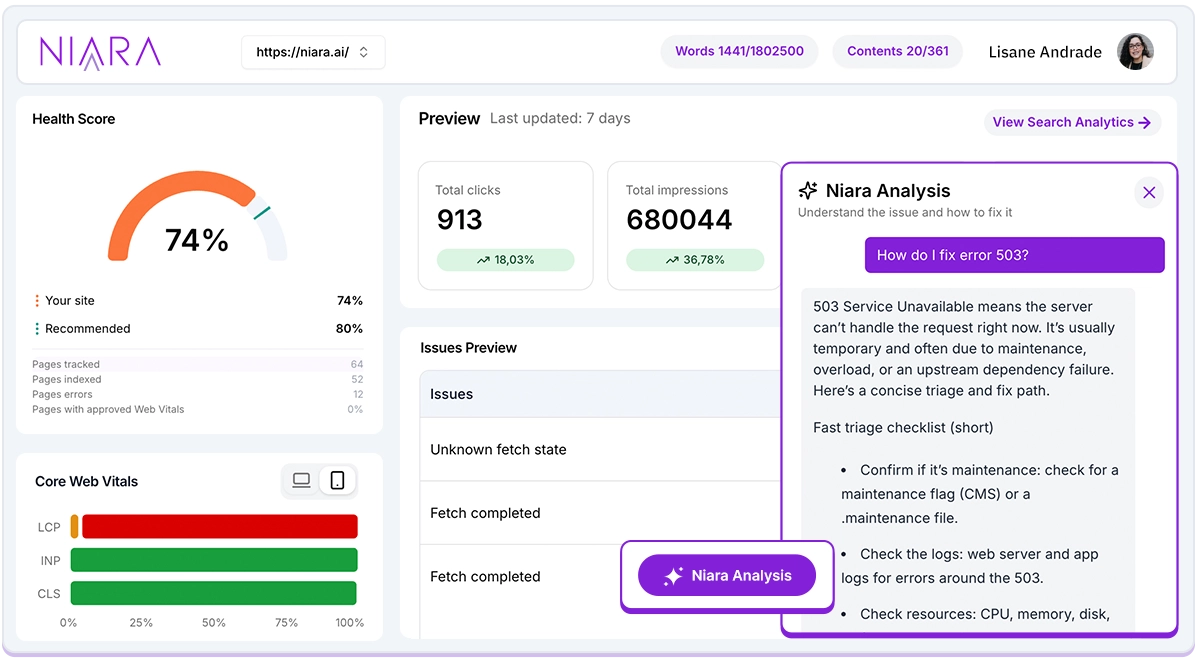
The Niara Advantage: Instead of hiring an expensive consultant, use our Technical SEO Agent. It’s like having a 24/7 technical consultant. It integrates directly with your Search Console and PageSpeed Insights to provide a live report of errors, indexing issues, and speed bottlenecks. It even gives you specific instructions for your CMS (like WordPress or Webflow) on how to fix them. Simply speak with Niara to find out your next steps.
Keyword Research for Disruptors
If you are disrupting an industry, people might not even be searching for your solution yet. You need to target “problem-aware” keywords.
Don’t just look for high volume. Look for Search Intent. Focus on long-tail keywords where you can provide the absolute best answer.
For example: chasing broad, high-volume keywords like “Fitness” is often a trap. Because the intent is vague—ranging from workout tips to apparel—it is nearly impossible to convert this traffic. Instead, focus on specific long-tail keywords where the user’s problem is clear.
- Target Keyword: “Best foldable rowing machine for small apartments”
- The Strategy: By addressing specific needs (dimensions, noise levels, storage), you provide the “absolute best answer” for that user.
By addressing specific pain points, this strategy drives higher conversions from ready-to-buy users and attracts qualified leads instead of raw traffic. This level of specificity also builds SEO authority, allowing you to outrank generic competitors through superior relevance to search queries.
Pro Tip: Keyword research alone isn’t enough anymore. To rank in the age of AI, you must become the definitive source in your niche. This means covering every aspect of a topic, from the basic “what is” to the advanced “how to.”
The Niara Advantage: Niara simplifies the path to topical authority by allowing you to lead comprehensive keyword and theme research through two powerful modules: ChatSEO and Tasks.
-
In Tasks, you can automate the discovery of thematic clusters to ensure your content map covers every angle of your niche.
-
In ChatSEO, you can take your research a step further by activating the Web Search feature. This allows you to pull real-time data and live examples of what your competitors are currently doing. By analyzing live search results, you can identify content gaps and “disrupt” the SERPs with more timely, relevant, and data-backed answers than the incumbents.
Phase 3: Authority Mapping
One of the biggest mistakes startups make is writing random blog posts. To rank today, you need Topic Clusters. This means you pick a “Pillar” page (a comprehensive guide on a main topic) and surround it with “Cluster” pages (shorter articles that dive into specific sub-topics). This tells Google that you aren’t just a site with a few articles; you are an authority.
The Niara Advantage: This is where our Authority Map shines. It takes your existing data from the Google Search Console and identifies exactly where your “gaps” are. It finds the clusters where you are already showing promise and tells you what content you need to create to dominate that niche. With a single click, you can generate a comprehensive 3-month editorial calendar, turning days of manual planning into seconds of automated strategy. This not only eliminates writer’s block but ensures every topic is primed for growth.
Once your calendar is ready, simply select your preferred themes and move them into the Content Workflow. Within this specialized environment, you can analyze SERP competitors, generate detailed briefings, and produce full-length articles significantly faster. From the initial strategy to the final draft, every step is fully customizable to align perfectly with your brand’s voice and goals.

Phase 4: Get Other Sites (and People) to Talk About You
Link building for startups is often the hardest part. You don’t have the “brand name” to get easy links. However, you do have something big companies don’t: speed and a unique voice.
Use your high-quality content as a magnet. If you produce a unique data report or a deeply insightful guide, other sites will naturally want to link to it. Focus on backlink quality and relevance over quantity; one link from a reputable industry site is worth more than 100 links from random directories.
For example: if you are in the Cybersecurity niche, you could publish an original “Small Business Ransomware Vulnerability Report” featuring proprietary data from security audits conducted over the past year. Because you are offering specific insights into common technical loopholes that haven’t been documented elsewhere, major tech news outlets, government security agencies, and enterprise software blogs will reference your data and link back to your report as the authoritative source. This establishes your brand as a thought leader while securing high-authority backlinks that drive your domain rating and search visibility upward.
Complementing this data-driven approach with strategic PR further amplifies your reach. Once you have established authority through original research, you can leverage those insights to secure guest spots on industry podcasts or features in mainstream news.
By positioning a founder with a strong story as the voice behind the data, every media mention and digital citation contributes to your Brand Authority SEO, turning individual press wins into long-term search engine dominance.
The Niara Advantage: To help you execute this phase successfully, we provide a unified solution within our platform. Niara combines strategic task workflows to help you identify and create high-value “digital assets”—like industry reports and calculators—with a library of expert-level ChatSEO prompts that ensure your outreach pitches and press releases are optimized to convert journalists and editors into brand advocates.
Phase 5: Content Quantity Over Quality
In the ongoing SEO debate of quality vs. quantity, the priority for any startup must always be quality. While the pressure to produce a high volume of content is real, sacrificing depth for frequency is a strategy that often leads to failure.
Google’s E-E-A-T (Experience, Expertise, Authoritativeness, and Trustworthiness) guidelines are designed to reward content that provides genuine value and deep insight.
For a growing brand, it is far more effective to create content intentionally. One comprehensive, well-researched guide that solves a user’s problem will do more for your search rankings and brand reputation than dozens of thin, shallow articles.
Focus on building a foundation of excellence.
In the world of modern SEO, depth is the only sustainable way to earn both user trust and algorithmic visibility.
How do you do both without burning out your team? Automation.
The Niara Advantage:
- Content Workflow: Don’t start with a blank page. Our tool analyzes the current SERP and your competitors to generate a complete SEO briefing in one click. It tells you exactly what headings to use and what questions to answer to outrank the current leaders. Taking the process even further, the final phase of the workflow—the Content Creator panel—allows you to generate a complete draft from scratch. Niara handles the entire writing process based on your briefing, so the only thing you need to do is review and polish the content before publishing.
- YouTube to Article: Startups are often great at video—webinars, demo videos, or founder interviews. Niara can convert these videos into fully optimized, high-ranking blog posts in seconds.
- Brand Voice: One fear with AI is that it will sound robotic. With Niara, you set your brand voice once. Whether you want to sound “innovative and bold” or “helpful and professional,” Niara applies this tone to every piece of content it generates. No more generic-sounding AI text.
At Niara, we follow our own advice. We don’t post just to post. We publish in-depth content that helps our audience solve real marketing challenges. Our goal is quality that scales.
Read more: Scaling Content Without Losing Your Brands’ Soul (or Rankings)
Phase 6: Data-Driven Pivoting
In a startup, if something isn’t working, you pivot. SEO should be no different. You need to stop guessing and start measuring.
Basic reports from Google Search Console can be overwhelming. You need to know which specific keywords are driving your growth and which ones are “near-misses” (ranking on page 2).
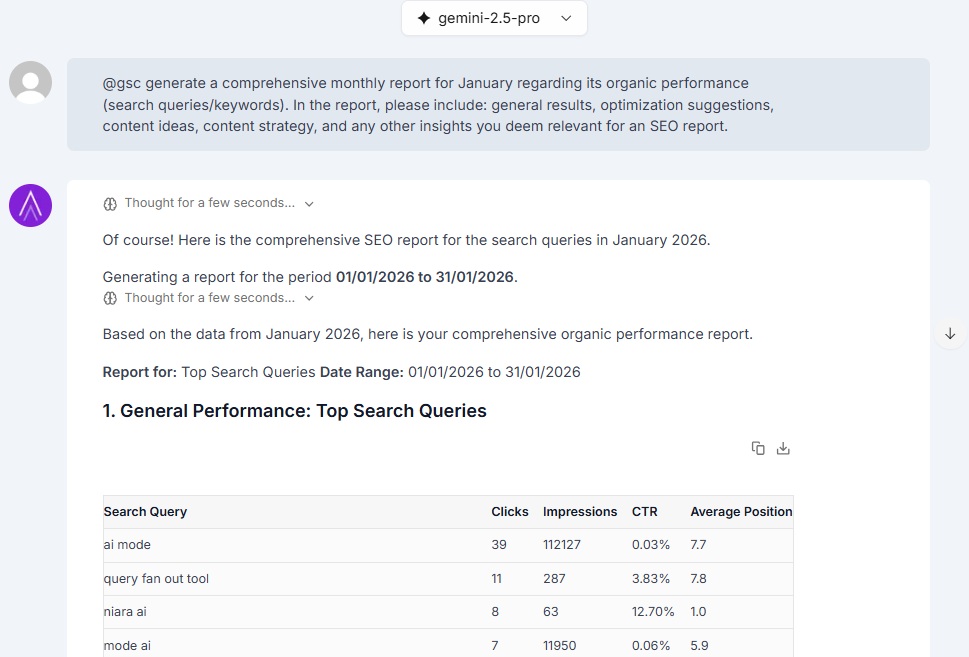
The Niara Advantage: Our Search Analytics feature gives you 5x more data than the standard Google Search Console. But more importantly, it makes that data accessible through Conversational Analytics. Unlock instant SEO insights by chatting with your data. ChatSEO eliminates the need for complex spreadsheets, allowing you to make data-driven decisions in seconds. Ask:
- Which queries have a search volume (impressions) over 1,000 but an average ranking between 11 and 20?
- List the queries that are driving the most impressions for [Specific URL].
Furthermore, in the era of AI-driven search, you need to be ready for AI Mode. Our Google AI Mode Insights analyzes your URLs and provides a diagnostic on how to optimize your content for AI-driven queries. This is crucial for staying ahead of the curve as search behavior shifts.
Your startup can be SEO-ready by end-of-day
You don’t need a month to “get ready” for SEO. You can start today. SEO for early-stage startups is about momentum. Here is a 1-day action plan to get your “Lean SEO” engine running:
- Audit: Connect your site to Niara and run the Technical SEO Agent. Fix the top 3 critical errors it identifies.
- Strategy: Use the Authority Map to analyze your Search Console data. Identify the topics you must own and let Niara generate your 3-month calendar. Leverage Google AI Mode Insights to understand how to optimize your most important pages for AI Mode.
- Execution: Take the first topic from your new calendar. Use the Content Workflow to generate a briefing and write your first high-authority pillar post.
- Optimization: Use the Structured Data Generator to add Schema markup to your new page, ensuring Google understands exactly what your content is about.
By the end of the day, you will have a healthier site, a clear strategy, and your first piece of “moat-building” content.
SEO startup checklist
Keep this checklist handy to ensure you are maintaining your organic growth engine:
- [ ] Technical Health: Run a weekly check with the Technical SEO Agent.
- [ ] Keyword Intent: Ensure every new page targets a specific user intent (Informational, Navigational, or Transactional).
- [ ] Topical Authority: Check your Authority Map monthly to see which clusters are growing.
- [ ] On-Page Optimization: Use Niara’s ChatSEO to review your meta titles and descriptions for high CTR.
- [ ] Content Repurposing: Turn your latest webinar or demo into a blog post using YouTube to Article.
- [ ] User Experience: Check your mobile load speeds and Core Web Vitals.
- [ ] Internal Linking: Ensure your cluster pages link back to your pillar pages.
- [ ] AI Readiness: Use Google AI Mode Insights to check your top-performing pages.
- [ ] Data Review: Use Conversational Analytics to identify opportunities.
- [ ] Security: Ensure your data is safe. Niara uses Zero Data Retention (ZDR), meaning your proprietary startup data is never used to train public AI models.
SEO is your most scalable asset
SEO is not a “set it and forget it” task, but it also shouldn’t be a manual grind that drains your startup’s resources. By adopting a Lean SEO framework and leveraging AI automation, you turn organic search into your most scalable asset.
Remember, the goal of SEO for startups isn’t just to get “clicks.” It’s to build a sustainable, repeatable engine for customer acquisition that gets cheaper and more effective over time. While your competitors are burning through their on expensive ads, you can be building a defensive moat of authority and trust.
At Niara, we believe that small teams can do big things. You have the vision; we have the tools to help you execute it at 10x the speed. Don’t let limited resources hold your growth back.
Ready to dominate the search results? Try Niara for free and start scaling your startup’s SEO today.
