
Content scaling is the biggest challenge for modern brands: how do you increase volume without falling into the content graveyard of generic, low-value text? To scale SEO content without sacrificing quality, you must move beyond simple automation and build a sophisticated system that prioritizes human-centric value and original insights.
The digital paradox is real: while AI makes publishing easier, ranking on Google and winning trust in AI-driven platforms has never been tougher. Successful scaling today is all about leveraging technology to handle the heavy lifting while your experts ensure every piece remains authentic and authoritative.
Let’s dive into how you can build this high-performance engine.
What’s the difference between strategic scaling and content abuse (Google Update context)?
According to Google’s Quality Rater Guidelines, scaled content abuse is a spam practice where an abundance of content is created with little effort, originality, or manual curation. The primary goal of this practice is to manipulate search rankings rather than help the user.
Google identifies several red flags for scaled abuse:
- Low-effort automation: using generative AI or other automated tools to produce many pages that add no unique value for visitors.
- Content scraping: repurposing feeds or search results through automated transformations like synonymizing or translating without providing original insight.
- Stitching: combining content from various web pages without adding meaningful value or synthesis.
- Obfuscation: creating multiple sites to hide the scaled nature of the content or generating pages that make little sense to a reader but are packed with search keywords.
On the other hand, strategic scaling is the process of increasing your content output without a linear increase in costs or, crucially, a decrease in quality.
The fundamental difference lies in the system. While abuse focuses on the bot, strategic scaling focuses on the user. It leverages technology to handle the heavy lifting while human experts ensure every piece remains authentic, authoritative, and aligned with the brand’s unique voice.
| Feature | Strategic scaling | Scaled content abuse (spam) |
|---|---|---|
| Primary goal | To provide unique value and help the user at a higher volume. | To manipulate search rankings and capture traffic with minimal effort. |
| Content origin | Human insights, expert interviews, and proprietary brand data. | Scraped content, automated translations, or generic AI hallucinations. |
| Production method | AI-asisted: technology handles the heavy lifting; humans handle strategy. | AI-automated: full automation without human oversight or curation. |
| Information gain | Adds new perspectives, local data, or unique “brand brain” insights. | Rehashes existing information (more of the same) with no added value. |
| Quality control | Subject Matter Expert (SME) review. | Little to no manual review; high frequency over high quality. |
| SEO impact | Builds long-term topical authority and sustainable organic growth. | High risk of boom-bust cycles and manual penalties from Google. |
When done correctly, scaling is highly versatile. Here is how different industries can bridge the gap between quality and industrial speed:
| Industry | Scaling strategy | The information gain factor |
|---|---|---|
| SaaS | Using standardized frameworks to generate integration or template pages. | Solves specific, long-tail technical problems that generic guides miss. |
| E-commerce | Generating unique, persuasive product descriptions for thousands of SKUs in minutes. | Moves beyond manufacturer specs to include brand voice and customer-centric benefits. |
| Real estate | Using structured data to create unique, data-rich guides for thousands of locations. | Provides hyper-local insights (market trends, neighborhood data) impossible to produce manually at scale. |
| Health and wellness | Supporting medically reviewed pillar pages with dozens of AI-assisted niche articles. | Ensures every micro-question a user has is answered while maintaining strict E-E-A-T standards. |
| Digital agencies | Transforming one high-value interview or podcast into dozens of SEO posts and snippets. | Preserves the human source of truth while expanding the reach across multiple search intents. |
Read more: From Commodity to Non-Commodity: How to Escape the “More of the Same” and Build Authority
Content scaling strategy gone wrong: a cautionary scenario
Bad scaling is increasingly defined by the “boom-bust” cycle often seen in aggressive AI content automation (or “Mount AI,” as SEO and AI Search Consultant Glenn Gabe calls it.).
Research by Lily Ray into over 220 websites reveals that rapid AI content scaling is often unsustainable, leading to severe long-term traffic penalties. The data highlights a stark correlation between high-volume automated output and subsequent crashes: 54% of analyzed sites lost 30% or more of their peak organic traffic, 39% saw declines exceeding 50%, and 22% suffered a catastrophic loss of 75% or more.
This bad scaling follows a predictable trajectory where massive page growth triggers a temporary traffic peak, followed by a steep decline that often drops site visibility below its original baseline.
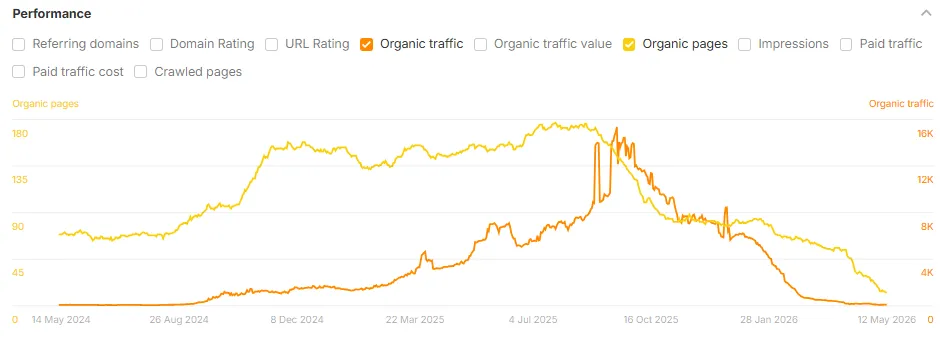
Across industries like SaaS and healthcare, these findings prove that prioritizing quantity over quality is a high-risk strategy.
Content scaling strategy done right: the Ânima Educação success model
Managing the digital presence of 18 higher education institutions simultaneously is one of the most significant operational challenges in the Brazilian education sector.
By implementing Niara’s Enterprise module, Ânima Educação went beyond standard content production during the ENEM season (Brazil’s national high-school exam and peak recruitment period). They built an AI-driven SEO ecosystem that unified their strategy while preserving the unique brand identity of each institution.
They leveraged our intelligence for:
- Full-funnel journey coverage: using our data intelligence, the team identified content gaps and structured articles for every stage of the candidate’s journey — from pre-exam preparation to the final results announcement.
- Optimized generation at scale: Niara enabled the creation of SEO-optimized content tailored to the regional reality of each institution, respecting distinct brand voices and local data.
- Generative AI readiness: pages were technically structured to perform not only in organic search results but also to be cited as authoritative references in AI-generated answers (such as AI Overviews and LLMs).
- Operational efficiency: our technology handled the heavy lifting and repetitive tasks, allowing Ânima’s SEO team to focus 100% on human curation, strategic review, and user experience.
This strategic shift allowed them to significantly boost their organic presence while reinforcing the educational authority their students and faculty expect. It is a prime example of achieving quality at scale — leveraging technology to handle the heavy lifting of data analysis so the creative team can focus on high-level strategy.
Read the full Ânima Educação case study on our blog.
How do you scale content with AI without going generic?
The secret to avoiding AI-beige content lies in building a scalable content system that treats artificial intelligence as a production layer, not a strategic one. Instead of asking AI to write a post, you use it to assemble content based on your proprietary brand brain — a centralized repository of your unique data, expert opinions, and specific editorial constraints.
1. Documentation and standardization
To scale content without sacrificing quality, you must codify your brand’s DNA into a “brand brain” using three repeatable pillars:
- Comprehensive style guide that define specific linguistic rules like active voice and sentence length;
- Structured content blueprints that mandate frameworks such as Problem-Agitation-Solution (PAS) and strategic keyword placement;
- Definition of Done (DoD) checklist to ensure every piece meets SEO and quality standards (including internal linking, meta-descriptions, and alt-text) before publishing.
This systematic approach allows both human creators and AI tools to produce high-precision, consistent output that aligns perfectly with your brand standards.
2. Roles and governance
To scale content production without compromising authority, implementing a robust content governance model is essential. This means establishing a clear hierarchy of responsibilities, ensuring that every stage — from ideation to final approval — has a designated owner. Without this structure, workflows become chaotic, and technical precision is often sacrificed in favor of volume.
The cornerstone of this process is the integration of Subject Matter Experts (SMEs). They are vital for validating information and upholding the E-E-A-T pillars required by Google’s Search Quality Raters. Key roles in the chain of command includes:
- Content strategist: identifies topics based on keyword gaps and search intent to ensure the content meets market demand.
- Writer: transforms the strategy into fluid, engaging, and SEO-optimized copy tailored for the target audience.
- SME (Subject Matter Expert): a professional whose role is to ensure the content is technically flawless — such as a lawyer reviewing legal articles or an engineer validating a technical tutorial.
- Final editor: acts as the brand gatekeeper ensuring that the tone of voice and editorial guidelines are strictly followed before publication.
By adopting this governance framework, you prevent the spread of generic information and ensure that every piece of content reinforces your brand’s credibility and leadership in the market.
3. Purposeful technology integration
Adopting tools without defined processes is, in practice, simply automating chaos. Technology should be viewed as a means to scale what already works, rather than a “magic bullet” for disorganized workflows. Before implementing management software or artificial intelligence, it is essential to map out every stage of your operation.
This strategic mapping ensures you identify the precise tools or platforms that align with your unique goals, allowing for a seamless transition from manual tasks to a high-output, AI-enhanced production model. Instead of delegating the entire creation process to a machine without a filter, use technology to eliminate operational and repetitive bottlenecks.
For example, in the context of content production, the strategic use of AI-assisted writing is an excellent choice for driving efficiency and innovation. It can be used to:
- Research and briefing: use AI to synthesize large volumes of data and extract market trends in seconds, speeding up the foundational research phase.
- Technical standardization: automate reference formatting, complex grammatical corrections, and tone-of-voice adjustments across different channels to ensure brand consistency.
- Asset repurposing: instantly transform a technical long-form article into multiple social media posts, maintaining a unified message while maximizing reach.
By offloading these mechanical tasks to intelligent systems, you free up your human capital to focus on what is truly irreplaceable: high-level strategy, critical thinking, and building an emotional connection with your audience.
4. Content modularization
The COPE (Create Once, Publish Everywhere) methodology is the foundation of a scalable content strategy. Instead of treating every platform as a unique starting point, you adopt a modular approach, breaking down complex topics into atomic content blocks. This significantly boosts your content velocity by ensuring no research effort goes to waste.
For example, a 2,500-word pillar guide on “Remote Work Security” can be architected to produce:
- Educational snippets: three specific “how-to” sections transformed into a series of high-engagement LinkedIn carousels.
- Micro-video scripts: key statistics and data points from the guide used as scripts for 60-second YouTube Shorts or Instagram Reels.
- Newsletter segments: each sub-header serves as the lead story for a weekly email digest, driving traffic back to the main site.
This modularity is essential for SEO for large content libraries. By repurposing a pillar piece into various formats and strategically interlinking them, you build topical authority and a cohesive internal linking structure. This ensures that while you are publishing across multiple channels, every block reinforces the primary asset.
Also, COPE allows you to maintain a high-frequency presence without the burnout of constant creation, turning a single pillar into a multi-channel ecosystem.
5. Feedback loops and optimization
Scaling content production is not a one-time event, but rather an iterative cycle of refinement. To prevent quality from diluting as volume increases or AI hallucinations, it is essential to establish feedback loops that analyze both external impact and the internal health of your operation.
Data-driven insights allow you to identify exactly where to “tune the gears”. Consider the following pillars to optimize your strategy:
- Results analysis: rigorously monitor content performance metrics, such as conversion rates and dwell time. For instance, if a technical guide attracts significant traffic but has a high bounce rate, you should adjust the readability or incorporate visual elements to better retain the reader.
- Workflow efficiency: evaluate the time spent on each stage of production. If the approval phase takes 48 hours and consistently delays publication, implementing project management software can centralize feedback and eliminate bottlenecks.
- ROI by format: compare production costs against the return on investment. If short-form videos cost the same as long-form articles but generate triple the qualified leads, you should reallocate your resources toward the higher-impact format.
Use these insights to lubricate your content engine, ensuring that each new cycle is more cost-effective, faster, and more impactful than the last.
Scale your SEO content strategy with the Niara ecosystem
Scaling a content operation is one of the biggest challenges for SEO and content professionals. Without the right tools, growth often leads to a drop in quality or a chaotic workflow. Niara was built to solve this by creating a complete ecosystem that supports professionals across every operational stage: from initial research and strategic planning to high-volume creation and deep performance analysis.
Here is how Niara transforms your workflow into a high-performance engine.
1. Research and strategy: data-driven planning
Scaling without a data-backed map is a recipe for wasted resources. Niara helps you identify exactly where you have the “right to win” by turning raw data into actionable insights.
- Get to know Authority Map: stop guessing which topics to cover. Niara’s Authority Map connects directly to your Google Search Console data to identify topic clusters where you already have traction. It highlights content gaps and can generate a 3-month content calendar in seconds, ensuring your site builds the semantic SEO depth required to dominate your niche.

- Get to know Google AI Mode Insights: an advanced SEO tool designed to analyze how your content perform within Google’s AI Mode and AI Overviews. It analyzes your URL based on official Google documentation to diagnose how your content appears in AI results. It identifies content gaps and provides actionable optimization recommendations to boost your visibility and authority within AI-generated search results.
- Get to know ChatSEO: elevate your strategy with ChatSEO, which distinguishes itself from ChatGPT and generic chatbots by focusing exclusively on search engine performance. Use it to analyze live URLs and documents, extracting deep insights that standard AI models miss. Transform real-time web data into actionable intelligence, ensuring your marketing approach is powered by precision-engineered, data-driven SEO expertise.
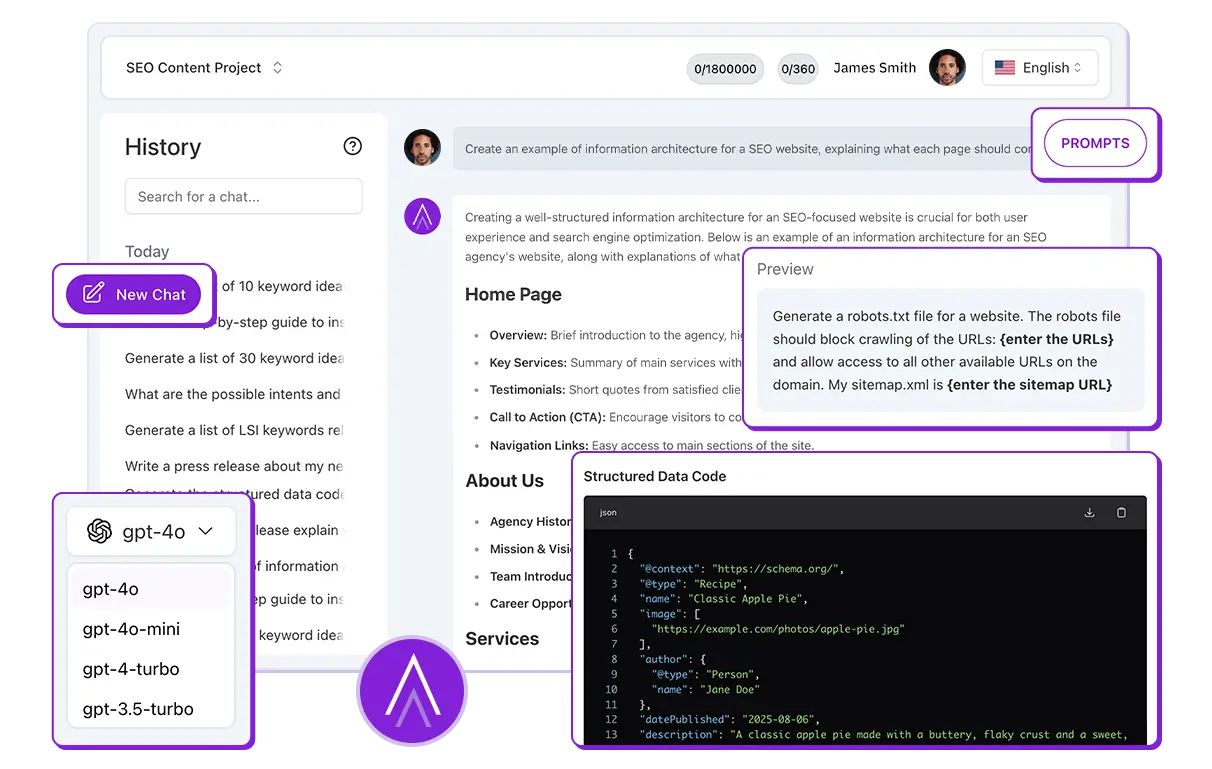
2. Content operations: standardizing the workflow
A scalable system requires a repeatable process. Niara ensures that whether you are a solo creator or managing a team of fifty, the quality remains consistent.
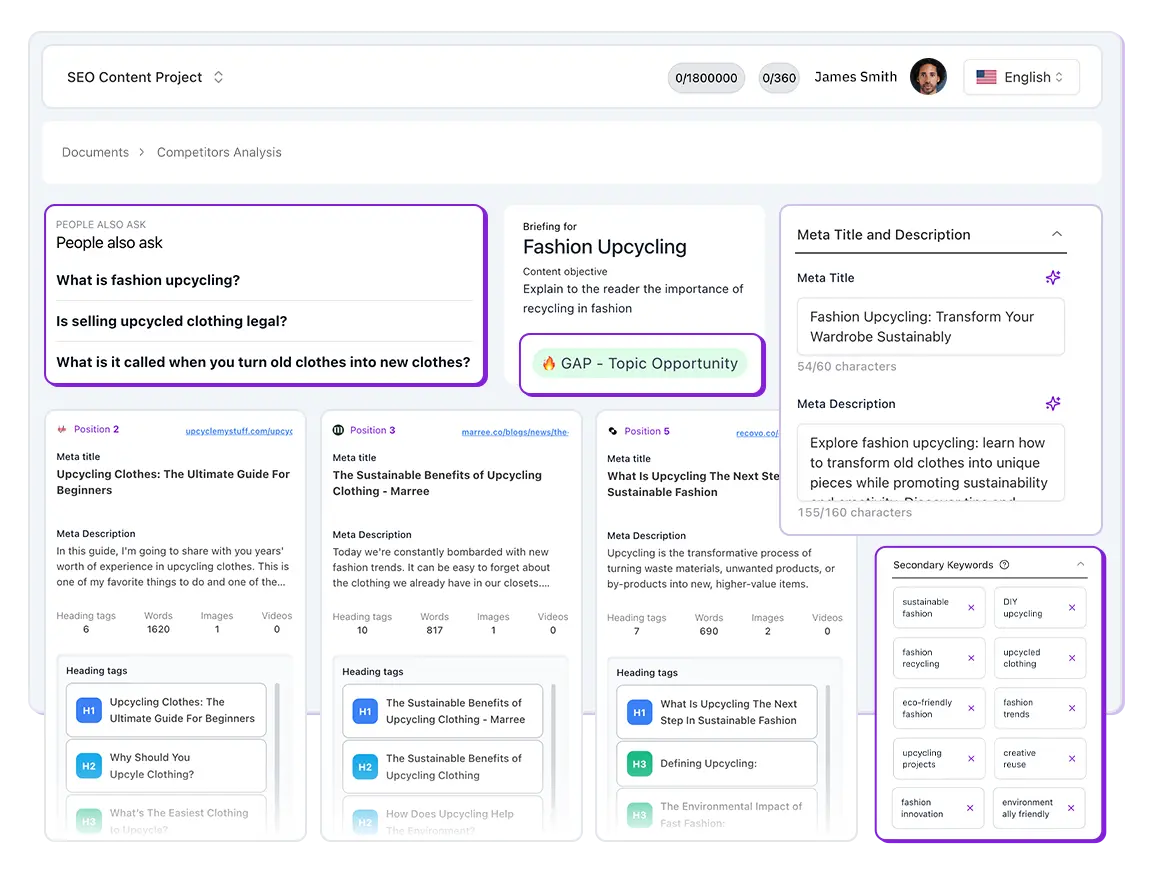
- Get to know Content Workflow: a great article starts with perfect content briefs. The Content Workflow tool analyzes the SERP and your top competitors to generate a comprehensive briefing. It includes H2/H3 structures and identifies competitor gaps, ensuring your writers have a clear roadmap to create content that outranks the competition. Additionally, you can generate full articles in just one click, moving seamlessly into the content editor to refine and finalize your post for publication.
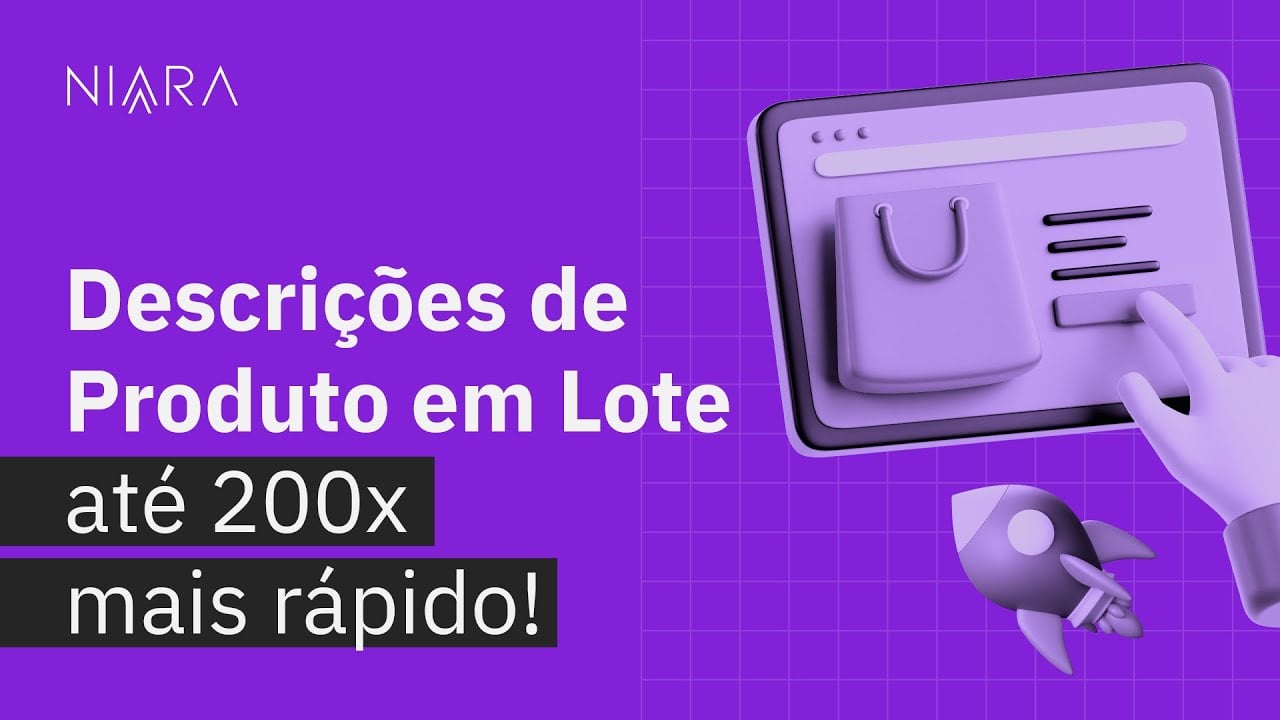
- Get to know Bulk Content: efficiency is the key to scaling. Scale repetitive, high-volume tasks like meta description and product descriptions across any CMS (VTEX, Shopify, WooCommerce and more). For Enterprise clients, we provide custom formatting tailored to your brand’s unique guidelines through strategic consulting. You can easily manage large-scale updates with bulk spreadsheet uploads for VTEX and WooCommerce — in this case no API is required, making your data management faster and simpler.
3. Creation and assistance: the AI co-pilot
Niara doesn’t just write; it collaborates. We provide the tools to bridge the gap between AI efficiency and human expertise.
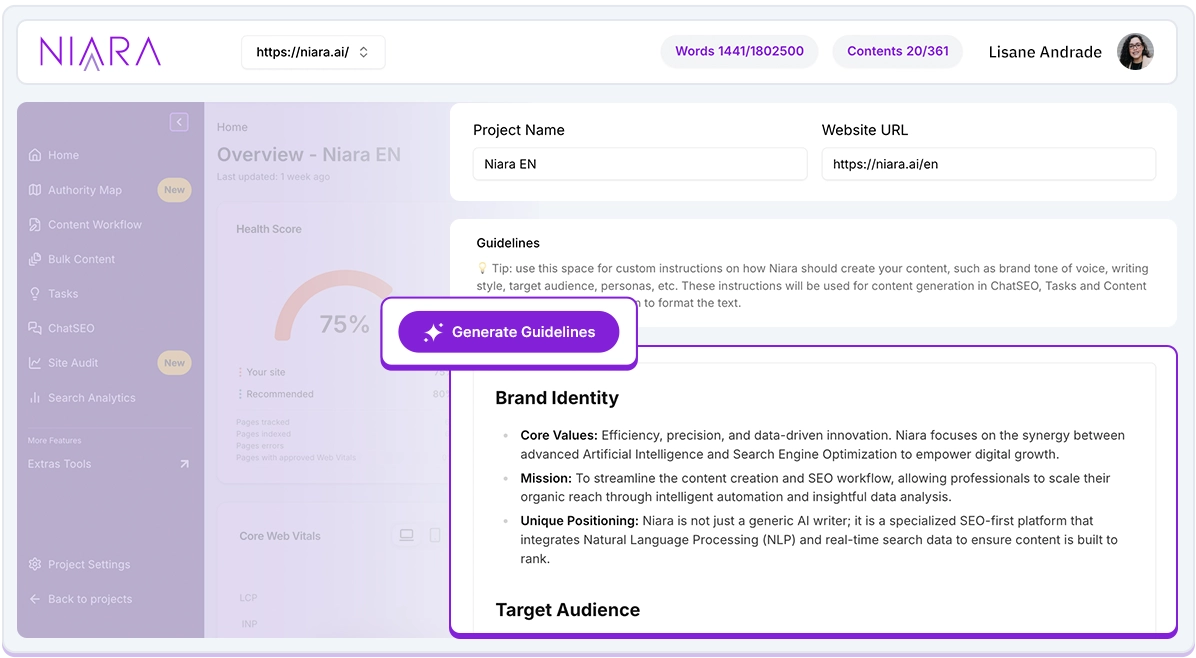
- Get to know Brand Guidelines: this feature allows you to define and store your unique brand specifications. By adding details like tone of voice, style preferences, and core messaging, Niara automatically applies these recommendations to every output generated across the platform, ensuring brand voice consistency every time.
- Get to know Prompt Library and Tasks: ChatSEO features a comprehensive prompt library with ready-to-use templates and tasks designed to automate your most demanding operational SEO workflows. You can also use our SEO and Marketing Tasks to accelerate your workflow and meet operational demands, including keyword research, grammar checks, FAQ generation, copy creation, and more.
4. Analysis and health: monitoring your success
The job isn’t over once the content is published. A true ecosystem must provide the tools to monitor health and measure ROI.
- Get to know Search Analytics: move beyond basic click tracking. Niara’s Search Analytics allows you to perform Conversational Analytics via ChatSEO. You can ask complex questions like, “Which of my pages lost the most traffic this month?”. This makes refreshing old content (often more effective than creating new pieces) a data-driven breeze.

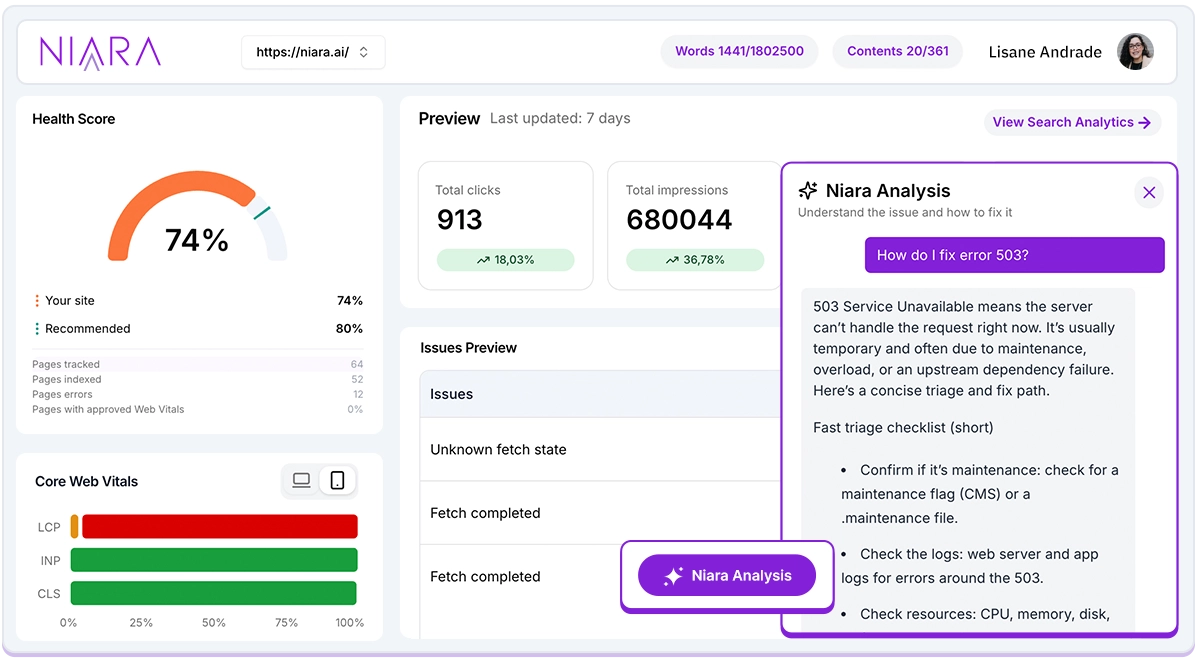
- Get to know Site Audit (Technical SEO Agent): as your content library grows, so does the risk of technical debt. Our Technical SEO Agent performs comprehensive Site Audits to monitor indexation errors, Crawl Budget efficiency, and Core Web Vitals. It ensures that your high-quality content isn’t held back by underlying technical issues.
5. Multimodal SEO: diversifying your content strategy
To stand out in today’s search results, you need more than just standard blog posts. To capture attention across all platforms, your strategy must be versatile. Niara’s multimodal SEO capabilities allow you to generate repurposed content, helping you transform and expand your reach with ease.
- Get to know YouTube to Article: repurpose your video assets instantly. This tool converts video content into structured, SEO-optimized articles, ensuring your insights reach both viewers and readers while maximizing the ROI of your video production.
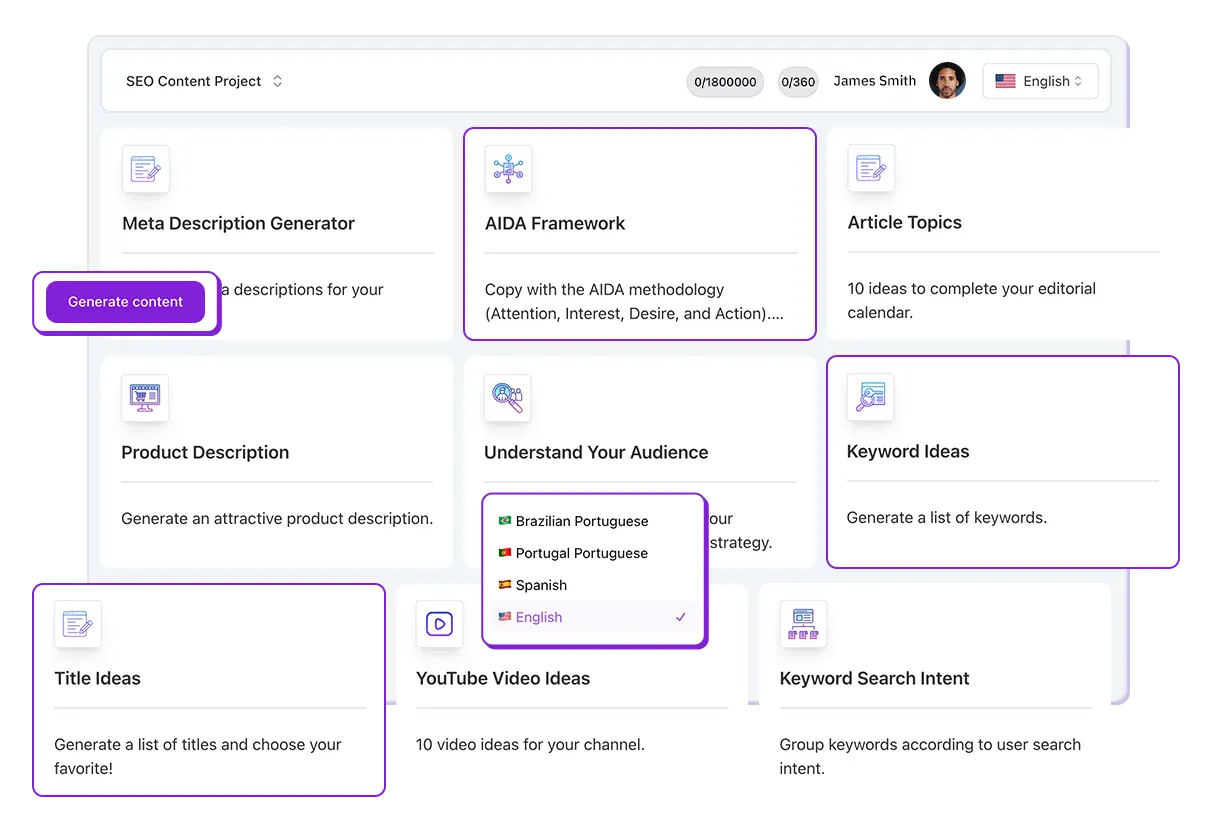
- Get to know Prompt Library and Tasks: our extensive library comes equipped with ready-to-use Tasks and Prompts designed for diverse content needs. From generating social media copy to crafting specialized marketing materials, these tools allow you to pivot between different content types without leaving the ecosystem.
By integrating research, creation, analysis, and multimodal capabilities into a single ecosystem, Niara empowers SEO and content professionals to scale their impact without ever compromising on quality or strategy.
Keep the audience at the center: outcomes-driven content scaling
At the end of the day, scaling is a marathon of consistency, not a sprint of spam.
Remember: your goal isn’t to have the most content; it’s to be the most helpful resource for your audience.
If you focus on providing value and use AI to remove the friction of production, you will win. Don’t just produce more; produce better.
Audit your current process today. Where is the bottleneck? Is it the time spent on manual keyword research? Is it the struggle to keep a consistent voice?
Identify that one friction point, solve it with a system, and watch your organic growth accelerate. SEO doesn’t have to be complicated — we’re here to simplify it.
Stop letting complexity stall your progress. Take control of your strategy and unlock your site’s full potential without the headache. Try Niara’s powerful SEO tools for free and start scaling your organic traffic with ease.