
The search landscape has evolved beyond the race for mere visibility. With the integration of Generative AI and AI Overviews (AIO), the focus has shifted from simple discoverability to the critical demand for verifiability. In this AI-first environment, appearing in results is only half the battle; the new benchmark for authority is ensuring your content is substantiated and trustworthy enough to be synthesized by automated systems.
In this landscape, the concept of grounding indexing emerges as the central pillar of the new search marketing era. Unlike previous algorithmic updates, the current revolution shifts the focus from information retrieval to rigorous data validation. Grounding serves as the vital link between Large Language Models (LLMs)—such as Gemini and GPT-4—and the real world, ensuring that AI-generated responses are not merely probabilistic inferences, but extractions rooted in authoritative sources of truth.
If you want your brand to be the source that AI trusts, you need to understand how grounding indexing works and how to optimize for it. Let’s dive deep into the mechanics of grounding and how you can anchor your content in the age of AI.
Read more: What is Google AI Mode? A Complete Guide for SEOs and Content Creators
What is Grounding Indexing?
Grounding is the process of connecting an AI model to a real-time, verifiable, and external source of truth.
Think of it as giving the AI an “open-book exam”. Instead of relying solely on its memory (training data), the AI uses Grounding Indexing to look up specific information from the live web (the Index) to answer a user’s prompt. This ensures the response is accurate, current, and anchored in reality.
How Grounding Indexing Works
In the era of AI-driven search, “Grounding Indexing” has become a critical concept for anyone looking to maintain visibility. To understand how it works, we first need to look at how modern AI—like the ones powering Google’s AI Overviews or Bing Chat—actually “thinks.”
The Problem: LLMs and Hallucinations
Large Language Models (LLMs), such as GPT-4 or Gemini, are incredibly smart at predicting the next word in a sentence, but they don’t actually “know” facts. They are trained on massive datasets, but that data can be outdated or incorrect. When an AI makes up a confident but false answer, it’s called a hallucination.
Consider this high-stakes real-world example involving one of the biggest tech companies in the world.
In February 2023, Google launched its AI chatbot, then called Bard (now Gemini), to compete with ChatGPT. To showcase its capabilities, Google posted a promotional video on Twitter (X) demonstrating how Bard could answer complex questions for a child.
The LLM Hallucination: The prompt asked: “What new discoveries from the James Webb Space Telescope (JWST) can I tell my 9-year-old about?”
Bard provided several facts, including one confident but incorrect statement:
“JWST took the very first pictures of a planet outside our own solar system.”
In reality, the first image of an exoplanet was taken by the European Southern Observatory’s Very Large Telescope (VLT) in 2004—nearly two decades before the JWST was even launched.
For a search engine giant, accuracy is the backbone of “Experience, Expertise, Authoritativeness, and Trustworthiness” (E-E-A-T). By hallucinating a scientific fact in its own marketing, Google undermined its status as a reliable source of information.
Also, the error was caught by astronomers shortly after the ad went live. The resulting loss of investor confidence caused Google’s parent company, Alphabet, to lose over $100 billion in market value in a single day.
This Google-Bard incident serves as a reminder that in the high-stakes world of AI, the difference between a breakthrough and a billion-dollar blunder lies in the rigorous pursuit of accuracy over mere probability.
Read more: How SEO automation can accelerate your results in the AI era
The Solution: Grounding via RAG
To prevent these high-stakes errors and bridge the gap between “mere probability” and absolute precision, businesses need a mechanism that forces the AI to stick to verified facts. This is where Grounding comes in.
Grounding is the process of anchoring an AI’s response to a trusted, real-world data source—specifically, your website’s index. By tethering the model to your own verified content, you ensure that the AI functions as a reliable extension of your brand’s expertise rather than a generator of confident hallucinations.
The most common way to achieve this is through a framework called Retrieval-Augmented Generation (RAG). Again, think of it like an “open-book exam” for AI:
- Retrieval: When a user asks a question, the system doesn’t just rely on the LLM’s internal knowledge; it first consults its own extensive library of information and then, depending on the specific search query, it actively retrieves real-time data from the web to ensure the most up-to-date results. Then, it searches a specific “library” (real-time indexed content) to find the most relevant information.
- Augmentation: The system takes those specific facts from trustworth websites and adds them to the user’s prompt.
- Verification: The system checks the output against the sources to ensure nothing was added or misrepresented. It implements a dedicated verification layer that cross-references the generated output against primary sources. This ensures that no fabricated information is introduced and that the source material is represented with absolute fidelity—providing a critical safeguard where standard grounding often falls short.
- Generation: The AI then writes a response based only on the facts it just retrieved.
Technically speaking, the system slices your documents into smaller chunks, converts the meaning of these texts into mathematical coordinates (embeddings), and when you ask a question, it quickly locates the segments with the closest semantic meaning so the AI can generate an accurate response based on your data.
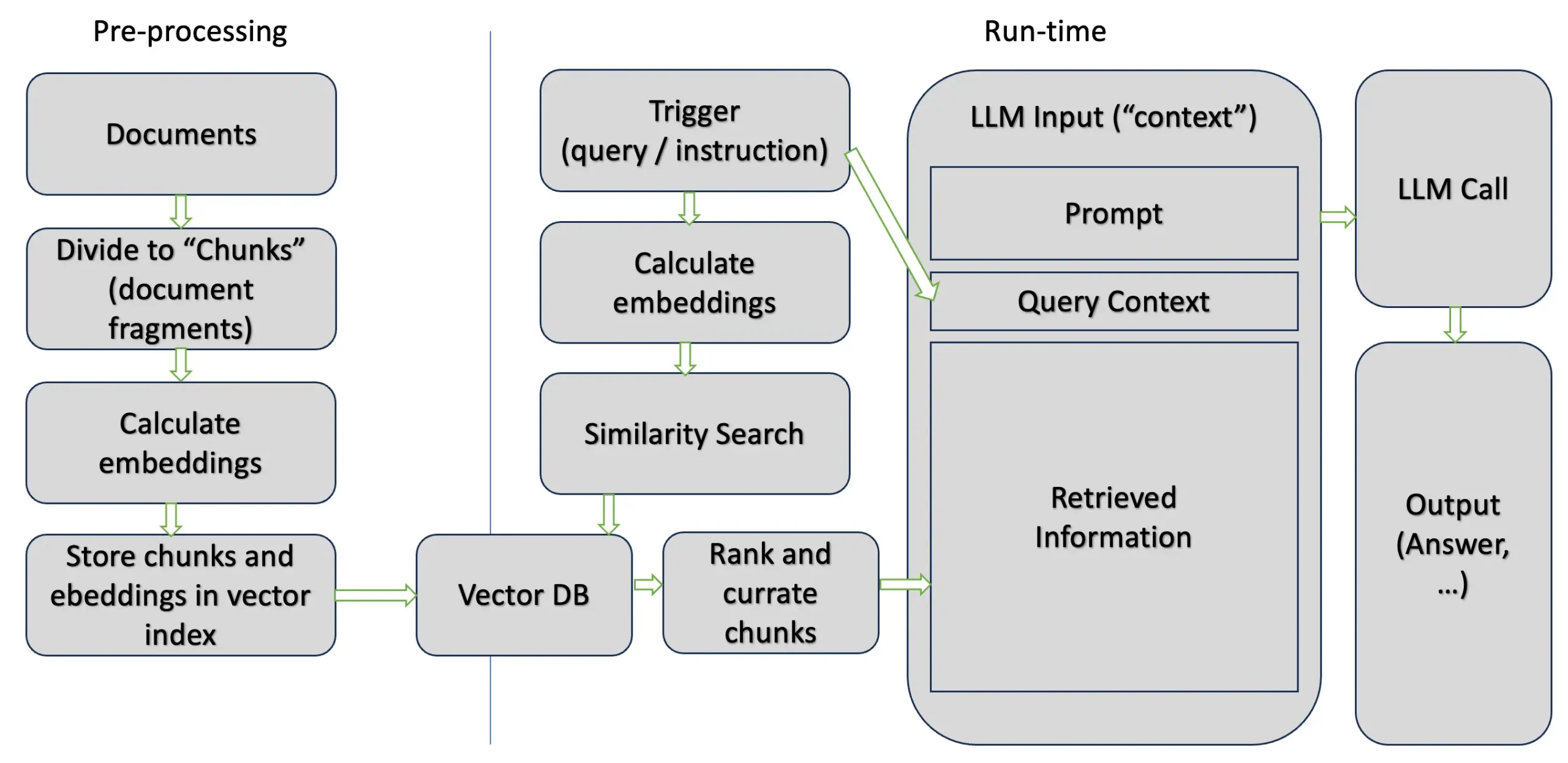
Grounding Indexing is the technical process of preparing your content so that these AI systems can “retrieve” it accurately and quickly. For SEO professionals, the goal remains the same but the stakes are higher: you must provide clear, authoritative, and well-structured data so that when the AI goes looking for a “source-of-truth,” your website is the one it picks.
How Google and Bing Utilize Grounding
The major players are already using our websites as grounding sources in very specific ways:
- Google (Vertex AI & Gemini): Google uses its massive Search Index as a primary grounding source. When you use Gemini, it often triggers a search in the background. It leverages Google Search to validate responses and attribute sources. This is why having your content properly indexed in the Google Search Console (GSC) is the first step toward grounding.
- Microsoft (Copilot & Bing Search): Microsoft integrates the Bing Index directly into the RAG process for Copilot. It uses the index to provide real-time information that the base model (like GPT-4) wouldn’t know because its training data has a “cutoff date.”
Read more: Types of Artificial Intelligence: From Theory to Applications That Transform Businesses
Grounding Indexing vs. Traditional Search Indexing
To master this new era, we have to distinguish between the index we’ve known for years and the one that powers AI. While they are related, their goals and workflows differ significantly. Based on Bing’s recent documentation, grounding and traditional search differ in the following aspects:
The Fundamental Question
- Traditional Search: Focuses on “Which pages should the user visit?”. The goal is to direct the human to the source.
- Grounding: Focuses on “What information can the AI system responsibly use to construct an answer?”. The goal is to extract data for synthesis.
Unit of Value
- Traditional Search: The primary unit is the document (the webpage) as a whole.
- Grounding: The unit of value is groundable information (discrete, supportable facts with clear provenance).
Error Dynamics and Recovery
- Traditional Search: Ranking errors are tolerable. If the first result isn’t great, the user clicks the second one and self-corrects.
- Grounding: Errors are critical. If the AI retrieves incorrect or outdated information, it generates a false response (hallucination or misinformation), and this error can propagate through multiple stages of the AI’s reasoning.
Handling Contradictions and “Abstention”
- Traditional Search: If two sources diverge, the search engine shows both and lets the user decide which to trust.
- Grounding: The system must detect conflict before responding. Abstention (deciding not to answer) is considered a valid and positive outcome when evidence is insufficient or contradictory.
Factual Fidelity vs. Relevance
- Traditional Search: Success is measured by clicks and user satisfaction with the found page.
- Grounding: Success is measured by factual fidelity. The process of “slicing” content (chunking) for the AI must not distort the original meaning of the page—a concern that doesn’t exist in traditional ranking.
How They Complement Each Other
Grounding and traditional search indexing they are not mutually exclusive; they are symbiotic.
Traditional ranking signals (like high-quality backlinks and strong E-E-A-T) act as a “gatekeeper.” If your site doesn’t have the authority to get into the traditional index, it’s highly unlikely it will be used for grounding. However, once you are in the index, grounding signals—like structured data, clear content hierarchy, and factual consistency—determine if the AI will actually “read” your content to generate its response.
At Niara, we see this as a two-step process: Traditional SEO gets you an invitation to the party; Grounding Optimization makes sure the AI actually talks to you once you’re there.
| Aspect | Traditional Search | Grounding (AI) |
|---|---|---|
| Fundamental Question | Which pages should the user visit? | What information can the AI responsibly use to answer? |
| Unit of Value | The document or webpage as a whole. | Groundable information (discrete facts). |
| Error Dynamics | Tolerable (user self-corrects by clicking another link). | Critical (leads to hallucinations or misinformation). |
| Contradictions | Shows multiple sources for the user to decide. | Detects conflict; may choose to abstain from answering. |
| Success Metric | Clicks and user satisfaction with the page. | Factual fidelity and precision of the “chunked” data. |
The 4 Pillars of Grounding Optimization
If you want your site to be the “source of truth” for AI, you need to establish robust trust signals for AI and optimize across these four pillars. This is where the “how-to” of modern SEO lives.
Pillar 1: Veracity and Accuracy (Anti-Hallucination)
AI models are trained to look for patterns. If your website or brand around the web contains contradictory information—for example, a blog post from 2021 says your software costs $50, but your pricing page says $70—the AI may flag your site as unreliable for grounding.
How to optimize:
- Content Audits: Regularly use tools like Niara to find and update outdated information.
- Internal Consistency: Ensure that facts, figures, and claims are consistent across all pages.
- Fact-Checking: Use external citations to back up your claims, showing the AI that your data aligns with the broader web’s “consensus.”
- Freshness: If your content hasn’t been updated in two years, its “confidence score” for grounding will drop. You can use the “lastmod” tag in your sitemap to signal to crawlers that information has changed.
Pillar 2: Site Structure
Large Language Models are excellent at reading natural language, but they are even better at reading structured data. Schema Markup (JSON-LD) acts as a direct “translator” for the AI. It tells the AI exactly what a piece of data represents without any ambiguity.
How to optimize: here’s some key schema types for grounding:
- Organization: Define who you are and your official social profiles.
- Product: Provide precise specs, pricing, and availability.
- FAQ: Give direct “Question-Answer” pairs that AI can lift directly.
- Author: Link the content to a real person with established expertise.
Beyond these basics, to truly optimize for Grounding, leverage the citation and isBasedOn properties within your Article Schema. This creates an explicit digital trail of where your information originated, allowing the AI to validate its veracity by cross-referencing data with government, academic, or industry-leading sources.
At Niara, our Structured Data Generator already accounts for this hierarchy, ensuring your content is read as a trustworthy ‘primary source’ of truth.
Pillar 3: Strengthened E-E-A-T
Experience, Expertise, Authoritativeness, and Trustworthiness (E-E-A-T) are no longer just “nice-to-haves.” They are verification signals. If an AI is looking for a grounding source for a medical query, it will prioritize content written by a verified MD over an anonymous blog post.
How to optimize:
- Detailed Author Bios: Include credentials, links to social profiles (LinkedIn), and other publications.
- Provenance: Show how you know what you know. Mention primary research, case studies, or hands-on experience.
Pillar 4: Content Chunking
LLMs have a context window size—a limit on how much information they can process at once. If your content is a 5,000-word “wall of text,” the AI might struggle to extract the specific answer it needs.
How to optimize:
- Lists and Tables: AI loves structured HTML. A table comparing product features is 10x easier for an AI to “ground” than three paragraphs describing the same thing.
- Direct Answers: Start your sections with a clear, concise sentence that summarizes the main point.
- Modular Writing: Use clear H2 and H3 headers that ask and answer specific questions.
Pro Tip: For every major H2, start the following paragraph with a single, concise sentence (under 40 words) that answers the topic directly.
Why this works: This simplifies the AI’s ‘slicing’ process. When you provide a direct answer upfront, you reduce the computational load required for the AI to understand your content, drastically increasing your chances of being selected as the cited source for an AI Overview.
Step-by-Step: How to Optimize Your Site Today for Grounding Indexing
You don’t need to be a data scientist to start optimizing for grounding indexing. Here is a practical workflow you can implement right now:
- Prioritize “Groundable” High-Value Pages: Focus optimization on pages with factual, unique data (Product Specs, Pricing, FAQs, and Documentation) rather than generic top-of-funnel content.
- Optimize for “Chunkability”: Structure content with clear H2/H3 headers and start sections with concise “Key Takeaways” to help AI systems extract specific information segments easily.
- Implement Structured HTML: Convert data-heavy descriptions into <table>, <ul>, and <ol> tags to eliminate ambiguity during AI data retrieval.
- Deploy High-Fidelity Schema Markup: Use advanced JSON-LD (like Product, FAQ, Organization, and Author) to provide a direct “translation” of your data for the LLM.
- Establish Provenance and Trust Signals: Link to authoritative primary sources (gov, academic, or official data) and use the citation property in your Schema to verify your claims.
- Verify Author Personhood: Link author bios to verifiable profiles (LinkedIn/ORCID) and use Person schema to provide “Proof of Personhood” for the AI.
- Enable Multimodal Grounding: Provide descriptive, data-driven Alt Text for images and full Transcripts/Chapters for video content to allow retrieval across different media types.
- Ensure Real-Time Accuracy: Display prominent “Last Updated” dates to signal the most recent or optimized articles.
- Audit for Internal Consistency: Remove contradictory information across your site (e.g., conflicting prices or outdated specs) to prevent the AI from flagging your site as unreliable.
- Perform “Hallucination Gap” Testing: Prompt AI search engines (Copilot, Gemini) with specific queries about your brand to identify where they fail to retrieve your data, then create content to fill those gaps.
How Niara Accelerates Your Grounding Strategy
Niara was built to bridge the gap between traditional SEO and the new era of AI-driven search. Here is how our platform streamlines every step of your optimization process:
1. Identify Your Trust Clusters with the Authority Map
Before optimizing individual pages, you need to know where your brand already holds authority. Niara’s Authority Map transforms your Search Console data into a growth strategy by identifying your dominant content clusters and highlighting gaps.
Grounding works through proximity: if an AI already trusts you on ‘Technical SEO,’ it will have higher ‘inherited trust’ when using your content for ‘Grounding Indexing’ queries. Use the Map to plan an editorial calendar that covers the exact gaps preventing your total niche domination.

2. Optimize High-Value Pages
Niara’s Google AI Mode Insights is your ultimate ally for page optimization. This tool pinpoints exactly how to refine each page to become a definitive “grounding” source.
By analyzing your URL against official Google documentation, it provides detailed recommendations to mitigate query fan-out—the phenomenon where AI must pull from multiple sources due to a lack of clarity in a single one. It identifies the information gaps you need to bridge so your page provides a complete, structured response, ensuring that AI engines prioritize your content as the primary source of truth.
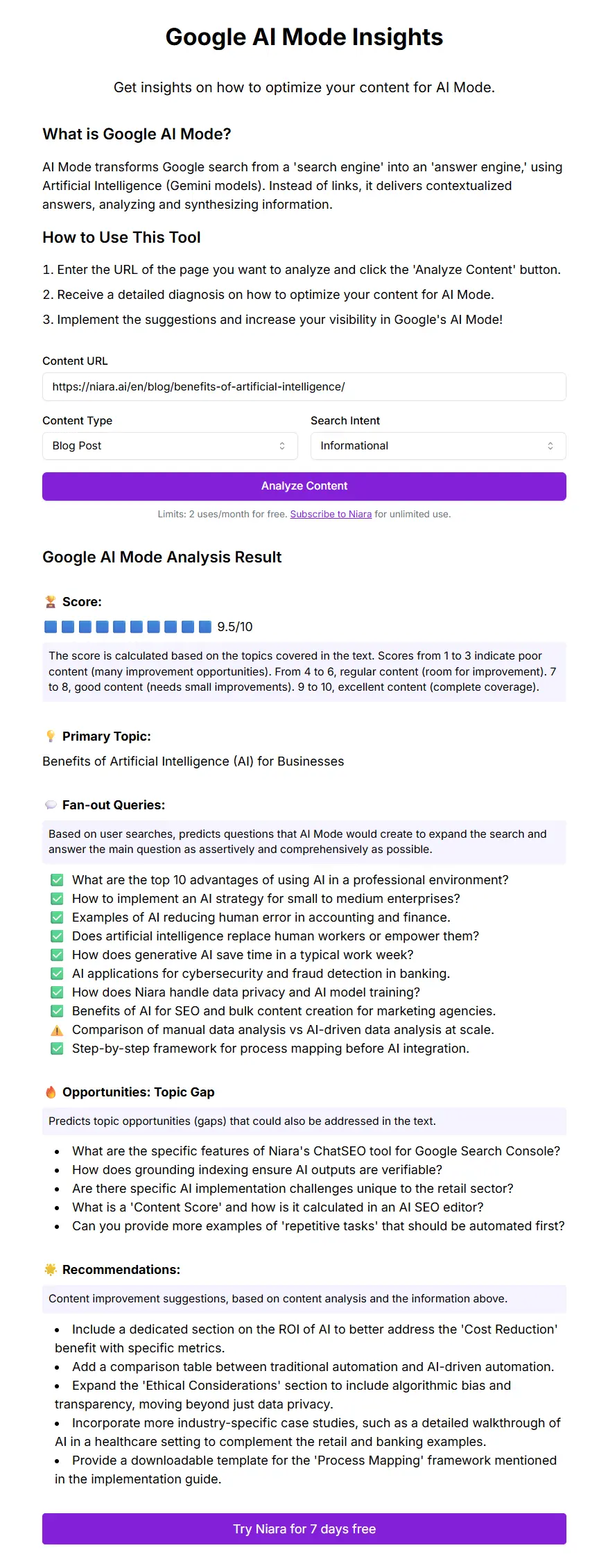
To decide which pages to prioritize for this level of deep optimization, you can use Niara’s Search Analytics and Conversational Analytics.
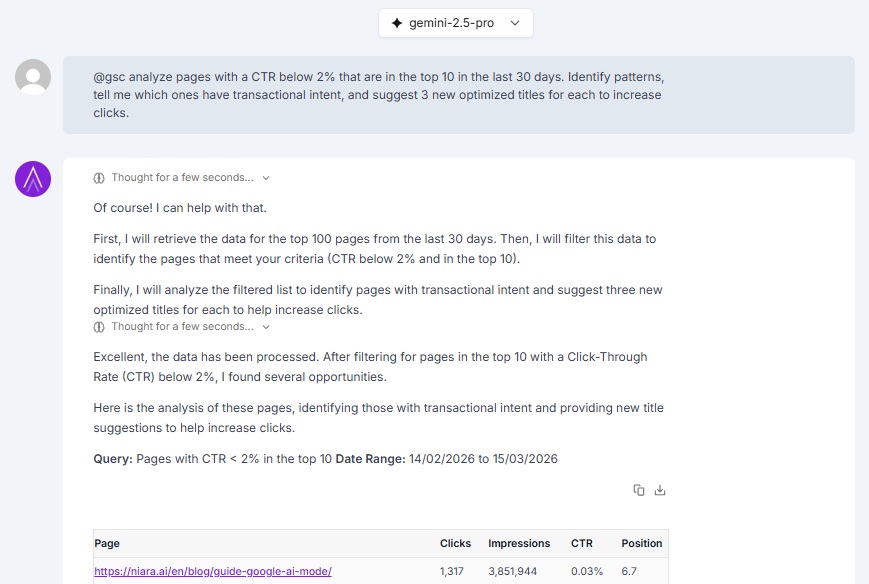
By integrating your Google Search Console data directly into Niara, you gain a bird’s-eye view of your site’s performance. Instead of manually sifting through endless spreadsheets, you can use Conversational Analytics to talk to your data and uncover hidden opportunities in seconds. These tools help you identify high-potential pages that are already attracting interest but need that extra “AI-ready” polish to dominate search results.
You can simply ask Niara’s Conversational Analytics a specific question to surface the best candidates for AI Mode Insights.
Example Workflow:
- Ask the AI: “Which of my pages have the highest impressions for ‘SEO automation’ keywords but a click-through rate (CTR) below 2%?”
- Analyze the Result: Niara identifies a comprehensive guide you wrote last year that is getting thousands of impressions but isn’t capturing the clicks or the “featured” spots.
- Take Action: Now that you’ve identified the “weak link,” you take that specific URL and run it through AI Mode Insights.
- Refine: Use the tool’s recommendations to fill information gaps and restructure the content according to Google’s documentation.
By combining these analytics with AI Mode Insights, you stop guessing and start optimizing with surgical precision, ensuring every update you make moves the needle toward becoming a definitive source of truth.
3. Optimize for “Chunkability”
Content Workflow is designed to streamline your entire production process, generating comprehensive briefings and articles that are pre-structured with H2 and H3 tags. This specific hierarchy is meticulously optimized for both traditional Search Engine Results Pages (SERPs) and modern AI data extraction, ensuring your content is easily “crawlable” by bots and readable for users.
A standout feature of this tool is its deep integration with your Brand Guidelines. Every piece of content generated within the workflow adheres strictly to your brand’s unique voice, tone, and style guidelines, ensuring SEO optimization never comes at the cost of brand identity.
To further enhance your content for AI retrieval and user experience, you can implement “Key Takeaways” at the beginning of your sections. While you can use ChatSEO for complex executive summaries, you don’t actually need to leave the editor to do this.
Simply select any block of text directly within the Content Workflow editor and ask Niara to generate a summary or a list of key points. This makes it incredibly easy to “chunk” your information, allowing AI models to retrieve and process your data more efficiently.

You can create the Key Takeaways section in the dashboard, as well as pull in external sources to enrich your text with data, statistics, and research.
For those who prefer a more conversational approach or need to build highly specific prompts, ChatSEO remains a powerful recommendation to complement your workflow. But the core of your SEO-optimized, brand-aligned content creation happens entirely within the seamless environment of the Workflow editor.
4. Solidify Your Technical SEO Foundation
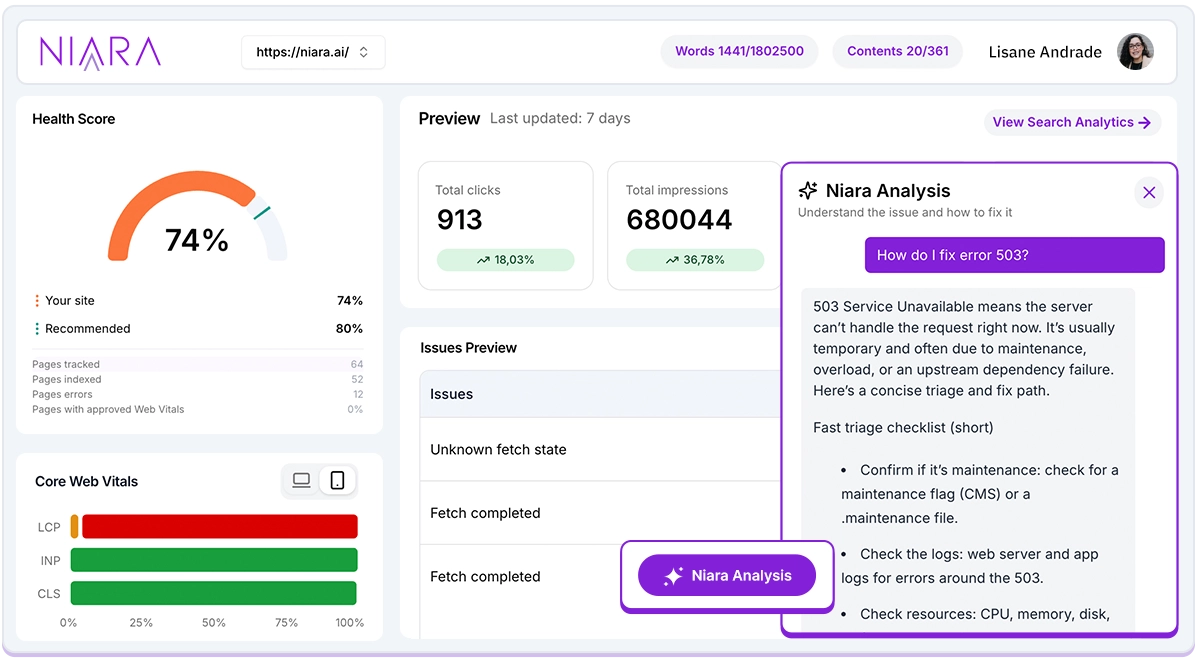
High-quality content and perfect “chunking” are only effective if generative algorithms and search bots can seamlessly access, crawl, and index your site. To ensure your technical foundation is rock-solid, Niara provides the Technical SEO Agent—your 24/7 virtual consultant dedicated to site health.
Generative AI models rely on clean data and fast loading speeds to prioritize sources. If your site has indexing hurdles or poor performance metrics, it risks being ignored by the very algorithms you are trying to reach. Niara simplifies this complex layer of SEO by integrating data from Google Search Console and Page Speed Insights into a single, conversational interface.
The Technical SEO Agent automates site health by providing real-time error monitoring, actionable Core Web Vitals optimizations, and platform-specific technical guidance to ensure your content is always accessible and high-performing.
5. Implement Technical Precision (Structured HTML & High-Fidelity Schema)
For AI models and search bots to interpret your content without ambiguity, the underlying code structure is just as vital as the text itself. Niara helps you “translate” complex information into machine-readable formats that ensure your data is extracted and indexed with 100% accuracy.
Within ChatSEO, you can transform dense paragraphs into organized data structures in seconds. Simply paste your technical specifications and ask: “Convert these properties into a clean HTML table and a bulleted list.”
This eliminates “noise” for Large Language Models (LLMs), allowing them to pinpoint specific attributes—like product dimensions or comparison data—more efficiently than they could from raw text.
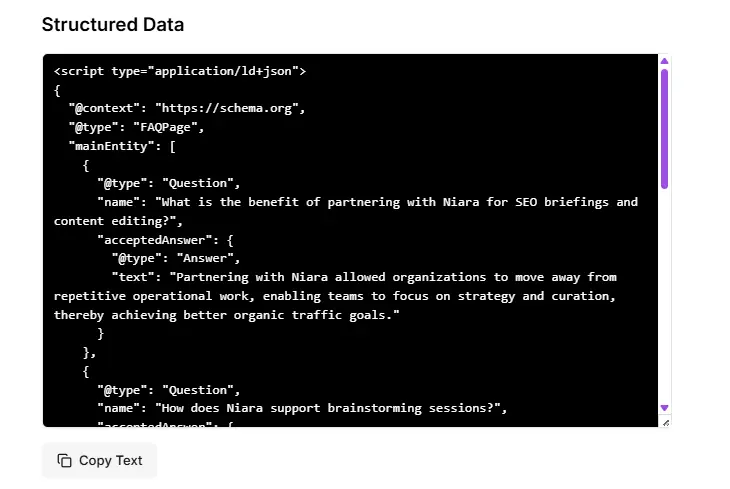
To further solidify your technical authority, Niara provides a dedicated Structured Data Generator. Instead of manually coding complex scripts, you simply enter your URL and select the specific data type (Product, FAQ, Review, Article, etc.). Niara then generates precise JSON-LD code, ensuring your site’s technical “handshake” with AI engines is error-free and fully optimized for Rich Snippets.
6. Enable Multimodal Grounding
In the era of AI-driven search, “Multimodal Grounding” is the process of connecting information across different formats—text, images, and video—to provide a comprehensive answer. If your visual and video assets aren’t properly “grounded” in machine-readable code, they remain invisible to the AI’s discovery process. Niara bridges this gap by ensuring your non-textual assets and technical data are fully indexed and understandable.
In addition to the tools already mentioned, such as Structured Data Generator and ChatSEO, Niara offers other supporting features designed for the AI-driven era of SEO.
- Alt Text Generator: Niara’s vision-capable AI analyzes your URLs to automatically generate factual HTML and ALT tags. Instead of outdated “keyword stuffing,” it focuses on descriptive accuracy, ensuring your images are accessible and ready for AI Overviews.
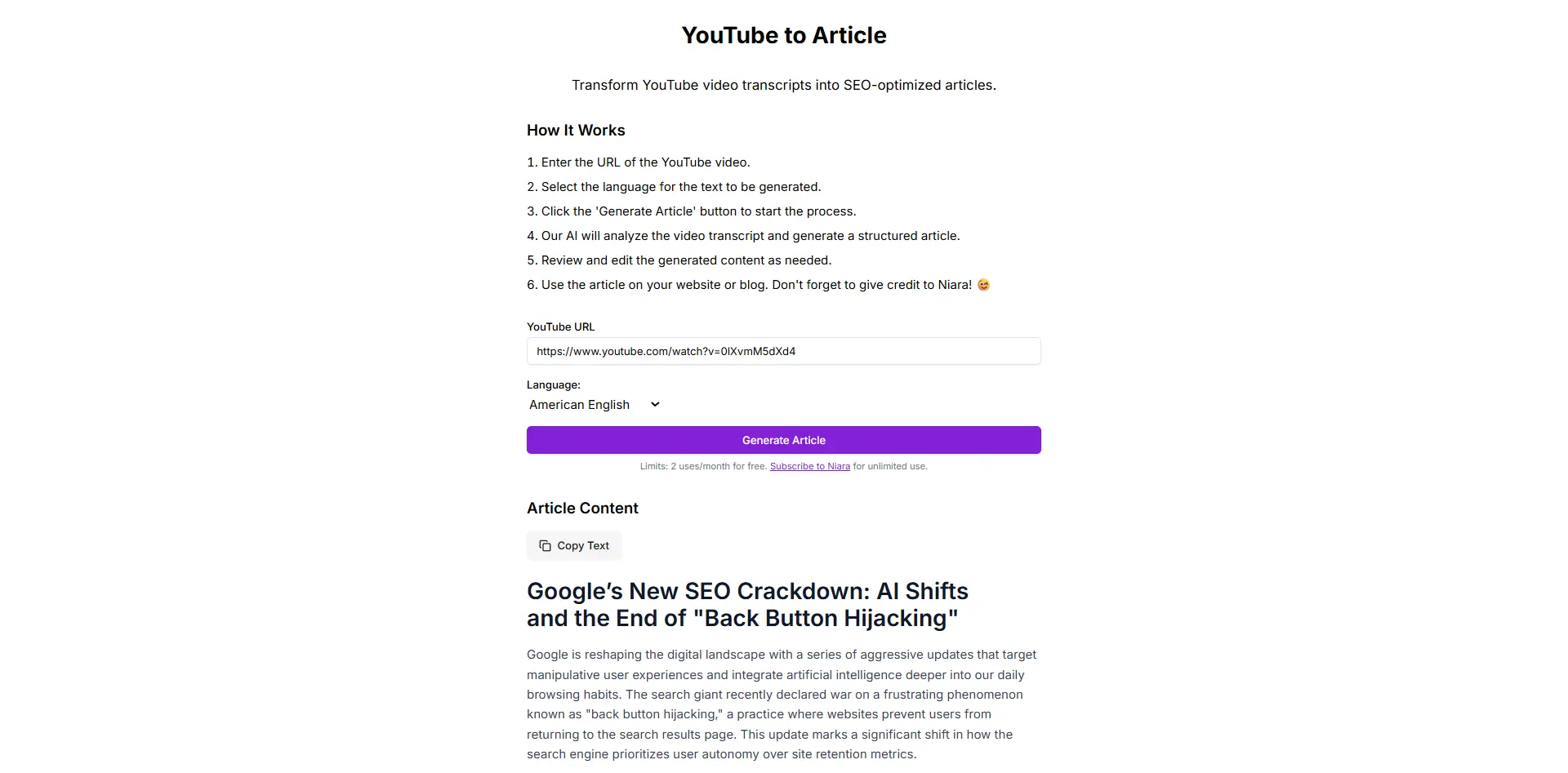
- YouTube to Article: This tool unlocks the “black box” of video content. By converting transcripts into structured, SEO-optimized articles, you turn a single video into a high-authority text asset, facilitating multimodal indexing across both video carousels and standard search queries.
Read more: Multimodal SEO: Learn How to Make Your Brand the Best Answer in Any Digital Format
The Dawn of Verifiable Authority
The shift toward grounding indexing evolves SEO from “ranking for clicks” to “optimizing for trust”. In an LLM-driven landscape, visibility is granted to the most reliable sources of truth.
By combining technical precision with high-quality data signals, you ensure your brand isn’t just seen—it’s cited.
Transitioning to an AI-first environment doesn’t replace SEO; it demands a “machine-readable” reputation where accuracy and structural clarity make your content the definitive choice for AI synthesis.
At Niara, we bridge this gap by streamlining content indexing for AI. We automate the technical complexities of grounding so you can focus on your core mission: establishing your brand as an indispensable pillar of truth.
SEO hasn’t died. It has simply become more demanding. Grounding Indexing is proof that data quality and structure now outweigh sheer word count.
Is your site ready to be the AI’s source of truth? Don’t leave your visibility to chance. Join Niara and use our Google AI Mode Insights to audit your pages today and ensure you aren’t just another search result—but the chosen answer.
