

The Privacy-First Era: How to Replace Cookie Dependence with a Proprietary Content Strategy

Your digital marketing strategy is deeply dependent on third-party cookies. Retargeting pixels tracking visitors across websites, lookalike audiences built with cross-site behavioral data, and complex attribution models connecting multiple touchpoints.
Then the headline hits: Google delays but will eliminate third-party cookies from Chrome. Safari and Firefox already block them by default. Panic sets in because much of the martech stack was built on a foundation that’s being gradually removed—and there’s no clear plan for continuing to measure, segment, and optimize when this infrastructure disappears.
The extreme reaction is also common. The idea that “the end of cookies means the end of effective digital marketing” creates paralysis, while teams wait for a miracle solution to emerge. Meanwhile, more adaptable competitors adjust strategies and reduce their dependence on invasive tracking. The reality is that the transition to a privacy-first internet is inevitable. GDPR, LGPD, and CCPA have already defined the regulatory path, and browsers will continue to reinforce privacy protection regardless of the ad industry’s pushback.
The more realistic take is less dramatic. SEO and organic marketing are naturally positioned to thrive in this scenario because they never actually depended on third-party cookies. Rankings, search discovery, and content consumption don’t require cross-site tracking.
First-party data collected with explicit consent, contextual targeting, and focus on experience quality aren’t just more ethical—they’re also sustainable in the long term. This is the terrain where resilient strategies will keep working, regardless of regulatory or technological changes.
Why Third-Party Cookies Are Disappearing
Global regulatory pressure has made the current model unsustainable. GDPR in Europe, LGPD in Brazil, CCPA in California, and similar legislation establish privacy as a fundamental right. Tracking without explicit consent is no longer just questionable—it’s illegal. Third-party cookies operate opaquely and frequently violate both the spirit and often the letter of these laws. Potential fines of up to 4% of global revenue have made compliance a concrete requirement.
At the same time, browser competition has accelerated the shift. Safari has blocked third-party cookies since 2017 with Intelligent Tracking Prevention. Firefox followed suit. Privacy has become a clear competitive differentiator, and browsers that prioritize it have gained ground. Chrome resisted as long as it could but eventually gave in to the combination of regulatory, competitive, and public perception pressure.
That perception, by the way, has changed drastically. Data breach scandals and the popularization of the surveillance capitalism debate have made aggressive retargeting practices uncomfortable for users. The ad that “follows you around the internet” went from being tolerated to generating rejection. Today, insisting on this model brings not only legal risk but also reputational risk.
How the Cookieless Era Affects (or Doesn’t) Organic SEO
SEO has never structurally depended on third-party cookies. Google indexes pages via crawler, not through tracked users. Rankings are determined by content quality, relevance, backlinks, technical performance, and aggregated behavioral signals—not by individual user identification across the web.
Even behavioral metrics like CTR, dwell time, and pogo-sticking are observed within the search ecosystem itself. When someone clicks a result and quickly returns to the SERP, Google interprets this as a negative signal. When they remain engaged, the signal is positive. None of this requires cross-site tracking.
First-party cookies remain fully functional. Analytics, on-site behavior, conversions, and navigation paths remain measurable within your domain. What disappears is the ability to follow users across sites you don’t control—something critical for display ads and retargeting but marginal for organic SEO.
Impact by Marketing Channel
| Channel | Third-Party Cookie Dependence | Cookieless Era Impact | Adaptation Required |
|---|---|---|---|
| Organic SEO | None | Minimal | None fundamental |
| Display ads | Very high | Devastating | Total transformation |
| Retargeting | Total | Current model collapse | First-party or contextual |
| Social ads | High | Significant | Lookalike degradation |
| Email marketing | None | None | Already first-party |
| Organic content | None | None | Growth trend |
Competitive Advantages of SEO in a Privacy-First World
The sustainability of organic traffic is independent of tracking infrastructure. A well-ranking article continues generating visits even when tracking technologies disappear. Companies overly dependent on paid ads face structural disruption; those with solid organic presence absorb the impact much more easily.
Perceived trust also weighs in favor of organic. Users tend to trust non-paid results more, especially in a context of heightened privacy sensitivity. Brands that grow through content and search align better with emerging values of user respect.
Additionally, relative cost improves. As paid targeting degrades, CPMs rise and CAC increases. Organic traffic maintains stable efficiency and, in many cases, improves as competitors reduce investment in less predictable paid channels.
Collecting First-Party Data Ethically and Effectively
Explicit consent is the foundation. Cookie banners need to clearly explain what’s being collected, why, and allow genuine refusal without compromising the essential experience. Transparency doesn’t reduce conversion when executed well; it frequently increases trust.
Clarity about data use also matters. Privacy policies should explain direct benefits to the user, not just fulfill legal formalities. When value is understood, willingness to consent grows. Respecting those who refuse is equally important—the site should function fully without non-essential tracking.
Value exchanges are the engine of first-party data. Newsletters, tools, premium content, and exclusive features offer real reasons for users to voluntarily share information. Data provided consciously is more accurate, richer, and more useful than passive tracking.
Analytics and Measurement Without Cookie Dependence
GA4 was designed for this new context. The event-based model prioritizes first-party data and allows modeling when direct data isn’t available. Migrating isn’t just a technical update but a mindset shift toward privacy-first measurement.
Server-side tracking also gains relevance. Instead of relying exclusively on the user’s browser, data first passes through your server, increasing control, performance, and resilience against ad blockers, while enabling better privacy governance.
Strategic insights don’t require individual identification. Aggregated patterns—which topics perform best, where engagement rises or falls—are sufficient to guide content and SEO decisions without violating anyone’s privacy.
Restructure your measurement to prioritize aggregated and first-party data before dependence on invasive tracking becomes a bottleneck.
Contextual Targeting Instead of Behavioral
Contextual targeting is making a comeback because it’s inherently privacy-compatible. The ad appears because the page content is relevant, not because the user was previously tracked. This eliminates legal and ethical risks without destroying relevance.
In organic, the content itself functions as an intent proxy. Someone reading a comparison guide or advanced tutorial is already demonstrating explicit interest. Serving contextually appropriate CTAs at that moment is effective without any surveillance.
Initiatives like Topics API attempt to create a middle ground, using aggregated rather than individual segmentation. The debate continues, but the overall movement is clear: less individual tracking, more context and aggregation.
Invest in content that reveals intent through context, not through surveillance of users across the web.
GDPR, LGPD, and Technical Compliance
A robust Consent Management Platform (CMP) is the technical foundation of compliance. Solutions like OneTrust, Cookiebot, or custom implementations are responsible for presenting the consent banner, capturing user choices, and technically applying those preferences. An adequate CMP doesn’t just display a notice but effectively blocks tracking scripts until explicit consent is granted. Additionally, consent needs to be versioned, auditable, and easily revocable at any time.
Data minimization is another core principle of GDPR and LGPD. Collecting only information strictly necessary for a legitimate purpose reduces legal and technical risks. Excessive forms that request data “just in case” violate this principle and expand the exposure surface in case of incidents. Each additional field needs clear justification of operational necessity.
Data subject rights also need to be technically executable. Legislation guarantees access, correction, deletion, and portability of data. This means systems must allow users to request a complete copy of stored information, make corrections, and request definitive deletion. Implementation can be complex, but it’s a legal obligation, not optional.
Technical Compliance Checklist
- Consent banner with clear opt-in, without pre-selected options
- Granularity to accept some cookies and refuse others
- Real script blocking until consent
- Clear, accessible, and understandable privacy policy
- Auditable consent registry (timestamps and versions)
- Easy revocation via visible link on all pages
- Portal for data access, correction, and deletion
- Minimal collection of only essential data
- Retention policy with automatic deletion after defined period
- Encryption of sensitive data in transit and at rest
- Incident notification process within 72 hours
- Appointed DPO when applicable
Content Strategy as Competitive Moat
Topical authority built through content can’t be blocked by ad blockers or invalidated by regulatory changes. Organically dominating core terms in your niche over years creates a defensible moat. Competitors can copy features but can’t quickly replicate link history, editorial depth, and accumulated trust.
Direct audience ownership is also a pure first-party asset. A newsletter with tens of thousands of subscribers who voluntarily opted in to receive communication is far more resilient than any display ad campaign. Email is a company-controlled channel, immune to algorithm changes on advertising platforms.
Evergreen content amplifies this effect further. Articles published years ago continue ranking and generating traffic at no marginal cost. In a scenario where ads become less efficient and more expensive, the relative ROI of content grows consistently.
How Niara Simplifies SEO in the Privacy-First Era
Niara was built on the premise that the future is first-party. Our platform prioritizes the data you already own and control. By connecting via official API to Google Search Console, our Search Analytics module offers a view that is 5x deeper into your actual traffic data, without relying on third-party cookies or invasive pixels.
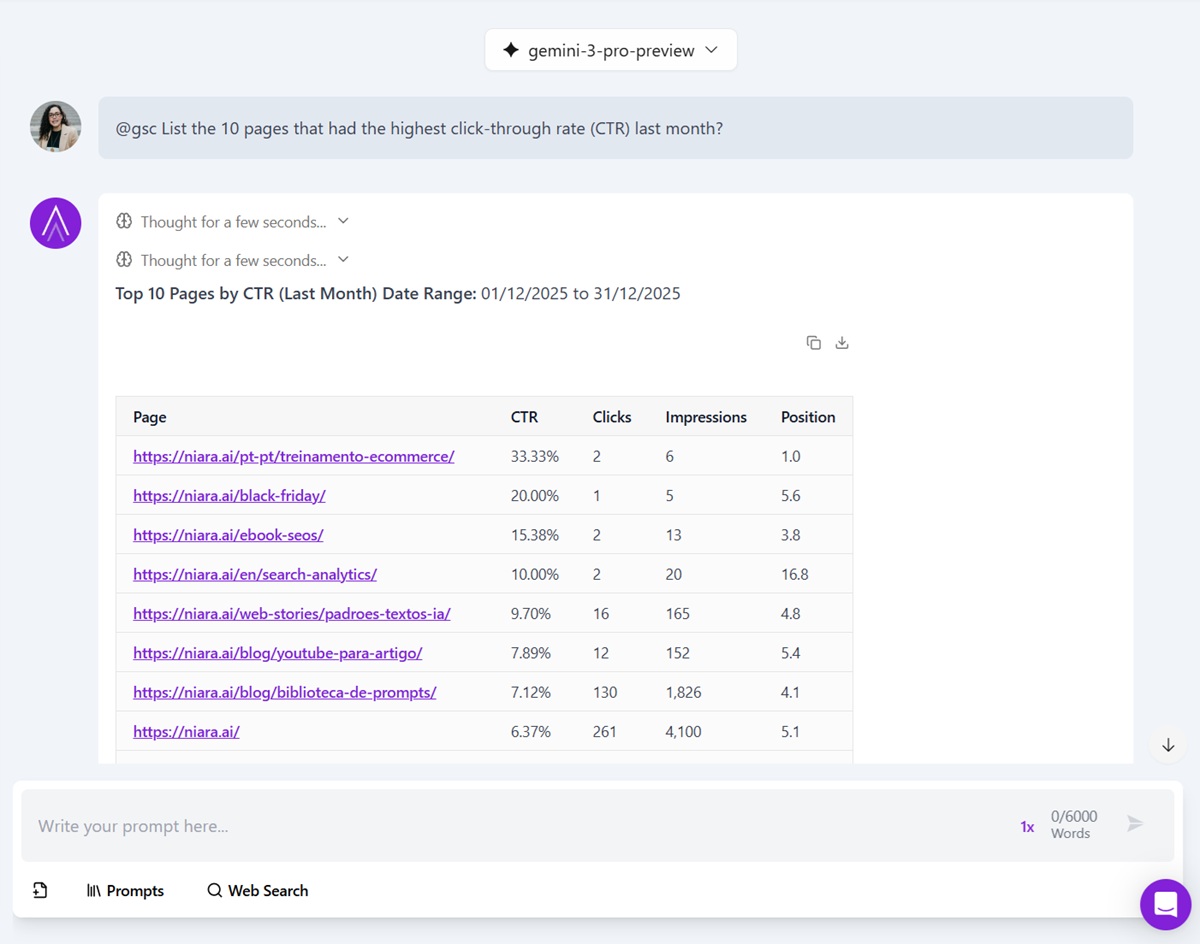
Our AI operates with Zero Data Retention (ZDR) at the processing layer. This means that when using ChatSEO or our Content Workflow to generate briefs and drafts, your strategic data is never used to train AI models.
Niara’s recommendations focus on building the competitive “moat” we mentioned earlier: topical authority and technical excellence. We help you scale quality content production and analyze real user search intent, ensuring your strategy grows sustainably and aligns fully with privacy regulations (GDPR, CCPA, and LGPD).
Preparing Infrastructure for an Uncertain Future
Channel diversification reduces structural risks. A balanced mix between organic, email, social, paid, and direct traffic makes companies less vulnerable to abrupt changes in any specific channel. Excessive dependence on ads with sophisticated tracking represents growing existential risk.
Investment in proprietary infrastructure also strengthens data sovereignty. Your own blog, email list, server-side analytics, and controlled domain reduce dependence on external platforms. It’s not about abandoning them but not being held hostage to decisions beyond your control.
A privacy-first mindset anticipates future regulations. LGPD and GDPR are just the beginning. Organizations that treat privacy as an operational principle rather than a minimum obligation adapt with much less friction over time.
Opportunities in a Transitioning Market
Transition moments create competitive asymmetries. Companies that adapt quickly gain advantage while competitors still depend on declining models. As old practices lose effectiveness, the gap between sustainable and obsolete strategies widens.
Market education also strengthens positioning. Brands that transparently communicate how they respect privacy build trust and brand equity. This discourse is more effective when it reflects real practices, not just legal compliance.
The talent market also responds to this. Qualified professionals tend to prefer companies with clear ethical stances. A culture of responsible data and rejection of dark patterns become real factors in attracting and retaining talent,
Measuring Success Without Invading Privacy
Aggregated metrics continue answering the most important strategic questions. Evaluating ROI by channel, average conversion rate, and LTV by segment doesn’t require individual tracking. Most decisions can be made with aggregated and anonymized data.
A/B testing also remains entirely viable. Statistical comparison between variants works at the group level, without needing to identify users individually. Population inference remains valid and effective.
Direct feedback complements this model. Surveys, interviews, and voluntary forms provide qualitative insights that no pixel can infer with the same clarity. First-party declarative data is richer, more ethical, and more actionable.
Build your measurement on aggregated, consented, and actionable data before invasive practices become a competitive liability.
Conclusion
The transition to the cookieless era doesn’t represent the end of digital marketing but an inevitable evolution toward a more ethical and sustainable model. Invasive tracking practices have always been fragile from legal and social standpoints. The current adjustment merely makes explicit a misalignment that already existed.
Channels based on consent, context, and real value gain relevance. Organic SEO, proprietary content, email marketing, and first-party relationships don’t just survive—they become even more strategic. Topical authority and owned audience become central assets.
The future isn’t the absence of data but better data: ethical, first-party, and contextualized. Privacy-by-design tools show that growth, measurement, and respect for privacy aren’t opposing forces. For companies thinking long-term, adapting to the cookieless reality isn’t defensive concession but a strategic opportunity to build solid foundations that withstand any regulatory, technological, or cultural change.
Turn compliance into a competitive advantage
Stop relying on third-party data. Unlock the power of Niara and create content that truly ranks, without compromising your users’ privacy.
