

Is Paid Media Too Expensive? Discover How SEO Reduces CAC and Generates Real Profit

If you lead a company or a marketing team, you’ve likely noticed the red flags flashing on your spreadsheets: the cost to acquire a customer via ads keeps rising, margins are tightening, and dependency on third-party platforms has become an operational risk.
The inconvenient truth of today’s digital market is that if your growth relies exclusively on paid media, you don’t own an asset—you have an expensive rental. And when you stop paying or your ad account gets flagged, the “store” closes.
This is where SEO (Search Engine Optimization) moves beyond “just content” and takes its seat at the strategic decision-making table. We aren’t just talking about generating traffic; we are talking about financial efficiency and building digital equity. Something that is truly yours.
If you stop paying, you disappear
Many companies have fallen into the short-term trap. Paid media offers immediate results, which is great for gaining initial traction.
However, with increased competition, taxes, and the end of third-party cookies (making user tracking harder), CPC (Cost Per Click) has skyrocketed while ROAS (Return on Ad Spend) has plummeted.
In Meta Ads, for instance, ad costs have increased by 21% in 2025.
And if you think Meta Ads is expensive, know that advertising on ChatGPT can be four times more expensive!
Not to mention Google Ads, which has “silently” increased its CPC over the years. Last Black Friday, some advertisers reported needing to invest nearly double to achieve the same results as in 2024.
In short, continuing to inject money solely into ads to maintain revenue is unsustainable. It erodes your profit margin.
SEO enters as the necessary counterweight to balance this equation on your P&L statement.
How SEO Directly Impacts Your Financials
For leadership, the value of SEO must be translated into business metrics. Forget clicks, impressions, and traffic… SEO needs to walk hand-in-hand with the business.
Here is how it acts on your company’s financial health:
1. CAC Reduction (Customer Acquisition Cost)
In paid media, the amount you invest to bring in a qualified lead (one that results in a sale) tends to increase over time. As you scale, audiences get saturated, and clicks get pricier.
In SEO, the logic is reversed. The initial effort is higher, yes. But once you conquer the top of Google and/or start being suggested by LLMs, the cost to maintain that qualified visitor tends toward zero (after the initial investment in content and technology). The result? Your cost to acquire new customers plummets, and your profit margin expands.
SEO is the most efficient tool for diluting acquisition costs over time.
2. Attracting Qualified Audiences (Purchase Intent)
Unlike paid media, which often interrupts user browsing, SEO captures the user at the exact moment they are searching for a solution on Google or LLMs (AI models like ChatGPT, Gemini, Claude).
Someone searching for “best financial management software” already has clear intent. They are interested in your product.
Organic traffic tends to have a superior conversion rate and a shorter sales cycle because trust in the brand is higher when it appears organically as an authority.
3. Building Digital Equity
Here is the biggest differentiator for the CFO:
- Paid Media is OPEX (Operational Expenditure): It is a recurring operational expense. Stop paying, stop selling.
- SEO is CAPEX (Capital Expenditure): It is an investment in an asset. A well-positioned article or an optimized product page from 2024 continues generating leads and sales in 2026, with no additional cost per click.
You build authority that belongs to your company, not to Google or Meta.
A proprietary and predictable acquisition channel generates more market value for your company.
“I have a limited budget. Where do I start?”
That is the million-dollar question. If the budget is tight, the answer is categorical: start with content.
Paid media demands constant cash. SEO demands strategy and consistency. For those starting out or with limited budgets, SEO levels the playing field.
Want a clear example of how content works? Look at Niara.
We launched the platform in April 2023, and as of this article’s publication, we haven’t invested in ads. Only in useful, high-quality content for the user. The result: hundreds of people discover the platform every month via Google, ChatGPT, Gemini, and other channels—always organically. Over 20,000 users have tested Niara over these years.
And you can do this in your business too.
Think with me: if you start a furniture e-commerce store, it would be very expensive to compete in the Google Ads auction with major brands like Wayfair, IKEA, or big local players, as they have massive budgets. Your money would run out before noon.
But, if you have an attractive and optimized e-commerce site, with product descriptions that answer all user questions, good photos, and reviews praising your store, you can indeed compete toe-to-toe on the Google results page and also in LLM results like ChatGPT, Perplexity, and others.
The Role of Leadership in Flipping the Switch
Many leaders hesitate to invest heavily in SEO because they think “it takes too long.” Let’s demystify this with technology.
With the use of Artificial Intelligence and tools like Niara, production and optimization time has been drastically reduced. What used to take weeks (keyword research, competitor analysis, creating briefs) is now done in minutes.
But that’s not the only benefit. Your team also gains efficiency and reduces rework. This reflects in faster results for your business. Or even the very next day, as shown in the screenshot below with the performance of an article published on our blog on January 21 already getting clicks on January 22:
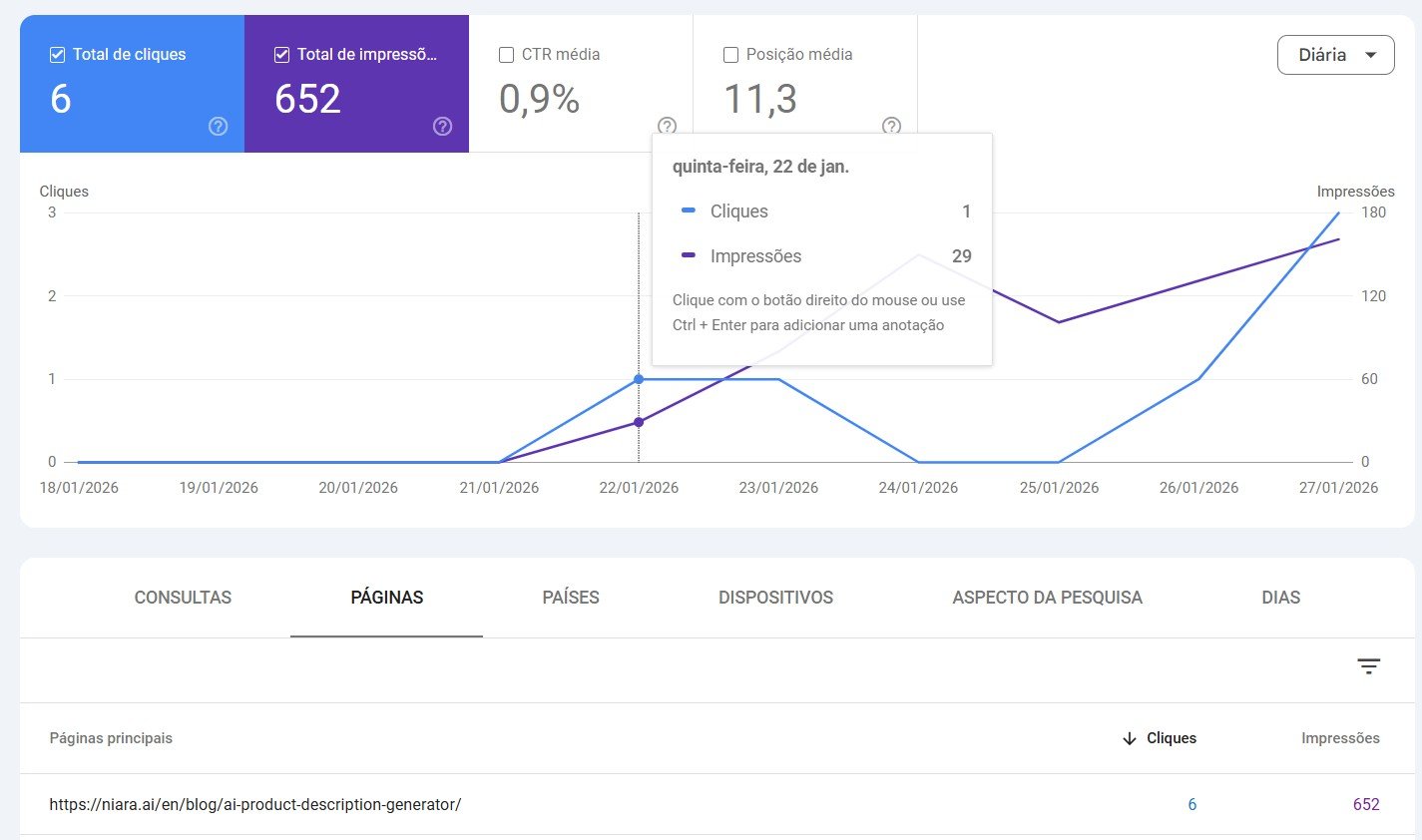
Liked the result above? Then check out the case study of one of the largest SEO agencies, which reduced their SEO strategy time from 2 weeks to just 48 hours with Niara.
Accelerating Strategy with Data Intelligence
To make SEO scalable and predictable, technology is indispensable. At Niara, we simplify SEO so your team focuses on strategy, not grunt work:
- Search Analytics: We offer 5x more data than Google Search Console, allowing you to see exactly which terms drive revenue.
- Content Flow: Your team creates briefs based on real data, ensuring every piece of content has a business purpose.
- ChatSEO: Analyze your data by talking to the AI, without needing data scientists to extract basic insights.
ProTip: See our step-by-step guide to going from zero to a complete article with Niara.
Should I abandon paid media?
No! The smartest strategy is balance.
Use paid media to:
- Leverage immediate results or specific promotions like Black Friday, Valentine’s Day, and other seasonal dates.
- Validate keywords and generate cash flow quickly while building your organic authority in parallel. For example, if you detect a keyword generates a lot of sales but has a high CPC, start an organic strategy for it.
Ads should go where SEO cannot reach.
But use the profit from those ads to fund your SEO strategy. The goal is for the curve to invert over time: your organic (free) traffic should surpass paid.
This is sustainability. This is security for your business.
FAQ: 5 Questions Every Leader Asks About SEO
If you still have doubts about allocating budget for SEO, here are direct answers to the most common boardroom questions:
1. “SEO takes 6 to 12 months to show results. Can we wait?”
Answer: Traditional SEO was slow. Modern SEO, driven by AI and automation, is agile and efficient. While domain authority takes time to build, “Quick Wins” strategies—like optimizing pages already on the second page of Google or updating old content—can bring results in weeks. Plus, time will pass anyway; a year from now, you’ll wish you had started today.
2. “Should I cut my entire Paid Media budget?”
Answer: It depends on the case. In Niara’s first 3 years, we ran no ads. But for most projects, I suggest a hybrid strategy. Use paid media for immediate results and market testing while building your SEO foundation. As your organic traffic grows, you can gradually reduce ad spend or reallocate it to remarketing campaigns, lowering your overall Customer Acquisition Cost (CAC).
3. SEO or Paid Media: Which generates more ROI in the long run?
Answer: Historically, SEO. While paid media brings immediate sales, the CAC tends to rise with auction inflation. In SEO, after winning the top positions, the cost to maintain that traffic is minimal, causing your profit margin to increase exponentially over the years, surpassing the ROI of ads.
4. “How do I measure SEO ROI if I don’t pay per click?”
Answer: SEO ROI is measured by production cost (tools + team) versus revenue generated by the organic channel. An excellent metric for leadership is “Equivalent Traffic Cost”: how much would you have to pay Google Ads to get the same volume of qualified traffic your SEO brings for free today? Usually, this number is surprising and proves the value of the digital asset you’ve built.
5. “Will Artificial Intelligence (like ChatGPT or Google AI Overviews) kill SEO?”
Answer: No, it will transform SEO. People will continue searching for answers and products. The difference is that the answer will be more direct. SEO now requires high-quality content, real experience, and technical authority (what Google calls E-E-A-T). Companies using AI just to generate spam will lose ground; those who use AI to create deep, useful content, as we do with Niara, will gain prominence in new search interfaces.
6. “Do I need a huge team to make this work?”
Answer: Not anymore. In the past, you needed an army of writers and analysts. Today, with automation platforms and AI like Niara, a lean team (or even a single strategic professional) can produce and optimize with the volume and quality of an entire agency. Technology is your team’s force multiplier.
SEO is Your Future Profit Margin
As a leader, your mission is to ensure the longevity of the business.
Investing in SEO today is ensuring that tomorrow, your acquisition cost is lower and your brand owns its audience.
Want to scale your organic presence with intelligence? Subscribe and discover how we simplify SEO to accelerate your results.