
Integrating Blog, YouTube, and Social Media in Your Strategy
Your company invests heavily in SEO-optimized blog: publishes articles consistently, researches keywords, writes impeccable meta tags. Even so, traffic grows slowly and conversion is disappointing.
Meanwhile, a competitor with technically inferior content dominates simply because they’re present where your audience actually spends time: videos on YouTube solving problems visually, daily quick tips on Instagram, and strategic insights on LinkedIn. You brilliantly optimize a single channel while ignoring the entire ecosystem where the modern audience discovers, consumes, and decides.
The opposite temptation is also common: trying to be on all platforms simultaneously and ending up spreading energy so thin that no channel receives enough attention to generate real impact.
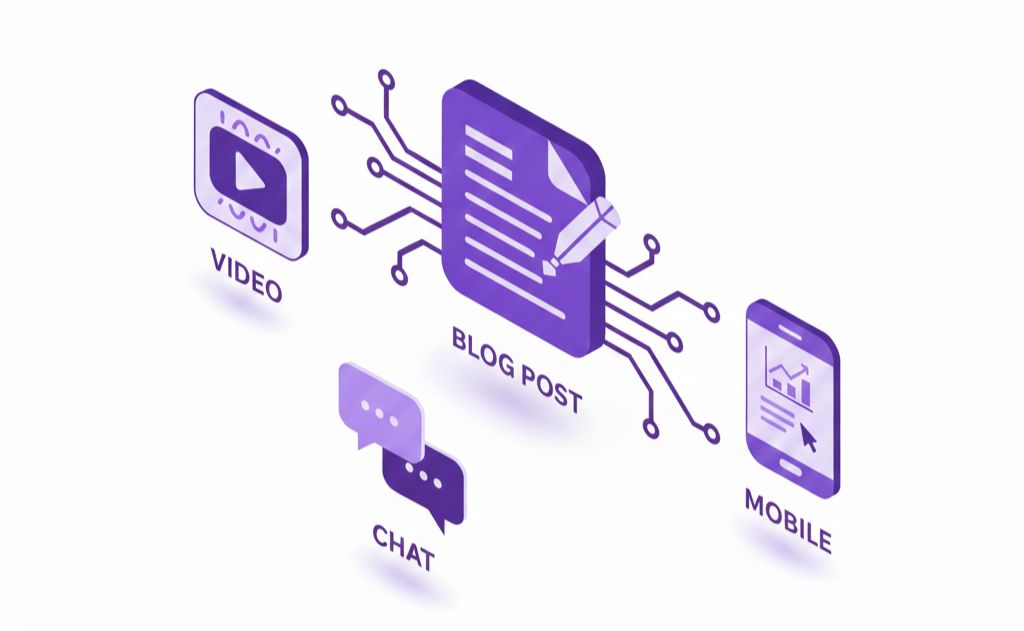
The reality is that channels don’t compete with each other—they complement each other when orchestrated intelligently. The blog functions as a lasting hub of deep content that ranks in search engines. YouTube captures those who learn better visually and functions as the world’s second-largest search engine. Social media distributes, amplifies, and engages the audience daily in their native spaces.
Each channel has its unique strength, and an integrated strategy multiplies impact by making all work in synergy instead of operating in isolation. This is where artificial intelligence becomes your greatest ally. Tools like Niara allow you to create the complete strategy in minutes, not days.
In this guide, we’ll show exactly how to build a unified organic presence that dominates discovery across multiple platforms simultaneously.
Why Single-Channel Strategy Is Insufficient Today
Discovery behavior has changed profoundly. Although older generations still initiate their searches on Google, Millennials and Gen Z frequently start on YouTube, TikTok, or Instagram.
The “how to do X” typed in Google competes directly with “how to do X” searched on YouTube—and if you’re present only in the former, you lose half the audience that prefers to learn visually. Each platform today functions as its own search engine, with completely distinct algorithms, formats, and preferences.
Trust also builds through multiple touchpoints. A person who reads an article on your blog, then sees a video on your YouTube, and later encounters you commenting in a LinkedIn thread develops a level of familiarity that a single visitor will never have.
The basic marketing principle remains valid: 7 or more touchpoints are needed to convert a lead. Multichannel presence multiplies these opportunities, accelerating the journey from awareness to trust and, finally, to conversion.
Blog as Central Hub of Permanent Content
The blog remains the foundation because it’s the only channel you truly control. Social platforms can change rules, limit reach, alter algorithms, or simply disappear; but content published on your own domain is permanent. It becomes a digital asset that accumulates authority over years, appreciates as it earns backlinks, and never disappears because a platform decided to change its business model.
Depth is also the blog’s natural territory. Articles of 2,000 to 5,000 words that explore themes completely simply don’t work on Instagram or TikTok, but are ideal for the search environment.
Google rewards precisely this type of deep content that fully resolves intent. It’s on the blog that you establish true topical authority—something that ephemeral social media content can never equal.

The good news is that producing this depth no longer requires weeks of research and manual writing. With Niara’s content editor and ChatSEO, you can structure complete articles, based on SEO best practices and competitor analysis, in a fraction of the time. AI helps expand topics, suggest paragraphs, and ensure search intent is ideal for ranking.
The permanence of URLs makes the investment continue generating returns indefinitely. An article published three years ago can continue ranking, attracting traffic, and generating conversions daily.
A three-year-old Instagram post is buried in the feed and invisible, and an old tweet is practically nonexistent. Blog content, when well executed, is evergreen: it continues working for you continuously, instead of disappearing in 24 or 48 hours.
YouTube as Visual Search Engine
YouTube processes over 3 billion monthly searches and has consolidated as the world’s second-largest search engine. A significant portion of “how to do X” searches happen there, not on Google.
If you don’t produce content for YouTube, you become invisible to this audience that learns better visually—ignoring YouTube is, in practice, forfeiting a massive discovery channel.
Video optimization follows principles similar to traditional SEO, but adapted to format. Descriptive titles with keywords, complete descriptions with links to resources, well-selected tags, and thumbnails optimized for CTR are fundamental.
Complete transcriptions help the algorithm understand content, while closed captions improve accessibility and are indexable, strengthening relevance and ranking within the platform. And with the help of YouTube to Articles, you can generate text in seconds from videos.
Integration with the blog creates exceptional synergy. A 15-minute “How to Do X” video embedded in an in-depth article about the same theme perfectly serves both learner profiles. The article ranks on Google, the video ranks on YouTube, and together they deliver a superior experience.
YouTube Optimization Checklist for Discovery:
- Title: 60 characters, includes main keyword naturally
- Description: First 150 characters critical (appear truncated), includes secondary keywords and links
- Tags: 10-15 relevant tags, mix of broad and specific
- Thumbnail: High contrast, readable text, human faces increase CTR
- Transcription: Upload SRT or allow reviewed auto-caption
- Cards and End Screens: Direct to related videos or CTAs
- Chapters: Timestamps facilitate navigation and improve retention
- Engagement: Encourage likes, comments, and shares (algorithm weighs engagement)
Pro Tip: Filling this checklist manually for each video is exhausting. In Niara, you find Tasks and prompts in ChatSEO specific to YouTube that generate magnetic titles, keyword-rich descriptions, and even script suggestions in seconds, ensuring your video is born optimized.
Social Media for Distribution and Engagement
Social platforms aren’t primary search engines, but function as indispensable amplifiers. An exceptional blog article loses impact if nobody discovers it. Distributing it via LinkedIn, Twitter, Facebook, or Instagram multiplies initial reach, while organic shares amplify exposure to entire audience networks—generating a viral effect that isolated organic traffic doesn’t achieve with the same speed.
Engagement on social media also creates relationships that the blog, by itself, can’t. Responding to comments, opening conversations, and actively participating transforms content from monologue to dialogue. This continuous interaction generates personal connection and familiarity; when someone needs the service you offer, the prior trust built in social interactions significantly facilitates conversion.
Segmentation by platform maximizes relevance and performance. B2B content thrives on LinkedIn, while lifestyle visuals dominate Instagram. Discussions, debates, and threads find fertile ground on Twitter. Instead of replicating the same content across all channels, adapting format and message to each platform’s culture and expectation maintains the core message but optimizes expression and impact for each context.
Strategic Content Repurposing Cross-Channel
The 2,500-word blog article functions as centerpiece that feeds multiple channels simultaneously. The same piece transforms into a complete script for 10 to 15-minute YouTube video, into a 10-slide carousel on Instagram or LinkedIn highlighting main insights, into an X thread that deepens each point in sequence, into a newsletter that summarizes the essence for your subscribers, and even into an infographic that visually synthesizes the most relevant data.
The same principle applies to webinars or long videos, which can be fragmented into smaller formats without value loss. A 60-minute recording becomes an edited transcription as in-depth article, five short 2-3 minute videos exploring specific topics, ten quotes transformed into independent social media posts, and even 90-second audiograms perfect for Reels, Shorts, or TikTok.
This intelligent atomization multiplies each content piece’s lifespan and dramatically elevates production efficiency. Instead of creating something new for each platform every day, you produce one core piece—an in-depth article, a complete video, or a webinar—and extract from it 20 to 30 derivative assets that supply channels for weeks.
This is exactly where Niara shines. Instead of hiring an entire team just to rewrite content, you can use the tool to do this ‘atomization’ instantly. Just insert your article into ChatSEO and ask it to generate:
- A Twitter/X thread
- Captions for Instagram and LinkedIn
- A short video script for Reels
The tool understands your article’s context and adapts the tone of voice for each channel automatically, according to the Brand Guide specified in your project.
Content Atomization Framework:
CORE ASSET: 2,500-word blog article “Complete Email Marketing Guide”
DERIVATIVES:
- YouTube: 12min video “Email Marketing Explained”
- LinkedIn: 10-slide carousel “10 Email Marketing Strategies”
- Twitter: 8-tweet thread “How to optimize email marketing [THREAD]”
- Instagram: 5 individual posts, each about one strategy
- TikTok/Reels: 3 short videos (60s) about common mistakes
- Newsletter: Executive summary with link to complete article
- Infographic: Visualization of email marketing funnel
- Podcast: 20min episode deepening topic (audio extracted from video)
Cross-Channel Synergies That Multiply Impact
Cross-discovery also expands reach by creating an ecosystem where each channel boosts the other. The YouTube video directs to the in-depth blog article through description links, while the article embeds the video and encourages channel subscription. Thus, who arrives via YouTube finds the blog; who arrives via blog discovers the channel—a continuous circulation that strengthens joint growth instead of competing for attention.
Cross-platform retargeting further reinforces this nurturing. People who read an article and didn’t convert can encounter your brand weeks later on LinkedIn, keeping you on the radar without depending exclusively on paid ads.
Consistent organic presence across multiple channels creates repeated familiarity in different contexts, and this recurrence accelerates natural advancement through the journey—especially for leads that need multiple touchpoints before making decisions.
Social validation also intensifies when engagement signals are distributed across platforms. Voluminous comments on YouTube, expressive shares on LinkedIn, and discussions on X can be cited in blog articles or social posts as explicit proof that content resonates.
Workflow Management for Consistency Without Burnout
The unified editorial calendar also avoids conflicts and ensures balanced coverage between channels. When a dashboard shows, in a single view, everything scheduled for blog, YouTube, LinkedIn, and Instagram, coordination becomes natural. This prevents the same topic from being published across all channels simultaneously—saturating the audience—and also avoids any channel going weeks without content.
Production batching equally maximizes efficiency because it reduces effort lost in constant context switching. Dedicating one morning to recording four YouTube videos, the afternoon to writing three blog articles, and the next day to creating twenty social media posts derived from that content creates continuous execution flow. This organization allows entering flow state in each task type, multiplying output without increasing hours worked.
To avoid the fatigue of alternating between multiple tabs and disconnected tools, Niara centralizes creation. You research, plan, and create content for all channels in a single environment, drastically simplifying your workflow.
And scheduling tools complete the system by automating distribution at scale. Platforms like Buffer, Hootsuite, or Later allow programming weeks of content across multiple social networks in a single session.
In two hours, you guarantee consistent presence throughout the entire month, freeing creative time to focus on high-quality core content—not the repetitive operation of posting daily.
Measuring Multichannel Presence ROI
Multi-touch attribution also recognizes each channel’s real contribution throughout the journey. Last-click models give credit only to the final channel before conversion and, therefore, underestimate important touchpoints like YouTube discovery, social media nurture, or blog deepening.
An attribution model that distributes credit among discovery, nurture, and conversion reveals how channels collaborate—and provides solid basis for proportional investments.
Cost per channel also needs to consider time invested versus results generated. If the blog accounts for 70% of leads using only 40% of editorial effort, ROI is clear and high.
However, if Instagram consumes 30% of team time but generates only 5% of leads, it’s necessary to question the return. Rigorous ROI analysis per channel allows reallocating resources from low performance to channels that truly move results.
Cohort analysis still deepens this understanding, revealing whether multi-touchpoint visitors convert better. When data shows that prospects who interacted with 3 or more channels convert twice as much as single-channel ones, this quantifies multichannel presence value. Even if CAC is slightly higher, the superior LTV of these customers validates the investment and reinforces that journeys rich in multiple touchpoints produce much more robust results.
Avoiding Dispersion That Dilutes Impact
Strategic prioritization also recognizes that being mediocrely present on ten channels is much less effective than operating exceptionally well on just three. Therefore, start with two or three core channels where your audience truly concentrates.
Master these channels before expanding. Often, blog + YouTube + LinkedIn already form sufficient base; only add Instagram or Twitter when initial channels function without requiring heroic effort.
The “minimum viable presence” concept also helps define the minimum sustainable standard per channel. LinkedIn demands three well-constructed weekly posts; Instagram may require daily stories; YouTube works very well with one or two monthly high-quality videos.
The key is realistically defining what your team can maintain consistently. Sporadic presence across multiple channels is worse than total absence, because it signals abandonment and lack of professionalism.
Quarterly evaluation also ensures adjustments based on real performance. If, after six months, Twitter generates irrelevant engagement while LinkedIn thrives, the logical path is redirecting resources. Persisting in a channel that doesn’t work due to attachment to initial investment is a common mistake. Pivoting based on data isn’t failure—it’s strategic intelligence applied to operations.
Specific Cases by Business Model
For B2B SaaS, LinkedIn tends to be the most valuable social channel because it concentrates decision-makers and professionals searching for solutions. Twitter works better as thought leadership platform, while YouTube serves for demos and tutorials that show the product in action.
The blog remains essential for capturing bottom-funnel searches via SEO, while LinkedIn reinforces distribution, authority, and networking. Instagram usually has much less relevance than in B2C brands.
For consumer e-commerce, the scenario changes radically: Instagram and TikTok dominate discovery, especially among young audiences who buy influenced by visual content and quick recommendations. YouTube shines in formats like unboxing and reviews, while the blog captures product searches through SEO.
Pinterest also plays an important role as visual discovery engine in segments like fashion, decoration, and gastronomy. In this context, LinkedIn is much less priority than in B2B.
For professional services—consulting, law, accounting—LinkedIn is critical for credibility, authority, and relationship with corporate prospects. The blog becomes showcase of deep expertise, providing technical ballast. YouTube works well for seminars, specialized analyses, and explanations of complex topics demonstrating mastery. TikTok is hardly priority for a corporate law firm, where inappropriate tone can even harm authority perception.
Prioritization Framework by Sector:
| Sector | Priority Channels | Justification |
|---|---|---|
| B2B SaaS | Blog, YouTube, LinkedIn | Long cycle, decision-makers on LinkedIn, visual demos critical |
| E-commerce | Instagram, YouTube, Blog, Pinterest | Visual-driven, discovery via social, SEO for product terms |
| Professional services | Blog, LinkedIn, YouTube | Credibility via expertise, B2B networking |
| Online education | YouTube, Blog, Instagram | Visual educational content, SEO for topics, community on social |
| Health/Wellness | Instagram, YouTube, Blog | Visual transformation stories, YMYL SEO, community engagement |
Conclusion
Multichannel strategy isn’t a luxury for large companies—it’s a modern necessity. The days when an SEO-optimized blog alone dominated discovery are behind us. Today, the search journey happens on YouTube, Instagram, TikTok, LinkedIn, and Google.
Strategic integration is what separates effective presence from wasted effort. When the blog functions as hub, YouTube as visual channel, and social media as amplifiers, you create synergy and trust.
However, we know theory is beautiful, but manual execution can be brutal. Don’t let lack of time prevent your company from dominating all search channels.
Niara unites SEO, content creation, and artificial intelligence so you produce more, better, and faster. How about transforming your next blog article into a complete social media campaign in minutes?
Create your free Niara account and start scaling your digital presence right now.
