
You’ve spent years obsessing over your brand’s pulse. You’ve tuned its voice until it’s the perfect mix of sharp wit and deep expertise—a voice that feels less like a corporate broadcast and more like a conversation over a stiff drink.
Then, you hit “generate” on a standard AI tool.
In an instant, that vibrant, punchy identity is sterilized. It’s flattened into a sea of beige prose. Sure, the grammar is flawless, but the soul is gone. It’s the marketing equivalent of a mannequin trying to sell you a dream—technically present, but entirely hollow.
This is the modern marketer’s quiet panic: the demand to produce more content while watching your brand’s unique DNA evaporate into a cloud of generic, algorithmic mush.
At Niara, we believe efficiency shouldn’t feel like a lobotomy. You shouldn’t have to trade your “spark” for a higher output. Maintaining a consistent brand voice in the AI era isn’t about chasing the “perfect prompt”—it’s about building a digital nervous system that recognizes your brand’s nuances as instinctively as you do.
Here is how to automate your content workflow without diluting the human touch that turned your audience into fans in the first place.
Read more: Your Brand, Your Voice: How Brand Guidelines Revolutionize Content Creation at Scale
The Brand Voice Architecture: Foundation for AI-Generated Content
Before you even open an AI tool, you need a blueprint. Brand voice architecture is the structural framework that tells the AI not just what to say, but how to say it. Without this foundation, your content will feel disjointed—one article might sound like a technical manual while the next sounds like a Gen Z social post.
According to research published in the Journal of Business Research, this lack of consistency is more than just a stylistic oversight; it is a strategic liability. The study, “Unveiling the power of brand voice in AI-driven content marketing“, highlights that a well-defined brand voice serves as the essential bridge between AI efficiency and consumer trust.
The findings suggest that when AI-generated content lacks a distinct, human-like brand personality, it fails to resonate with audiences, potentially diminishing brand equity. By establishing a robust brand voice architecture, companies can ensure that AI outputs remain aligned with their core identity, transforming generic, automated text into a powerful tool for building long-term customer engagement and authenticity in a crowded digital marketplace.
Step 1: Define Your Brand DNA for AI
To guide an AI, you must move beyond vague descriptors. Instead of saying “we are professional,” define the nuances. We recommend choosing 3 to 5 core traits and providing “This, Not That” examples.
- Authoritative but Accessible: You are the expert, but you don’t use technical jargon to confuse the reader. Example: “We use simple analogies to explain complex SEO concepts like Crawl Budget.”
- Empathetic and Partner-oriented: You understand the user’s pain. Use “we” and “us.” Example: “We know how frustrating it is to spend hours on a spreadsheet, which is why we built Search Analytics.”
- Provocative but Respectful: You challenge the status quo but remain professional. Example: “Questioning traditional SEO myths with data-backed insights.”
Mapping these traits to your audience ensures the AI understands the emotional resonance required for each piece of content.
Pro Tip: Create a “Lexicon of Choice.” List your brand’s power words and a list of “Forbidden Words.” AI loves terms like “delve,” “leverage,” and “comprehensive”—if these aren’t part of your DNA, tell the AI to ban them.
Step 2: Train the Engine with Golden Samples
An AI is only as good as the data it’s fed. To build a proprietary voice engine, you need to assemble a “Golden Sample” dataset. This includes your best-performing blog posts, email newsletters, and social media captions.
Using a technique called Few-Shot Prompting, you you show AI the rhythm.
- The Rhythm: Let the AI see your sentence structures and how you transition between ideas.
- The Logic: Explain the “why.” Tell the AI, “We use short sentences here to create urgency,” or “We use bullet points to make complex data digestible.”
Step 3: Create a voice matrix by channel and context
Your voice shoul be a spectrum. A “Voice Matrix” defines how your core traits adapt to different platforms.
- Web/Blog: Informative, long-form, optimized for search but written for humans.
- Email: Personal, direct, and action-oriented.
- Social Media: Punchy, engaging, and conversational.
- Ads: High-urgency, benefit-driven, and concise.
By defining these variations, you ensure that your brand remains recognizable even as the tone shifts to suit the context of the user’s journey—from awareness to conversion.
Step 4: Build the brand voice QA checklist
Before any AI-generated content goes live, it should pass a quick checklist:
- Tone: Does this sound like our defined personality traits?
- Terminology: Does it use our “Lexicon of Choice”? Does it avoid “Forbidden Words”?
- Channel Suitability: Is the length and formatting appropriate for the platform?
- Localization: Does it respect regional idioms if targeting a specific market?
- Compliance: Does it meet our internal ethical and legal standards?
Step 5: Develop localization and cultural nuance
If your brand operates in multiple regions, your voice must be “glocal”—globally consistent but locally relevant. AI is excellent at translation, but it often misses cultural nuances. Use AI to create the base content, but always have a local expert review it to ensure the “spirit” of the brand voice translates correctly into the local culture.
Step 6: Human-in-the-Loop: The Essential Final Step
At Niara, we always say: AI is the assistant, you are the director. Human curation is irreplaceable for:
- Emotional Nuance: AI can mimic empathy, but it can’t feel it.
- Cultural Sensitivity: Avoiding “tone-deaf” content in sensitive contexts.
- Fact-Checking: Ensuring that the “hallucinations” common in LLMs don’t make it into your published work.
Always perform a “Vibe Check.” Read the content out loud. If it sounds like a robot wrote it, it needs another human pass.
Crafting the Perfect Brand Voice Prompt: A Fashion Brand Example
To ensure your AI consistently hits the mark, your prompt needs to act as a comprehensive mini-brief. By combining your core traits, channel context, and “Golden Sample” data, you can eliminate generic outputs. Here is an example of a high-performing prompt for a fashion brand:
The Prompt:
Act as the Lead Copywriter for Lumina Style. Our brand personality is Chic but Conscious.
Core Traits:
- Sophisticated but Simple: Use elegant vocabulary but keep sentence structures short.
- Eco-Centric: Focus on the ‘why’ behind the fabric. Use terms like ‘low-impact dyes’ and ‘textile longevity.’
- Avoid: Do not use ‘fast-fashion’ buzzwords like ‘must-have,’ ‘drop,’ or ‘cheap.’
Task: Write a product description for our new sustainable summer collection.
Channel: Web/Product Page.
Training Data/Style Reference: ‘We don’t believe in seasons; we believe in staples. Our organic cotton is harvested with the future in mind, creating a silhouette that feels as good as it looks.’
Output Requirement: Write 3 sentences focusing on the breathability and ethical sourcing of our new Linen Wrap Dress.
By providing this level of detail, the AI no longer guesses your tone, but replicates it. This ensures that every generation aligns with your brand’s emotional resonance and SEO goals.
AI Workflows to Preserve Brand Voice
The biggest bottleneck in AI content production is prompt fatigue. Copying and pasting your brand guidelines into every new chat session is a waste of time and a recipe for inconsistency.
This operational friction is exactly why we built Niara’s Brand Voice Guide. You configure your persona, tone, and rules once in your project settings. From that moment on, Niara applies this context automatically across all tools—ChatSEO, Content Workflow, Tasks, Bulk Content and more.
You don’t need to remind the AI who you are every time, because it already knows. This centralizes your identity and ensures that every output is 100% aligned with your DNA, saving you hours of manual prompting and ensuring your voice remains recognizable across every channel, from Web/Blogs to Ads.
Setting Up Your Brand Voice Guide in Niara
Now that you understand the architecture, it’s time to automate it. Instead of pasting your guidelines into every new prompt, Niara allows you to bake your DNA directly into the platform. Here is how to set it up in seconds:
- Access Project Settings: Look for the gear icon (Settings) in the left-hand sidebar of your Niara dashboard.
- Define Your Identity: In the “Brand Voice Guide” section, input your core instructions. This is where you paste your tone of voice, mission, vision, values, and those crucial Do’s and Don’ts.
- The “Always-On” Advantage: Once saved, Niara will automatically apply this context to every tool you use, ensuring absolute consistency without extra effort.
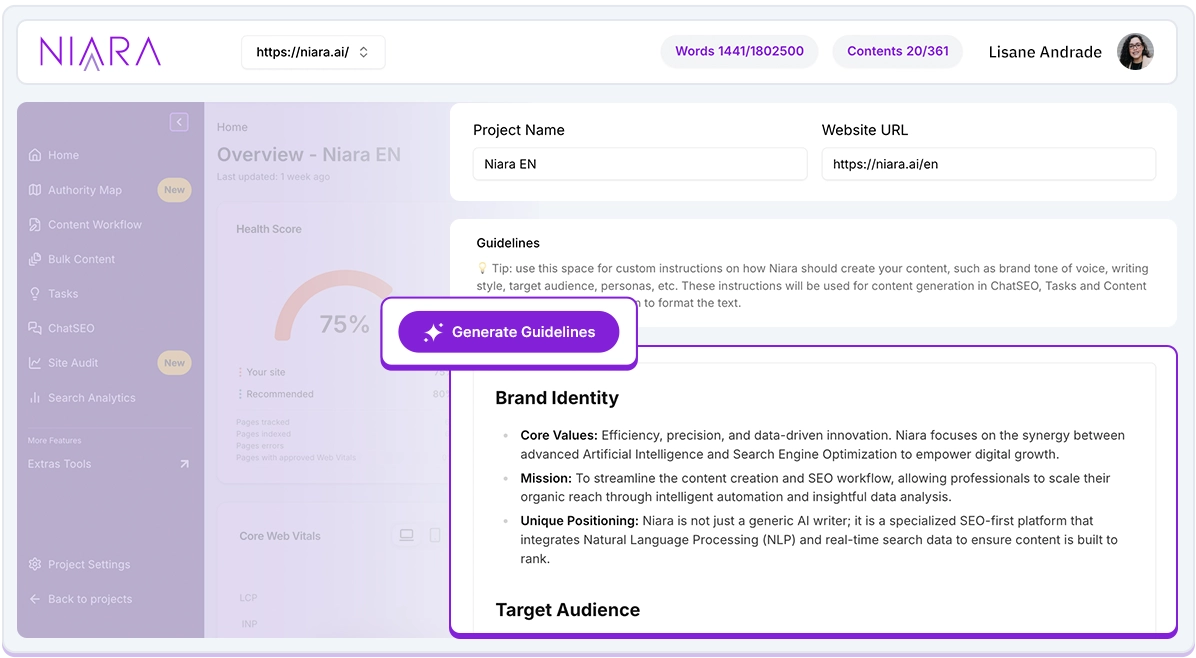
If you’re starting from scratch or want to see how the world perceives your brand, Niara can generate your guide automatically.
By simply providing your website URL, Niara will perform a comprehensive crawl of your digital presence. It analyzes your existing content, messaging patterns, and public information to distill your unique brand essence into a structured guide. In seconds, you’ll have a professional foundation ready to power your entire SEO and content strategy.
You just need to check the information to ensure everything is aligned with your brand.
Continuous Improvement and Updates to Guidelines
Your brand is a living entity. Set a quarterly review to update your brand guidelines. Analyze which AI-generated pieces performed best and add them to your “Golden Samples.” This creates a feedback loop of continuous improvement.
AI Governance and Ethics
Responsible use of AI is non-negotiable. Ensure your team follows a framework for privacy and data security. At Niara, we prioritize this with our Zero Data Retention (ZDR) and annual Pentests. Your proprietary brand data should never be used to train public models.
Evaluating Your AI Generated Brand Voice Effectiveness
How do you know if your brand voice is actually working? You need both quantitative and qualitative metrics.
1. Qualitative Feedback and QA Rating
Implement a rating scale (1-5) for every piece of content produced. Ask your stakeholders: “On a scale of 1 to 5, how much does this sound like our brand?”.
Over time, these ratings will help you calibrate your tone of voice and improve the AI’s accuracy. Integrating this structured feedback into your workflow is a core component of effective AI data governance, as it ensures that the data used to refine your models remains high-quality and brand-aligned.
Example in practice: Your AI generates a blog post about a new product launch. Your Head of Marketing reviews the draft and gives it a 3 out of 5. Their feedback indicates that while the technical details are correct, the tone is “too clinical” and lacks the “energetic and bold” personality defined in your brand identity.
By documenting this specific gap, you can refine the instructions in your brand guideline—perhaps by adding a list of “power words” to use or “corporate jargon” to avoid. This creates a feedback loop that trains the AI to hit a 5 out of 5 in future iterations, maintaining consistency across all channels.
2. Brand Voice Consistency Across Channels
Maintaining a unified brand voice is a critical component of building consumer trust, since content is distributed across dozens of platforms.
To manage this, marketers use a Cross-Channel Consistency Dashboard. This tool allows you to audit performance metrics side-by-side. The goal is to determine if your AI-generated content is resonating as effectively as your human-authored pieces. Specifically, you should monitor conversion rates: if there is a significant discrepancy between AI and human outputs, it is a clear indicator that your AI’s “personality” is disconnected from your core brand identity.
This level of alignment is particularly vital when executing a multimodal SEO strategy. Since multimodal SEO involves optimizing content across various formats—such as video, images, and voice search—your brand voice serves as the “anchor” that keeps your identity recognizable, regardless of how or where the user discovers your content.
Example in practice: An upscale home decor brand, “Aura Interiors,” uses AI to generate hundreds of product descriptions and SEO-driven blog posts about “Modern Minimalist Styling.”
To ensure their AI efficiency doesn’t diminish brand equity, the team monitors Average Engagement Time on their product pages.
If AI-generated descriptions show high traffic but significantly lower dwell time compared to human-authored ones, it probably indicates a “resonance gap.” This lack of a distinct, human-like personality fails to serve as the essential bridge to consumer trust, causing users to bounce.
To close this gap, AI needs to be treated not as a mere generator, but as a Proprietary Voice Engine. Instead of relying on standard prompts, the model is fed a “Brand Lexicon” — a curated library of sensory-rich language and rhythmic structures exclusive to Aura. This approach ensures the output captures the “unspoken elegance” of the brand’s aesthetic, moving away from generic adjectives toward evocative storytelling.
The final layer consists of a “Curatorial Polish”: a high-level human intervention where editors go beyond proofreading to inject contextual empathy.
Consequently, content shifts from a functional list of attributes to a sensory invitation, ensuring that every digital touchpoint resonates with the depth of a private consultation with a world-class interior designer.
Don’t Just Generate, Direct
Scaling your content shouldn’t mean losing the very thing that made your brand successful: its personality. By building a solid voice architecture and treating AI as a highly capable assistant rather than a replacement for your judgment, you ensure that every article, ad, and email still sounds like you.
In the end, AI is a tool of efficiency, but your brand’s DNA is your competitive moat. Keep your Golden Samples close, your “This, Not That” guidelines clear, and always give the final output a human vibe check. When you stop fighting the tool and start directing it, you don’t just scale—you lead.
Tired of fighting with generic prompts? See how Niara’s Brand Voice Guide automates your identity so you can focus on the strategy.
