
Stop chasing high-volume keywords that don’t convert. In 2026, Google ranks expertise — that’s when topical authority comes in. Most SEO strategies fail because they publish disconnected content just to capture traffic.
To survive the shift to AI-driven search, you need information gain. Think about it: when you search for an answer, you don’t want to read the same recycled summary on five different blogs. AI engines feel the exact same way.
Instead of trying to trick a keyword tool, focus on establishing complete ownership of your topic across every page you publish. When your content works together as a cohesive network, you stop relying on one-off traffic spikes and build sustainable authority search engines can’t ignore.
Want to see how to make that shift step-by-step? Let’s dive in!
What is topical authority SEO?
Topical authority is the measure of relevance and credibility a website holds over a specific subject (depth and breadth of coverage) in the eyes of search engines. It’s the difference between having a popular site and being the definitive reference in a specific niche.
To understand this in practice, imagine two websites in the health and fitness space.
Site A is a massive national health portal that covers everything from mental health to yoga and general nutrition. While it has a few articles on “protein powder”, its coverage is broad and surface-level.
Site B, on the other hand, is a dedicated hub focused exclusively on high-performance protein supplementation. Its content explores the differences between whey isolate and hydrolyzed casein, the impact of leucine thresholds on muscle protein synthesis, and detailed reviews of cold-filtration manufacturing processes.
Even if Site A is more popular in general, Google will likely favor Site B for specific, high-intent queries about protein science. This happens because Site B’s entire architecture proves it understands the subject better than a generalist ever could.
Achieving this level of authority requires satisfying three strict dimensions:
- Topic breadth: ensures you cover every logical subtopic within your niche.
- Topic depth: ensuring each page provides expert-level insights rather than generic summaries.
- Semantic interlinking: acts as the connective tissue showing how these concepts relate to one another.
Topical authority in the age of LLMs
In the age of LLMs like ChatGPT and Gemini, topical authority shifts from satisfying a search crawler to becoming a trusted node in an AI’s knowledge graph. When AI assistants look for sources to synthesize an answer, they are looking for a domain that provides a reliable, interconnected ecosystem of facts.
To stay relevant, your content must move beyond basic definitions and provide unique insights that AI models can’t find in the commodity content of the top 10 results.
Recent studies, such as “GEO: Generative Engine Optimization,” show that visibility in generative engines tends to improve when content includes verifiable evidence, such as citations, statistics, and reliable sources, rather than relying solely on keyword repetition. The study also indicates that these practices can increase a domain’s visibility in AI responses by up to 40% within the scenario tested by researchers.
Why different LLMs associate brands differently?
Large Language Models (LLMs) connect brands to topics through a process called co-occurrence and semantic vector alignment. When a model processes millions of pages, it tracks how frequently a brand name appears alongside specific concepts.
Over time, the brand becomes a distinct entity in the model’s internal map. For instance, if a brand is constantly mentioned near “sustainable supply chain”, the LLM’s neural network develops high weights connecting that entity to that concept. When a user asks for sustainable options, the model recommends that brand because it is the “statistically natural” answer.
However, if you ask ChatGPT, Claude, Perplexity, and Gemini for recommendations, they will rarely agree. This divergence happens because each model interprets authority through a different lens. While one might prioritize community sentiment from Reddit, another might rely on Google’s live search index or academic datasets.
The following table breaks down the primary reasons why AI assistants diverge in their brand associations:
| Factor | Why recommendations vary | Impact on your brand |
|---|---|---|
| Training datasets | Models are fed different “diets”. One may favor Reddit and forums, while another prioritizes news. | A brand popular on social media will shine in “community-heavy” models but may vanish in formal ones. |
| RAG and search indexes | Gemini uses Google; ChatGPT uses Bing; Perplexity uses a hybrid. Each index weights web pages differently. | Your visibility depends on which search engine the AI uses to read the live web in real-time. |
| Entity disambiguation | Models struggle with common nouns. “Bloom” or “Apex” are harder to identify than unique, distinct brand names. | Clear schema markup and consistent naming are required to help all models recognize you as a single, unique entity. |
| System guardrails | Invisible instructions (system prompts) tell the AI to be neutral, diverse, or highly specific. | Some AI models are programmed to avoid direct endorsements, while others are optimized to pick a winner. |
| Probabilistic sampling | LLMs are non-deterministic. They sample different paths even when asked the same question twice. | A brand might be the top choice in 70% of runs but drop out in the other 30% due to architectural randomness. |
How to build topical authority for LLMs
Building authority for AI requires a shift in how you structure information. To ensure your expertise is ready for AI synthesis, follow this strategic framework:
| Strategy pillar | Action for AI visibility |
|---|---|
| Topic clusters | Build a central pillar supported by dozens of micro-content pieces to answer every logical follow-up question. Use internal links as neural pathways to show AI exactly how your ideas connect. |
| BLUF structure | Start every section with a clear, 30-60 word direct answer to provide citation-ready blocks for AI. |
| Primary entities | Prioritize proprietary data, specific statistics, and proper nouns to anchor your content in the AI’s knowledge graph. |
| Technical signaling | Use advanced schema markup to guide AI crawlers directly to your authoritative nodes. |
1. Topic-based keyword research: from keywords to entities
Forget linear keyword lists. Think in entities. While keywords are isolated terms, entities are the concepts, people, and objects that search engines and LLMs use to map the world.
For example, if you write about “skincare”, AI expects to see related entities like “Vitamin C”, “Dermatologists”, and “Melanin” to verify your expertise.
AI measures how logically your ideas fit together. If your “Skincare” page doesn’t mention “Dermatology”, the coherence score drops — that’s what we call semantic coherence.
Niara offers a dual-layer approach to help you master these entities. At the macro level, the Authority Map analyzes your entire niche to generate a complete ecosystem of subtopics and related entities, mapping out exactly where your authority needs to be built.
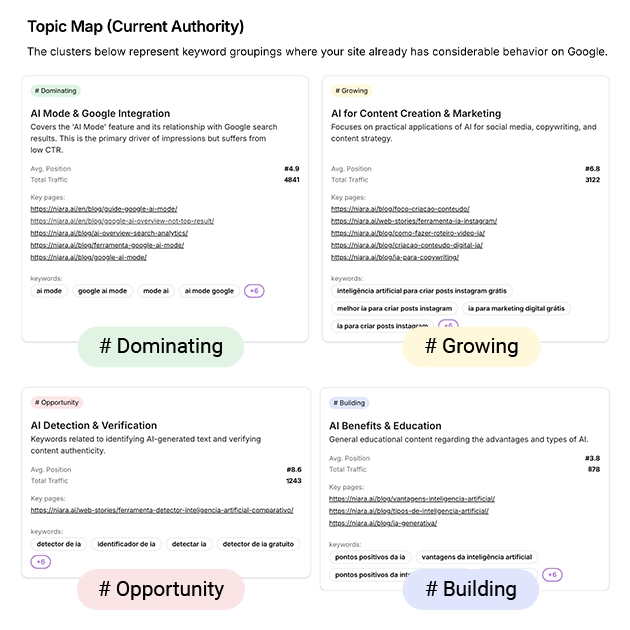
At the micro level, the Semantic Entity Mapper works specifically on each page or article, identifying entity gaps compared to the top players in the SERP.
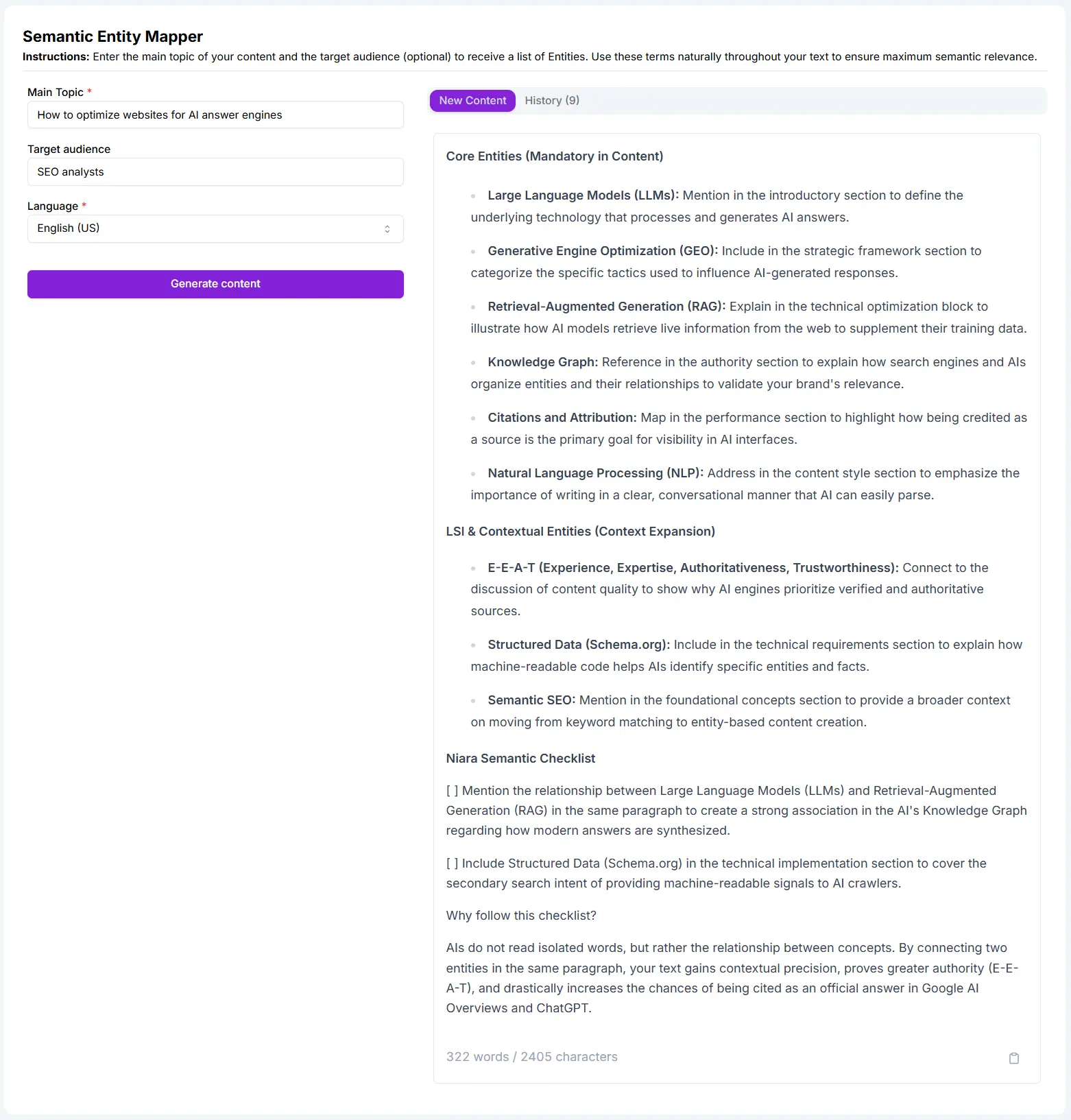
The tool points out exactly which terms and concepts need to be cited and how to do so, ensuring that AI assistants understand your full context and transforming your content into a structured, highly reliable data source.
2. Clusters and query fan-out
A topic cluster organizes your content around a pillar page (the comprehensive guide also known as cornerstone content, thosedeep, comprehensive pillar page) connected to several clusters (supporting articles). This architecture is the antidote to query fan-out — the process where AI breaks a broad prompt into sub-queries. By covering every branch of the topic and its search intent, you ensure the AI doesn’t have to leave your site to find the full answer.
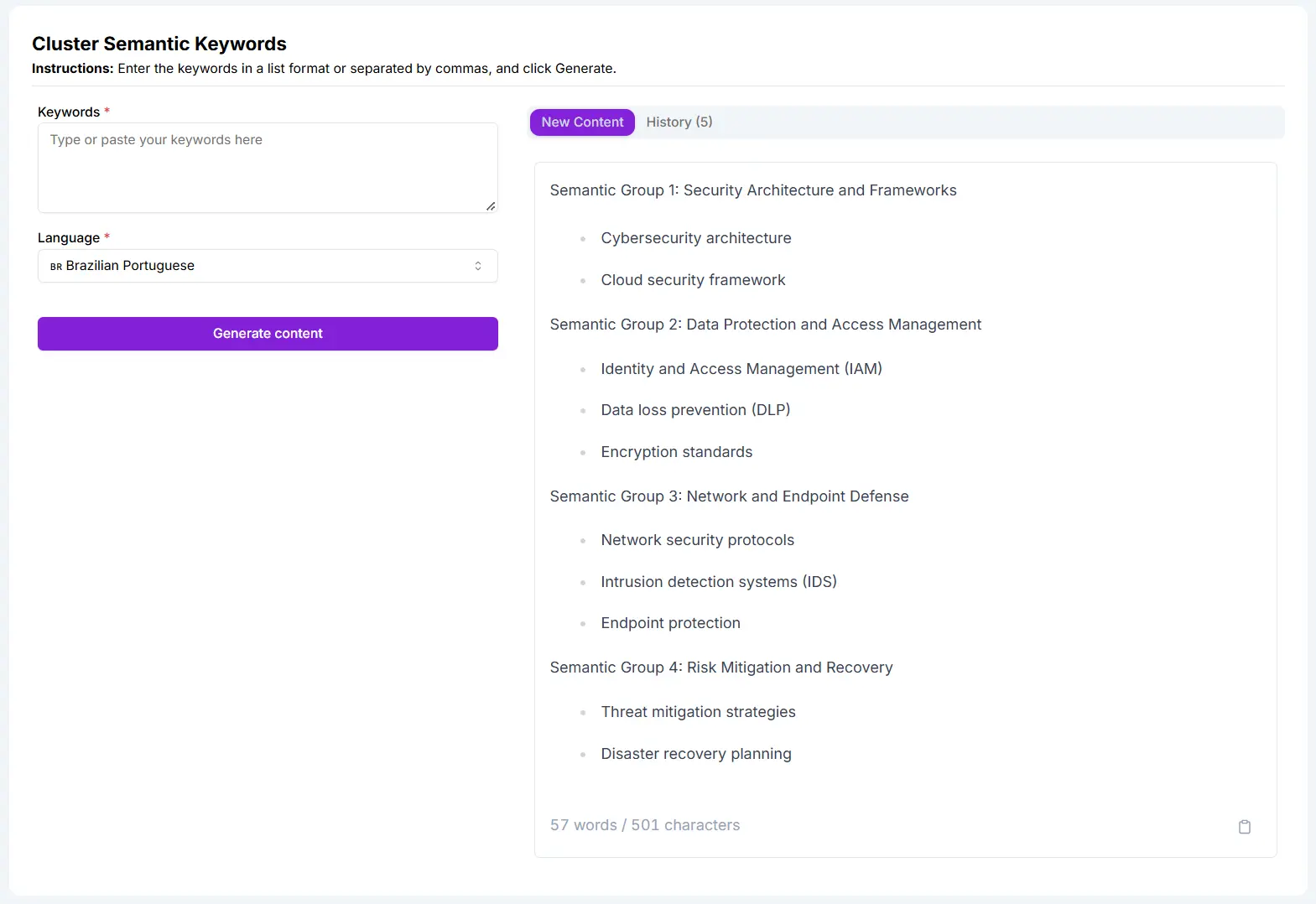
Niara streamlines the complex process of ecosystem architecture from the ground up. Through AI Agents and ChatSEO, you can group thousands of raw keywords into logical semantic clusters in seconds, eliminating the need for days of manual spreadsheet analysis.
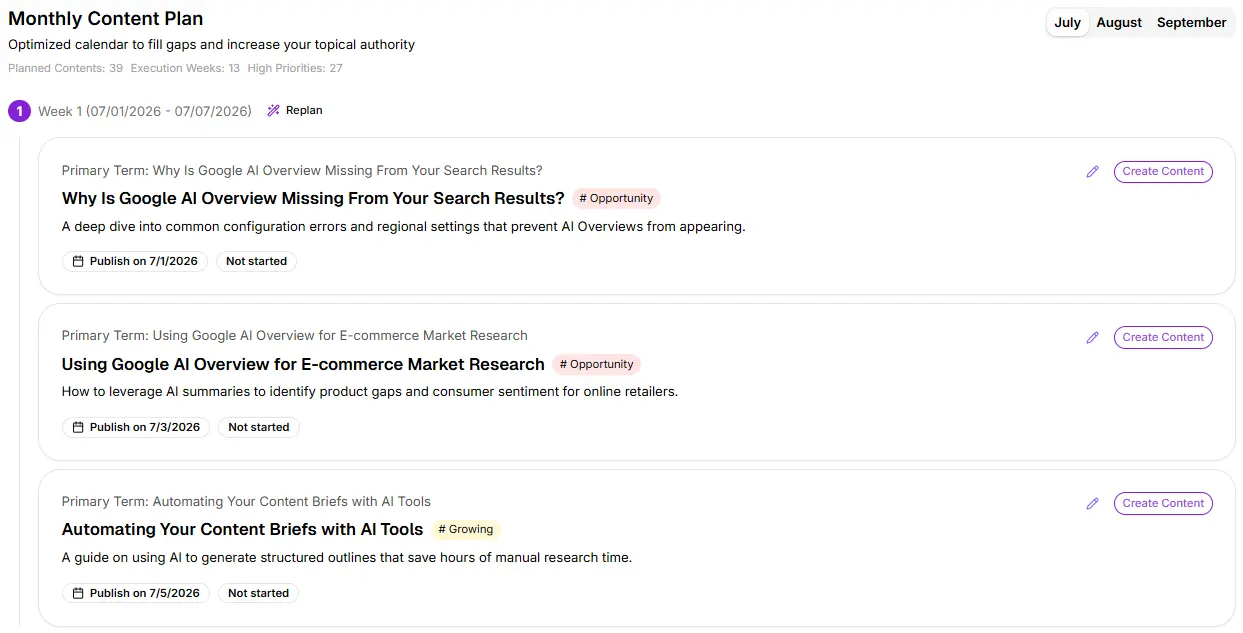
To ensure long-term dominance, the Authority Map goes a step further by generating a complete 3-month editorial calendar. This ensures every pillar page you create is backed by the necessary supporting cluster content, building a robust knowledge web that AI models recognize as the definitive source for your niche.
3. BLUF and information gain
To be cited by an AI, your content strategy must go beyond commodity information. You need information gain. You can use BLUF (Bottom Line Up Front) method: place the direct answer at the very beginning of your sections. This provides AI models with citation-ready blocks of text that are easy to synthesize into a final response.
Niara ensures your content is both unique and machine-readable. Our Content Workflow tool analyzes the current SERP to identify specific content gaps — the topics and questions your competitors have ignored — allowing you to provide the high-value information that AI craves.
To maximize your chances of appearing in AI Overviews, the Google AI Mode Insights tool provides a detailed diagnostic based on official documentation. it tells you exactly how to optimize your headers and summaries to meet the citation-readiness standards of modern LLMs, ensuring your expertise doesn’t just sit on the page but actually powers the AI’s answer.
4. Technical signaling
Authority is also related to how your information is architected. To be recognized as a primary entity, you must establish relational connectivity: a clear, logical map showing how your concepts relate to one another.
Niara provides the tools to make these invisible connections visible to AI crawlers. Our Structured Data Generator automates the creation of JSON-LD Schema (such as FAQ, Article, and Organization tags), explicitly defining your entities and their relationships in a language LLMs speak natively.
Technical schema turns your site into a cohesive authority, ensuring AI engines can easily verify your data and prioritize it in their answers.
5. Entity linking
Authority in the age of LLMs is defined by how your information is architected. To be recognized as a primary entity, you must establish relational connectivity through a deliberate synergy between topic vlusters and internal linking.
Topic clusters provide the semantic framework, while internal links serve as the neural pathways that bind them together. This strategic mapping guides AI models to understand the precise hierarchy between your pillar pages and supporting clusters, to explicity relationships.
This transforms flat text into a multi-dimensional knowledge graph that generative engines can easily navigate, verify, and trust as a definitive source.
6. Monthly audit
Niara replaces manual spreadsheet digging with Conversational Search Analytics via ChatSEO.
Instead of spending hours in Search Console, you can simply ask the chat: “Which pages lost the most traffic this month?” or “Show me pages ranking in position 4-10 with high impressions“. This direct interaction with your data allows you to identify structural issues and growth opportunities in seconds.
With these insights, you gain surgical precision in your optimizations, stopping the guesswork and focusing your efforts exactly where the ROI is highest for your domain.
Consistent monitoring ensures your strategy evolves as fast as the algorithms do.
How to measure the site’s topical authority now?
Measuring topical authority is more complex than looking at total traffic. Now, it is necessary to analyze the depth of coverage of a theme, the semantic interconnection between contents, and how search engines perceive your domain as a reliable reference source and expert in a specific niche.
To understand if your SEO strategy is truly building this authority, you should consider the following factors:
- Entity coverage in the index: how many keywords of a certain cluster do you dominate?
- Crawl behavior: does Googlebot visit your niche pages frequently?
- Organic traffic by topic: is growth consistent across all pages in the cluster?
- Real conversions: is authority traffic generating leads or sales?
Avoid vanity metrics. Ranking first for an isolated keyword is good, but dominating 80% of the terms in a topic is what brings security to the business.
How to identify if the site is already an authority on what it says
Do a quick diagnosis with this checklist:
- Share of Voice by topic: monitor the growth in the number of keywords. List and group the main searches and analyze how many of them you appear in the top 3 and/or generative results.
- High-quality content: is your content frequently cited or shared organically? This is the ultimate sign of authority.
- Internal link profile: do your most important pages receive the majority of internal links? Use a hub-and-spoke structure where everything points to what is essential.
How long does it take to build topical authority?
Building topic authority is not a quick fix like changing a meta tag. Since you are moving from ranking for keywords to becoming a trusted entity in an AI’s knowledge graph, the timeline depends on your starting point and the competitive density of your niche.
Some factors can accelerate (or delay) your progress, like:
- Niche competition: building authority in health (YMYL) takes significantly longer due to stricter E-E-A-T requirements than building it in a hobbyist niche like “mechanical keyboards”. It’s the difference between being just another blog and being the definitive source people actually trust.
- Existing domain strength: if you already have a high-authority domain, you can build a new topical cluster in weeks. For a brand-new site, expect the full 6–12 month cycle.
- Content frequency: the faster you publish a complete cluster, the sooner the AI can connect the dots of your expertise. However, this doesn’t mean publishing more for the sake of volume. Remember: authority is built through precision, not noise. It is better to publish 10 high-quality, interconnected articles than 50 disconnected ones.
The key is to constantly analyze what is performing, double down on what works, and have the courage to optimize or even delete content that isn’t providing value. A clean, highly relevant knowledge graph is always more powerful than a bloated one.
Your must-read: Publish and rank myth: why scale without curation fails in the generative search era
Your ready-to-go action plan (and timeline) to achieve topic authority
While the speed of results varies based on niche competition and your existing domain strength, most brands follow a predictable three-stage evolution as they transition from being a source of information to a source of truth.
Phase one (0–3 months)
During this stage, you are focused on content velocity and semantic architecture.
- What happens: you publish your pillar pages and the first 10–20 cluster articles. You implement advanced schema markup and clean up your internal linking.
- Results: you likely won’t see a massive traffic spike yet, but you will notice your pages being indexed faster. Search engines are beginning to map your domain to specific entities.
Phase two (3–6 months)
This is where semantic coherence starts to pay off.
- What happens: as you fill the content gaps identified by tools like Niara’s Authority Map, Google and LLMs start to see your site as a comprehensive resource rather than a collection of isolated posts.
- Results: you’ll start ranking for long-tail cluster keywords. Your pillar page will begin to climb into the top 20 or 30 positions for broader, high-volume terms.
Phase three (6–12+ months)
At this stage, you have achieved topical dominance.
- What happens: you have covered the topic so thoroughly (addressing the query fan-out) that search engines trust you by default.
- Results: new content on this topic starts ranking faster. You begin to see your brand cited in AI Overviews and synthesized answers, as you are now a verified node in the knowledge graph.
It is critical to remember that topical authority is not a destination, but a continuous cycle. Technical SEO and content creation must remain active throughout every phase.
You cannot set and forget your architecture. You must audit, monitor, and refine your content continuously.
As search engines update their understanding and competitors attempt to fill your gaps, your ability to maintain dominance depends on your commitment to ongoing technical health and strategic updates.
Authority is built through momentum, but it is sustained through constant optimization.
Building for what comes next
The digital marketing and SEO landscape is no longer the same as it was a few years ago, and the speed of change only tends to increase.
More than just automating tasks, the true power of artificial intelligence lies in freeing up your time for what truly matters: strategic vision and human creativity. Building for the future means creating solid foundations today, using tools that allow for scale, technical precision, and, above all, a real connection with your audience’s search intent.
The future of SEO belongs to those who know how to unite data and intuition. Don’t wait for the next algorithm update to adapt; stay one step ahead with the right tools by your side.
Want to transform your content production and optimize your SEO intelligently?
Try Niara’s features for free and discover how to boost your results, from planning to execution.
