

ChatGPT Ads: Is SEO the New Quality Score for AI-Driven Ads?
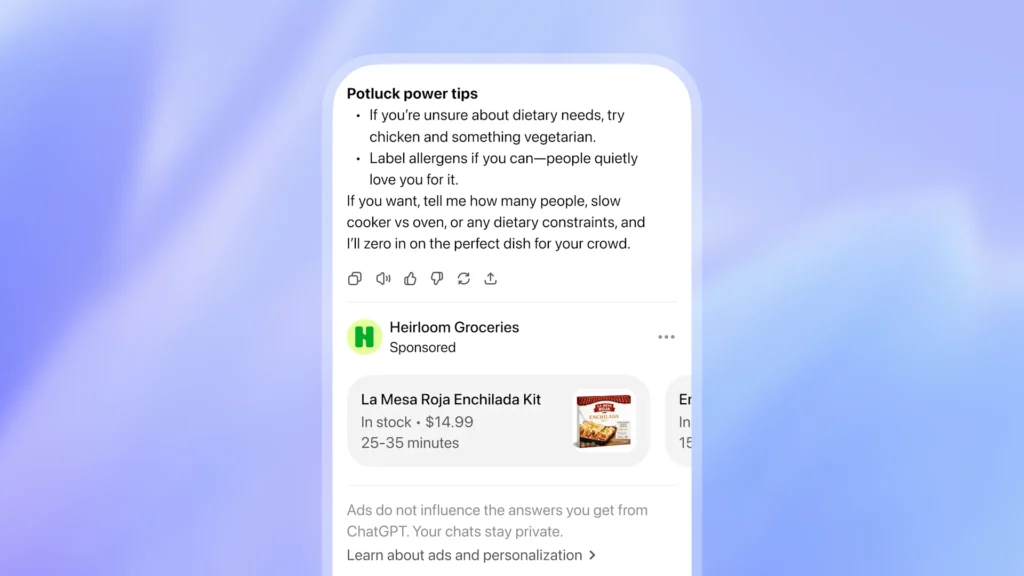
In a recent analysis regarding the future of search (you can check our deep dive here), I discussed a critical shift that most of the market hasn’t grasped yet: just as SEO has always influenced Google Ads success (ensuring a better Quality Score and lower CPC), SEO will also be the primary engine behind ChatGPT Ads.
For those working with Google Ads, the math has always been clear: a fast, semantic, and relevant Landing Page boosts your ad score, and Google rewards you by charging less per click. SEO was already a factor in financial efficiency.
But what about the Generative AI era?
The truth is, within the ChatGPT ecosystem—and with OpenAI’s official confirmation regarding ads—the barrier between organic and paid traffic isn’t just shrinking; it’s ceasing to exist. Analyzing market trends and new features confirms my thesis: if your SEO isn’t up to par, Artificial Intelligence won’t know how to sell your product, even if you pay for it.
Here is why SEO is the new (and more rigorous) “Quality Score” for AI advertising.
1. ChatGPT is a Task Environment, Not a Feed
The first major paradigm shift is behavioral.
- When we open Instagram, we passively scroll through a feed.
- When we open Google, we perform a quick search.
- When we open ChatGPT, we enter a task environment.
The user is there to solve a complex problem, make a difficult decision, or process data. Tolerance for interruption is zero. If your ad is just an intrusive banner, it will be ignored.
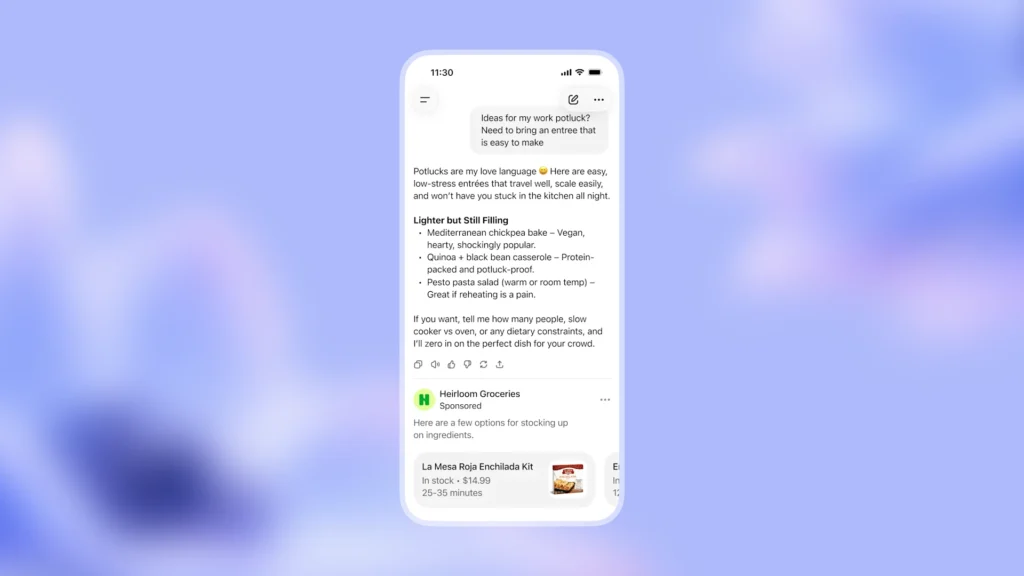
To work, the ad must be useful. It must act as a contextualized suggestion that helps complete the task. According to ChatGPT, ads should connect people to new products and services that fit naturally into what they are trying to do.
And who creates useful, structured content focused on solving pain points (like guides, calculators, and direct answers)? Exactly: the SEO team.
2. Prompt Intelligence and the End of the Isolated Keyword
In Google Ads, you open the Keyword Planner. In ChatGPT Ads, your market research begins with Prompt Intelligence.
AI doesn’t operate with exact, “cold” keywords (e.g., “best CRM”). It operates with rich, variable, and contextualized intents. The user asks: “What is the best CRM for a B2B SaaS startup with fewer than 50 employees that integrates with Slack?”
If on Google, we type “running shoes.” On ChatGPT, we converse: “I’m training for my first marathon, I overpronate, and my knees usually hurt after 10km. Which shoes do you recommend?”
See the difference? Here we don’t just have a keyword; we have rich context.
These ramifications of semantic intentions are what we call Fan-out Queries.
For the AI to choose your ad for this answer, it needs to have “read” and “understood” your site beforehand. If your organic content doesn’t semantically explain that your software serves “B2B SaaS” and “integrates with Slack,” or that your shoe is ideal for “overpronation” and “knee pain,” the AI won’t make the connection. AI Ad strategy is born from the organic data that SEO mines into LLMs.
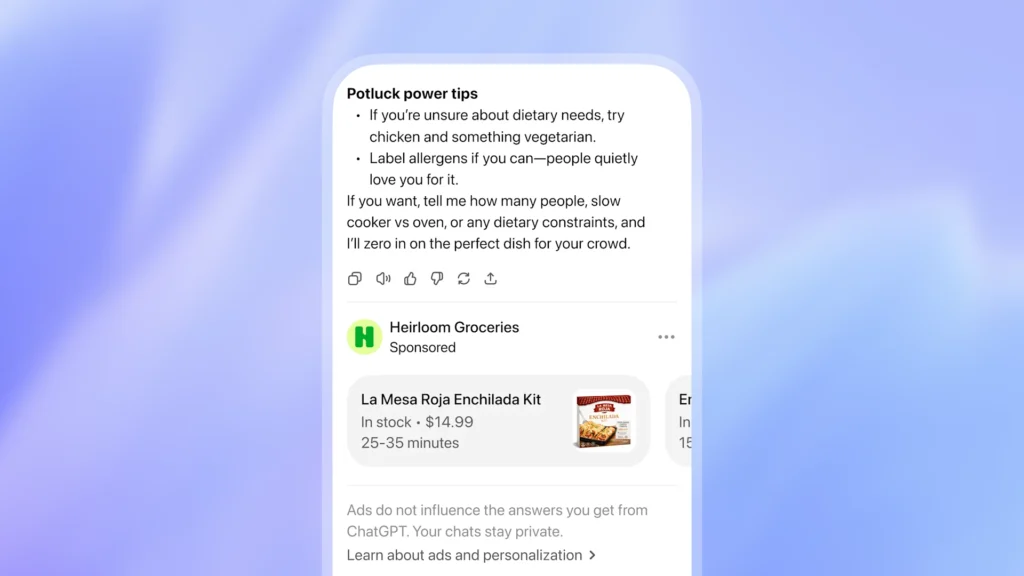
This is made very clear in OpenAI’s official announcement: “if you’re looking for recipes, you might see ads for meal kits or grocery delivery. If there are multiple advertisers, we’ll select the most relevant one to your chat to show first.”
In other words, without Semantic SEO, your ad loses relevance.
3. The Fall of the Wall Between Organic and Paid
In the AI ecosystem, Entity Understanding is the pillar of the Quality Score.
- Trust: AIs are trained to avoid hallucinations (false answers). If your site has low E-E-A-T (Experience, Expertise, Authoritativeness, and Trustworthiness), the AI will hesitate to use your data to compose an answer, even if sponsored. It prioritizes utility and truth.
- Technical Crawlability: If bots (like GPTBot) cannot crawl your site due to technical blocks or poor architecture, you are invisible. How can AI generate a dynamic ad about your product if it cannot read your specifications?
In short: Content and Technical SEO in the AI era are prerequisites for your media investment to perform.
4. The Infinite Loop: Where Ads and SEO Merge
This is where the Quality Score analogy becomes irrefutable. There is a virtuous cycle—or vicious, if you ignore SEO—in the AI ecosystem:
- Ad conversion spikes: If you direct traffic to a semantically rich and optimized page (SEO), the user finds exactly the solution to their task.
- The LLM learns from your page: A clear and well-structured page “trains” the language model on what your business is about.
- Organic authority grows: By perfectly understanding your content and verifying the utility of your page via ad interactions, the AI begins to cite your brand organically in future answers.
In summary: SEO work optimizes your ad conversion, and the assertiveness of that page feeds back into your brand authority within the AI’s “brain.”
How to Prepare Your Brand Today with Niara
The future does not accept silos. If your company still separates SEO and Paid Media into different rooms, you are going to lose money. Preparation for ChatGPT Ads begins with the SEO you do today.
Here is how to apply this practically with Niara:
1. Speak the Robot Language (Schema Markup)
If content is king, Structured Data is the crown. It helps AI explicitly understand what your content is: Is this a product? A review? An event?
- Action: Use Niara’s Schema Markup Generator. Insert your URL and let our AI generate the JSON-LD code (Product, Article, FAQ). This ensures bots understand your attributes without ambiguity, increasing your algorithmic “Quality Score.”
2. Optimize for Questions, Not Just Terms
Stop creating content just for the exact keyword. Create content that answers the complex questions in your customer’s journey.
- Action:
- Use Niara’s ChatSEO. Ask it to analyze your audience’s pain points and list the fan-out queries or complex questions that precede a purchase.
- Analyze the Conversational Queries report (in Search Analytics) and understand how users are already searching for your brand in Google’s AI Overview and AI Mode.
- Use the Content Flow to generate articles that answer these doubts with depth, setting the stage for your ads.
3. Audit Your Visibility for AIs
Do you know how AIs see your site today?
- Action: Use the Google AI Mode Insights feature in Niara. It diagnoses your content based on AI Overviews guidelines, pointing out gaps that prevent your site from being used as a trusted reference by AIs.
We prepared a complete guide on Google AI Mode, check it out!
Conclusion: The Era of Unified Visibility
The intersection between paid and organic traffic is no longer the search engine results page (SERP). It is the language model itself.
Those who master content curation and technical excellence today will pay less for leads tomorrow. SEO remains the foundation of everything—now, more than ever.
And Niara was built exactly to help you navigate this new era, simplifying complex processes so you can focus on strategy.
Is your SEO ready to dictate the rules of your Ads?
Sign up for Niara and enjoy 7 days free to try all features and prepare for the future!