
The marketing team celebrates 40% organic traffic growth last quarter. The CEO then asks: “And how many customers did that generate?”—followed by awkward silence. This disconnect between SEO metrics and business results is a chronic problem that erodes the channel’s credibility and leads companies to waste resources on optimizations that don’t move the needles that actually matter.
Most companies treat SEO as an isolated marketing initiative, focused on its own objectives like rankings, traffic, and visibility. The problem is that businesses don’t exist to accumulate impressions or sessions; they exist to generate revenue, acquire customers, strengthen brand, or achieve specific strategic goals.
When SEO operates disconnected from these core objectives, you can celebrate technical wins while the business, in practice, fails.
Real transformation happens when you completely invert the logic. Instead of asking “how do we improve our SEO?”, the question becomes: “which business objectives can SEO accelerate and how, exactly?”
This perspective shift repositions SEO from a marketing cost to a strategic investment, with trackable ROI and direct impact on metrics that CEOs, boards, and investors actually value. This guide shows exactly how to make this transition from tactical SEO to business-results-driven SEO.
Why Misalignment Between SEO and Business Is So Common
The first problem is language. SEO teams talk about “domain authority,” “featured snippets,” and “crawl budget,” while business leadership discusses “LTV,” “market share,” and “contribution margin.”
When you don’t translate SEO work into terms leadership understands and truly values, you stop being seen as a strategic driver and start being perceived, at best, as a necessary cost—or, worst case, as dispensable spending.
Timing also creates misalignment. Companies typically operate in quarterly cycles and expect visible short-term results, while SEO, especially when starting from a weak base, can take 6 to 12 months to gain significant traction.
If you don’t set realistic expectations from the start and demonstrate incremental progress along the way, frustration becomes inevitable when results don’t appear in the first quarter.
Another challenge is the lack of clear connection between actions and results. You optimize 50 pages, publish strategic content to build authority, and three months later, see traffic grow. But did growth come from your optimizations? Seasonality? An algorithm change?
Without a clear methodology for attribution and experimentation, it becomes impossible to demonstrate convincing causality between SEO investment and actual performance impact. And ultimately, correlation without causality isn’t enough to justify budget.
Translating Business Objectives into SEO Strategy
The process begins by deeply understanding what the 3 to 5 most important business objectives are for the next year—not marketing objectives, but business objectives. It could be increasing revenue by X%, expanding into a new customer segment, reducing churn, improving margin, or preparing the company for fundraising.
For each objective, the central question is: “how can organic search accelerate this?”. If the answer seems vague, indirect, or forced, that’s a clear signal that SEO might not be the priority channel for that specific objective, avoiding efforts disconnected from what actually moves the company.
This often means ignoring keyword opportunities with high volume but low qualification, which would bring irrelevant traffic from SMBs that don’t represent the desired target audience. In business-oriented SEO, not all traffic growth is positive—the right traffic matters.
Doing this triage manually can take days, but artificial intelligence has changed this game. At Niara, for example, AI analyzes search intent and suggests topic clusters aligned with your customer’s buying journey. This allows skipping the manual research phase and focusing directly on strategy.
KPIs also derive directly from business objectives, not generic metrics like impressions or average positions. If the objective is reducing CAC by 30%, the primary KPI should be cost per qualified lead from organic compared to other channels.
If the objective is building awareness in an emerging category, the KPI might be share of voice for strategic terms in that category. The principle is simple: every metric tracked in SEO needs a direct, clear line connecting it to a concrete business objective, otherwise it becomes just operational noise without strategic value.
Framework for translating objective → strategy:
- Identify clear, measurable business objective (ex: increase ARR by 40% this year)
- Break down into specific drivers (new customers + existing base expansion + churn reduction)
- Map how search influences each driver (new customer discovery, pre-sale education, content marketing for expansion)
- Define SEO’s specific role (capture 35% of new leads via organic vs current 20%)
- Establish intermediate and final metrics (impressions for key terms, conversions, organic CAC, pipeline contribution)
- Create roadmap of initiatives prioritized by expected impact on objective
Establishing Metrics That Connect SEO to Revenue
Traffic is a vanity metric when it doesn’t convert, but it’s also wrong to evaluate SEO solely by immediate conversion, because many visitors arrive still in research phase and aren’t ready to buy. The correct framework tracks the complete journey—awareness, consideration, conversion, revenue, and retention—attributing to SEO the role it actually plays at each stage.
Multi-touch attribution helps reveal this real contribution. Last-click models attribute the entire conversion to the last touchpoint, typically a brand search or direct access, ignoring that the visitor discovered your company through an article three weeks earlier.
First-click models do the opposite: they give full credit to the first touch and ignore intermediate interactions that were essential to convincing the prospect. Linear or time-decay models distribute credit more fairly throughout the entire journey, making SEO’s assistive role visible even when it’s not the last step before conversion.
The concept of influenced revenue completes this view by capturing SEO’s value in long, complex sales cycles. In B2B, for example, buyers might visit your site eight to twelve times before converting, passing through various channels. If 40% of those visits occurred via organic search, it makes sense to attribute 40% of that deal’s revenue as “influenced by organic.”
| Metric | What It Measures | When It’s Useful | Limitation |
| Organic traffic | Volume of visitors | Tracking awareness and reach | Doesn’t indicate quality or conversion |
| Organic conversion rate | % of visitors who convert | Relative traffic quality | Ignores visitors in research phase |
| Organic CAC | Cost to acquire customer via organic | Efficiency vs other channels | Difficult to allocate costs precisely |
| Pipeline influenced | Opportunities with organic touchpoint | Contribution in long cycles | Requires sophisticated tracking |
| LTV:CAC organic | Lifetime value vs acquisition cost | Channel economic sustainability | Requires cohort historical data |
Building an SEO Roadmap Aligned with Business Priorities
Annual SEO planning must be synchronized with business planning, not occur in parallel. If the company plans to launch a new product line in Q2, then Q1 SEO strategy needs to create the foundation of content, authority, and relevance for it. In SEO, the role isn’t to react to business initiatives but to anticipate and prepare the ground so they perform from day one.
The major bottleneck here is usually execution: how to produce an entire ‘content foundation’ in a few weeks? It’s unfeasible to do this only with writers without blowing the budget. Using Niara’s Content WorkFlow allows scaling this production while maintaining technical quality and brand tone of voice, ensuring the roadmap is met on schedule without sacrificing the depth Google demands.
See the testimonial from Vitória Nunes, Senior SEO at Flash Benefícios, who managed to reduce operational time from 38 hours to just 2 hours and 30 minutes with Niara – and the briefing was what consumed most of her time:

Initiative prioritization can follow a simple framework based on expected impact on business objective × probability of success ÷ effort required. An initiative capable of generating $500K in pipeline, with 70% success chance and requiring two months of work, has a much higher score than one generating $100K, with 40% success chance and requiring four months of effort.
The quarterly roadmap should balance short-term initiatives—optimizations capable of generating impact in 1 to 3 months—with long-term investments like authority strengthening, topic cluster building, and structural improvements. An effective rule of thumb is dedicating 60% of effort to initiatives with visible impact within the quarter and 40% to those for the future.
Demonstrating SEO Value to Non-Technical Stakeholders
The narrative must always start with business result, not tactical SEO activity. Instead of saying “we published 20 articles and earned 150 backlinks,” the correct communication is “we generated 340 qualified leads via organic and reduced CAC from $180 to $95 in this segment.”
The volume of deliverables matters more to you than to the stakeholder.
Internal case studies make this narrative even more powerful. Documenting a specific SEO initiative with clear objective, execution, and concrete results gives substance to the discourse. For example: “We created a content hub about [topic X] for persona [Y]. In six months, traffic for these terms grew 280%, generating 89 leads with 40% higher conversion rate than average. Estimated ROI: 380%.
Specificity, numbers, and explicit causality reinforce credibility and show that SEO is directly tied to real outcomes.
Competitive benchmarking complements this communication by contextualizing your performance within the market landscape. Saying you grew 35% in organic visibility is positive; saying you grew 35% while the market grew 12% and main competitors only 8% is significantly more impactful.
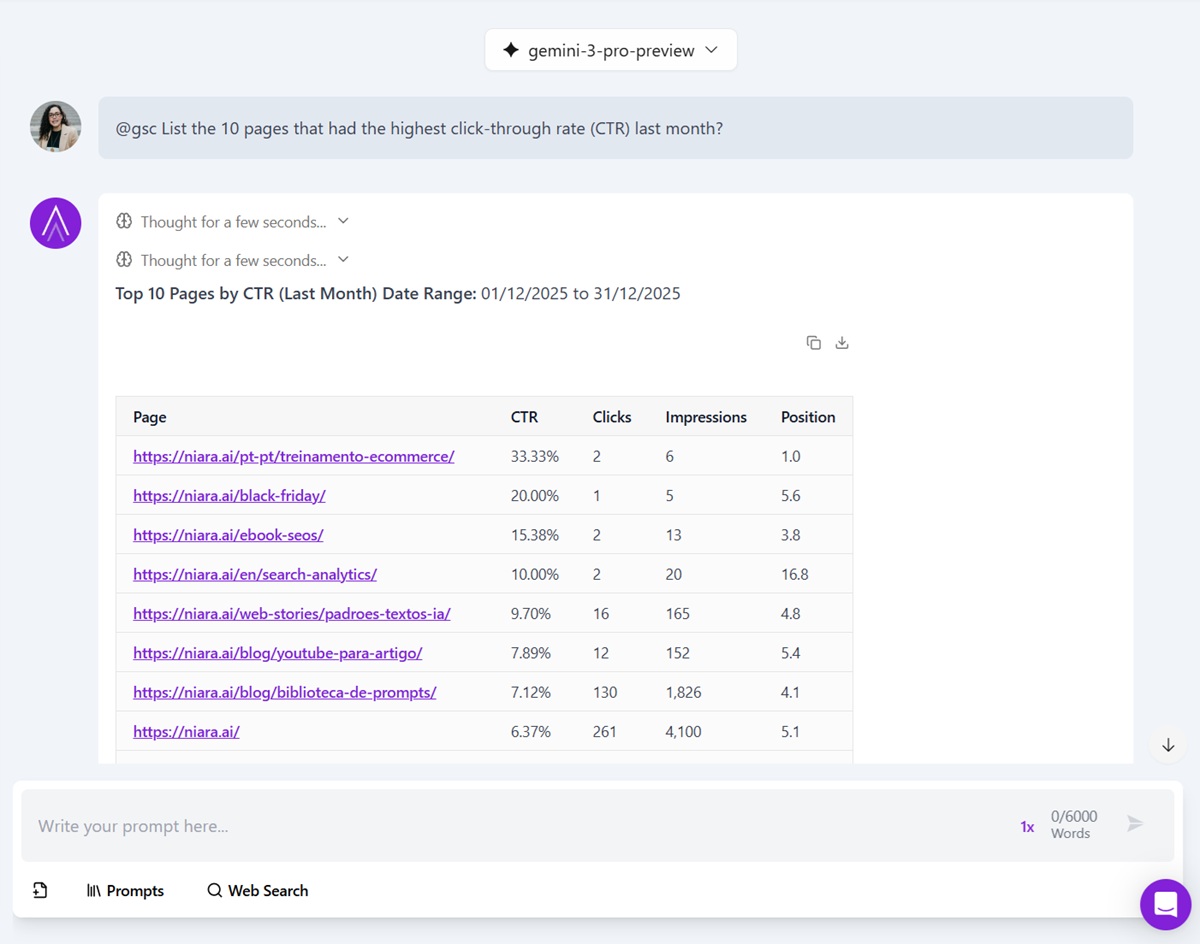
To get these numbers without drowning in Excel spreadsheets or complex GA4 screens, technology is your ally. With Niara’s ChatSEO, integrated with Google Search Console, you can simply ask: ‘List the 10 pages that had the highest click-through rate (CTR) last month?’ or ‘What’s the performance of cluster X?’. The tool delivers ready analysis, facilitating creation of executive reports that C-Level understands.
Executive reporting template (one page):
Quarter Business Objective:
[specific objective ex: reduce CAC by 20%]
SEO Contribution:
- Leads generated via organic: [number] (+X% vs previous quarter)
- Organic CAC: $[number] (benchmark: $[number] in paid)
- Pipeline influenced: $[number]
Main Initiatives Executed:
- [Initiative] → [specific result]
- [Initiative] → [specific result]
- [Initiative] → [specific result]
Impact on Objective:
[Ex: Overall CAC reduced 23%, exceeding 20% goal. Organic contributed 45% of this reduction through increased volume of lower-cost leads]
[1-3 priority initiatives for next quarter]
Integrating SEO with Other Growth Initiatives
Synergy with product marketing multiplies the impact of both teams. When the product launches a new feature, product marketing develops messaging and positioning, while SEO transforms that positioning into optimized content capable of capturing searches related to the problem this new feature solves.
When timing is coordinated, you reach the market exactly when people start searching for the solution—and already have a strong organic presence prepared to absorb that demand from day one.
Collaboration with sales also creates extremely valuable feedback loops. The sales team knows which objections appear most frequently, which questions repeat in all calls, and which competitor comparisons are inevitable. Each of these insights can transform into optimized content that educates the prospect before the sales conversation, reducing cycle time and improving conversion.
Finally, integration with customer success complements this view by informing long-term strategy. Understanding which customers have higher LTV, lower churn, and faster expansion can reveal important patterns about how they found you. Post-sale behavior often reveals more about SEO’s real value than any short-term metric.
Making Organic Growth Predictable Through Modeling
Historical modeling establishes a causality baseline that allows understanding how SEO actually drives results. By analyzing 12 to 24 months of data—content investment, link building efforts, and technical optimizations—it becomes possible to observe how these factors correlate with growth in traffic, leads, and revenue.
Segmentation by initiative type further refines these predictions. Different SEO components have completely distinct ROI and timelines. Technical optimizations can generate impact in weeks; domain authority building occurs over quarters; evergreen content tends to appreciate for years.
Creating separate models for each initiative category makes projections more accurate and helps prioritize the ideal mix of activities, balancing quick impact with sustainable long-term growth.
“If-then” scenarios enable much smarter contingent planning. This data-driven approach transforms budget allocation decisions—previously guided by intuition—into rational, optimized choices, dramatically increasing predictability and efficiency of SEO investment.
Conclusion
Aligning SEO with business objectives isn’t a theoretical planning exercise but a profound shift in how you view organic channel’s role. SEO stops meaning “improve rankings and traffic” and starts representing “accelerate specific business objectives through discovery and conversion.”
Transform your strategy today!
Making this alignment requires time to think about strategy, and you shouldn’t spend that valuable time on repetitive operational tasks.
Niara is the SEO and Content platform that automates operations so you can focus on business growth. From keyword research to advanced data analysis, we simplify your routine so you can prove SEO’s ROI.
Try Niara free and discover how to accelerate your SEO results.
Funded by the European Union – NextGenerationEU. However, the opinions expressed are those of the authors only and do not necessarily reflect the views of the European Union or the European Commission. Neither the European Union nor the European Commission is responsible for these opinions.
Visit the official website: https://recuperarportugal.gov.pt/

