
Let’s be honest: trying to rank for “2026 fashion trends” or “how to wear a blazer” while competing with Vogue, Elle, or major e-commerce giants is a losing battle for 99% of blogs. They have decades of history, millions of backlinks, and a massive editorial team.
But I have good news: you don’t need to be Vogue to get qualified traffic and revenue.
In 16 years of working with SEO, I’ve seen small projects dethrone giants not by the quantity of content, but through a Topical Authority strategy. The secret isn’t to talk about everything in fashion, but to know everything about a specific slice of it.
In this guide, I’ll show you how to move from “random content” to a cluster strategy that Google loves, turning your blog into a profitable technical reference.
What is Topical Authority (and Why It’s Your Blog’s Oxygen)
Before we talk about outfits, we need to talk about concepts. Topical Authority is the depth of knowledge a site demonstrates on a specific subject.
In modern SEO, Google doesn’t just want to deliver a page containing the keyword; it wants to deliver the subject matter expert.
Think about it: if you publish a cake recipe today, a car tire tip tomorrow, and a post about shoes next week, Google sees you as a generalist. But if you have 50 interlinked articles covering absolutely everything about “Minimalist Fashion,” the algorithm understands that you are the ultimate authority on that topic.
Topical authority isn’t just important for “blue links.” Google recently launched the first update specific to Google Discover aimed at eliminating shallow content and “showing more detailed, original, and up-to-date content from sites with expertise in a particular area.”
For fashion blogs, this is essential because the sector is saturated. Topical authority is what separates “outfit of the day blogs” from portals that generate recurring revenue.
To build topical authority, you need to prove to the search engine that you’ve covered all the nuances, questions, and subtopics of a theme. This is what we call covering semantic gaps.
Step 1: Where to Plant Your Flag (Defensible Niches)
The number one mistake is defining your niche simply as “Fashion.” That’s too broad. To build authority fast, you need to “niche down the niche.”
A defensible niche has three characteristics:
- Search Demand: Are people looking for it?
- Possible Depth: Can you write 50 articles about it?
- Winnable Competition: Are the giants only covering this superficially?
Practical Examples Beyond the Obvious:
- Instead of “Women’s Fashion” → Focus on “Plus Size Executive Wear.” (You solve the specific pain point of finding quality formal wear in larger sizes).
- Instead of “Shoes” → Focus on “Sneakerheads and Streetwear.” (Deep reviews of drops, where to buy, how to spot fakes).
- Instead of “Style Tips” → Focus on “Capsule Wardrobe and Minimalism.” (Combination guides, fabric quality, conscious consumption).
Step 2: The Architecture of Authority (Pillars and Clusters)
This is where the SEO magic happens. Writing loose posts won’t work. You need to structure your content like a spider web.
The Pillar Page
This is your definitive guide. A dense piece of content (2,000+ words) that covers the topic broadly.
Example: “The Ultimate Guide to Women’s Tailoring.”
The Clusters (Satellites)
These are specific articles that answer derived questions (the Fan-out Queries). They deepen what was cited in the Pillar.
- Example 1: What is the difference between linen and cambric for suits?
- Example 2: How to care for a cold wool blazer.
- Example 3: Best made-to-measure tailoring brands.
- Example 4: Tailoring looks with sneakers: how to get it right.
Step 3: Balancing Seasonality and Evergreen Content
Fashion is ephemeral, but your traffic shouldn’t be. If you only write about “Summer Trends 2025,” your traffic dies in February 2026.
The smart strategy uses the 80/20 rule:
- 80% Evergreen Content: This is the foundation and must bring traffic rain or shine.
- “How to combine colors,” “History of Jeans,” “Types of collars.”
- 20% Trending Topics (Seasonal): This is the “hype.” The secret here is using the trend to pull traffic to the evergreen content.
- “Pantone Colors 2025,” “Met Gala Looks.”
The “Query Fan Out” Strategy in Practice:
If “Cowboy Boots” is the winter trend:
- Create the trend post (“How to wear Cowboy Boots in 2026”).
- Inside it, link to your evergreen posts (“How to clean leather,” “Guide to boot styles”).
Learn more about Query Fan Out in our complete guide to mastering the technique.
Golden Tip: Use Seasonality to Feed Your Perennial Authority
Covering Fashion Week? Don’t just say “see the runway shows.”
Write an article “What NYFW teaches us about the return of Tailoring (and how to wear it today).” Link this news article to your Tailoring Pillar.
This is exactly what Vogue did with the article “This New York Fashion Week, Valentine’s Day Will Have to Wait“, leveraging Valentine’s Day (February 14th) to talk about Fashion Week!
The magazine transfers the moment’s hype to long-term authority.
Step 4: Visual and Technical Optimization (Beyond Alt Text)
In fashion, the image is content, and it sells. But Google doesn’t “see” the image; it reads the code. If you upload a photo named IMG_5402.jpg, you are losing money.
To build visual authority:
- File Names: Use
oversized-beige-blazer-look.jpg. - Alt Text: Describe the image for accessibility and SEO. “Woman wearing oversized beige blazer with jeans in natural light.” Niara has an Image Alt Text Generator that does this by reading your image URL, saving you hours.
- Structured Data (Schema): Use Product or Article markup so Google displays price, availability, and ratings directly in search. Use our Structured Data Generator.
- Original Photography vs. Stock Images: Google values unique content. DIY photos (taken at home) with good light and a phone, showing fabric details or fit, are worth more for SEO (and the user) than a generic stock photo everyone uses.
- Short Videos: Embed your Reels or TikToks in articles. This increases Dwell Time, a very strong quality signal for Google.
Step 5: Internal and External Link Building
The “secret sauce” is connecting all of this.
- Internal Linking: The Pillar article links to all Clusters. And each Cluster links back to the Pillar. This distributes Link Juice (authority) throughout the site and tells Google: “Look how robust and interconnected my content on Tailoring is. I am the encyclopedia of this.”
- External Link Building (Backlinks): In fashion, partnerships are everything. Instead of buying links, build relationships. Send products for reviews, do guest posts on complementary niche blogs (e.g., a fashion blog writing about “Interview Outfits” on an HR blog).
How to Measure and Monetize This Authority?
You know you’ve reached topical authority when:
- Organic traffic grows steadily, without relying on social media virality.
- Brands start looking for you.
- Your new posts index and rank on the first page in hours, not weeks.
I asked ChatSEO: “@gsc Niara, we published the article at the URL https://niara.ai/en/blog/ai-product-description-generator/ on January 21th. Did it receive any impressions and/or clicks the following day? Please provide only the data from this URL“.
See Niara’s response:
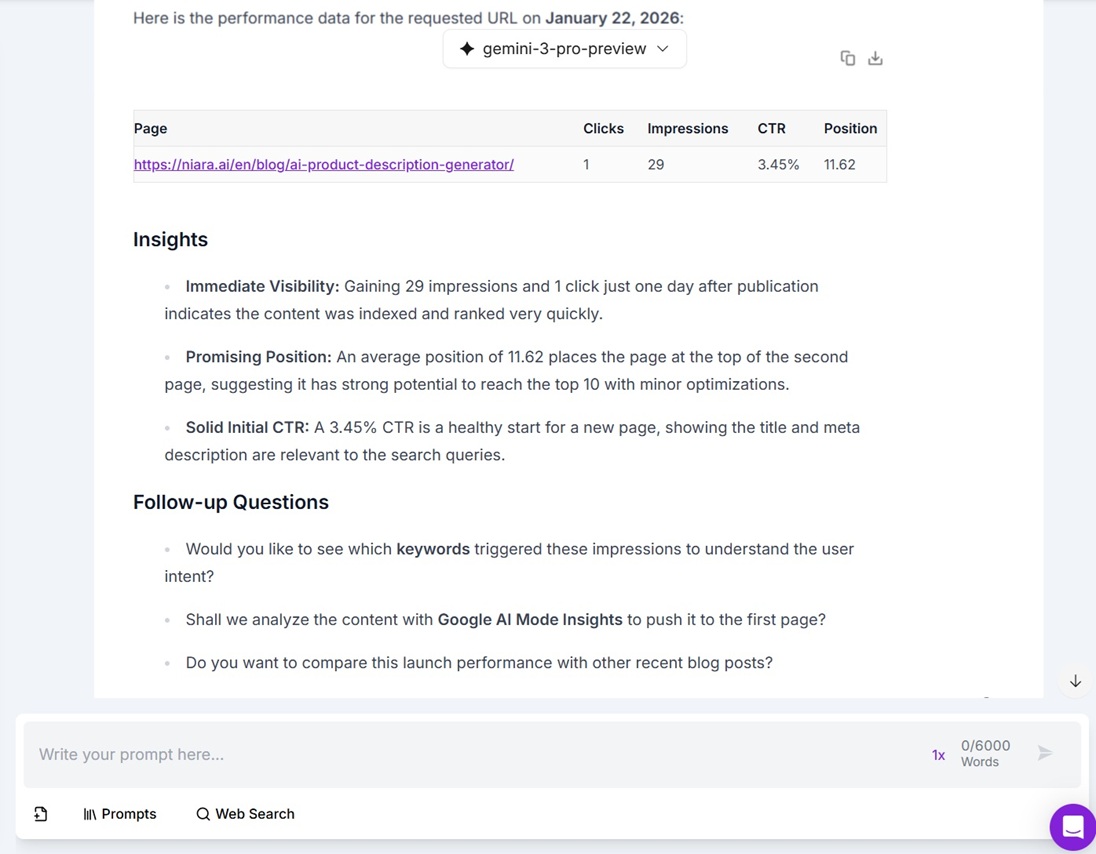
Smart Monetization: With authority, you don’t depend solely on AdSense (which pays little). You can:
- Sell affiliate products with deep, honest reviews (which rank well).
- Create digital products (Style E-books, Color Analysis courses).
- Curate for partner brands.
How to Do All This Without Taking 6 Months? (The New Way of Working)
I know what you’re thinking: “Lisane, this is beautiful in theory, but I’m just one person (or have a small team). How am I going to audit my site, find gaps, create clusters, and plan 3 months of content?”
In the past, you would need complex spreadsheets, advanced access to Google Search Console (GSC), and days of analysis. We solved this (and you can use it starting late February).
Meet Niara’s Authority Map
We developed a feature that automates the strategic intelligence SEO consultants take weeks to build.
- Automatic Diagnosis: Niara connects to your GSC, analyzes your real data, and identifies which clusters you already have and which are “weak.”
- Gap Coverage: It tells you exactly: “You have authority in ‘Party Dresses,’ but you are missing these 5 topics to dominate the niche.”
- 1-Click Calendar: Based on this analysis, you generate a complete editorial calendar to cover these gaps and strengthen your authority.
- Execution: The Authority Map connects directly to our Content Workflow, allowing you to create suggested articles – taking into account organic competitors and SEO optimization.
Stop Guessing and Start Ranking
You stop writing about what you think will work and start writing about what the data shows will build your authority.
Consistency Beats Hype
Building topical authority doesn’t happen overnight. It’s a game of patience, strategy, and above all, consistency. It’s about proving to Google, article after article, that you are the best answer for the user.
Don’t try to embrace the entire fashion world. Choose your territory, use data to map opportunities, and deliver the best possible content. Google rewards those who organize information and make life easier for the user.
Want to discover what niches and opportunities are hiding in your site’s data?
Join the Enterprise plan and get early access to the new features. Book a demo with our team now!
Let’s turn your blog into a reference, one cluster at a time.
