
Crossing borders is the dream of any growing business. New markets, diversified revenue, and a global brand. But in practice, the scenario is often frustrating: you have a flawless site in the US, you translate everything into Spanish or Portuguese, invest months of work, and… zero traffic.
I’ve seen this happen dozens of times. The mistake? Thinking that International SEO is just translation.
It isn’t. Google treats each regional version of your site as an almost blank slate, often with zero authority and zero context. If you just “translate,” you will be invisible.
In this guide, we’ll break down a real internationalization strategy. I’ll show you how to structure your domain, solve the nightmare of hreflang tags, and most importantly, how to use Niara to organize this complexity.
Here is how to turn translation into localization to achieve real rankings.
1. Localization vs. Translation (where most fail)
Before we talk about code, we need to talk about culture.
Translation is converting words from one language to another. Localization is adapting the experience, the message, and the intent to the local culture.
Why does this matter for SEO? Because search behavior changes. In the US, we might search for “vacation rentals.” In the UK, the search might be “holiday lets.” A literal translation (or using the wrong regional variation) can make you rank for a keyword that no one searches for in that country.
How to apply strategic localization:
- Native Keyword Research: Never just translate your keywords. Use tools to discover how the local audience actually searches for your product.
- Cultural Context: What is a standard feature in the US (e.g., Free Shipping) might be a huge differentiator in Europe. Conversely, if you are selling to Brazil, offering “payment in installments” is mandatory, whereas in the US, it’s optional. Adapt your sales arguments.
- Legislation and Data: Pay attention to CCPA in California, GDPR in Europe, and LGPD in Brazil. Your content and forms must respect local rules.
Niara Tip: Use ChatSEO to act as a local expert. Ask: “Act as a native SEO specialist from Spain and list the cultural variations and search terms for [your niche] that differ from the Latin American market.“
2. Technical Structure: The Domain Dilemma
This is the first major decision and the most expensive to reverse. How do you structure your site for the world? There is no “best,” there is only the best for your available resources.
Subdirectories (yoursite.com/us/ or yoursite.com/es/)
- Advantage: Consolidates authority. Backlinks you earn on the root domain help all folders. It is easier and cheaper to manage.
- Disadvantage: The geolocation signal to Google is weaker than a ccTLD.
- Who it’s for: 90% of companies that want to scale without tripling their technical team.
- Example:
https://niara.ai/en/andhttps://www.apple.com/fr/
Subdomains (us.yoursite.com or es.yoursite.com)
- Advantage: Clear separation of content.
- Disadvantage: Google may treat them as different sites, fragmenting your authority. Requires more link-building effort for each subdomain.
- Who it’s for: Large companies with very different product lines per country.
- Example:
https://en.wikipedia.org/andhttps://blog.hubspot.es/
ccTLDs (yoursite.us, yoursite.es, yoursite.fr)
- Advantage: The strongest signal of localization. Generates immediate trust with the local user.
- Disadvantage: Zero authority. You start from scratch in every country. It is expensive and complex to maintain multiple domains and infrastructures.
- Who it’s for: Enterprise brands with robust budgets and dedicated teams per country.
- Example:
https://www.amazon.de/andhttps://www.google.fr/
3. Hreflang: Google’s GPS (No Margin for Error)
The hreflang tags are the most critical technical aspect. They tell Google: “Is this user in Spain? Show this version of the page. Are they in Mexico? Show that one.”
If you get this wrong, Google may consider your content as duplicate and ignore both versions.
The Golden Rule: Symmetry
Tags need to be a two-way street. If Page A (English) points to Page B (Spanish), Page B must point back to Page A. If the link is not reciprocal, Google ignores the tag.
Essential Elements:
- Canonical Tag: The page must point to itself.
- X-default: Define a default page for users who do not fit into any specified language (usually the English version or the global home).
- Correct ISO Code: Use
es-ESfor Spain andes-MXfor Mexico. Justescovers all Spanish speakers.
For this article you are reading, the code contains:
<link rel="alternate" href="https://niara.ai/blog/internacionalizacao-de-conteudo-organico/" hreflang="pt" />
<link rel="alternate" href="https://niara.ai/en/blog/challenges-in-internationalizing-organic-content/" hreflang="en" />
This way, we inform search engines which is the Portuguese version and which is the English version.
Don’t try to do this manually in spreadsheets if you have more than 50 pages. The risk of human error is huge. There is a specific hreflang prompt in the ChatSEO Prompt Library.
4. International Content Strategy and Link Building
You configured the domain and the tags. Now what? Now the real work begins. Authority doesn’t travel well. A link from the New York Times is great, but for your SEO in Germany, you need local relevance.
It’s not enough to translate. You need to create content that answers local pain points.
- Localized Briefs: Create specific outlines for each country.
- Avoid Duplicate Content: Even in different languages, if the structure is identical, it can be thin. Enrich each version with local data, examples, and case studies.
- Regional Link Building: Prioritize backlinks from domains with the target country extension (.fr, .de, .pt).
Simplifying with Niara: With the Content Workflow, you can analyze the SERP of the target country (e.g., Google France) and generate a brief based on what is already ranking there, not here. This ensures you cover the topics the local audience actually wants to read. See how to create your first high-performance article on Niara.
5. Managing the Chaos: Niara’s Project Structure
This is where theory meets practice. Managing 3, 5, or 10 countries in the same “box” is a recipe for disaster. You will mix data, confuse personas, and lose cultural nuance.
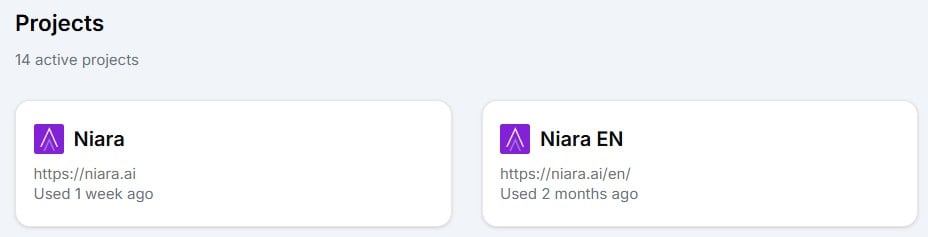
The Projects feature is already known to our users, but for International SEO, it is vital.
Recently, Projects have evolved to hold your brand context and segregated data connection. This means everything you create—whether in ChatSEO, Content Flow, or Tasks—will be isolated and automatically personalized for that specific country.
Here is a detailed look at how to use the Projects feature for your global expansion.
Why Work with Projects in Internationalization?
Organizing by projects isn’t just aesthetic; it’s functional and strategic. When expanding to new countries, you should structure your account as follows:
- Project 1: US Site (EN-US) – Focused on the domestic market.
- Project 2: Spain Site (ES-ES) – Focused on the European market.
- Project 3: Brazil Site (PT-BR) – Focused on LATAM.
By accessing a project, you ensure you won’t mix data from different clients or countries and that Niara will be focused on the context of that specific business. For example, in my account, there is a project for each country/language we operate in.
I’ll explain below how this helps with content personalization and monitoring.
The Game Changer: Brand Guidelines per Country
We know one of the biggest bottlenecks in using AI for internationalization is having to repeat, in every prompt, that the text is for Spain and not Mexico, or that it should use “lift” instead of “elevator.”
With the Projects update, you insert the Brand Guidelines once in the settings of each project:
- In the US Project: You instruct Niara to use a direct tone, American idioms, and focus on speed.
- In the Spain Project: You configure the Guide to use the appropriate tone (tú or usted), focus on local culture, and European vocabulary.
What does this mean in practice?
When asking for a text inside the Spain Project, Niara already knows it must write like a Spanish brand, without you needing to ask. All articles, briefs, and product descriptions generated in that project will follow the same local verbal identity.
Practical Tip: AI Auto-Fill 💡
Don’t know how to describe the tone of voice for the new market? In ChatSEO, choose the Gemini model and ask Niara to analyze local competitors in that country and generate the ideal Brand Guidelines for that market.
Search Analytics: Data Segregated by Market
Use the native integration with Google Search Console (GSC) through our Search Analytics.
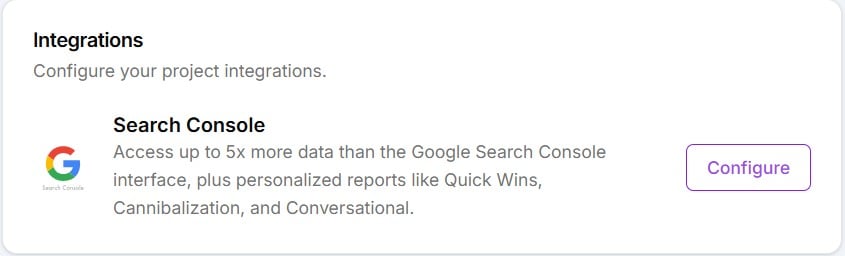
By linking a GSC property to a specific Project in Niara, you unlock exclusive reports. You can open ChatSEO inside “Project Spain” and talk only to the data from the .es domain or the /es/ folder.
Example prompt: “@gsc List the 10 pages with the least traffic in Spain in the last 30 days and suggest optimizations based on the local Brand Guidelines.”
Niara will cross-reference the traffic data from the linked GSC with the writing rules of your Brand Guide for that country. This is true data-driven International SEO.
Security and Privacy: GDPR, CCPA, and Zero Data Retention (ZDR)
We know that by inserting Brand Guidelines and connecting GSC data, we are dealing with your business’s most valuable assets. That’s why Niara operates with a strict Zero Data Retention (ZDR) policy on AI models and is compliant with GDPR and CCPA. Data from your international projects and your Search Console information are never used to train public AI. Check out how we protect your data.
Conclusion: Start Small, But Organized
Internationalization is a marathon, not a sprint. If you try to embrace the world all at once, you will fail.
- Start small: Choose 1 or 2 priority markets.
- Organize the house: Create separate Projects in Niara for each market.
- Localize, don’t translate: Configure the Brand Guidelines with the cultural nuances of each country.
- Monitor: Connect the corresponding GSC and track growth in isolation.
International SEO is fragile. A URL change can break the entire hreflang chain.
Want to speed up this process? At Niara, we unify global keyword research, local SERP-based brief creation, and content generation in one place.
Not a customer yet? Create your account and try it free for 7 days. Simplify your Global SEO.
