
For years, SEO departments were defined by desks buried under endless spreadsheets and crawl data. Manual audits were slow, grueling marathons. It was like trying to paint a portrait of a speeding train; by the time the first stroke was dry, the subject was miles away. This lag meant that reports were essentially history lessons by the time they reached the client, rather than actionable insights.
Today, success in modern search marketing depends on real-time insights and the ability to pivot instantly. If you’re still auditing sites manually, you’re working harder than you need to. Learning to run an SEO audit with AI is the quickest way to trade boring data entry for high-impact results.
Instead of losing days to identifying technical leaks or content decay, automated systems can analyze thousands of data points in seconds. This shift allows teams to stop acting as data processors and start acting as architects, focusing on high-level strategy and creative execution.
At Niara, the goal is to eliminate the repetitive, “boring” tasks that drain a team’s energy. By leveraging AI to handle the heavy lifting, SEO professionals regain the time needed to innovate and scale. This guide explores how to turn a week-long headache into an optimized, automated process that identifies opportunities at lightning speed.
Ready to modernize your workflow? Explore our AI-driven audit framework below.
Why AI makes SEO audits faster and deeper?
The traditional SEO audit is limited by human bandwidth. For most practitioners, the real pain isn’t just the data volume; it’s the exhausting ritual of opening fifty browser tabs, toggling between three different SEO tools, and wrestling with massive, clunky spreadsheets. You spend hours manually stitching data points together just to build a single coherent graphic.
By the time you’ve finished jumping between Search Console, your crawler, and your reporting dashboard, mental fatigue has already set in. This fragmented workflow forces you to waste your expertise on data entry and visualization rather than high-level strategy, killing your momentum before you’ve even identified your first optimization opportunity.
AI changes the game by offering three core advantages:
- Unmatched Speed: What used to take 20 hours of manual analysis now takes 20 minutes. AI can process thousands of URLs simultaneously, identifying patterns in indexation or site architecture that a human might miss.
- Granular Coverage: AI doesn’t get tired. It can audit every single meta description, check every internal link, and analyze the sentiment of every H2 across a massive enterprise site without losing accuracy.
- Predictive Consistency: By using an AI-powered SEO audit checklist, you ensure that every project follows the same high standard. You eliminate the “human error” factor where a tired analyst might overlook a critical canonical tag or a slow-loading script.
However, let’s be clear: AI is your co-pilot, not the captain. While AI is incredible at finding the “what,” you are still responsible for the “why” and the “how.” The goal is to use AI to surface the insights so you can make the strategic decisions.
AI-powered audit framework: Inputs, Analysis, Output, Action
To run a successful AI SEO site audit, you need a repeatable framework. We break this down into four distinct stages that turn raw data into a roadmap for growth.
Inputs
Before you prompt an AI or run a tool, you must define the boundaries. This includes:
- Defining Goals: Are you auditing for a site migration, recovering from a core update, or preparing for an enterprise scale-up?
- Scope: Is this a full technical audit or a specific content gap analysis?
- Data Access: Ensure your AI SEO audit tool includes access to Google Search Console (GSC), Google Analytics 4 (GA4), and PageSpeed Insights. Without real data, AI is just guessing.
Analysis
This is where the heavy lifting happens. Using AI-driven SEO analysis, the system cross-references your GSC data with live site crawls. It looks for discrepancies between what Google sees and what your site is actually delivering.
This stage identifies “Crawl Budget” leaks, keyword cannibalization, and technical debt that is holding back your rankings.
Output
An audit is useless if it’s just a list of errors. The output should be a prioritized matrix. Instead of a 100-page document, you want a dashboard that highlights “High Impact, Low Effort” tasks.
AI can help categorize these automatically, separating “Critical Fixes” (like 404 errors on high-traffic pages) from “Optimizations” (like improving a meta description).
Action
The final stage is converting those insights into a sprint-ready task list. This phase is where strategy meets execution, ensuring that the data gathered doesn’t just remain theoretical but drives tangible progress.
To effectively transition from insights to action, use a prioritization matrix (such as the Impact vs. Effort framework) to identify “quick wins”—tasks that deliver high value with low development effort.
Then, you can break down broad insights into specific tasks that clearly define the user, the problem being solved, and the desired outcome.
The result? A seamless transition from high-level discovery to a high-velocity execution phase that delivers real value to your end users.
Phases of the AI SEO audit step-by-step
Now, let’s dive into the practical side of things. Conducting a comprehensive SEO audit can often feel overwhelming, but Niara’s SEO AI agents are designed to make the entire process significantly easier and more actionable.
We’ll show you exactly how to harness the power of Niara to execute a modern audit that is both simple to manage and highly effective:
Phase 1: Define goals and scope
Start by setting your KPIs. Are you looking for a 20% increase in organic traffic or a better click-through rate (CTR) for your top 10 pages? Use Niara’s Search Analytics to look at your current performance. We provide 5x more data than the standard GSC interface, allowing you to filter by search intent. This helps you decide if your audit should focus on “Informational” content gaps or “Transactional” technical hurdles.
To take your data deep-dive even further, you can leverage our Conversational Analytics feature. This AI-powered interface allows you to skip the manual filtering and talk directly to your data. Instead of digging through rows of spreadsheets, you can ask complex questions in plain English to uncover hidden opportunities instantly.
Examples of what you can ask:
- Performance drops: “Which of my top 20 pages saw a decline in CTR over the last 30 days despite maintaining their average position?”
- Content planning: “Create a performance summary for my /blog/ subfolder over the last quarter.”
- Top queries for a specific page: “List top 5 queries that are ranking for my URL in the last 15 days: [Insert URL].”
- Cannibalization: “Are there two or more different URLs ranking for the same keyword ‘[Insert Keyword]’?”
By using Conversational Analytics, you transform raw data into an actionable to-do list, making your SEO audit more efficient and data-driven.
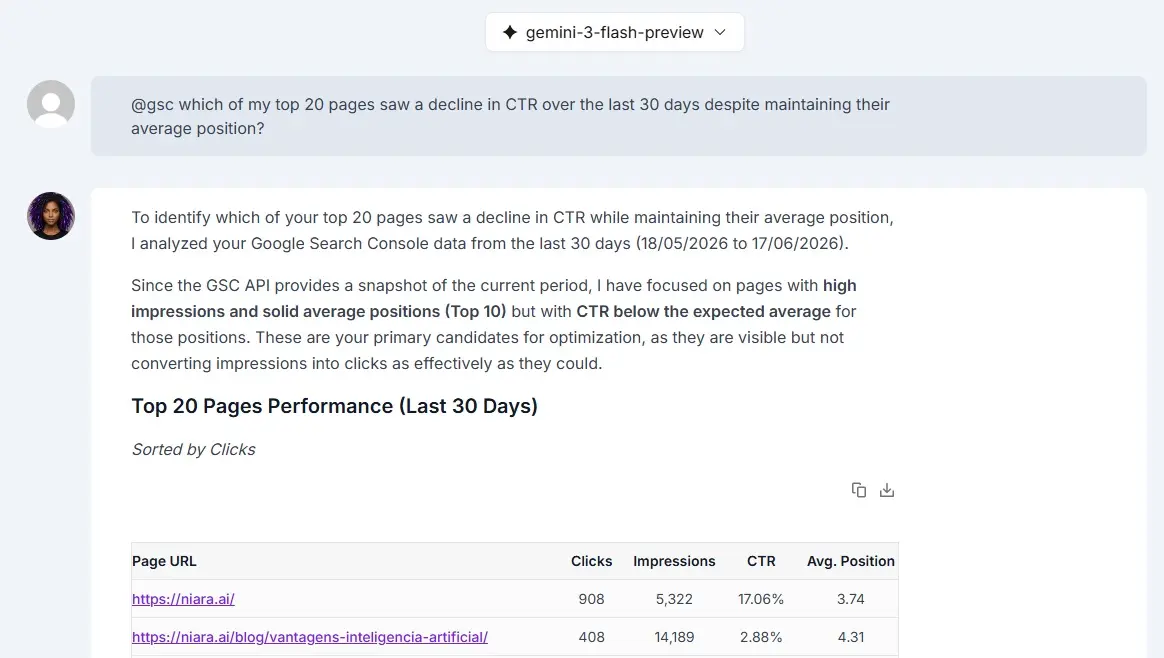
After delivering the analysis results, Niara continues to provide insights and follow-up questions to deepen your understanding and help you build a robust strategy:
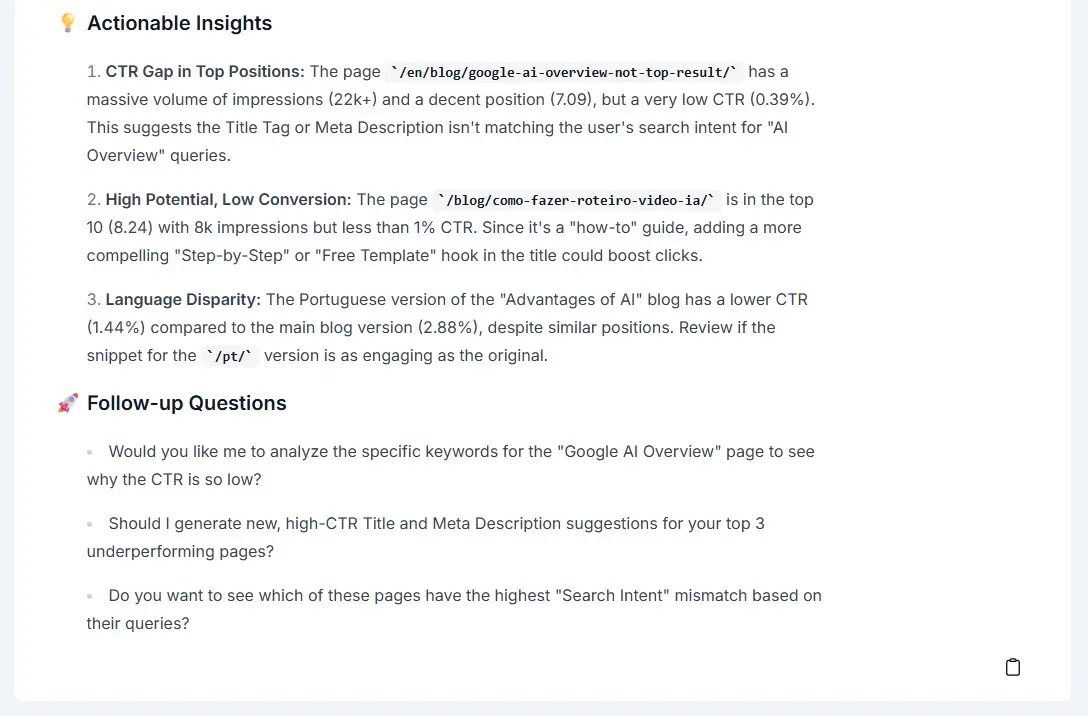
Phase 2: Technical health & indexability at scale
Technical SEO is often seen as the “boring” part of the job, but it’s the foundation of everything else. If Google can’t crawl you, it can’t rank you.
Using Niara’s Site Audit (our Technical SEO Agent), you have a 24/7 consultant at your fingertips. Instead of manually checking robots.txt or sitemap errors, the agent integrates your GSC data and provides a real-time report. It identifies crawl budget leaks—where Google is wasting time on low-value pages—and highlights specific indexation errors.
For those who find technical SEO jargon overwhelming, there is no need to worry. If there’s a report or an error code that you don’t understand, you can simply ask Niara to explain it. The AI acts as a personal tutor, breaking down complex problems into plain English. You can ask questions like, “What does this indexation error mean?” or “How do I fix this specific crawl issue?” to receive clear, step-by-step instructions tailored to your website.
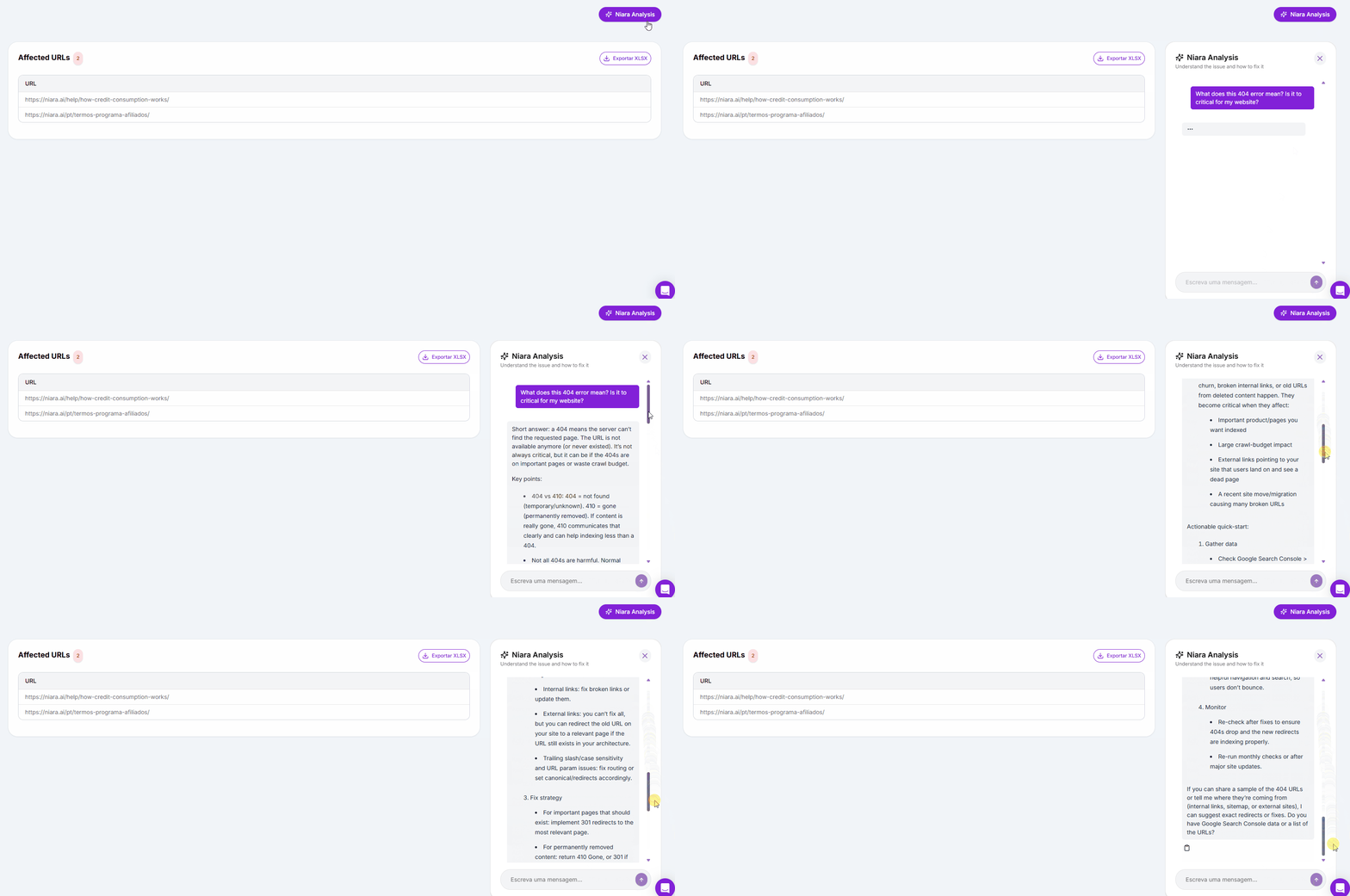
Beyond just identifying problems, Niara helps you master your workflow. If you are unsure where to start, you can ask the agent to prioritize your action plan. By analyzing which fixes will yield the highest return on investment (ROI) for your organic traffic, Niara ensures you spend your time on high-impact tasks first, rather than getting lost in minor technicalities that won’t move the needle.
Phase 3: Decoding Core Web Vitals and UX
Page speed is a core user experience (UX) signal. Our Technical SEO Agent tell you that your LCP (Largest Contentful Paint) is slow, interprets the lab data and gives you specific code recommendations.
Whether you are on WordPress, Shopify, or a custom React build, the AI provides tailored advice. It might suggest specific CSS minification or image optimization techniques that are unique to your CMS, making the audit results much easier for your dev team to implement.
Phase 4: Content gap and semantic authority audit
A technical audit tells you if your “house” is built correctly. A content audit tells you if anyone wants to visit. This is where we move from keywords to topic clusters.
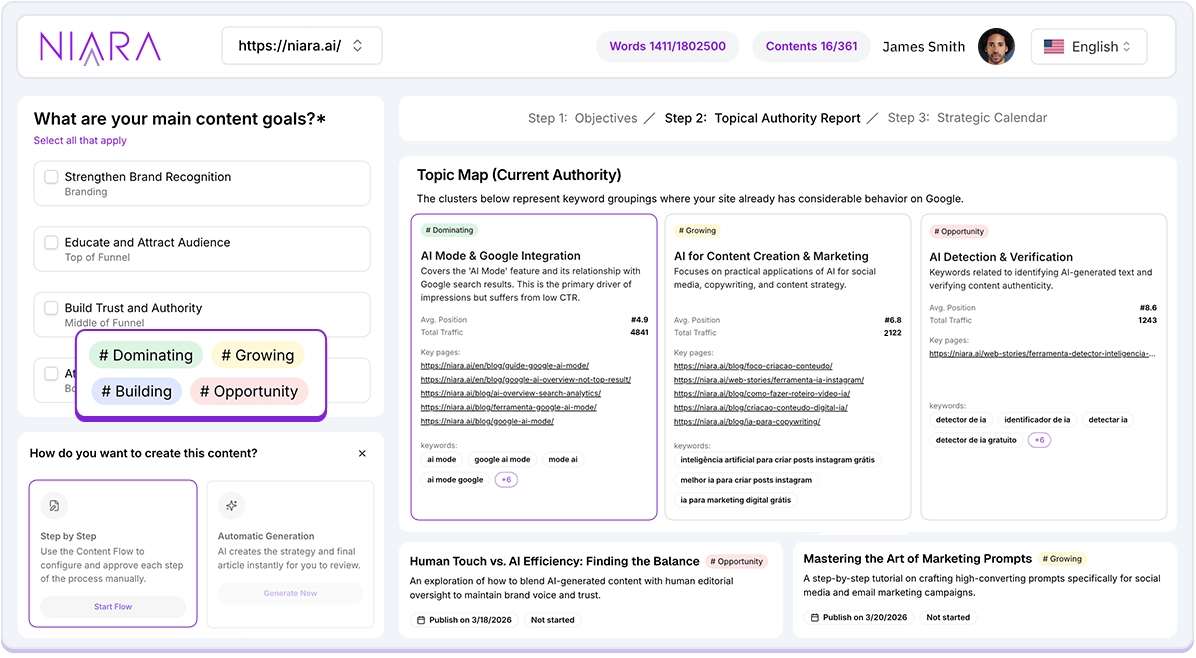
The “killer feature” here is Niara’s Authority Map. By analyzing your Google Search Console (GSC) data and your entire content ecosystem, Niara creates a visual representation of your topical authority.
To help you prioritize your SEO strategy, Niara identifies your main topic clusters and classifies them into four distinct categories:
- Dominant: Topics where you have already established high authority, consistently earning significant clicks and top rankings.
- Growing: Clusters showing a steady increase in impressions and improving positions. These represent high-leverage areas where a small optimization push can yield major results.
- Opportunity (Quick Wins): Topics that generate high impressions but suffer from a low CTR. These are your “quick wins” that require immediate optimization to capture existing search demand.
- Building: Topics with lower volume or distant rankings that remain semantically vital to your niche. Niara ensures these aren’t ignored, as they provide the essential foundation for long-term authority.
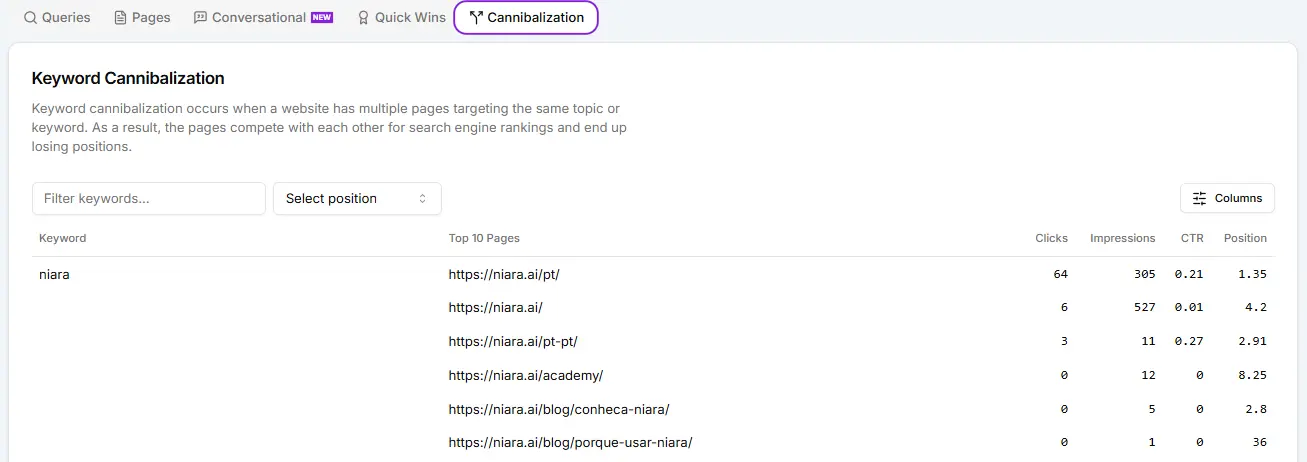
Beyond mapping authority, you can also leverage Niara’s Search Analytics to uncover keyword cannibalization issues.
Cannibalization occurs when multiple pages on your website compete for the same keywords and search intent, effectively diluting your ranking power. By using Search Analytics to spot these overlaps, you can consolidate content or refine your internal linking strategy to ensure your strongest pages are the ones reaching the top of the SERPs.
Phase 5: Competitive intelligence & AI search readiness
We are entering the era of AI, with AI Mode, AI Overviews and more. Traditional tools like Semrush or Ahrefs are great for keyword volume, but they don’t tell you if your content is optimized for LLMs to cite.
Niara’s Google AI Mode Insights is designed for this. You can audit specific URLs to see if they are “AI-ready.” The tool provides a diagnostic on “query fan out” and content gaps, ensuring your site is the one the AI chooses to summarize in search results. This is a critical part of any competitive SEO audit strategy today.

Phase 6: From Data to a Strategic Roadmap
Once you’ve used Niara’s tools to collect technical data, identify content gaps, and analyze your overall performance, you don’t have to wonder what to do next. Instead, you can feed this data into ChatSEO, your personal AI-driven SEO consultant.
ChatSEO analyzes the findings and helps you understand exactly what to prioritize for the coming month, ensuring you focus on the tasks that will deliver the highest ROI.
To get the most out of your data, copy and paste your audit findings or keyword reports into ChatSEO and use a prompt like this:
I have collected the following SEO data [Paste your data here, e.g., content gaps or ideas, technical errors, or SERP rankings]. Act as a Senior SEO Strategist and analyze this information. Based on these insights, create a prioritized action plan for my next 30 days. Please categorize the tasks by ‘Ease of Implementation’ and ‘Potential Traffic Impact’ so I know exactly where to start for the quickest wins.
While ChatSEO provides a powerful, data-backed roadmap, your strategic oversight is the final and most crucial step in the process.
As the project lead, you are responsible for reviewing the generated recommendations and critically analyzing the output to ensure it aligns with your specific business objectives and resource availability.
By taking ownership of this analysis, you will gain a deeper understanding of the logic behind each task, allowing you to determine exactly how to execute the plan and move forward with full confidence in your SEO operations.
How to manage risks and data privacy in AI SEO audits
While AI offers unprecedented speed in SEO auditing, it also introduces new vulnerabilities that require a proactive security strategy. To protect your brand’s digital assets, you must balance the efficiency of automation with a rigorous framework for data integrity and risk mitigation.
AI limitations and guardrails
AI can hallucinate. It might suggest a technical fix that doesn’t apply to your specific server configuration. This is why human oversight is non-negotiable.
Use AI to do the 80% of the heavy lifting, but always have a senior SEO review the final recommendations. At Niara, we advocate for the “Human-in-the-loop” model—AI provides the data, you provide the wisdom.
Data governance and privacy
For Enterprise clients, data security is paramount. When you run an automated SEO audit with AI, you need to know where your data is going.
Niara uses Zero Data Retention (ZDR) and total segregation. Your site’s private GSC data is never used to train public AI models. We undergo annual Pentests to ensure your competitive intelligence stays yours.
Read more: Privacy & Security: How Niara Protects Your Data & Ensures Compliance
Say goodbye to manual audits
Manual auditing often creates a bottleneck that prevents you from keeping pace with the evolving search landscape.
By unifying technical health, semantic authority, and AI-readiness into a single, streamlined workflow, you transform your SEO from a reactive task into a proactive competitive advantage. This approach ensures your brand remains visible and authoritative as search engines become more sophisticated.
Ready to scale your results while keeping your information private? Automate your next audit with Niara. Our Zero Data Retention (ZDR) policy and enterprise-grade security guarantee that your data remains protected at every step.
Start your next audit with Niara and simplify your path to organic growth.
