
With nearly two decades of evolution in the SEO industry, professionals have witnessed numerous game-changing updates, ranging from primitive keyword stuffing to the complex nuances of BERT and Helpful Content updates. However, the current shift toward Artificial Intelligence represents a transformation far more profound than a standard algorithm tweak.
This has created a stark paradox in modern SEO: while AI offers unprecedented speed in content production and data processing, it simultaneously introduces unprecedented risks to search rankings and brand integrity if left unmanaged.
The industry dialogue has transitioned from whether to adopt AI to how organizations must govern its implementation.
AI Data Governance in SEO has emerged as a vital component of a sustainable digital strategy, serving as more than just a set of restrictive rules. It is a comprehensive framework designed to protect a brand’s most valuable asset—its data—ensuring that the high volume of AI-generated output does not compromise the security, quality, or ethical standards that search engines and users demand.
Niara’s “Privacy-First” platform provides the governance needed to leverage AI as a secure growth asset. By prioritizing data security, we help brands scale automation and protect search rankings without compromising their reputation.
Ready to secure your SEO future? Discover how Niara’s Privacy-First AI platform can scale your growth safely.
Why Data Governance is the New SEO Requirement
SEO has evolved. For years, we focused on technical checklists and backlinks. But in today’s world of generative AI (AI Overview and AI Mode, for example), the goal has shifted. The new priority is your “Share of Model”—essentially, how often AI models like ChatGPT or Gemini cite your brand as a trusted authority.
To earn that trust, you need data governance.
Impact on Content Quality and E-E-A-T
Google’s Helpful Content guidelines are clearer than ever: content must be created for humans. This policy indicates a shift in focus from the method of production to the purpose and utility of the information.
Current search engine ranking systems evaluate content based on the E-E-A-T framework: Experience, Expertise, Authoritativeness, and Trustworthiness. This evaluation applies regardless of whether the content is human-authored, AI-generated, or a combination of both.
Google’s documentation states that the use of automation or AI does not violate guidelines, provided these tools are not used primarily to manipulate search rankings. Ranking performance is determined by the ability to satisfy user intent. Content that provides verifiable value and a functional user experience is positioned to maintain stability across algorithmic updates, irrespective of the production tools utilized.
AI-generated content SEO risk is high when there is no governance, because without a framework, you risk producing “gray” content—stuff that is grammatically correct but adds zero new value to the web.
Governance ensures that every piece of content created with AI goes through a quality assurance process. It forces you to ask:
- Does this demonstrate real-world experience?
- Is this backed by our first-party data?
Think of data governance as a quality control system for your information. When AI models process your content, they need clear, accurate, and structured data. If your content is messy or inconsistent, the AI might “hallucinate” (output false information) or simply ignore you. This destroys your E-E-A-T (Experience, Expertise, Authoritativeness, and Trustworthiness) and leads to lower rankings.
By using Niara’s Authority Map, for instance, you aren’t just guessing what to write; you are using your actual Search Console data to identify gaps, ensuring your AI-assisted content is grounded in reality.
Brand Integrity and User Trust
Your brand is your most valuable asset. If AI starts generating content that sounds like a generic robot, you lose the unique personality that your customers love. Responsible AI SEO means using tools that allow you to bake your brand’s DNA into the AI’s brain.
Imagine an e-commerce brand that prides itself on being “edgy and youthful.” If their AI tool generates a “professional and stiff” product description, the brand signal is broken. Niara’s Brand Guidelines prevents this by applying your specific rules to every prompt, ensuring consistency across thousands of pages. This protects your trust signals in search, which are vital for long-term rankings.
Compliance, Privacy, and Risk Reduction
Data privacy is a major concern for Enterprise-level companies. When you use a free AI tool, you are often inputting sensitive information: your keyword strategy, your upcoming product launches, or your internal performance data.
They often use your prompts to train their models, which can leak private client data or company secrets.
A robust governance strategy requires AI tool evaluation SEO. You must ask:
- Where does my data go?
- Is it being used to train a public model?
At Niara, we solve this with our Zero Data Retention (ZDR) policy. We believe your data is yours. It should never be used to train a general AI, ensuring your competitive advantage remains yours alone.
From Clicks to Citations: The Governance ROI
The ultimate goal of SEO has shifted from winning the click to becoming the citation. In AI Mode and platforms like Perplexity, your brand only appears if the LLM (Large Language Model) deems your data “citation-worthy.” This is where governance moves from a defensive tactic to a competitive advantage.
Through data lineage, governance allows AI engines to trace your information back to a verified, first-party source. When your data is structured, consistent, and ethically managed, you reduce the “friction” for AI models, making it easier for them to pick your brand as the primary authority.
By implementing a framework that prioritizes AI transparency, you are auditing your brand’s truth. If you aren’t being cited in AI answers, it’s a signal that your data governance—or lack thereof—is failing to prove your authority. In the age of AI, being unverified is the same as being invisible.
Our Google AI Mode Insights tool is a game-changer here. It analyzes your URL against official Google documentation on AI Mode. It identifies gaps and provides recommendations on how to optimize your content so that the AI understands your value and cites you as a primary source.
How AI is Used in SEO Workflows Today
Effective AI governance begins with a comprehensive audit of how artificial intelligence actually permeates your operational DNA. Within the SEO industry, professionals typically integrate this technology into:
- Content Creation & Optimization: Use AI to automate structural tasks like meta descriptions, outlines, and initial drafts. Human experts provide the “soul,” brand voice, and final fact-checking to ensure quality.
- Example: A digital marketer uses an AI tool to generate a structured outline and SEO meta tags for a blog post about “The Future of Remote Work.” A human editor then steps in to inject real-world case studies, refine the brand’s unique conversational tone, and fact-check recent labor statistics to ensure the piece is both authoritative and engaging.
- Keyword Research & Intent Modeling: Leverage AI to identify conversion-driving patterns and cluster keywords by search intent (e.g., informational vs. transactional) in seconds, while maintaining strict data security protocols.
- Example: An AI tool can ingest thousands of raw search queries for a “SaaS project management” niche and instantly categorize them into clusters: “what is agile” (Informational), “best project management software” (Commercial), and “buy enterprise license” (Transactional), enabling teams to build targeted content maps in minutes rather than days.
- Technical SEO & Data Analysis: Utilize SEO AI agents to bridge the gap between complex data (Page Speed Insights, Search Console) and actionable fixes. Human oversight remains essential to vet recommendations and manage technical risks.
- Example: An SEO specialist feeds a bulk export of Google Search Console data into an AI agent to identify “striking distance” keywords (ranking in positions 11-20). The AI quickly clusters these keywords by search intent and generates a list of internal linking recommendations from high-authority pages to help push those specific URLs onto the first page.
Impacts of Data Governance on SEO Metrics and Outcomes
While generic AI data governance focuses on broad corporate ethics and IT security, AI data governance in SEO is laser-focused on search-specific outcomes. It’s not just about “is this data safe?” but “does this data signal quality to a search engine?”
When you implement a governance framework, your metrics move from “vanity” to “value.” You’ll see:
- Higher Content Accuracy: Reducing the need for massive rewrites.
- Improved Indexation: Search engines prioritize high-quality, governed content over mass-produced AI spam.
- Better Conversion: Content that sounds like your brand builds trust, leading to more sales.
- Reduced Risk: No more “manual actions” from Google for thin or unhelpful content.
The 4 Pillars of a Robust AI SEO Governance Strategy
At Niara, we’ve developed a framework to help our clients scale safely. These four pillars are the foundation of any successful AI-driven SEO operation.
1. Input Integrity (The “Garbage In, Garbage Out” Problem)
The quality of your AI’s output is directly tied to the quality of the data you give it. If you use generic web scrapes, you get generic content.
How Niara Bridges the Gap: Our Search Analytics feature provides 5x more data than the standard Google Search Console interface. By feeding your actual performance data into our ChatSEO, you are giving the AI the best possible context.
Example: Instead of a generic prompt, you say: “Based on our last 30 days of GSC data, which of our ‘how-to’ pages are losing impressions, and how can we update them to reclaim the featured snippet?”
Read more: Conversational Analytics: What It Is and How to Analyze Google Search Console Data with ChatSEO
2. Data Privacy & Zero Data Retention (ZDR)
If you aren’t paying for the product, you (and your data) are the product. Many free AI tools use your prompts to train their next generation of models. This is a massive security risk for any business.
How Niara Bridges the Gap: We prioritize security above all else. Our Zero Data Retention policy means your prompts, your data, and your strategy are segregated. We perform annual Pentests to ensure our environment is a fortress. This is essential for SEO compliance AI, especially for Enterprise clients who handle sensitive market data.
3. Human-in-the-Loop (HITL) Oversight
AI should be your co-pilot, not the captain. Governance workflow SEO requires a mandatory human check at every stage. This is where you verify facts, check for AI bias in SEO, and ensure the content actually helps the user.
How Niara Bridges the Gap: Our Brand Guidelines acts as a “pre-editor.” By setting your persona and tone once, you ensure the AI starts from a place of brand alignment. The human provides the E-E-A-T; the AI provides the speed.
4. Technical Security & Google-Based Access Control
For larger teams and agencies, you need to guarantee that sensitive information, such as custom Brand Voices or Search Analytics, remains strictly within the organization’s control, even as team members change.
How Niara Bridges the Gap: We prioritize security by regulating access through professional credentials. Niara requires users to log in using the Google account that holds administrator permissions for the specific site property.
This approach provides a critical layer of protection: if an employee leaves the company or is reassigned, revoking their access to the Google property or deactivating their corporate account automatically terminates their access to Niara. This eliminates the risk of former team members accessing sensitive data via personal accounts.
It’s about creating a secure, professional environment where your team can innovate without compromising the organization’s security posture.
A Strategic Roadmap for Ethical and High-Performance AI Scaling in SEO
Expanding your content reach through automation shouldn’t lead to a dip in authority.
By leveraging Niara’s specialized toolset, you can accelerate your output while maintaining the rigorous standards search engines demand. Here is how to scale with precision and responsibility:
1) Architecting a Transparent SEO Production Line
- Topic Discovery: Use Auhtority Map to identify the topical clusters you need to dominate. Example: If you run a real estate blog, this tool might reveal that you need to cover “property taxes” extensively before you can rank for “luxury homes.”
- Strategic Planning: Use Content Workflow with your Brand Voice active to transform those topics into a detailed briefing and to generate a first draft that sounds like your team, not a robot.
- The Human Filter: Perform a manual review to add unique insights, personal anecdotes, and fact-check data.
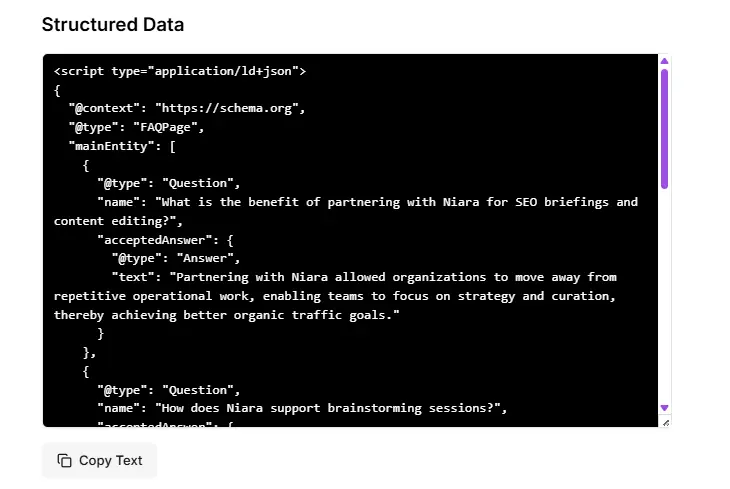
- Technical Enhancement: Use the Structured Data Generator to ensure search engines understand your content’s context through Schema markup.
2) Implementing a Triple-Check Quality Guardrail
- The SEO Specialist: Analyzes the draft for keyword density, search intent alignment, and internal linking.
- The Editorial Lead: Focuses on the narrative flow, checking if the advice is actually helpful to the reader.
- The Brand Guardian: Ensures the text strictly adheres to your brand voice.
- Example: An AI might generate a “generic and data-heavy” blog post for a luxury travel agency. The Brand Guardian would detect this and refine the copy to match your brand’s “inspirational and sophisticated” narrative, ensuring it meets all SEO content quality assurance standards.
3) Prioritizing Strategic Utility Over Mass Production
Google’s algorithms are increasingly sophisticated at identifying “scaled content abuse”—content created solely for search engines without adding value. Use AI to solve problems, not just to fill a publishing quota.
- The Strategy: Use Niara to enhance existing high-value assets rather than creating “thin” new ones.
Boost production using tools like YouTube to Article and the Structured Data Generator, but never sacrifice quality. By optimizing your workflow and applying a critical revision step, you ensure every piece of content remains authoritative, high-value, and SEO-ready.
-
- Example: A fitness blogger uses YouTube to Article to turn a video into a draft instantly. They then refine the brand voice, add personal anecdotes, and apply Structured Data for SEO. This human-led process creates a high-ranking, expert post in just 45 minutes. The result is maximum authority with minimal manual labor.
4) The “Pilot-First” Methodology for Risk Mitigation
Never roll out a massive AI strategy site-wide without proof of concept. Start with a controlled experiment to see how search engines react to your specific AI-human hybrid workflow.
- The Strategy: Select a small category or a set of 10 pages. Apply your AI governance framework to these pages and monitor them for 30 to 60 days.
- Example: If you own an e-commerce site, test AI-optimized descriptions on a single product category like “running shoes.” If you see a lift in rankings and a healthy click-through rate in AI tools, you have the green light to scale to the “apparel” section.
5) Continuous Optimization and the AI Feedback Loop
The AI landscape shifts weekly. You must treat your AI tools as evolving assets that require regular tuning.
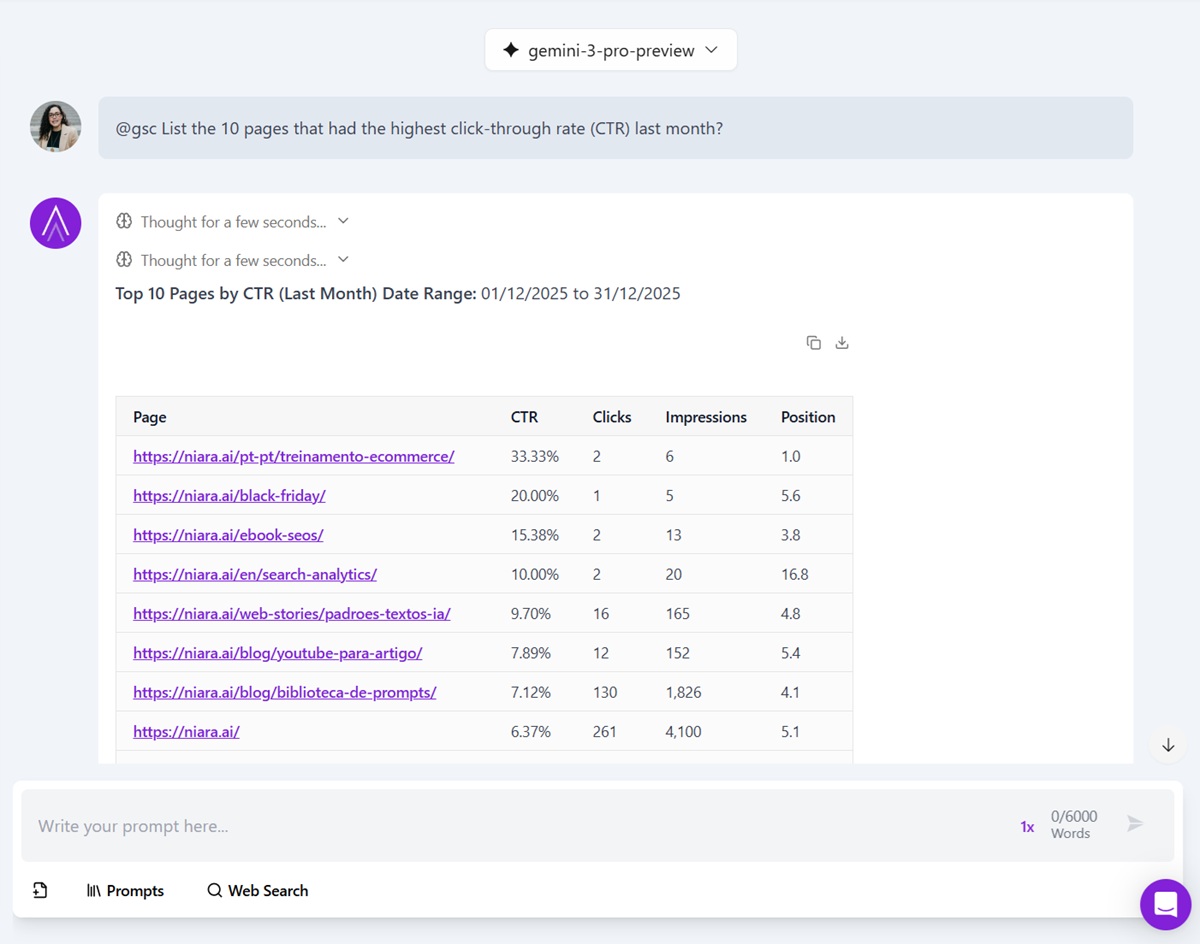
- The Strategy: Use Niara’s Search Analytics to compare the performance of AI-assisted pages against your traditional content.
For instance, you can monitor conversational queries within Search Analytics to identify exactly which prompt-style searches are citing your brand as a primary source. This analysis allows brands to understand the specific triggers for visibility in AI Mode and AIO (AI Overviews), providing a roadmap for content optimization.
-
- Example: A SaaS company notices it is frequently cited for specific “troubleshooting” prompts but is missing from broader “solution-seeking” queries. By identifying this gap, the marketing team can use their Content Workflow to generate comparison-style articles and use-case studies. They can then refine their Brand Guidelines to emphasize competitive advantages and ROI-focused language, ensuring the AI recognizes their brand as a top-tier recommendation for high-intent, conversational comparisons.
Getting Started: A Starter Plan
Ready to implement AI Data Governance in SEO? Use this as your strategic foundation to ensure every AI implementation is safe, effective, and scalable.
Here’s your 30-day plan:
- Usage & Impact Audit: Map where AI is currently integrated into your SEO processes. Is it actually saving time or creating more manual review work?
- Data Security Validation: Verify if your AI stack uses Zero Data Retention (ZDR). Ensure that proprietary company data or client strategies are not being used to train public models.
- Workflow Design: Define a clear “Human-in-the-Loop” process. Specify exactly where the AI handles the heavy lifting and where human strategic oversight is mandatory.
- Brand DNA Setup: Document and centralize your Brand Voice (tone, persona, and style) to ensure all AI outputs are consistent and require minimal editing.
- Compliance & Ethics: Establish a “Source Verification” step to prevent AI hallucinations and ensure all claims are backed by first-party data.
- Performance Monitoring: Define KPIs for AI-generated content, focusing on “Share of Model” (AI Overviews visibility) and indexation rates.
Niara Implementation Checklist
- GSC Integration: Connect your Google Search Console account to Niara. This is the foundation for all data-driven governance.
- Technical Health Check: Run the Site Audit (our technical SEO agent). Fix critical indexing and Core Web Vitals errors before scaling content.
- Brand Voice Configuration: Set up your Brand Guidelines in the project settings. This ensures all the tools always write in your specific brand DNA.
- Strategic Mapping: Generate your Authority Map. We use your GSC data to identify content gaps and create a governed 3-month editorial plan in seconds.
- Governed Execution: Use the Content Workflow to generate articles based on the Authority Map, ensuring they follow the SERP analysis and your Brand Guidelines.
- AI Visibility Audit: Use Google AI Mode Insights to analyze your URLs and optimize them for citations in AI Overviews.
- Scale with Security: For large-scale projects (E-commerce/Enterprise), use Bulk Content to maintain governance across hundreds of meta titles, descriptions or product descriptions simultaneously.

Future-Proofing Your SEO with Data Governance
AI Data Governance in SEO is the strategic bridge between raw automation and sustainable authority. By integrating operational audits, strict privacy standards, and first-party data from the Google Search Console, you transform AI from a risky experiment into a secure growth engine.
As search engines evolve into answer engines, your visibility depends on how well your data is governed. The question is no longer if AI will change your SEO, but whether your governance framework is strong enough to turn that change into a permanent competitive advantage.
Are you scaling your content, or are you scaling your authority?
Simplify your SEO and scale with confidence. Explore Niara’s secure AI features today and take control of your data governance.
