
For any high-scale e-commerce or enterprise-level business, the ERP system serves as the central hub that seamlessly connects every part of the operation. It manages inventory, handles pricing, and centralizes product data. However, there is a recurring problem we see at Niara: while ERPs are excellent at logistics, they are often “SEO-blind.” They store data for machines and internal processes, not for search engines or human shoppers.
When you rely solely on raw ERP data to populate your website, you create a massive disconnect. Your inventory is ready, but your visibility is non-existent. To dominate the search results, you need a bridge—an intelligence layer that transforms dry database entries into high-ranking, persuasive content. This is where SEO and ERP integration becomes the most critical part of your digital growth strategy.
By integrating your SEO strategy with your ERP data, you move from manual, repetitive data entry to an optimized, automated workflow. We are talking about scaling your outputwhile maintaining the human touch that both Google and your customers demand.
Wondering how to automate your daily tasks efficiently? Niara provides the perfect solution to optimize your process. Let’s explore how it works below.
Read more: Scaling Content Without Losing Your Brands’ Soul (or Rankings)
ERP Data Gap: The “Silent Killer” of E-commerce SEO
Simply “uploading” product data from an ERP to a CMS is not enough for organic growth. In fact, doing so without a dedicated SEO layer often leads to what we call the “silent killer” of online rankings. Without a strategic filter, you fall into three major traps that can stall your traffic for years.
The Duplicate Content Trap
Most ERPs are populated with raw manufacturer descriptions. These are the same descriptions sent to hundreds of other retailers. If you push this data directly to your storefront, you are publishing duplicate content. Google’s algorithms are designed to prioritize unique value; if your page looks exactly like 50 others, you will struggle to break into the first page of results.
The “Broken Telephone” Effect
Crucial SEO metadata—such as optimized titles, Alt text, and meta descriptions—often gets lost or corrupted during the synchronization from the ERP to the CMS. ERP fields are often character-limited or formatted for internal SKU tracking, not for Click-Through Rate (CTR). When this data syncs without optimization, your search snippets end up looking like technical gibberish rather than inviting invitations to shop.
Scalability vs. Quality
As your catalog grows to thousands of SKUs, the struggle to maintain E-E-A-T (Experience, Expertise, Authoritativeness, and Trustworthiness) becomes overwhelming. Managing massive catalogs manually is impossible, but letting an unguided AI do it leads to generic, “robotic” text. The challenge is scaling without losing your brand’s unique soul or technical accuracy.
SEO Foundations for ERP Websites
Before we automate, we must build on solid ground. ERP SEO optimization requires a blend of traditional on-page tactics and high-level technical foundations engineered for massive data sets.
On-page SEO for ERP content
Every product or service page synced from your ERP must be treated as a landing page. This means moving beyond just a “title and price.”
- Keyword Integration: Naturally weave primary and secondary keywords into product stories, not just lists of specs.
- Faceted Navigation: ERPs often provide the data for filters (size, color, material). From an SEO perspective, these must be handled carefully to ensure they create indexable, valuable “long-tail” pages without creating infinite crawl loops.
- Educational Content: Don’t just list the product; explain how it solves a problem. Use your ERP’s technical specs to fuel educational guides that demonstrate expertise.
Technical SEO considerations
Technical SEO is the “plumbing” of your ERP site optimization.
- Site Speed: Large databases can slow down page load times. Optimizing how data is pulled from the ERP is vital for Core Web Vitals.
- Structured Data: This is the language search engines speak. Every product should have Schema.org markup (Product, Price, Availability).
- Crawl Budget: With thousands of pages, you must ensure Google spends its time on your most important URLs. This involves strategic use of canonical tags and managing pagination correctly.
By combining both content and technical SEO you provide the critical context required for grounding and indexing by AI models. By producing high-quality, data-driven content, you ensure your brand remains discoverable and authoritative in both traditional search results and AI-driven discovery engines.
Content Strategy and Buyer Journeys in ERP
A successful content strategy maps every product to a specific stage in the buyer’s journey. Your ERP tells you what you have; your SEO strategy tells you why the customer needs it at that specific moment. We recommend a full-funnel approach that emphasizes ROI and case studies, moving away from “vendor-speak” toward customer-centric solutions.
Top-of-funnel educational content
At this stage, users aren’t looking for a specific SKU; they are looking for answers. To capture high-value traffic in an era where “What is” and “How to” content has seen a drop in organic CTR, you must pivot away from generic definitions that AI can easily replicate. The modern SEO edge lies in Information Gain: providing original research, deep dives into complex industry mechanics, and documented first-hand experiences that an LLM cannot synthesize.
For example, if your brand operates in the fashion B2C space, move past surface-level trends and focus on high-authority content such as:
- Original Research: Instead of listing “Summer Style Trends,” publish a proprietary study like “The Longevity Report: We Stress-Tested 30 ‘Luxury’ Cotton T-Shirts to See Which Ones Actually Last 50 Washes.”
- Deep Dives: Move beyond “How to Style Denim” to complex technical breakdowns like “The Tensile Strength of Selvedge: A Technical Comparison of Japanese vs. American Denim Weaving Processes.”
- First-hand Experience: Replace generic styling guides with documented case studies, such as “I Wore a 10-Item Capsule Wardrobe for 90 Days: A Data-Driven Analysis of Cost-Per-Wear and Garment Fatigue.”
By focusing on these content pillars, you establish topical authority and provide the unique value and E-E-A-T that both search engines and human readers now demand.
Read more: How to Build Topical Authority in Fashion Blogs (and Beat Big Magazines on Google)
Middle- and bottom-funnel use cases
This is where you convert interest into intent. Use the detailed technical data from your ERP to create comparison charts, ROI calculators, and deep-dive use cases. Show the cost/benefit analysis of choosing one ERP-managed solution over another.
Still thinking about our previous example, a fashion B2C space must convert interest into intent to bridge the gap between “looking stylish” and “the perfect fit and longevity.” Use technical specifications and personalized data to move the customer from the product gallery to the checkout page.
- Fabric Performance & Durability Metrics: Instead of just listing “Premium Wool,” provide data-driven insights such as pilling resistance scores, breathability ratings (GSM), or stretch recovery percentages. Show a comparison chart illustrating how your fabric maintains its shape after 50 washes compared to fast-fashion alternatives.
- “Cost-Per-Wear” (CPW) Analysis: For high-end or sustainable investment pieces, justify the price tag by calculating the long-term value. Demonstrate that a $300 ethically-made coat worn 150 times over three seasons costs only $2.00 per wear—far less than a “cheap” alternative that needs replacing every few months.
- AI-Powered Fit Analytics & Body Mapping: Use data-driven diagnostic tools that analyze a user’s specific measurements and body shape to recommend a “true-to-size” fit. By integrating virtual fitting room technology or “size-twin” data (showing how it looks on similar body types), you significantly reduce the perceived risk of a “wrong size” return.
By presenting clear, quantifiable evidence—whether it’s fabric longevity or a personalized fit guarantee—you transform a passive browser into a confident, ready-to-buy customer.
But here’s the thing: the journey now is a fluid, ever-changing experience. As your customers’ needs evolve and their search habits shift, your content must be flexible enough to keep up. This is where conversational SEO becomes your most valuable asset.
Instead of just targeting rigid, high-volume keywords, you need to focus on how real people actually talk and the specific questions they ask as they move through different stages of awareness. By adopting a more natural, dialogue-driven tone, you’re meeting your customers where they are in their unique, evolving journey and building a relationship that feels less like a transaction and more like a conversation.
Pre-Optimization: Setting the Standard with Niara
Before your data ever hits the ERP or moves to your storefront, it needs a quality filter. At Niara, we act as this intelligent layer, ensuring that your ERP marketing integration is flawless from day one.
Brand Voice Consistency
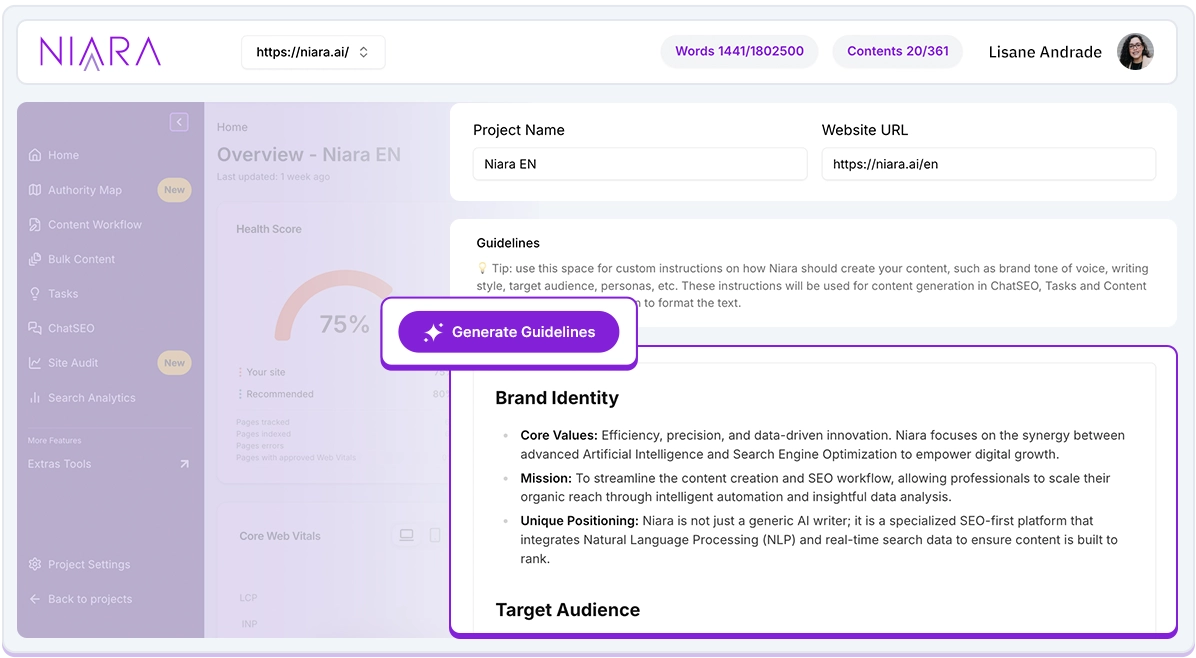
One of the biggest fears in automation is losing your identity. With Niara’s Brand Guidelines, you configure your persona and tone once. Whether you are generating ten descriptions or ten thousand, Niara applies your specific rules automatically. This ensures that every piece of content—from the ERP to the CMS—sounds like you, not a generic bot.
Keyword Intelligence
Use ChatSEO to identify high-intent attributes that might be missing from your raw ERP data. Does your ERP list “Blue” while customers are searching for “Navy Blue Waterproof Jacket”? Niara identifies these gaps, allowing you to map high-value keywords to your ERP fields to power your site’s faceted navigation and filters effectively.
To take your competitive edge even further, users can activate the Web Search feature. This allows you to pull real-time online information or analyze specific URLs from your competitors or even look for what customers are talking about specific products. By seeing exactly how others are capturing market share or saying about your products, you can identify the strategic adjustments needed to surpass competitors and offer exactly what users want.
Furthermore, our Google AI Mode Insights tool offers a sophisticated deep dive into your digital presence. By analyzing specific URLs against official Google documentation and utilizing query fan out logic, this tool provides a comprehensive roadmap for improvement. Whether it is refining your technical SEO, enhancing content depth, or optimizing the User Experience (UX), Google AI Mode Insights ensures your pages are perfectly aligned with what search engines and users are looking for.
High-Volume Execution: Bulk Content Generation
This is where the magic happens for enterprise-level operations. ERP SEO for manufacturing or large-scale retail requires speed that humans simply cannot match manually.
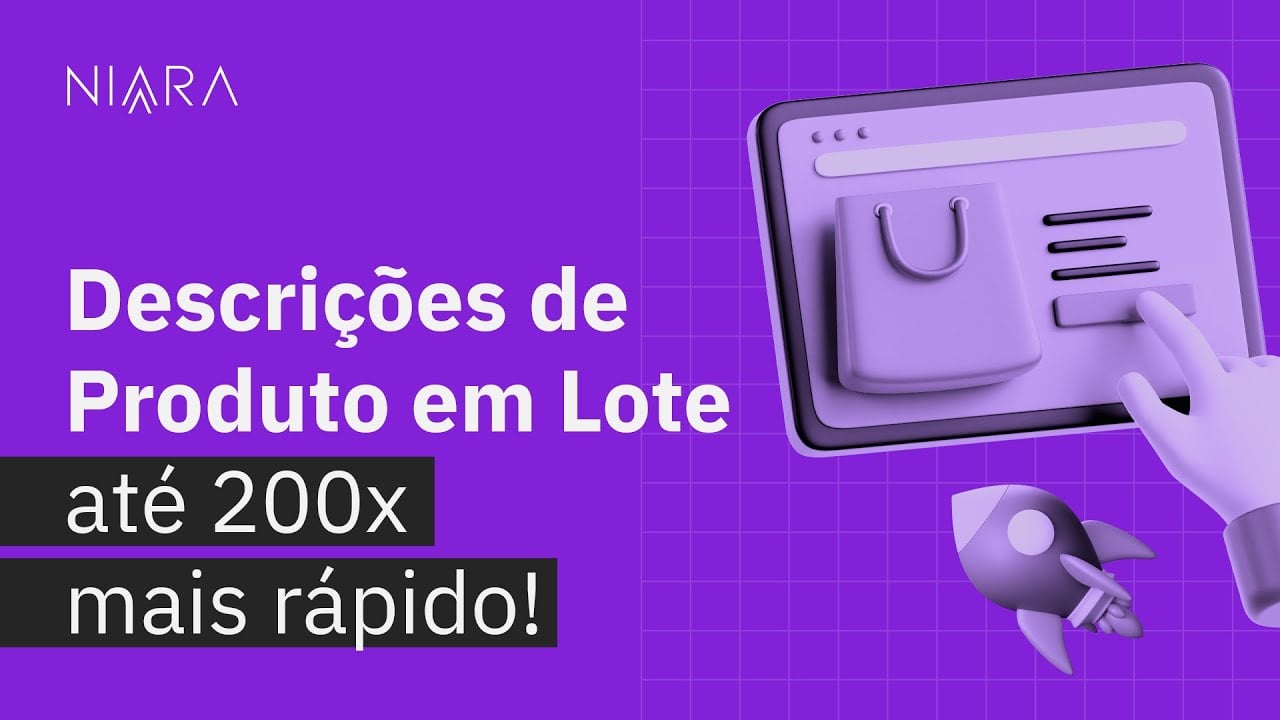
Niara’s Bulk Content engine is a powerful automation tool designed to eliminate the manual grind of e-commerce copywriting. Instead of writing descriptions one by one, this engine allows you to generate high-quality, SEO-ready assets for your entire inventory simultaneously.
- Mass SEO Optimization: It instantly generates search-optimized titles and high-impact meta descriptions for over 500 SKUs in minutes, ensuring every product is primed for search engine rankings.
- Automated Storytelling: The engine crafts unique, compelling product narratives for every item in your catalog. This helps you avoid “duplicate content” penalties from Google while providing a better shopping experience for your customers.
- Universal Integration: It is built to work with any CMS, allowing you to transform your product data and upload it directly to your store without formatting headaches. For platforms like VTEX and WooCommerce, you can perform bulk uploads directly via spreadsheets, eliminating the need for complex API integrations.
In short, Niara’s bulk content generation takes your raw product list and turns it into a fully optimized, customer-ready digital storefront in a fraction of the time it would take a traditional team.
By adopting this streamlined approach, you slash your operational and move beyond the “copy-paste” trap that holds your competitors back. Instead of settling for dry manufacturer data, you are arming your site with persuasive, high-converting copy that captures both search engine attention and customer trust. With Niara, you aren’t just filling boxes—you are building a brand that outperforms the market.
The Next Frontier: Image-to-Product Descriptions
To further optimize enterprise workflows, Niara’s team has developed a solution for a common e-commerce bottleneck: Image-to-Product Descriptions.
This tool is specifically designed for stores that receive new inventory with high-quality imagery but absolutely no written documentation. Instead of waiting days for a copywriter to manually describe every detail, Niara’s AI automatically analyzes the product image to generate detailed, high-quality descriptions instantly.
While this innovative functionality was originally developed to address the highly specific requirements of a private client, we recognize its immense potential for the broader e-commerce community. As a result, we are currently in the final stages of preparing this feature for its official release, and it will likely be made available for Niara’s Enterprise and Scale plans in the very near future. Stay tuned!
Visual SEO: Beyond the Image File
ERPs often treat images as mere logistics files—just a URL attached to a SKU. Niara turns them into search assets. Our Alt Text Generator analyzes your URLs and automatically creates descriptive, keyword-rich Alt Text for every image before it’s uploaded. This not only improves web accessibility but also secures high rankings in Google Images, a massive and often overlooked traffic driver for e-commerce.
To further empower large-scale operations, Niara’s team has developed a specialized bulk solution specifically for e-commerces: Bulk Alt Text & Titles. This feature allows businesses to generate SEO-friendly image metadata for thousands of products simultaneously, eliminating the bottleneck of manual entry.
Much like our Image-to-Product Descriptions tool, this feature was originally engineered to meet a specific client’s high-volume needs. As part of our commitment to high-level performance, we regularly develop specific tools for Enterprise clients to ensure our platform meets the complex demands of large-scale operations.
See how Niara clears the chaos and simplifies your toughest tasks, so your team can focus on what actually moves the needle. Explore our Enterprise plan today to see how we can elevate your business to the next level.
Technical SEO & Structured Data: The Conversion Backbone
Integration often overlooks how search engines “read” the data. If the search engine doesn’t understand your ERP data, it won’t show it to users.
- Automated Structured Data: Use Niara’s Schema Markup Generator to ensure every product synced from your ERP includes correct Schema.org markup. This triggers Rich Results (stars, prices, and availability in search), which significantly increases your CTR.
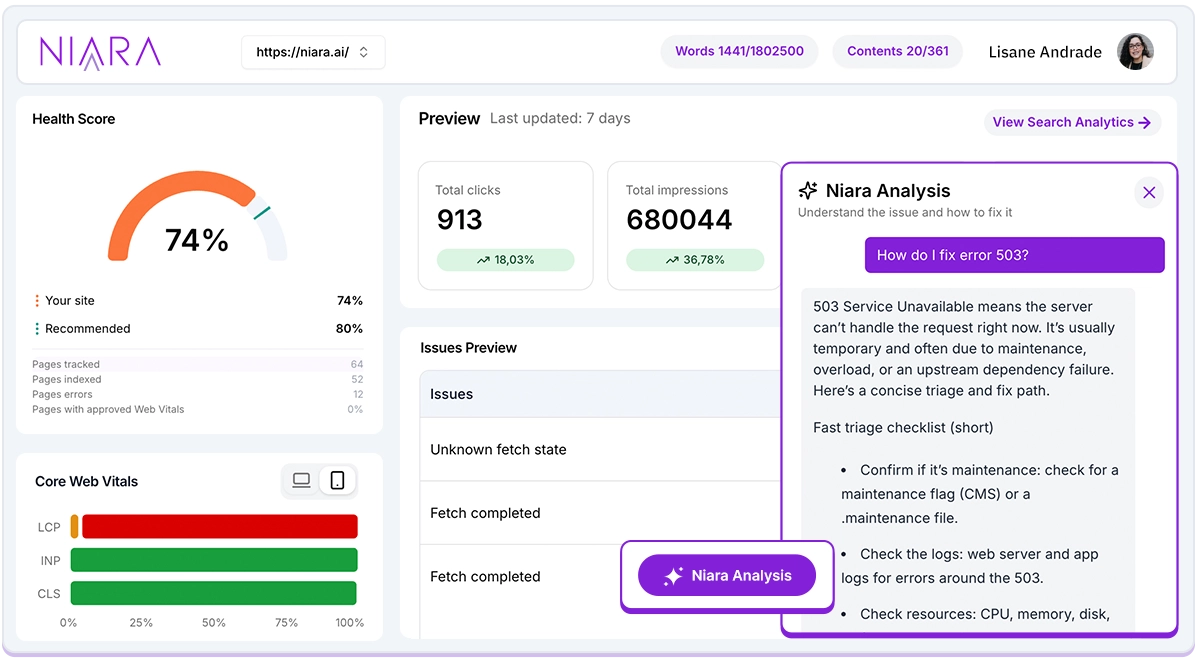
- Technical SEO Agent: Think of this as your 24/7 consultant. Niara’s Technical SEO Agent audits your website data to identify indexing errors and Core Web Vitals issues. By providing a comprehensive view of your site’s performance, it ensures your SEO strategy is proactive rather than reactive.
Content Strategy and Buyer Journeys in ERP
Mapping the journey involves using your website categories to create a full-funnel strategy.
- Top of Funnel (Awareness): Use Niara’s Authority Map to identify informational gaps. It looks at your domain and tells you exactly what you need to write to become a market leader in that niche.
- Middle of Funnel (Consideration): Have video demos of your products? Use our YouTube to Article tool to turn those demos into optimized blog posts in seconds.
- Bottom of Funnel (Decision): Optimize your Product Detail Pages (PDPs) with the technical specs pulled from the ERP, but enhanced by Niara to focus on benefits, not just features.
The Authority Map is the “brain” of your content strategy. It connects the operational side (what you sell) to the strategic side (what you need to do to become the biggest authority in your niche), generating a 3-month editorial calendar in seconds.
Data Intelligence: From ERP to Market Share
The ERP centralizes sales; Niara centralizes growth. To achieve lasting success, mastering data analysis is essential for turning information into a competitive advantage.
- Search Analytics & Conversational Analytics: Stop struggling with complex spreadsheets. With Niara, you can ask: “Which product pages saw a drop in clicks last month?” or “List the 10 keywords with the most clicks in the last 30 days.”
We offer 5x more data than the standard Google Search Console, allowing you to make decisions based on real ROI. In addition, our Search Analytics also provide deep visibility into conversational queries, which are the primary triggers for AI Mode and AI Overviews.
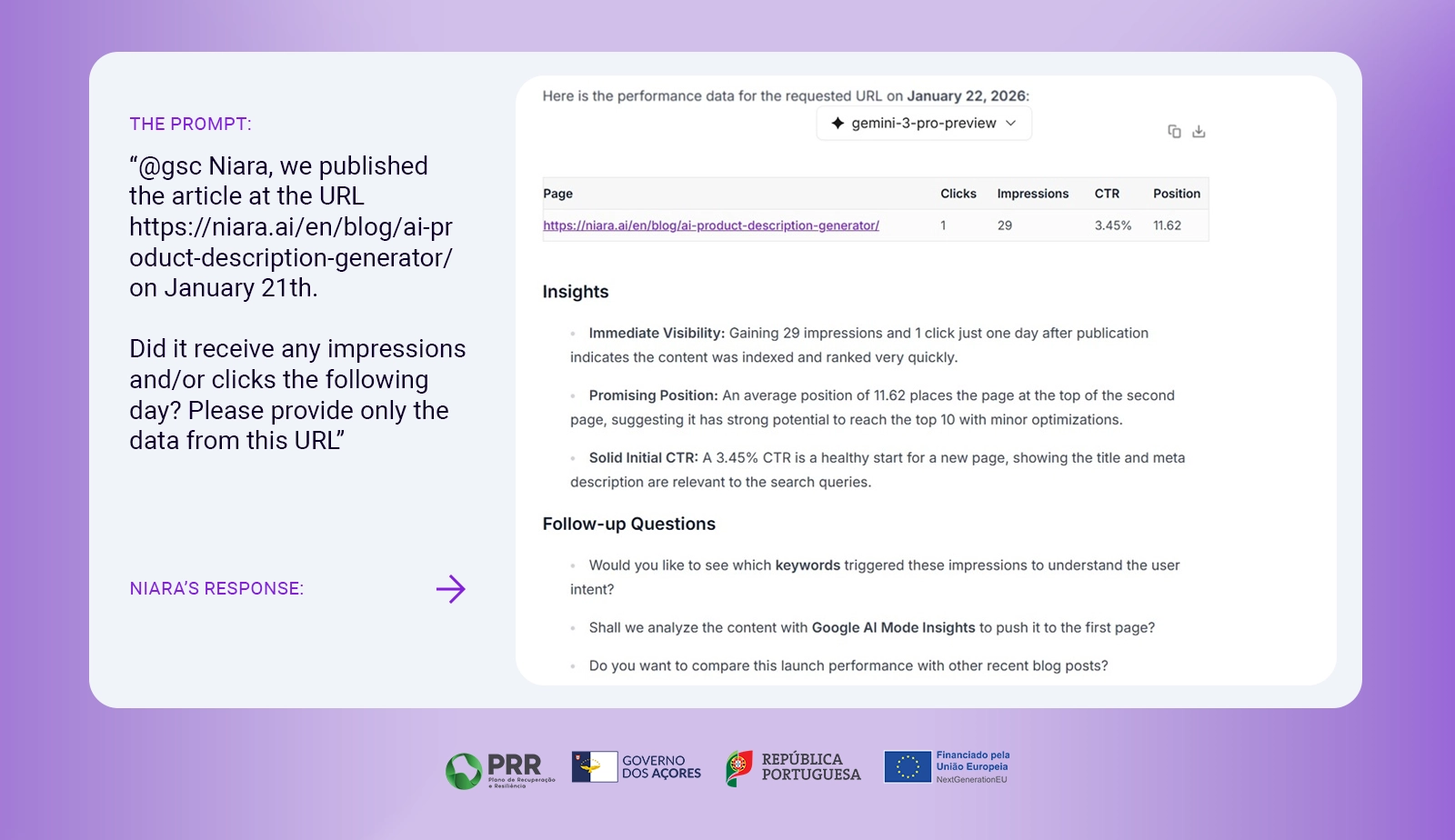
Tracking these interactions allows you to optimize for AI-assisted discovery while identifying the strategic clusters needed to align your ERP inventory with evolving market demand.
The ERP is the Heart, Niara is the Voice
Managing high-volume e-commerce without an SEO intelligence layer between your ERP and the customer is like having a powerful engine with no fuel. You have the inventory and the data, but without optimization, no one will find it.
By using Niara, you:
- Eliminate duplicate manufacturer content that kills rankings.
- Guarantee Brand Voice across thousands of SKUs simultaneously, ensuring a human and consistent feel.
- Scale your operation by 10x, allowing your team to stop doing manual data entry and start focusing on high-level strategy.
- Leverage technical excellence with automated structured data and 24/7 technical auditing.
Don’t let your ERP be a data graveyard where products go to be forgotten. Transform it into an organic sales machine that works for you around the clock. With Niara, we simplify the technical workflow and accelerate what truly matters: your bottom line.
Ready to transform your ERP data into a ranking powerhouse? Try Niara for free today and start scaling your SEO strategy with the power of specialized AI.
